 Foreword - foreword.htm
 by T. W. RHYS DAVIDS, 1921
Update: 2012-11-24 04:06 AM +0630
PTS-indx.htm
• by The Pali Text Society, T. W. Rhys Davids, William Stede, editors, 1921-5.8
[738pp in two columns], reprint 1966
¤ California Digital Library, reprint 1952:
http://archive.org/details/palitextsocietys00pali 121015
Downloaded and edited by by U Kyaw Tun (UKT)
(M.S., I.P.S.T., USA) and staff of
Tun Institute of Learning (TIL)
. Downloaded:
palitextsocietys00pali.pdf
• with reference to:
#1 materials in Burmese-Myanmar (Bur-Myan) by U Hoke Sein,
Pali-Myanmar Dictionary, {pa.dat~hta.miñ-zu-þa},
1st printing ca. 1959, Ministry of Religious Affairs publication,
Rangoon , p1180,
#2 materials in English-Latin (Eng-Lat) by U Pe Maung Tin, The Student's Pali English dictionary , 1920
#3 and others.
Not for sale. No copyright. Free for everyone. Prepared for students and staff of TIL Computing and Language Center, Yangon, MYANMAR : http://www.tuninst.net , http://www.softguide.net.mm, www.romabama.blogspot.com
UKT notes
• Doggie's Tale - copy-paste
• IPA Pulmonic consonants
• PTS dictionary
• TIL downloads¤ imports from UPMT and other sources
CAUTION: Five sites using different English transliterations:
PTS, PMT, UHS, MNW, MAC, SSK - listed below.
1. PTS (PaliTextSoc): brackets if needed «...» translit: diff. from IAST
2. PMT (U Pe Maung Tin): «...» translit: diff. from PTS, similar to IAST
3. UHS (U Hoke Sein): Pal-Myan {...} Romabama
4. MNW (MonierWilliams): «...»" translit: IAST [rarely cited]
5. MAC (Macdonell): Skt-Dev «...»: translit: simple ASCII or older transcript
6. SSK (Spoken Sanskrit online): Skt-Dev «...»" in IAST
© indicates an item taken from the group immediately above.
Foreword - foreword.htm
by T. W. RHYS DAVIDS, 1921
Vowels:
 {a.} p001-092
- a1-indx.htm
The original group, a1.htm
is split for BEPS work.
Unless you are editing,
do not go into this file.
 {a} p092-117 - a2.htm
 {i.} & p117-123 - i1.htm
 {i} p123-124
- i2.htm
{i} p123-124
- i2.htm
 {u.} p124-159 -
u1.htm
{u.} p124-159 -
u1.htm
 {u},
{u},
 {é} p159-162
-
u2.htm
{é} p159-162
-
u2.htm
 {au:}
p162-171 - au3.htm
{au:}
p162-171 - au3.htm
Last page from Digital Dictionaries of South Asia: p171
I have added those left behind from PDF version.
Mnemonic
The Doggie Tale:

Little doggie cringe in fear -- ŋ (velar),
Seeing Ella's flapping ears -- ɲ (palatal)
And, the Shepard's hanging rear -- ɳ (retroflex).
Doggie so sad he can't get it out
What's that Kasha क्ष
when there's a Kha ख ?
And when there's Jana ज्ञ
what I am to do with Jha झ?
Note to digitizer: you can copy and
paste the following:
Ā ā Ē ē Ī ī Ō ō Ū ū
Ḍ ḍ Ḥ ḥ Ḷ ḷ Ḹ ḹ Ṁ ṁ Ṃ ṃ Ṅ ṅ Ñ ñ Ṇ ṇ Ṛ ṛ Ṝ ṝ Ś ś Ṣ ṣ Ṭ ṭ ɕ ʂ
• Instead of Skt-Dev ः {wic~sa.} use "colon" :
• Root sign √
• Skt-Deva : श ś [ɕ] /ʃ/; ष ṣ [ʂ] /s/; स s [s]
/θ/;
• Undertie in Dev transcription: ‿ U203F
• IPA symbols: ə ɪ ʌ ʊ ʧ ʤ θ ŋ ɲ
ɳ
ɹ
Go back Dog-tale-note-b
-- UKT 121102
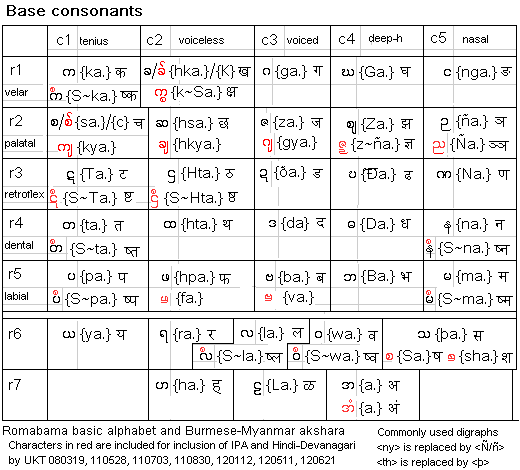
For my BEPS inter-linguistic study, I need to know how the speakers of different linguistic groups -- the IE (Indo-European) and the Tib-Bur (Tibeto-Burman) -- would change the pronunciations in one group into another. The following is my attempt to integrate the four languages of BEPS in one table.
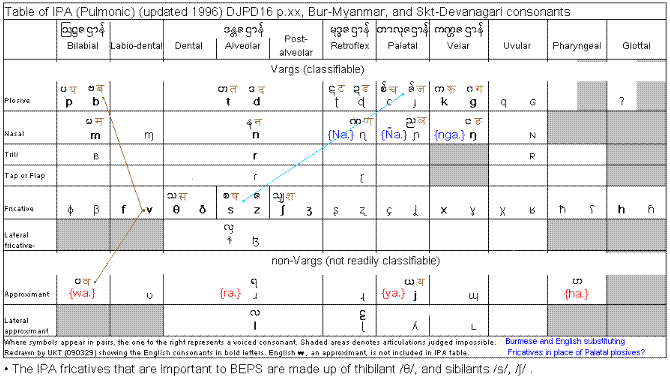
The most note-worthy is the change of velar sounds changing
into rhotic /r/ /ɹ/ and nasal /n/ of the dental-alveolar POA.
Here we must note that the velars, especially the velar-nasal
 {nga.}
is the most troublesome for the Westerners.
For example: we are finding that the equivalent of Pal-Myan
{nga.}
is the most troublesome for the Westerners.
For example: we are finding that the equivalent of Pal-Myan
 {ag~ga.} is Skt-Myan
 {a.gra.}. It is not as rhotic as the repha
 {ar~ga.} nor highly-rhotic
 {aRga.}. However, when the sound becomes close by including the vowel /i/ --
 {ag~gi.} -- the tendency is to change into the nasal.
See examples from Macdonell:
{ag~gi.} -- the tendency is to change into the nasal.
See examples from Macdonell:
MAC: अग्रिम «agr-i-ma» -- a. leading, first; following (of sequence in writing or speaking). -- MAC003c3-b07
MAC: अग्रिय «agr-i-ya» -- a. foremost, best; firstborn; n. what is best. -- MAC003c3-b08
MAC: अग्नि = अ ग ् न ि «agni» -- m. fire; conflagration; Deva-god Agni. -- MAC003c1-b15
We will have to take this into account for inter-language transcription between English and Burmese. -- UKT121102
Go back IPA-conson-note-b
-- UKT 111207
My principle objection to the PTS dictionary is the way
it uses capital and small letters. To be in conformity
with the original scripts - the Devanagari and the Myanmar,
I have changed all the capital letters into small letters.
I still need to check this digitized form with
the print-on-paper book [the reprint of 1999, pp738],
that is with the TIL library. My second concern is that
the PTS presents Pali as a sibilant language. However,
I hold that it was a thibilant language brought into
Tagaung in northern Myanmar by King Abiraza before
the time of Gautama Buddha. Accordingly, I have changed
the «s» of PTA to
 {þa.}. Thirdly, I usually get confused with
PTS «aŋ». It might be either
{þa.}. Thirdly, I usually get confused with
PTS «aŋ». It might be either
 {än} or
 {ing}. The two syllables have entirely different pronunciations:
{än}
[
{a.} with a
{ing}. The two syllables have entirely different pronunciations:
{än}
[
{a.} with a
 {þé:pé:ting}] is pronounced similar to /ʌn/, whilst,
{ing}
[
{a.} checked with a
{þé:pé:ting}] is pronounced similar to /ʌn/, whilst,
{ing}
[
{a.} checked with a
 {nga.þût}] has /ɪn/.
To take care of my above objections to the PTS,
I have rewritten the entries in Pal-Myan followed
by Romabama and the original transliteration of the PTS.
I find that this is the only way to help the
Bur-Myan elders (monks, nuns, and learned lay-persons)
to make better use of the PTS dictionary. Moreover,
if there is a need I have taken out a particular entry
and marked with a © and gave it below to be compared
to UPMT, UHS, and Skt-Dev from Macdonell.
The reference to page numbers in this version follows that of
-
http://dsal.uchicago.edu/cgi-bin/philologic/getobject.pl?p.0:0.pali 111207 and
will not tally with the page numbers on the print-on-paper book.
However, I check the diacritics with the print-on-paper
book [reprint of 1999, pp738, in two columns], or with
[during my travels when the print-on-paper book is
not available] the online Archive.org
http://archive.org/details/palitextsocietys00pali 121017 ,
or with online Abidhamma.com
http://www.abhidhamma.com/Pali_English_Dictionary_RhysDavids.pdf 121017
Both these have been downloaded:
--
palitextsocietys00pali.pdf
-- PTS-Dict-1925-Abidhamma-com.pdf
Excerpt from: http://en.wikipedia.org/wiki/Pali_Text_Society 111212
The Pali Text Society was founded in 1881 by T.W. Rhys Davids "to foster and promote the study of Pali texts".
Pali is the language in which the texts of the Theravada school of Buddhism is preserved. The Pali texts are the oldest collection of Buddhist scriptures preserved in the language in which they were written down.
The society first compiled, edited, and published Roman script versions of a large corpus of Pali literature, including the Pali Canon, as well as commentarial, exegetical texts, and histories. It publishes translations of many Pali texts. It also publishes ancillary works including dictionaries, concordances, books for students of Pali and a journal.
T. W. Rhys Davids was one of three British civil servants who were posted to Sri Lanka, in the 19th century, the others being George Turnour, and Robert Caesar Childers (1838–1876). At this time Buddhism in Sri Lanka (then Ceylon) was struggling under the weight of foreign rule and intense missionary activity by Christians. It was an administrative requirement that all civil servants should be familiar with the language, literature, and culture of the land in which they were posted, so the three men studied with several scholar monks where, along with an introduction to Sinhala culture and language, they became interested in Buddhism.
The Pali Text Society was founded on the model of the Early English Text Society with Rhys Davids counting on support from a lot of European scholars and Sri Lankan scholar monks. The work of bringing out the Roman text editions of the Pali Canon was not financially rewarding, but was achieved with the backing of the Buddhist clergy in Sri Lanka who underwrote the printing costs.
Childers published the first Pali-English dictionary in 1874. This was superseded in 1925 by the new Dictionary which had largely been compiled by T. W. Rhys Davids over 40 years, but was finished by his student William Stede. Currently another dictionary is being compiled by Margaret Cone, with the first of three volumes (A - Kh) published in 2001.
By 1922, when T. W. Rhys Davids died, the Pali Text Society had issued 64 separate texts in 94 volumes extending over 26,000 pages, as well a range of articles by English and European scholars.
In 1994, the Pali Text Society inaugurated the Fragile Palm Leaves project, an attempt to catalogue and preserve Buddhist palm-leaf manuscripts from Southeast Asia. Prior to the introduction of printing presses and Western paper-making technology, texts in Southeast Asia—including the Pali scriptures—were preserved by inscription on specially preserved leaves from palm trees. The leaves were then bound together to create a complete manuscript.
While palm-leaf manuscripts have likely been in use since before the 5th century CE, existing examples date from the 18th century and later, with the largest number having been created during the 19th century.[1] Because of the materials used and the tropical climate, manuscripts from earlier eras are generally not found intact in palm-leaf form, and many manuscripts have been badly damaged. During the colonial era, many palm-leaf manuscripts were disassembled and destroyed, with individual pages of texts being sold as decorative objets d'art to Western collectors.
The Pali Text Society created the Fragile Palm Leaves project to collect, catalogue, and preserve these artifacts, including scanning them into electronic formats in order to make them available to researchers without threatening their preservation. In 2001, the project was formalised as a non-profit foundation in Thailand as the Fragile Palm Leaves Foundation.
Presidents of the Pali Text Society since its foundation:[2]
1881–1922: Thomas William Rhys Davids (1843–1922) (Founder)
1922–1942: Caroline Augusta Foley Rhys Davids (1857–1942)
1942–1950: William Henry Denham Rouse (1863–1950)
1950–1958: William Stede (1882–1958)
1959–1981: Isaline Blew Horner OBE (1896–1981)
1981–1994: Kenneth Roy Norman FBA (1925– )
1994–2002: Richard Francis Gombrich (1937– )
2002–2003: Lance Selwyn Cousins
2003–present: Rupert Mark Lovell Gethin (1957– )
1. ^
The Fragile Palm Leaves Foundation
2. ^ Journal of the Pali Text Society,
volume XXIX, pages ix–xii
Go back Pali-Txt-Soc-note-b
-- UKT 121015
The first downloads were from Univ. of Chicago :
-
http://dsal.uchicago.edu/cgi-bin/philologic/getobject.pl?p.0:0.pali 111207
-
http://dsal.uchicago.edu/cgi-bin/philologic/getobject.pl?p.0:91.pali 121009
However, the material could not be checked against the ink-on-paper reprint 1966
that I had bought in the late 1990s and which is now in TIL archives at 35
Thantadalan, Sanchaung, Yangon. This had frustrated me for a long time. The
reason is the ink-on-paper book is in two columns, whereas those from Univ. of
Chicago is in one column.
Another downloadable was found on the internet:
--
http://www.abhidhamma.com/Pali_English_Dictionary_RhysDavids.pdf 111212 .
It is in one one column and again I could not check with the ink-on-paper
reprint of 1966. You can see the downloaded version:
pdf version
Undaunted, I search again, and have come across
¤ California Digital Library :
http://archive.org/details/palitextsocietys00pali 121015
See the downloaded version: palitextsocietys00pali.pdf .
I can now check against the ink-on-paper reprint of 1966, which is too heavy for
me to carry around during my travels.
Go back TIL-download-note-b
End of TIL file