ch01-1.htm Orthoepy
- Burmese Grammar and Grammatical Analysis by A. W. Lonsdale, Education Department, Burma, British Burma Press, Rangoon, 1899. A photocopy of the ink-on-paper book , and downloaded PDF copies are available in the TIL Research Station, in Yangon.
Copied and edited by UKT and staff of TIL . Not for sale. No copyright. Free for everyone. Prepared for students and staff of TIL Research Station, Yangon, MYANMAR : http://www.tuninst.net , www.romabama.blogspot.com
UKT 160405: Lonsdale has given section numbers which are more useful than page numbers. Because of which I am giving both in red, e.g. s001-p001, s002-p001, s003-p001, etc. You can just go by section numbers instead of page numbers. There are 525 sections, and 434 pages. The last section s525-p429 is actually a whole chapter, Ch10.
UKT 201122: After getting the PDF pages, I've decided to simply throw away my older work, and start anew. Though it means more work, there is no confusion. Remember, there are more than one page in a Chapter.
Introduction
s001.
Burma or Myanmar controversy
s002. Grammar
s003. Akshara
s004. Phonetics and
Phonology; Inflection and Derivation; Syntax
s005. Sentence
 {wa-kya.}
s006. Clause
 {wa-kya.kûN~ða.}
s007. Phrase
 {pa.da. sa.ya.}
Author's footnotes
UKT 191002: Lonsdale has given more explanations on
the terms in the form of foot-notes. He writes
«á» in stead of «ā» , e.g.,
Pali for Pāli .
UKT notes
• Incomplete thought or Clause
• Kāraka
•
Magadha language
•
Pali-Ceylon vs. Pali-Myan
•
Polytonic orthography
• Spelling changes
with time
UKT 201109: I've split up Lonsdale Ch01 into two parts: ch01-1 and ch01-2
See downloaded BkCnd<OL>
The downloaded book has no Preface which I've already given: ch00.htm
The downloaded book begins with p001 | Introduction given below:
(s001-p001)
s001. The Burmese
Language proper is radical or
monosyllabic , but contains many
polysyllabic words of foreign origin received
from Páli. It belongs to the great Polytonic ¹
(
fn001-01) family of Languages, forming
one branch of the Tibeto-Burman subdivision of
that family.
Its alphabet and the method
of writing that alphabet, however, have been
borrowed from the ancient Nágarí through the
medium of Mágadi or Páli, the language in which
the Buddhist scriptures, introduced into Burma
from Ceylon, were written.
UKT 201111
Burmese : Burma or Myanmar controversy : Which is the correct term? First we must make a distinction in English usage. By the word "Myanmar" we can mean (a) the geo-political unit or country, (b) the population, and (c) the speech and (d) script (collectively called language). I make the distinction as: (a) the geo-political unit or country as
{mrûn~ma præÑ} ; (b) the population as

{mrûn~ma præÑ-þu præÑ-þa:}
The Myanmar
{mrûm~mak~hka.ra}, and in sibilant-rhotic form Myarmakshara are presented in a joined matrix of 5x5 + 5x2. In Bur-Myan there are only 33 basic aksharas whereas in Mon-Myan there are 35. The upper portion of 5x5 is known as the Wag aksharas
{wag}, and the lower portion 5x2 is the Awag

{ka.} /ka/, and the first row is Ka-wag. MLC defines the Wag and Ka-wag as given below:
- from MLC Burmese Grammar for high-schools: bg-mlc-1-2 .
Radical : What does Lonsdale mean by radical ? AHTD (American Heritage Talking Dictionary) gives: rad·i·cal adj. 1. Arising from or going to a root or source; basic: a radical flaw in a plan; chose the radical solution of starting all over again. 2. Departing markedly from the usual or customary; extreme: radical opinions on education. 3. Favoring or effecting fundamental or revolutionary changes in current practices, conditions, or institutions: radical political views. 4. Linguistics Of or being a root: a radical form. ...
Lonsdale probably means the Bur-Myan differs markedly from Pali and Sanskrit in being a non-inflectional language.Monosyllabic : Burmese Language is said to be monosyllabic. That, is each syllable is a word in itself, and there is no need to include white spaces where one word ends and the next begins. Yet it contains many polysyllabic words of foreign origin received chiefly from Pali
{pa-Li.}. Lonsdale is unaware of the presence of northern routes between Burma and India through which Magadhi

{ma-ga.Da. sa·ka:} (the language of Magadha Mahajanapada

{ma-ga.Da. ma·ha za·na.pa.da.), as well as Sanskritized Magadhi, which may be BHS (Buddhist Hybrid Sanskrit) could come in.
Myanmar chronicles state that long before the time Gautama Buddha, King Abhiraza
{a·Bi.ra-za-mín:} from India had taken refuge in northern Burma after losing a war. At that time, northern Burma was already populated by Pyu ethnics

{pyu-lu-myo:}. King Abiraza founded the first capital of Burma - Tagaung kingdom

{ta.kaún: mín:né-præÑ} (a city-state).
Pali-Lanka (Pali spoken in Ceylon) could have only come through sea-routes which the northerners (in Burma as well as India) are mortally afraid of. Moreover, Pali-Lanka was invented in Ceylon to spread the Theravada Buddhism, only about 200 years after the death of the Buddha. Pali-Lanka was not a colloquial language and was probably never spoken.
Lonsdale writes that Burmese "proper" belongs to the great Polytonic ¹ family of Languages (fn001-01), forming one branch of the Tib-Bur (Tibeto-Burman) subdivision of that family. Its akshara and the method of writing (with vertical-{paaHT.hsín.} and horizontal-conjuncts
{paaHT.twè:}) has been said to have been borrowed from the ancient Nagari through the medium of Magadhi or Pali, the language in which the Theravada Buddhist scriptures, introduced into Myanmarpré from Ceylon, were written. (see my note on Pali-Ceylon vs. Pali-Myan)
Alphabet : The term Alphabet is well-known in the West for a long time. It's basic unit is the mute Letter. However, the corresponding term Abugida was invented by Peter T. Daniels only in 1990, and Lonsdale could not have known the term.
The basic unit of Abugida is the Syllable (which, of course, is pronounceable and is not mute). In my work - BEPS - I differentiate the two speech-to-script writing systems as Alphabet-Letter and Abugida-Akshara systems. This differentiation is still unclear to my good friend U (Dr.) Tun Tint of the Myanmar Language Commission (MLC). He insists that Consonants are mute and I differ saying that they are pronounceable. What he means by Consonant is the mute Letter, and what I mean by Consonant is the syllable - pronounceable Akshara.
The terms "abugida" and "alphabet" are not complete unless we indicate what their basic units are. I suggest they be termed Abugida-Syllable and Alphabet-Letter, where the Syllable is pronounceable and Letter is mute. I've been using the term Abugida-Akshara to show that Abugida and Akshara are equivalent. Since some linguists would not accept the term Abugida, I propose that we drop the term "abugida" and use Akshara-Syllable.
(s002-p001)
s002. The Burmese
grammarians, having no suitable grammatical
terms of their own, were obliged to borrow
them from the Pali Language.
The term they employ for Grammar is
 {þûd~da-þût~htän}
(fn001-02),
commonly called
{þûd~da-þût~htän}
(fn001-02),
commonly called

 {þûd~da kyûm:}, or simply
{thûd~da}.
{þûd~da kyûm:}, or simply
{thûd~da}.
This word
{þûd~da} is the Páli
 {þûd~da.} slightly modified in its form,
and implies primarily Sound
{þûd~da.} slightly modified in its form,
and implies primarily Sound
 {a·þän}. Páli Grammarians place all sounds
under two heads, viz.
{a·þän}. Páli Grammarians place all sounds
under two heads, viz.
 {sait~ta.za. þûd~da.}
(fn001-03),
lit. 'mind produced sounds,' and
{sait~ta.za. þûd~da.}
(fn001-03),
lit. 'mind produced sounds,' and
 {U.tu.za. þûd~da.},
(fn001-04),
lit. 'season produced sounds' [accidentally
or naturally produced sounds].
{U.tu.za. þûd~da.},
(fn001-04),
lit. 'season produced sounds' [accidentally
or naturally produced sounds].
Under
{sait~ta.za. þûd~da.} are included all sounds uttered
by man for the purpose of communicating thoughts,
as well as those made by irrational beings,
which according to Buddhistic teaching, are
(p001end-p002 begins)
considered to be endowed with a mental faculty.
Under
{U.tu.za. þûd~da.} are included all kinds of sounds
produced in nature, such as those occasioned by
thunder, the falling of trees, the rustling of the
wind, &c. Along with these are placed the sounds
that are made in the body without any mental operation,
such as those caused by sneezing, snoring, &c.
[Lonsdale ¶]
{þûd~da} ¹ (
fn002-01), used as a grammatical term,
means only articulate sounds as applied
to language whether spoken or written.
UKT 201112
Grammar :
{mrûn-ma ak~hka.ra} and almost the same phonology, the languages are so intertwined that we do not know which is Pali and which is Burmese. As an example just listen to a song, in which the singer switches from one language to another without herself realizing it: - BkCndl-ThanBoadde<)) (link chk 201112)
The only way to differentiate Pali from Burmese is the presence of Virama{a·þût} in Burmese script, and absence of rhotic sounds in Burmese, e.g.
{mya.} and
{mra.} are pronounced the same in the main dialect.
Thus,
The unpopularity of Bur-Myan Grammar -- which I used to dislike with a passion -- is the requirement for the students to learn separate sets of Bur-Myan and Pali-Myan grammatical terms after having to learn them in English. Since Pali has become a foreign language in Myanmarpré, I feel that we need to learn only one set: the Eng-Lat terms. Refer to my English Grammar Glossary -- GramGloss-indx.htm (link chk 201109)
Sound
Mind produced sounds
- PHO105-Phonation<Ô> / Bkp<Ô> (link chk 201112)
An unfortunate connection of the commonly used Bur-Myan{za.} means 'origin', from which we can translate
To understand Phonation we must know the function of the Larynx in speech production. Furthermore remember that each human linguistic-groups, such as IE and Tib-Bur, uses different sets of muscles of the hyoid complex, resulting in different speeches. Therefore, a Bur-Myan speaker even after learning excellent English will still speak with a foreign accent. Your aim should be just to speak what an English speaking foreigner could understand. Now, go back and listen and watch Dr. Jürgen Handke again.Irrational beings : What does the author, Lonsdale, meant above by "irrational beings" ? Leaving aside "unseen beings" such as dévas and ghosts, all higher animals - be they terrestrial, aquatic or those capable of flying can communicate with one another. They use sound waves travelling through air or water. They are all rational (capable of resoning) to some extent. They have to be so to survive as a species. Of these those who can hear through sound-waves, such as apes, monkeys, dogs, cats, and birds can "understand" human sound signals and can respond. I've observed that in monkeys, dogs, cats, and crows and other song birds. Their understanding increases as the human language we use is simple. Burmese speech

See also: https://en.wikipedia.org/wiki/Human_beings_in_Buddhism 191006
"In Buddhism, humans are just one type of sentient being, that is a being with a mindstream. In Sanskrit Manushya means an Animal with a mind.Language whether spoken or written : What Lonsdale has written is misleading. Articulation is to produced spoken language,
{sa.}, is the script or marks to represent speech
(s003-p002)
s003. The written
representative of a sound is called
{ak~hka.ra}, letter, character. A combination
of letters is called
 {poad}, word.
(
fn002-02) . A syllable is called
{poad}, word.
(
fn002-02) . A syllable is called
 {wûN~Na.}
UKT 201112
For my BEPS work, I need not only the dictionary meanings, but one-to-one definitions. See inset Grammatical terms for BEPS work, which has last been edited on 151218.
Since ethnics in Myanmarpré use basic Myanmar-Akshara which we usually described as Ka'gyi-Kha'gwé-
{ka.kri:-hka.kwé:} we need a term for it which must be phonetically and politically correct.
We must take note that though the majority is Thibilant-non-rhotic speakers, there are also Sibilant-rhotic speakers. Secondly, though the most are Theravada Buddhists, there is also a sizeable number of Christians, among the Chins and Kachins, etc., especially in the border areas.
Now, let's find a phonetically and politically correct term for Ka'gyi-Kha'gwé{mrûm~ma}. It is not rhotic. Now try
{mRam~ma}. It can take a Skt Repha and can be written as {mRarma} and can be combined with
{ak~Sa.ra} to Mrarmakshara
{mRarmak~Sa.ra} .
Now, let's go through the terms given by Lonsdale, one by one.
Akshara
An advantage of my inclusion of Skt-Dev is twofold.
1. Skt-Dev glyphs are different from those of Bur-Myan, making it easy to check the spelling.
2. Skt-Dev is internationally well-known and is to find on the internet - whereas both International Pali and particularly Pal-Myan are not.
Letter

{þän-mè.sa-loän:} : Lonsdale has made a mistake to equate Akshara to Letter. It is because, in his days, Linguists were not aware that there are a few writing systems to represent human-speech. Two main systems with which we are concerned as Alphabet-Letter system, where the basic unit Letter is mute, whereas in the different system Abugida-Akshara system, the Akshara is sonant. I hold that Abugida-Akshara system is the original and that Alphabet-Letter system is a derivative, at least in the derivation of Georgian-Mkhedruli from Bur-Myan.
Now let's see what Thalun dictionary gives for the word Letter:
¤ Letter - n. 1.mya: ko
pru.
þæÑ.
Now, you'll notice that in the above translation by Thalun,
¤ Letter - n. 1.
We can now extend our definition of Grammatical Terms with an entry:
Letter =
Word
{waad} . Moreover, because Bur-Myan is said to be monosyllabic, there is the contention among some Linguists who use Devanagari and Bur-Myan akshara, that there is no need for "white-spaces" to show the individual "words". However, for BEPS we do need "white-spaces" to show where one word ends and the next begins.
Now let's see what Thalun dictionary gives for the word Word:
¤ Word - n. 1.. 2.
/
4. (in sing. or pl.)

5. ...
Since none of the Thalun's translation can be adopted as a definition, I'm still equating:
Word =
Syllable : Lonsdale gives
¤
It is quite common to take
¤ Syllable - 2.. 3.
/


//
Unless, I want to adopt the English word Unit
Syllable ={sa.ka:þän-su.}
Sentence
We'll begin with MLC definition:from: 2. bg-mlc-1-2.
MLC introduces two grammatical terms: Subject{kût~ta:} and Predicate
{kRi.ya}.

See: Section 2: TIL Grammar Glossary - GramGloss-indx.htm
English Grammar in Plain Language - EGPE-indx.htm -
Sentence =
(s004-p002)
s004. The Bur-Myan Grammar
may be divided into three principal parts, viz.
 {ak~hka.rûp~pa.Bé-da.} -- Distinction of Letters ;
 {pa.da.wi.wé-sa.na.} -- Word Investigation, and
 {ka-ra.ka.kûp~pa.} -- Rules concerning the
necessary relations of words in a sentence.
{ka-ra.ka.kûp~pa.} -- Rules concerning the
necessary relations of words in a sentence.
[Lonsdale repeats:]Under:
{ak~hka.rûp~pa.Bé-da.} are included Orthography
(spelling), and Orthoëpy ³ (fn002-03);
-
{pa.da.wi.wé-sa.na.} embraces the classification
of words, their accidence and derivation.
-
{ka-ra.ka.kûp~pa.} is what we understand by Syntax [
 {wa-kya.sæÑ] .
UKT 201113:
Phonetics and Phonology
-- includes Orthography (spelling) and Orthoepy (pronunciation)Inflection and derivation
-- embraces the classification of words, their accidence (inflection) and derivation (etymology)Syntax
-- what we understand by syntax. See my note on kāraka in Skt-Dev
(s005-p002)
s005
{wa-kya.} : A group of words, containing a
noun or a word or words equivalent to a
noun, and a verb, that makes complete sense
by itself by expressing a statement, a
command, an entreaty, a wish, or a question
is called a Sentence; in Bur-Myan it
is termed
{wa-kya.} 4
(fn002-04); as ,
(p002end-p003begin)
[Lonsdale's examples:]


{maún Ba. þwa: þæÑ}
'Moung Ba goes.' -- a statement.UKT 160405: Notice the spelling "Moung": it is rounded back-vowel. Eng-Latin speakers are more used to back-vowels, whereas Bur-Myan speakers are more used to front-vowels. We use "Maung" in place of "Moung" at present.
(
)
{(þín) þwa:}
'(you) go.' -- a command.UKT version:
{mín: þwa: sûm:}


{kwyûn~noap þwa: pa ra. sé}
'please let me go.' -- an entreaty.UKT version:


{þín to. kaún:sa: pa-sé-þauø}
'may you be prosperous!' -- a wish.UKT version:
{mín: to. kaung: sa: pa sé}
However the killed-{wa.}{uø}, as in
{pa-sé-þauø}, was the regular form of spelling of my father's generation.

{maún Ba. þwa: þa.lau:}
'Does Moung Ba go?' -- a question.UKT 191008: In the modern usage which is the Irrawaddy dialect,
{þwa:þa.la:}. According to Ma KyiKyi Nge and U (Dr.) Tun Tint, both from Yaw region, in their regional dialect
(s006-p003)
s006.
{wa-kya.kûN~ða.}: A group of words containing
a noun or a word or words equivalent to a noun,
and a verb, that make sense but not complete
sense by itself is called a
Clause; in Bur-Myan
it is termed
{wa-kya.kûN~ða.}
(fn003-01)
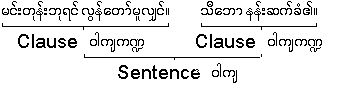
A clause always forms part of a sentence; as,
Clause: #1.


{mïn:toan: Bu.rïn lwun-tau mu lhyïn}
'when King Mindon passed away'Clause #2.


{þi-Bau nûn: hsak hkän Ei.}
'Thi-Bau inherited the throne'.UKT: Clause #1 has the word

{mín:toan:mín: nût-rwa-sän-pri:nauk þi-pau:mín: nûn:tak-tèý}
(s007-p003)
s007.
{pa.da. sa.ya.} : A group of words which does not
make any sense by itself is called a Phrase;
in Bur-Myan it is termed
{pa.da. sa.ya.}
(fn003-02)
as,
 {ta.né.þa.nhÉIk} "one day";

 {lûm:pau-nhÉIk} "on the road";
{né.teín:} "every day".
{lûm:pau-nhÉIk} "on the road";
{né.teín:} "every day".
e.g.
UKT:{ta.hka-ka.}
UKT:{lûm:pau-mha}
'every day'
(s007-p003end)
p001
fn001-01 Poly, 'many';
tonic, relating to tones or sounds'; polytonic,
'having more than one tone'
fn001-01b fns001-1
fn001-02 Pali,
 {þût~htän} , 'a treatise'
fn001-02b
{þût~htän} , 'a treatise'
fn001-02b
fn001-03 Pali,
 {sait~tän} , 'mind', and
{za.} 'born', 'produced' ['originating']
fn001-03b
{sait~tän} , 'mind', and
{za.} 'born', 'produced' ['originating']
fn001-03b
fn001-04 Pali,
 {U.tu.} , 'season'
[natural process such as menses
of women] fn001-04b
{U.tu.} , 'season'
[natural process such as menses
of women] fn001-04b
p002
fn002-01 From its primary
meaning of 'sound', this word has come to mean
'voice', 'word', -o ;
but we shall use it only in the sense of 'sound'
fn002-01b
fn002-02 This is from Pali
 {pa.da.} which has various meanings, viz.:
step, footprint, matter,
{pa.da.} which has various meanings, viz.:
step, footprint, matter,
?ng, a part, portion, a line of stanza, a word,
a sentence. In this work, it is used only with the
meaning of 'word'.
[? shows missing word]
fn002-03 That part of Grammar
which deals with the correct pronunciation of words.
fn002-03b
fn002-04 This in Pali is
 {wa-kyän}. The Burmese form
{wa-kya.} is pronounced as «wek-kya» .
{wa-kyän}. The Burmese form
{wa-kya.} is pronounced as «wek-kya» .
UKT: Don't be surprised by vowel change from <wa>
to <we>. It is quite common when both vowels are
either front or back. Here <a> and <e> and
both front vowels.
p003
fn003-01 Pali,
{kaN~ða.} means, 'a part', 'a portion';
{wa-kya.kûN~ða.} = 'a part of a sentence' fn003-01b
fn003-02 Pali,
{pa.da.} 'word';
 {sa.ya.} "a group", "a cluster"
UKT 160406: To find a word in Bur-Myan, for this Pali term, see:
• TIL Grammar and Linguistic glossary
- GramGloss-indx.htm
> Go to Entries P > P01.htm • phrase
"A phrase is a group of words that go together, but do not make a complete sentence."
- From UseE - fn003-02b
----------
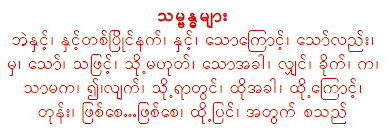
UKT 191128, 201115, A Clause can be identified
by the presence of words such as
{lhyín} "when" ,
 {nauk} "after" . These words combine the two clauses, and are
known as {þûm~bûn~Da.} - .
{nauk} "after" . These words combine the two clauses, and are
known as {þûm~bûn~Da.} - .
Further, parts of a sentence can be
differentiated as the beginning
 {wa-kya.sa.}, the middle
 {wa-kya.lèý}, and the end
 {wa-kya.hsoän:}. In the sentence above, there are
only two clauses: the beginning
{wa-kya.sa.} and the end
{wa-kya.hsoän:}.
{wa-kya.hsoän:}. In the sentence above, there are
only two clauses: the beginning
{wa-kya.sa.} and the end
{wa-kya.hsoän:}.
Let's see in my TIL Grammar Glossary on C - Conjunction:
A word that links and relates parts of a sentence. There are 3 types:
• Coordinating conjunctions (and, but, or, nor, for, so, yet)
connect words or word groups of equal grammatical rank: The lights went out, but the doctors and nurses continued caring for their patients.
• Correlative conjunctions or correlatives (such as either...or, not only...but also)
are two or more connecting words that work together: He was certain that either his parents or his brother would help him
.
• Subordinating conjunctions (after, although, as if, because, if, when, and so on)
begin subordinate clauses and link them to main clauses: The seven dwarfs whistle while they work.
#1.

{mïn:toan: Bu.rïn lwun-tau mu lhyïn}
'when King Mindon passed away'
#2.

{þi-Bau nûn: hsak hkän Ei.}
'Thi-Bau inherited the throne'.
UKT:
{mín:toan:mín: nût-rwa-sän-pri:nauk þi-pau:mín: nûn:tak-tèý}


For those who hate grammar, whether it
be Burmese or English, remember, grammar
can be fun when we do not have to memorize
definitions. See Barron's Grammar in
Plain English, or its TIL version
-- EGPE-indx.htm (link chk 201115)
To have more fun, I've presented a fictional account of Little Peanut
and his pre-teen love Daisy. The story ends with Daisy walking away,
leaving the self-styled Grammarian Peanut with only Snoopy as his companion!
In plain English a sentence is a statement
that conveys a complete thought. The
statement #1 becomes incomplete because of
the word
{lhyín} 'when'. Statement #1 is a
clause. It becomes a complete sentence
only when #2 is added. However, #2 conveys a
complete thought, and so it need not be
considered to be a clause.
In general, a sentence which begins with words such as when, after, because, as soon as, before, or since needs to have a completing thought.
Go back Incomplete-thought-note-b
UKT 201122 : Since I'm dealing with Sanskrit in BEPS, I'm curious to know what
some of the words such as
{ka-ra.ka.kûp~pa.} would be in Sanskrit.
From Apte Sanskrit Dictionary - directed from Sanskrit Dictionary
कारक a. (-रिका f.) [कृ-ण्वुल्] (Usually at the end of comp.) 1 Making, acting, doing, performing, creating, doer &c. स्वप्नस्य कारकः Y.3.15;2.156; वर्णसंकर- कारकैः Bg.1.42; Ms.7.24; Pt.5.36. कारका मित्रकार्याणि सीतालाभाय सो$ब्रवीत् Bk.7.29. -2 An agent. -3 Intending to act or do. -कम् 1 (In Gram.) The relation subsisting between a noun and a verb in a sentence, (or between a noun and other words governing it); there are six such Kārakas, belonging to the first seven cases, except the genitive: (1) कर्त; (2) कर्मन्; (3) करण; (4) संप्रदान; (5) अपादान; (6) अधिकरण. -2 That part of grammar which treats of these relations; i. e. syntax. -3 Water produced from hail. -4 An organ (इन्द्रिय); जगाद जीमूतगभीरया गिरा बद्धाञ्जलीन्संवृतसर्व- कारकान् Bhāg.8.6.16. -Comp. -गुप्तिः f. a. sentence with a hidden meaning. -Comp. -दीपकम् (in Rhet.) Case illuminator, a figure of speech in which the same Kāraka is connected with several verbs in succession; e. g. रिवद्यति कूणति वेल्लति विचलति निमिषति विलोकयति तिर्यक् । अन्तर्नन्दति चुम्बितुमिच्छति नवपरिणया वधूः शयने ॥ K. P.1. -हेतुः the active or efficient cause (opp. ज्ञापकहेतु).
Go back Kāraka-note-b
UKT: 121204 , 160401 , 191024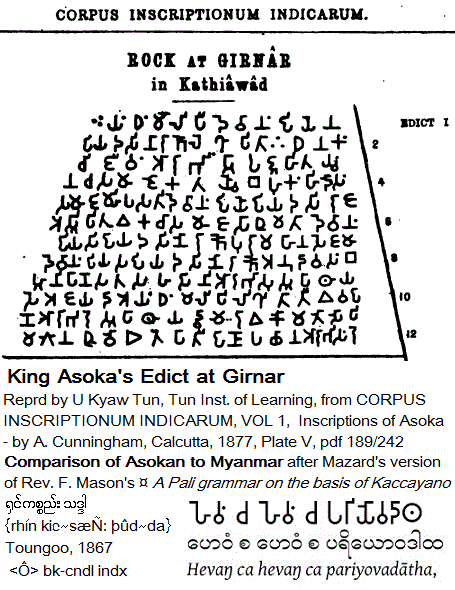
Since humans do not have to learn their
language, which they developed themselves,
there is no reason why a language such as
Magadhi
 {ma-ga.Di} - claimed to be so simple that even
animals could understand it - could not have
developed in the northern parts of
Myanmarpré along the foot-hills of Himalayas
extending west to the northern-west
highlands of India.
{ma-ga.Di} - claimed to be so simple that even
animals could understand it - could not have
developed in the northern parts of
Myanmarpré along the foot-hills of Himalayas
extending west to the northern-west
highlands of India.
And once a speech
 {sa.ka:} has become established, marks or glyphs
{sa} would develop side by with speech.
{sa.ka:} has become established, marks or glyphs
{sa} would develop side by with speech.
I wonder what had happened to the Old Magadhi that had been introduced over the land routes centuries before the "new" Pali from Ceylon. Surely remnants would remain in Myanmarpré. The present-day Pali spoken in Myanmarpré (Pal-Myan) is basically Old Magadhi heavily influenced by Lankan-Pali. Since the International Pali (Pal-Latin) was developed in Lanka by Western philologists, International Pali would be quite different from Pali-Myan. There is no reason for Myanmar monks to adopt the International Pali.
Moreover, Myanmar script is based on perfectly rounded circles and is so unlike the Aleph (Ox) and Bet (Stable) of the Alphabet-Letter system, it could have been the product of a single mind, or a close circle of like-minds -- the Rishis -- to record an esoteric language, Myanmar script might even be the original from which the Asokan developed.
That the
Myanmar Akshara is probably as old as Asokan -
the script on Asoka pillars - is attested by
the fact that Myanmar akshara
 {ta.} is still found in the country of Georgia
as a Letter of Alphabet თ 'Tan'.
{ta.} is still found in the country of Georgia
as a Letter of Alphabet თ 'Tan'.
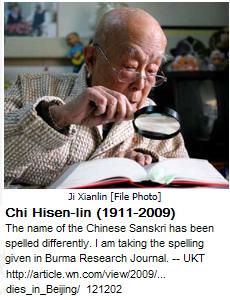 The reader should note that Magadhi and Pali
may be entirely different as shown by Chi Hisen-lin,
Journal of the Burma Research Society, XLIII, i,
June 1960. See ¤ Language problem of primitive
Buddhism, by Chi Hisen-lin
The reader should note that Magadhi and Pali
may be entirely different as shown by Chi Hisen-lin,
Journal of the Burma Research Society, XLIII, i,
June 1960. See ¤ Language problem of primitive
Buddhism, by Chi Hisen-lin
(季羡林 , 1911 – 2009) -
lang-probl.htm (link chk 191024)
Chi Hisen-lin states:
" ... there is a comparatively concordant point,
that is, most of the scholars advocated that the Pali
language was a Western dialect, and such was truly
the fact. The declensions of the Pali words are
similar to those of the language used in the Girnar
Inscriptions, of the Asokan Pillars [see Asoka-Great.htm
from Wikipedia; and Ven. S. Dhammika's The Edicts of
King Asoka], such as the locative case ending in
-amhi and -e, the accusative case in
-ne, etc. But on the other hand, the
Magadha language was an eastern dialect,
in which <r>
 {ra.} had become as <l>
 {la.}, and <s> as <ś>, while
the nominative case of words ending in -a ,
ended in -e , etc. There is a vast
difference between the two languages and they
should by no means be confused with each
other."
{la.}, and <s> as <ś>, while
the nominative case of words ending in -a ,
ended in -e , etc. There is a vast
difference between the two languages and they
should by no means be confused with each
other."
See: Translation of Asoka's Edicts by Ven. S. Dhammika
in Indic languages - indic.indx.htm > Asoka-edicts.htm (link chk 201123)UKT 191024: Since Chi Hisen-lin has based his conclusions on "the declensions of the Pali words are similar to those of the language used in the Girnar Inscriptions, of the Asokan Pillars ..." I have to read the latest findings on Girnar Inscriptions in Wikipedia:
- https://en.wikipedia.org/wiki/Junagadh_rock_inscription_of_Rudradaman 191024.
"The Junagadh rock inscription of Rudradaman, also known as the Girnar Rock inscription of Rudradaman, is a Sanskrit prose inscribed on a rock by the Indian Satraps ruler Rudradaman I. It is located near Girnar hill near Junagadh, Gujarat, India. The inscription is dated to shortly after 150 CE. [1] The Junagadh rock contains inscriptions of Ashoka (fourteen of the Major Rock Edicts of Ashoka), Rudradaman I and Skandagupta. [2]
I could not understand the statement
"<r>
{ra.} had become as <l>
{la.}, and <s> as <ś>"
for a long time until I came to study Skt-Dev.
The statement can be readily understood if we
take "Pali the Western dialect" was
under the influence of Sanskrit which was a
rhotic sibilant (hissing) IE language. My
suggestion is since Skt-Dev was an invented
language, we must see the transition as
<l>
{la.} -->
{ra.}. In that transition we should also expect
to see La-major
 {La.} the allophone of La-minor
{la.}.
{La.} the allophone of La-minor
{la.}.
"Magadhi the Eastern dialect" would be
a Tib-Bur language which would be non-rhotic
thibilant (non-hissing) language the same as the
Pal-Myan. Thus, <s> --> <ś> \
must be interpreted as
 {þa.} स -->
 {sha.}/
 {þhya.} श. What Chi Hisen-lin has given
as <s> is not palatal plosive-stop
/
{þhya.} श. What Chi Hisen-lin has given
as <s> is not palatal plosive-stop
/
 {sa.}/{c} च but dental fricative-thibilant
{þa.} स.
{sa.}/{c} च but dental fricative-thibilant
{þa.} स.
The statement of Chi Hisen-lin (JBRS, XLIII, i, June 1960):
"the Magadha language was an eastern dialect,
in which <r>
{ra.} had become as <l>
{la.}, " is acceptable, except for the term
"dialect". The term "dialect"
is incomplete, because a "dialect" is
a subset of a "language" , and the author
has not explicitly stated what language he meant.
However, if Magadhi had been a distinct language --
a Tib-Bur language, and being in the east,
far from the place in western India through which
the Sanskrit speakers had filtered in, we could
expect it to be relatively free from the rhotic nature
of IE languages. And we should expect
to see /l/ in the place of /r/. I am basing my
conclusions from my knowledge of Bur-Myan, a typical
Tib-Bur language.
The blood relatives of Gautama Buddha, the
Néwaris, still speak what is left of the
Old Magadha language now being slowly Sanskritized.
The spoken language of these people reflects the
original language, and it is my intention to look
into the Néwari language aka language
of Nepal Bhasa . Another source of information is
from the work of Prof. F. Edgerton on Buddhist
Hybrid Sanskrit (BHS):
#1. A Comparative and Etymological Dictionary
of Nepali Language by R L Turner
-
http://dsal.uchicago.edu/dictionaries/turner/
(link chk 191128)
Downloaded pages in a folder is in
the TIL SD-Library
On downloaded Turner-Nepali-Lang-Dictionary,
p159, there are a few words beginning with
{nga.}
#2. English to Nepal Bhasa Dictionary
by Sabin Bhuju सबिन भुजु , 2005
- SBhuju-NewarDict<Ô> /
bkp<Ô> (link chk 191128)
Being both Tib-Bur languages Bur-Myan and
Newa-Dev have words beginning with {nga.} ङ,
e.g. for <fish> न्या ; ङा
#3. Buddhist Hybrid
Sanskrit Grammar and Dictionary, F. Edgerton,
- BHS-indx.htm (link chk 191128)
As of today (080823, ... , 160404) I am inclined to agree with Chi Hisen-lin. My conjecture and observation is this: Pal-Myan and Bur-Myan are both Tib-Bur languages and that they are thibilant (referring to r6c5 akshara), where the IPA /θ/ is prominent.
On the other hand, Pali that is spoken in Sri Lanka aka Ceylon from which Pal-Lat was under the influence of native Lanka speech which is Aus-Asi different from IE and Tib-Bur. We should also remember that Buddhism was brought into Sri Lanka by missionaries sent by King Asoka who like Gautama Buddha was undoubtedly Tib-Bur speakers.
The Lankan Buddhist then came under the influence of Sanskrit of IE group which is sibilant where the /θ/ is replaced by /s/. See remarks by T. W. Rhys Davids in the foreword of his Pali Dictionary - PTS-indx.htm & foreword.htm (link chk: 191128).
Thus, the International Pali (Pal-Lat) is very much tainted by Sanskrit, an IE language. I can also pinpoint two areas where Pal-Lat, Pal-Myan, Bur-Myan are different.
• UKT 191024: There are no Pal-Myan words with r1c5 as the onset. The occupant of r1c5 is written as
{gna.} in Bur-Myan and as
{gn~ré} in Mon-Myan. Leaving aside the Mon-Myan for the present, Bur-Myan phoneme is non-nasal in the onset, and is nasal only in the coda. I've thus called it Semi-nasal and have written
{gna.}/{ng}. There is similarity between Bur-Myan and Néwari (& Népali) because both have onsets with
#1. A Comparative and Etymological Dictionary of Nepali Language by R L Turner
- http://dsal.uchicago.edu/dictionaries/turner/ (link chk 191128)
Files from Univ. Chicago in TIL HD-nonPDF and SD-nonPDF libraries:
- Turn-NepalDict<Ô> / Bkp<Ô> (link chk 170729)
Downloaded files from Govt. College in TIL HD-PDF and SD-PDF libraries
- RLTurner-NepalDict<Ô> / Bkp<Ô> (link chk 171224)
To refer to this dictionary use: Turn-Nepxxxx
Nepali-IE aka Gorkhali in Alphabetical order:
Népali-English Dictionary by Karl-Heinz Krämer, 2007.
Downloaded files in TIL HD-PDF and SD-PDF libraries:
- KHKramer-NepalDict<Ô> / Bkp<Ô> (link chk 180104)
#2. English to Nepal Bhasa Dictionary by Sabin Bhuju सबिन भुजु , 2005
- SBhuju-NewarDict<Ô> / bkp<Ô> (link chk 160221)
Newari-TibBur aka Nepal-Bhasa in Alphabetical order:
English to Nepal Bhasa Dictionary (Tib-Bur) by Sabin Bhuju सबिन भुजु , 2005
Downloaded files in TIL HD-PDF and SD-PDF libraries:
- SBhuju-NewarDict<Ô> / Bkp<Ô> (link chk 191015)Being both Tib-Bur languages Bur-Myan and Néwa-Dev have words beginning with
{gna.} ङ,
e.g. for <fish> न्या ; ङा• It is in the pronunciation of palatal (r2c1) akshara. In Pal-Myan
/
• It came as a surprise to me to find an isolated language that has both velar /ŋ/ and palatal /ɲ/
- https://en.wikipedia.org/wiki/Icelandic_language 191128
Chi Hisen-lin's remark "the Magadha language
was an eastern dialect, in which «r» had become
as «l», and ..." is intriguing from the point
of view of the Bur-Myan which has quite a number
of laterals:
 {la.},
 {La.},
 {lha.},
 {lhya.},
 {lwa.},
 {lya.}.


In a lighter vein, I should remark (especially to
my grandsons, Maung Kan Tun and Maung Thit Tun,
both born outside Myanmarpré): The favorite snack
of the Bur-Myan is
 {lak-Bak} 'processed tea-leaves' from the tender
leaves of tea plant Camellia sinensis .
{lak-Bak} loosely translated is "something
that is a companion of your hand" : the word
for <hand> is
{lak-Bak} 'processed tea-leaves' from the tender
leaves of tea plant Camellia sinensis .
{lak-Bak} loosely translated is "something
that is a companion of your hand" : the word
for <hand> is
 {lak}. So unless you love
{lak-Bak} and can articulate the "laterals",
you shouldn't call yourself Burmese!
{lak}. So unless you love
{lak-Bak} and can articulate the "laterals",
you shouldn't call yourself Burmese!
Go back Magadha-lang-note-b
UKT: 121204, 160404, 201112
What Lonsdale has said about Pali being
introduced from Ceylon or Lanka in the Pagan period
is true for the reintroduction of Pali
into Myanmarpré in 11th century. However,
I wonder what had happened to the Old Magadhi
- the language of King Asoka - that was
introduced when King Abiraza
{a.Bi.ra-za mín:} of Tagaung, came
into the land over land across the mountains,
centuries before the birth of Lord Buddha.
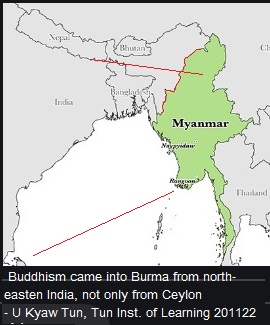 It is important to remember that both
Gautama Buddha and King Asoka who came
about 250 years after the Buddha, had
belonged to the area known as Magadha
Mahajanapada
{ma-ga.Da. ma.ha-za.na.pa.da.}
महाजनपद
It is important to remember that both
Gautama Buddha and King Asoka who came
about 250 years after the Buddha, had
belonged to the area known as Magadha
Mahajanapada
{ma-ga.Da. ma.ha-za.na.pa.da.}
महाजनपद
See: https://en.wikipedia.org/wiki/Mahajanapada 160404
The Mahājanapadas ( महाजनपद 'great realm', from maha, "great", and janapada "foothold of a people") were sixteen kingdoms or oligarchic republics that existed in ancient India from the sixth to fourth centuries BCE.
Magadha
Mahazanapada
{ma-ga.Da. ma.ha-za.na.pa.da.}
is an area larger than petty kingdoms which continually change boundaries --
sometimes disappearing altogether and which may come back to life later --
in which the culturally (and
linguistically) interrelated Magadha
language-speakers had settled. You are
advised to ignore the present-day
geo-political countries of Bangladesh,
Bhutan, India, Myanmarpré, Nepal, and
Pakistan.
This account given in the Glass Palace Chronicles was totally ignored by the British colonialist-historians probably because of political reasons.
There was not only the Abiraza group, but
another influx from Magadha
{ma-ga.Da.} in the
life-time of Buddha. During this time not
only the Tib-Bur (Tibeto-Burman) speakers
had come in but also IE (Indo-European)
speakers -- the Brahmana Poannas -- serving
as family priests.
UKT 191023: Yet the Westerners - academics and news media - loves to belittle us - the people and the land of Myanmarpré, I call upon Mother Earth to stand for us. See Section 8: Myanmar: what the Earth has to say "
- earth-indx > paleoant-indx > Fossil.htm (link chk 201122)See: Cenozoic drainage variation in the Bengal Bay since India-Asia collision:
- https://www.researchgate.net/figure/Cenozoic-drainage-variations-in-the-Bengal-Bay-since-the-India-Asia-collision-showing_fig5_269776803 191128
The land routes across the difficult-to-cross
mountain passes at present between India and Myanmarpré
must have been used by small groups of people. Moreover the mountains are being
built up, and the rivers are changing courses all the time. During all these
geological ages, animals of various kinds must have been traveling -- long before the
appearance of Hominids.

 Read about
Afrasia djijidae which is a
fossil primate that had lived in Myanmarpré
approximately 37 million years ago, during the
late middle Eocene.
Read about
Afrasia djijidae which is a
fossil primate that had lived in Myanmarpré
approximately 37 million years ago, during the
late middle Eocene.
The building up of mountains and the cutting up of rivers, such as the proto-Irrawaddy
has had happened before, in geologic time, when the
Himalayas were (and are still) building up.
See
Section 08: Myanmar: what
the Earth has to say
- earth-indx >
geol-indx
(link chk 190824)
and go to: Large rivers and orogens: The
evolution of the Yarlung Tsangpo–Irrawaddy
system and the eastern Himalayan syntaxis
https://www.sciencedirect.com/science/article/pii/S1342937X13002281
180530, 190824
Go back Pal-Ceyl-vs-Pal-Myan-note-b
- UKT 160404, 201110
In Lonsdale's time, linguists did not know that there are many systems of writing. And few still fail to recognize the importance of citing the script together with the speech as I am doing: Bur-Myan, English-Latin, Pali-Myan, and Skt-Dev.
Except for Eng-Lat, the other BEPS languages use Abugida-Akshara system aka Akshara-Syllable system, where Consonants and Vowels are written separately. What the westerners had taken as diacritics are actually vowels and cannot be disregarded as is done in the Alphabet-Letter system.
The following is from: The Free Dictionary http://encyclopedia.thefreedictionary.com/Polytonic+orthography 080821
However, some ten years after I've read the Free Dictionary article, I feel I must refresh my knowledge by looking at another article
- https://en.wikipedia.org/wiki/Greek_diacritics
which I'll record in ch01t.htm (link chk 191102)
The polytonic orthography of Greek uses a variety of diacritics (πολύ = many + τόνος = accent) to represent aspects of Ancient Greek pronunciation. It was the standard orthography for all varieties of Greek from Hellenistic times until 1982, although the distinctions it represented had disappeared from the spoken language early in the Christian era. In 1982, the Greek Parliament adopted the monotonic orthography. Polytonic is still sometimes used by people who consider monotonic an unfortunate break with tradition.
Descritption
Polytonic Greek utilizes a set of diacritics on certain letters,
illustrated below using the letter α:
• the accents (tónoi, τόνοι), on the vowel of the accented syllable of a word and indicating different tone patterns in Ancient Greek:
¤ ά Oxeía (ὀξεῖα), the acute accent
¤ ά Tónos (τόνος, used interchangeably in prose with the oxia, used to strengthen the tone of a vowel in poetry
¤ ὰ Bareía (βαρεῖα), the grave accent
¤ ᾶ Perispōménē (περισπωμένη), the circumflex, sometimes printed in the form of a tilde, macron, or inverted breve.• the breathings, written on the first syllable of a word starting with a vowel:
¤ ἁ Daseía (δασεῖα), or rough breathing ( spiritus asper), indicating an [h] in Ancient Greek. Also used on words starting with rho (ρ) transliterated as rh.
¤ ἀ Psilé (ψιλή), or smooth breathing (spiritus lenis), indicating the absence of an [h].• ᾳ the ypogegrammeni (iota subscript) (ὑπογεγραμμένη), written under alpha, eta, and omega to indicate the long diphthongs āi, ēi, and ōi, respectively; sometimes written adjacent to capitals (in which case it is called an iota adscript, prosgegrammeni, προσγεγραμμένη).
UKT: The "diphthong" mentioned above must be taken with caution. It can very well be "digraph" which does not involve the "sliding" of the English <boy>. What has been described commonly as "diphthong" in Bur-Myan are actually monophthong, but written in Eng-Lat (English speech in Latin script). Unfortunately UKT has no knowledge of Greek! -- UKT121117
The letters iota and upsilon can also take a diaeresis (διαλυτικά) to show that a pair of vowels is pronounced separately, rather than together: compare Modern Greek παϊδάκια [paiðakja] (lamb chops) and παιδάκια [peðakja] (little children). The diaeresis can be combined with acute, grave and circumflex but never with breathings (since the letter with diaeresis cannot be the first vowel of the word).
All of these diacritics are important in Classical Greek (and the breathings in particular are relevant to the etymology of words in other languages), but except for the diaeresis none have any significance in the modern language: there is no difference in pronunciation between words which formerly had smooth and rough breathings, and the pitch accent has been replaced with a stress accent. (Note that the transliteration of the names of the diacritics into the Roman alphabet varies, chiefly depending on whether they are considered words from Classical or Modern Greek.)
History
The rough and smooth breathings were introduced
in classical times in order to represent the presence
or absence of [h] in Attic Greek, which had adopted
a form of the alphabet in which the H sign was
no longer available for this purpose as it had been
used (as Eta) for the long e. Aristophanes of Byzantium
introduced the various accent markings during the
Hellenistic period for educational purposes. The
majuscule system written entirely in capital letters was used
until the 8th century, when the
minuscule polytonic was widely adopted.
The acute and circumflex accents were invented in Alexandria; the grave accent then meant an unaccented syllable, when it was important to mark one. The modern convention, by which an acute accent on the last syllable of a word becomes a grave accent, was devised in Byzantine times, after the accent became stress; the convention began with certain proclitic words, which lose their accent before another word, and was generalized.
In the later development of the language, the ancient tones were replaced by a stress accent making the differences among accents superfluous, and the [h] sound became silent. Some textbooks of Ancient Greek for foreigners have retained the breathings, but dropped all the accents, simplifying the task for the learner, but breaking the link with the modern language.
Following the final adoption of the Demotic (Dhimotiki) form of the language, in 1982, monotonic orthography was imposed by law. The latter uses only the acute accent (or sometimes a vertical bar intentionally distinct from any of the traditional accents) and diaeresis and omits the breathings. Some individuals, institutions, and publishers continue to prefer the polytonic system, though an official reintroduction of the polytonic system does not seem probable.
In an intermediate stage (between the beginning of the 20th century and 1982, official since the 1960s), the grave was replaced by the acute under certain circumstances, in particular in handwriting. (Even in Ancient Greek, they almost always meant the same thing; in modern Greek, there is no difference in the pronunciation of the three accents.) Greek typewriters from that era did not have keys for the grave accent. The grave was also not taught in primary schools where instruction was in Demotic. This system is still used in some publications such as the periodical Estia.
Go back poly-ortho-note-b
UKT: 191003
I've personally observed spelling changes without pronunciation changes even within my father's, mine, and my son's generations. I'll record them as we proceed to study Lonsdale work:
1. The prefix to a boy's name is now "Maung", however it was
"Moung" especially to the English natives. The nuclear vowel {oun} is
a rounded
back-vowel. Eng-Latin speakers are
more used to back-vowels, whereas
Bur-Myan speakers are more used to
front-vowels. We use "Maung"
in place of "Moung" at present. Maung Ba
 {maún-Ba.} is a common boy's name when we were young.
2. (to be continued)
Go back sp-change-b
End of TIL file