ch00.htm
- Burmese Grammar and Grammatical Analysis by A. W. Lonsdale, Education Department, Burma, British Burma Press, Rangoon, 1899. A photocopy of the ink-on-paper book , and downloaded PDF copies are available in the TIL Research Station, in Yangon.
Copied and edited by UKT and staff of TIL . Not for sale. No copyright. Free for everyone. Prepared for students and staff of TIL Research Station, Yangon, MYANMAR : http://www.tuninst.net , www.romabama.blogspot.com
Noteworthy passages selected by UKT
Preface
Original TOC (of the original book
indicating original pages)
TIL Definitions for BEPS work
See a video on the Declaration of Independence during WWII.
- https://www.youtube.com/watch?v=ML5lWWCfgRM 140125, 191001
Burmese Independence ceremony under Japanese Rule 1943. Some quoted this Independence as Fake. You can see Dr Ba Maw, Thakhin KoDawMhine, General AungSan (Minister of Defence in military uniform), etc. See Wikipedia:
- https://en.wikipedia.org/wiki/State_of_Burma 160804
UKT notes
• The official dialect of Bur-Myan
•
Uninflected English
UKT 191127: Read my note on the official dialect .
• The Burmese language is constructed on scientific principles, and there is no reason why its grammar should not be dealt with also from a scientific standpoint. But it may be safely said that Burmese grammar as a science has not received that attention it deserves.
• With regard to the grammatical treatises
by native writers, it is no exaggeration
to say that there is not one which can be
properly called a Burmese grammar. These
writers, not content with merely borrowing
the grammatical nomenclature of the Pali
language, also attempted to assimilate the
grammatical principles of the uninflected
Burmese to those of the inflected
Pali; so that they produced, not
Burmese grammars, but modified Pali grammars
in Burmese dress.
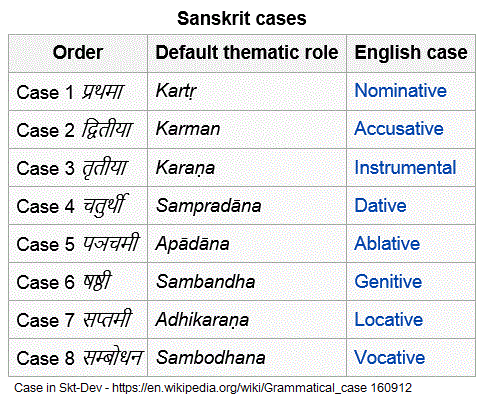
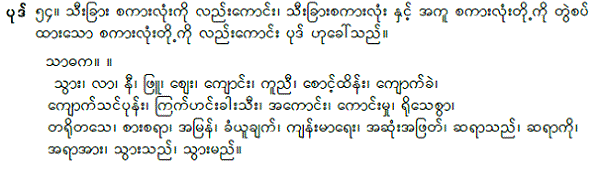
• The servile veneration in which they held Pali, the language they had adopted as the classic, is, no doubt, directly responsible for the composition of such works. In their endeavour to conform strictly to Pali methods, they often introduced unnecessary terms and misapplied them, ignoring those grammatical points in Burmese for which they could find no parallel in Pali. How futile their attempts were may be judged by the numerous difficulties and anomalies they created, from some of which even now teachers of the language have not quite extricated themselves - take, for instance, the case-inflexions.
UKT 191002: In order to put more emphasis on cases, I have given Skt-Dev cases in the inset. Also watch or just listen to Sanskrit Grammar by Dr. Pankaja Rajagopal - SktGramRajagopal<Ô> (mp4) or <)) (mp3) available only at Research station
- (link chk 191128)
Or, online, L205-Cases: BkCnd<))
Contents of this page
p.roman03
UKT 201109: Preface is not included in the downloaded BkCnd<OL>
What I've given is from the ink-on-paper book in the TIL research station.
(p.roman03)
ALTHOUGH there are several grammars of
the Burmese [Burmese speech written in
Myanmar script (Bur-Myan)] language already
published in English, no apology is needed
for issuing another. The study of a language
to be of any educational value should be
conducted on scientific lines; and a
treatise in which this fact is not usually
recognised can hardly be said to be of
practical utility to the student who aims
at gaining something more than a merely
superficial knowledge of the subject. [UKT¶]
The Burmese language is constructed on scientific principles [Phonetics & Phonology], and there is no reason why its grammar should not be dealt with also from a scientific standpoint. But it may be safely said that Burmese grammar as a science has not received that attention it deserves. In the present work an attempt is made to deal with it on the lines indicated. The practice usually followed in the grammatical treatment of the language is to give only certain facts which can be easily disposed of, and to pass over those which occasion difficulty. This would be well enough so far as an elementary work is concerned; but the facts presented are often so imperfectly classified and explained that the student is given the impression that the distinctions and rules of the language are purely arbitrary, and that it has, therefore, no grammar worthy of the name. It may be possibly due to this that some have even asserted that the language is but an incoherent medley of affixes and a few notional words. That Burmese is not devoid of a properly constructed grammar which admits of scientific treatment, the following pages, it is hoped, will show.
With regard to the grammatical treatises by native writers, it is no exaggeration to say that there is not one which can be properly called a Burmese grammar. These writers, not content with merely borrowing the gramma- (p.roman03end-roman04begin) tical nomenclature of the Pali language (Pal-Myan), also attempted to assimilate the grammatical principles of the uninflected Burmese to those of the inflected Pali; so that they produced, not Burmese grammars, but modified Pali grammars in Burmese dress. The servile veneration in which they held Pali, the language they had adopted as the classic, is, no doubt, directly responsible for the composition of such works. In their endeavour to conform strictly to Pali methods, they often introduced unnecessary terms and misapplied them, ignoring those grammatical points in Burmese for which they could find no parallel in Pali. How futile their attempts were may be judged by the numerous difficulties and anomalies the created, from some of which even now teachers of the language have not quite extricated themselves - take, for instance, the case-inflexions.
UKT 191002: If only Mr. Lonsdale had considered that the Pali spoken in Myanmarpré was perhaps the Old Magadhi written in Asokan script, brought overland to Tagaung, he might have been much kinder in his criticism of native writers.
To a very great extent this work is a first attempt to reduce to a system the grammatical principles of the language - an undertaking which has involved much patient labour. The author is fully conscious that it is not free from imperfections. Compelled, as he has been, to be original in dealing with the many difficult points which confronted him, and which previous writers had not touched upon, he has, no doubt, occasionally gone astray. Experience in using the work will probably disclose defects, and suggest some possible improvements.
In the preparation of the work, the author [Lonsdale] has generally followed the plan of English (Eng-Lat) grammar, since it is one with which the class of students for whom the book is designed would be most familiar. He has not, however dealt with 'Syntax' in a separate section for the reason given on page 36. It will be noticed that in the English renderings of many of the Burmese examples given, idiom has been sacrificed to literal accuracy. The author has deemed it advisable, even at the risk of writing bad English, to adopt this course so as to bring out clearly, in every case, the precise meaning and idiomatic use of words [p.roman04end-roman05begin] and phrases as well as the construction of sentences in Burmese. A section on 'Analysis of Burmese Sentences' a subject never attempted before - has been added. A careful study of this will, the author trusts, materially help the student to a better understanding of the structure a Burmese sentence. As the typical Burmese sentence the one in which the subordinate clauses are very much involved, the author has, in Chapter VIII of Part II , dealt very fully with the connective words which are used to mark these clauses.
The author begs to acknowledge his indebtedness to Mr. J. VanSomeren Pope, M.A., Director of Public Instruction, Burma, not only for the interest he has taken in the work, but also for the kind help he has given him. His hints and suggestions have been of very great service.
The author's cordial thanks are also due to Mr. W . Wedderspoon, M.A., B.L., Senior Inspector of Schools, central Circle, Burma, whose criticisms have frequently had the author to modify and even to re-cast various portions of his grammar. Being a student of the language himself, Mr. Wedderspoon took the keenest interest in the preparation of the work, and was ever ready and willing render help.
In the course of preparation, the author has had occasion to consult the works of various writers on English grammar. Wherever these have been cited acknowledgments have been made.
The acknowledgments of the author are also due to the proprietors of the 'British Burma Press' for their courtesy in affording him every facility for the successful printing of this work.
A. W. L.
RANGOON,
March, 1899.
(p.roman05 end) (p.roman06 is a blank page.]
See downloaded BkCnd<OL>
(p.roman07begin)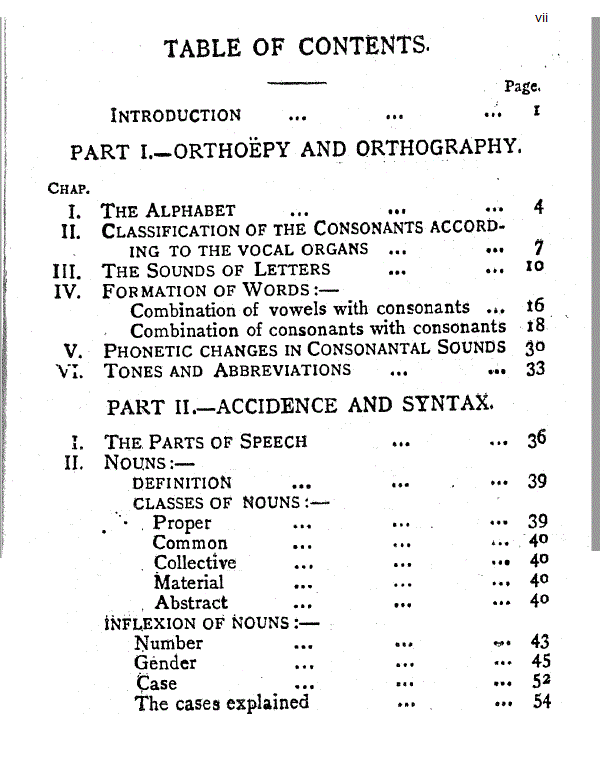
Introduction - p001
PART I ORTHOËPY (pronunciation) AND ORTHOGRAPHY (spelling)
UKT 160404: The reader must make a clear distinction between two writing systems: Abugida-Akshara and Alphabet-Letter. The aim of the Akshara is to give a one-to-one correspondence between script and speech, whereas in Alphabet systems there is no such correspondence. Bur-Myan is phonetic: English is chaotic. Pronounce a Bur-Myan word according to spelling and you will be understood. Never pronounce an English word as it is spelled - it is a disaster!
Chap01. The Abugida-Akshara Alphabet - p004
Chap02. Classification of the Consonants
according to the Vocal organs [Points of Articulation] - p007
Chap03. The sounds of the Aksharas Letters - p010
Chapter 04. Formation of [Syllables and] Words
Combinations of vowels with consonants [Syllables beginning with vowels
and ending in killed consonants] - p016
Combinations of consonants with consonants [Conjuncts and Medials] - p018
Chapter 05. Phonetic changes in Consonantal sounds - p030
Chapter 06. Tones [Pitch-registers] and abbreviations - p033
PART II ACCIDENCE AND SYNTAX
Chapter 01. The Parts of Speech - p036
Chapter 02. Nouns
Definition - p039
Classes of Nouns
Proper - p039
Common - p040
Collective - p040
Material - p040
Abstract - p040
Inflexion of Nouns
Number - p043
Gender - p045
Case - p052
The cases explained - p054
(p.roman07end-08begin)
Nouns in Apposition - p066
Substitutes for nouns - p067
Parsing of nouns - p068
Parsing model - p068
Chapter 03. Adjectives
Definition - p070
Classes of Adjectives
Adjectives of Quality - p070
Adjectives of Quantity - p072
Pronominal Adjectives - p088
The Two Different uses of Adjectives - p099
Substitute for Adjectives - p100
Inflexion of Adjectives
Comparison - p101
Rules of comparison - p102
Parsing of adjectives - p108
Parsing model - p108
Chapter 04. Pronouns
Definition - p110
UKT 201110:

For BEPS work, I need definitions for English-terms in Bur-Myan.
Translation with multiple meanings would not do. It must be one-to-one
definition.
The first candidate is the Eng Alphabet to Bur, which must also
hold for Skt . Akshara अक्षर
«akṣara». We must also note that Sanskrit speakers cannot pronounce
Thibilant sounds, for which they substitute Sibilants.
First and foremost, we need a term for
Akshara
 {ak~hka.ra} or
 {a.kSa.ra.}
अक्षर
«akṣara», and then will come:
{a.kSa.ra.}
अक्षर
«akṣara», and then will come:
Syllable
Word
-- Sentence
 {wa-kya.} ; Clause
or sentence-parts
{wa-kya.} ; Clause
or sentence-parts
 {wa-kya. gûN~ða.} ; Phrase or incomplete sentence
 {wa-kya.pyak},
 {pa.da. sa.ya.}
Lonsdale has also defined terms, such
Sentence
{wa-kya.}, Clause
or Sentence-part
 {wa-kya. kûN~ða.} [I'll rewrite as
 {wa-kya.peín:}], and Phrase
{pa.da. sa.ya.} in Bur-Myan.
{wa-kya.peín:}], and Phrase
{pa.da. sa.ya.} in Bur-Myan.
 Some of Lonsdale's
terms are not found in current MLC grammar.
However, for BEPS work, you need to define
dedicated terms between Burmese and English.
It is important to have such one-to-one dedicated
terms for inter-language translation. Since both
Burmese and English are living languages, I expect
it would be difficult to define one-to-one
dedicated terms. To mitigate this problem I have
decided to find first the correspondence between
Pal-Myan (Tib-Bur) and Skt-Dev (IE):
Some of Lonsdale's
terms are not found in current MLC grammar.
However, for BEPS work, you need to define
dedicated terms between Burmese and English.
It is important to have such one-to-one dedicated
terms for inter-language translation. Since both
Burmese and English are living languages, I expect
it would be difficult to define one-to-one
dedicated terms. To mitigate this problem I have
decided to find first the correspondence between
Pal-Myan (Tib-Bur) and Skt-Dev (IE):
- MC-indx.htm (link chk 201109)
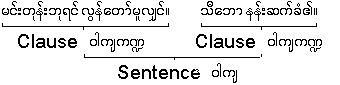
UKT 191128: To define the Clause
{wa-kya. kûN~ða.} or
{wa-kya.peín:} fully, I
will consider the Sentence made up of three parts:
- beginning clause
 {wa-kya.sa.},
- middle clause
 {wa-kya.lèý} and the
- ending clause
 {wa-kya.hsoän:}. I'll not use
{wa-kya.kûN~ða.}.
{wa-kya.hsoän:}. I'll not use
{wa-kya.kûN~ða.}.
A Phrase
{pa.da. sa.ya.}, on the other hand, is just a broken or
incomplete sentence
{wa-kya.pyak}. 
¤
UKT 121203, 160405, 201110: I'm going through MLC grammar to help me with
Lonsdale's work. See MLC Burmese Grammar, (pub. ca. 1986).
Ink-on-paper book available in TIL Research Library
in 3 volumes, 17 sections. MLC Grammar definitions are from
vol 1: mod: 2 , in pdf. They are from downloads in TIL HD-PDF-B and SD-PDF-B
libraries:
1. bg-mlc-1-1. 2.
bg-mlc-1-2. 3.
bg-mlc-1-3. 4.
bg-mlc-1-4.
5. bg-mlc-2-5.
6. bg-mlc-2-6.
1.
bkp1. --- ---
2. bkp2.
--- ---- 3.
bkp3.---
---- 4. bkp4.
-- - --- 5.
bkp5.
--- ---- 6.
bkp6.
For copying from above pdf, open bg-mlc-1-2. to 66.7% , Prt-Scr , paste on Paint, and resize to w=600 pix., e.g.,
Please remember, MLC grammar is for students in Myanmarpré, who can read and write in Bur-Myan. Translating it for foreigners will be an impossibility. In this section my interest is in coming up with one-to-one definitions for BEPS work.
{ak~hka.ra} अक्षर
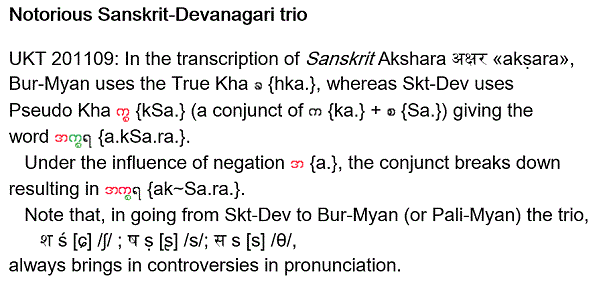
«akṣara» UKT 191003, 201110: Note Skt-Dev uses Pseudo Kha, a vertical-conjunct of
{ka.} +
{Sa.} =
{kSa.} , in places where Pal-Myan would use Regular Kha
{hka.}. Pseudo-Kha has short and long forms corresponding to those of Regular Kha:
{kSa}
The main difference between the two, is the ability to withstand the action of Virama
{a.þût}: Regular Kha
{hk}, but the Pseudo-Kha breaks up. Since the Dental fricative-sibilant
{Sa.}/{S} is unknown in Bur-Myan & Pal-Myan, this Skt-Dev conjunct is a source of confusion for Bur-Myan speakers, who know only the Palatal-stop
{sa.}/{c}.
It is the failure of Westerners. They do not take length of the vowels in terms of eye-blinks into account. They fail to notice the effect of the coda on the pronunciation. MLC also ignores all the ending sounds in accordance with the Irrawaddy dialect. Ending sounds are common in dialects of Da'nu, Inn'tha, Rakhine, Tavoy, etc. MLC also fails to recognize that Alphabet-Letter system and Abugida-Akshara system are different. They equate Akshara to the Alphabet.
From Skt-Dev अक्षर
«akṣara» is
{a.kSa.ra.}
e.g.
MLC definition:

I could not decide what I should give as definition for "word".
- MLC-BurGram
{sa.ka:loän:} - n. word -- MED2006-101c2
What MLC has given encompasses Speech but not Script and is not used in BEPS work. I decided to transliterate to
{waad}.
- MLC-BurGram
{poad} - n. 1. word. 2. [orth] punctuation mark -- MED2006-274c2
Note: This definition is not used in BEPS work.
- MLC-BurGram
{poad-su.} -- not entered in MLC2006
Note: I may use this definition in BEPS work.UKT 191003: this subsection 003 has been greatly modified, and the idea is no longer that of Lonsdale. Because of differing definitions, I've to come up with a new set of definitions for BEPS work.
UKT 191015:
Foreigners have difficulties with the Bur-Myan language, because there are actually two 'dialects' in use: the formal and official dialect, and the colloquial which is used by man on the street. Lonsdale usually gives the official dialect. I will add the colloquial whenever necessary.
Of course, the official dialect because of its being influenced by Pali from Ceylon, i.e. Pal-Lanka, is somewhat inflected, however, the colloquial Burmese is uninflected.
The colloquial is strictly Tib-Bur (Tibeto-Burman),
comparable to Néwari (now heavily influenced by
Skt-Dev), the language used by the still extant
relatives of Gautama Buddha.
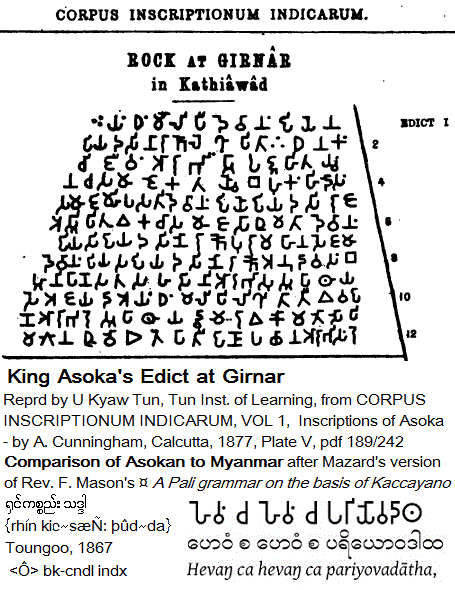
The script used by Néwari speech and Népali speech was Asokan up to about 12th century AD. It is now very similar to Devanagari
If Myanmar is the directly derived from Asokan as maintained by Rev. F. Mason in his A Pali grammar on the basis of Kaccayano, 1867, Néwari might even be called a Myanmar language - without any political implications. However, Népali is IE (Indo-European) heavily influenced by Tib-Bur. My sources on Népali and Néwari languages are:
#1. A Comparative and Etymological Dictionary
of Nepali Language by R L Turner
-
http://dsal.uchicago.edu/dictionaries/turner/
(link chk 160119)
Downloaded pages, 654 in number, are in TIL
non-PDF library
-
Turner-NépalDict-indx<Ô> /
bkp<Ô> (link chk 191015)
On downloaded Turner-Nepali-Lang-Dictionary, p159,
there are a few words beginning with
 /
/
 {gna.}/{ng}
UKT 191002: After studying Mon-Myan and observations on Peguan Mon, I have concluded that r1c5 is not a true nasal. I'm calling it Semi-nasal and depict it as
{gna.}/{ng} to show that as an onset it is non-nasal but a nasal only as coda. Of course IE language speakers could only identify as a nasal.
Remember, what you think you heard depends not only on how the phoneme is produced, but also on your mother-tongue, and your culture. We are all prisoners of our own culture.
#2. English to Nepal Bhasa Dictionary
by Sabin Bhuju सबिन
भुजु , 2005

- SBhuju-NewarDict<Ô> /
bkp<Ô> (link chk 191128)
Both being Tib-Bur languages, Bur-Myan and Newa-Dev have words beginning with
/
{gna.}/{ng} ङ,
e.g. for <fish> न्या ;
ङा
Go back official-dialect-note-b
- UKT 201110: I'm not a historian, and just a man-on-the-street

 {lûm:pau-ka.lu}. So what I'm writing below must be taken with cuation.
It is now recognized that Bur-Myan is actually two "languages" from the point of
grammar: the somewhat inflected Official language, and the
Colloquial language used by man-on-the-street
{lûm:pau-ka.lu}. When Lonsdale insists that Burmese is uninflected he must have
meant the Colloquial language used before King Anawrahta's religious reforms in
Pagan - the capital of Upper Burma (northern part). By that time Lower Burma
(the southern part) was in the hands of the Mon ethnics {mwun lu-myo:} who speak
an Aus-Asi language. Before the Mon incursion into the southern part it was
principally populated by Tib-Bur language speakers: the Pyu ethnics

 {pyu lu-myo:} with 3 minorities
 {ba·ma},
 {kûm:yän}, and
 {þak}. Remember the phonologies of Aus-Asi and Tib-Bur are very different.
Now that I've ventured into BEPS, I've to look into English (Eng-Lat) which not only differs in phonology but in script as well.
Is English the most uninflected language of all? is a question put to
- https://www.quora.com/Is-English-the-most-uninflected-language-of-all 201110
John Chambers answers:
Actually, English doesn’t even qualify as the “most uninflected language” in the Germanic family. The winner(s) there, by a small but significant margin, are the Nordic subfamily. They’ve gone somewhat farther along the path of losing their inflectional endings, though it does vary somewhat by dialect. For example, I’ve read the comment that in the “standard” (i.e., Stockholm) dialect of Swedish, between 2/3 and 3/4 of the nouns in sample texts of everyday speech have no marked plural. English has a few such words, such as fish and sheep, but Swedish is much further along the path to total loss of plural forms. Their verb forms are similarly simplified to just the root in most situations.
A linguistics prof in a class I once took commented that there was a (presumably tongue-in-cheek) linguistic proposal to formally evict English and the Nordic languages from the Indo-European family, and submit them for membership in the Sinitic (Chinese) family. Then we could publicly admit to our ongoing losses of inflections, and formally ban them from further use. We already have all the adjectives and adverbs that we need, so it would be quite easy to do. Plural forms are just an unneeded redundancy that complicate learning these languages.
But that wouldn’t actually agree with English-language customs, so we’d presumably “borrow” a whole flock of new ones to cement our transfer of membership. One set that would be easy to borrow would be Mandarin’s “classifier” or “measure” words. These are like the oddity of English phrases such as “gaggle of geese", “pride of lions” or “pack of wolves”. You wouldn’t believe how many such words Mandarin has, and they’re all in regular use. In effect, you need one any time you refer to a group of things, even if the group has only one member. One of the biggest barriers to people learning the language is memorizing all these group-marker words and when to use each of them. So we’d actually be eliminating all of the irregular plurals in English, which make no sense at all, and replacing them with a comparable pile of these classifiers that at least have the property that each one applies to nouns that have some common property in their meaning.
(This is sometimes used an a counter-argument about the claimed simplicity of the Chinese lack of inflections. If they didn’t do this, it would be simple. Just numbers and words for various sizes of sets: “one”, “few”, “some”, “seven”, “many”, “most”, “all”, etc. But real human languages are never that simple and straightforward. ;-)
UKT: End of answer.
Go back Uninflected-English-note-b
End of TIL file