Update:
2020-10-08 09:02 PM -0400
Romabama on Typewriter
con01.htm.htm
by U Kyaw Tun (UKT) (M.S., I.P.S.T., USA), and staff of Tun Institute of Learning (TIL).
Not for sale. No copyright. Free for everyone.
Prepared for students and staff of TIL Research Station, Yangon,
MYANMAR
-
http://www.tuninst.net ,
www.romabama.blogspot.com
index.htm |
Top
RBM-typewriter-indx.htm
Myanmar consonants : common to most indigenous
languages
Devanagari consonants : common to most northern Indic
languages
Nasalisation :
Devanagari virama &
Myanmar
 {a.þût}
Devanagari conjuncts -- Bur-Myan horizontal ligatures,
such as Tha-major are mute.
Medials - Bur-Myan medials are "pronounceable conjuncts
UKT notes
• Inherent vowel

 {mwé-hkûn þa.ra.}
Contents of this page
Myanmar consonants - the traditional two-dimensional array
- UKT 2008, 200716, 200826
Indigenous peoples of Myanmarpré - Bur-Myan, Mon-Myan, Shan-Myan, etc. always have a deep interest in matrixes which probably came from
their love arranging everything orderly. They believe some matrixes such as the traditional
magic squares have
magical powers.
UKT 200826: Now be careful to differentiate
Magic from Illusion. A person
who has magical powers is a magician or magus,
but an illusionist is just an entertainer.
" A magician is the one who is
connected to evil spirit in order to
do illusions, whereas an illusionist
is the one who uses wisdom and tricks to do what
look like magic to us. In other words
illusionists perform tricks and
magicians control apparitions.
- Google search 200826
These magic squares and their derivatives are the
runes
 { ín:}, for writing of which the Myanmar
consonants and the days of the week are given
numerical values.
{ ín:}, for writing of which the Myanmar
consonants and the days of the week are given
numerical values.
• Notice how the Devanagari characters of column #2
have been named such as ख «kha» (r1c2), छ
«cha» (r2c2), ठ «ṭha» (r3c2), थ
«tha» (r4c2), फ «pha» (r5c2). The English
"h" - the aspirate - is in the second place.
Since this second place has been reserved for
 {ha.hto:} in Romabama, "h"
will be placed before the regular consonant
"k". e.g.
{ha.hto:} in Romabama, "h"
will be placed before the regular consonant
"k". e.g.
 {hka.},
 {hsa.},
 {HTa.},
 {hta.},
 {hpa.} : Continue reading in Consonants
- con02.htm
{hpa.} : Continue reading in Consonants
- con02.htm
• Myanmar script is written left to right on a
"line" with three levels. For example,
in the syllable
 ,
the consonant
,
the consonant
 {ka.} क «ka» is in the middle level or the
main level (coloured yellow). The vowel /o/ is constructed with the vowel sign
{ka.} क «ka» is in the middle level or the
main level (coloured yellow). The vowel /o/ is constructed with the vowel sign
 written on 3 levels, with matra sign or the Visarga
 {wic~sa.} coming after the consonant
and is on the main level.
{wic~sa.} coming after the consonant
and is on the main level.
The matra sign gives the vowel length: 1 eye-blink, 2 blnk, and 2
emphatic blnk - the 2 emphatic-blnk being realized only in Bur-Myan.
 Myanmar script is based on circles and one of the first things a Myanmar child
has to learn in school is to draw perfectly round circles and that is the reason
why the very first kindergarten is called the Zero-grade.
Myanmar script is based on circles and one of the first things a Myanmar child
has to learn in school is to draw perfectly round circles and that is the reason
why the very first kindergarten is called the Zero-grade.
You will notice that some consonants in the table are formed from one circle, r1c2
{hka.}
ख,
and some from two adjacent circles, r1c1
{ka.} क. It has been suggested that the reason why Myanmar script is based on circles is
to prevent the palm leaves -- the writing pages of old -- from tearing while
characters are written using a sharp iron stylus. However, this explanation
seems to be pure conjecture by those who have never written Myanmar script with a stylus
 {ka·Ñic}
on a specially prepared Talipot palm (Corypha umbraculifera ) leaf page
{ka·Ñic}
on a specially prepared Talipot palm (Corypha umbraculifera ) leaf page
 {pé-rwak}.
It is a style of writing an astrological horoscope, and is still being practiced in
Myanmarpré.
{pé-rwak}.
It is a style of writing an astrological horoscope, and is still being practiced in
Myanmarpré.
This style of writing -- stylus on palm leaf -- was also used in India
where the aksharas were not in circular form. Even now when an Indian pundit (I
am thinking of my friend Malay Pundit who I met in Deep River, Ontario, Canada)
took out his religious text to read and chant in Sanskrit, the "book" is in the
form of a palm-leaf book but made of paper -- the same shape and size as a
Myanmar palm-leaf horoscope.
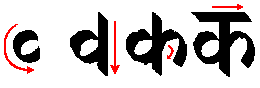
 Myanmar script is one of the easiest to write by hand. As an example see how
easy it is to write the Myanmar first character
{ka.} compared to writing क «ka». See writing
sequence of Devanagri by hand taken from:
Myanmar script is one of the easiest to write by hand. As an example see how
easy it is to write the Myanmar first character
{ka.} compared to writing क «ka». See writing
sequence of Devanagri by hand taken from:
-
http://nt.med.ncku.edu.tw/biochem/lsn/Pali/Devanagari/pali-devanagari-map.htm
070210
(no longer available0
Contents of this page
UKT 200716, 200826:
Since Hindi-Devanagari or Hindi is internationally more well-known than
Bur-Myan, it is
fitting that I should say something about Hindi-Dev to compare it with
Burmese-Myanmar language and script.
The comparison to be made is strictly structural and you should forget about the
wide phonetic dissimilarity. See:
• Unicode Standard, Version 4.0, chapter 9
http://www.unicode.org/versions/Unicode4.0.0/ch9.pdf , and
• Unicode Standard, Version 4.0, chapter10,
http://www.unicode.org/versions/Unicode4.0.0/ch10.pdf .
I have based most of the materials on Devanagari on these chapters.
A number of files from Unicode Consortium on
Unicode Standard Version 4.0 in HTML format are in the TIL archives, and you may
look into them without going on-line. The materials in this paper are from TIL archives: The
Unicode Standard, Version 4.0, chapter 9.
UKT: The material from the Unicode Standard ver. 4, had led me astray because of
its terms: "dependent vowels" and "independent vowels". In the following I am
using the terms "vowel-signs" and "vowel-letters".
Each consonant letter represents a single
consonantal sound but also has the peculiarity of having an
inherent vowel
{mwé-hkän-þa.ra.}, generally the short vowel /a/ in Devanagari and the other Indic scripts. Thus
क U0915 [ka] represents /ka/ and not just /k/. क «ka» is a
syllable and not just a letter. Being a syllable क «ka» can be pronounced,
however the English-Latin letter <k> can not be pronounced. In the presence of
a vowel-sign, however, the inherent vowel
{mwé-hkän-þa.ra.} of
the consonant is overridden by the vowel-sign  {þa.ra.þín~ké.ta.}.
UKT: This is the equivalent of:
{ka.} +
 {i.}-sign -->
 {ki.}
{ki.}
Contents of this page
See also -
https://en.wikipedia.org/wiki/Nasalization 200917
"In phonetics, nasalization (or nasalisation) is the production of
a sound while the velum is lowered, so that some air escapes through the nose
during the production of the sound by the mouth
[citation
needed]. An archetypal nasal sound is
[n]."
UKT: IPA transcriptions are my additions from DJPD16.
The inherent vowel (in fact most of the vowels) can be nasalised by placing a
 {thé:thé:ting}, with the sign
 ,
above a consonant. In Pali-Myanmar, this sign is known as
,
above a consonant. In Pali-Myanmar, this sign is known as
 {naig~ga.hait}. This sign corresponds to chandrabindu of the Devanagari.
UKT: I was not sure to what Myanmar diacritic Anusvara do correspond
until I came across an unequivocal statement in Wikipedia:
" In the Burmese alphabet, the anusvara is represented as a dot underneath
a nasalised final to indicate a creaky tone (with a shortened vowel)." --
Wikipedia
Anunaasika (anunāsika), also called 'chandrabindu' ("moon and
dot"), is a dot on top of a breve above a letter (मँ)
[UKT:
 {män}],used as a diacritic in Sanskrit and other Indo-Aryan languages written
in Devanagari script to represent vowel nasalization. When transliterated, it is
represented with a tilde above the letter ( ~ ). -- Wikipedia
{män}],used as a diacritic in Sanskrit and other Indo-Aryan languages written
in Devanagari script to represent vowel nasalization. When transliterated, it is
represented with a tilde above the letter ( ~ ). -- Wikipedia
UKT: Don't be led astray by the word 'chandrabindu'. It can be
transliterated to {san~da bain~du.}, which can be split up:
{sûn~da}
 /|san da|/ - n. moon. (Pali:
{san~da.}) -- MEDict124
/|san da|/ - n. moon. (Pali:
{san~da.}) -- MEDict124
{bain~du.}
 /|bein du.|/ - n. 3. dot superposed on vowels to give the /|am|
|eim| |oum|/ sounds. (Pali:
{bain~du.}) -- MEDict315
/|bein du.|/ - n. 3. dot superposed on vowels to give the /|am|
|eim| |oum|/ sounds. (Pali:
{bain~du.}) -- MEDict315
[cando] - the moon. (R. C. Childers, Dictionary of the Pali
Language, Regan Paul, Trench, Trubner & Co., London, 1909, p.099)
UKT: Childers gave the word in Pali-Devanagari, and the first akshara is
च (U091A).
The difference the sounds of word for <moon> is simply because the r2c1 in
Burmese-Myanmar is
 {sa.}
and in Hindi-Myanmar
{sa.}
and in Hindi-Myanmar
 {kya.} or च (U091A). Since, English pronunciation of
{kya.} sounds more like <ch> as in English <church>, the word {san~da}
eventually becomes "chandra". (Point to be checked with my peers.)
{kya.} or च (U091A). Since, English pronunciation of
{kya.} sounds more like <ch> as in English <church>, the word {san~da}
eventually becomes "chandra". (Point to be checked with my peers.)
The following is from:
www.garretwilson.com/education/languages/hindi/devanagari/lesson5/candrabindu.html
IPA transcription is from DJPD16.
Candrabindu (the first letter makes the same sound as, "champion")
is a sign written above a vowel to indicate that the vowel is nasalized
(Snell,
11).
UKT: Snell, R. and Weightman, S., Teach Yourself Hindi, NTC
Publishing Group, Lincolnwood, Illinois, USA, 1992.
When discussing the consonants म , "ma," and
न, "na," I [G. Wilson]
stressed the fact that these letters are always nasal —
to pronounce these two letters, you must force air up through the nose.
Most of the Devanagari vowels can either be nasalized or unnasalized. To
see the difference, first say the English word, <hawk> /hɔːk
(US) hɑːk/. Now, say the English word, <honk> /hɒŋk
(US) hɑːŋk/. Say them together: "hawk honk."
The difference is that in the first word, <hawk>, virtually no air is
forced up through the nose. However, with <honk>, you instinctively allow
much of the breath to pass through your nasal cavities. Thus, the "aa" sound
in <honk> is nasalized, while it is not in <hawk>.
Don't think that nasalization simply means the presence of the letter <n>,
because the vowel in <honk> /hɒŋk (US) hɑːŋk/
is nasalized without pronouncing the <n> at all. I
simply provide the word for you to practice making a nasalized, "aa" sound. In
fact, you should be able to pronounce the first part of <honk>
without pronouncing <nk> at all (that is, without your tongue ever touching
the top of your mouth) and still be able to hear the difference between the
sounds of the nasalized and unnasalized vowel sound. A nasalized vowel does
not mean that you end it by making the English, <n> sound with your
tongue.
A nasalized vowel, then, sounds exactly like the normal vowel except that
air is forced through the nose. To indicate a nasalized vowel, the sign
ँ,
or candrabindu is placed above the horizontal line from which the
vowel "hangs." Thus, if the vowel of our two English words were to be
transliterated into Hindi, the words would appear as "h
 k"
and "h
k"
and "h nk,"
which means that the maatraa
,
"aa," has been nasalized by adding a candrabindu, making
.
nk,"
which means that the maatraa
,
"aa," has been nasalized by adding a candrabindu, making
.
UKT:
<hawk> /hɔːk (US) hɑːk/ -- rendition into Devanagari:
हा
<honk> /hɒŋk (US) hɑːŋk/ -- rendition into
Devanagari: हाँ
Contents of this page
Devanagari virama - adapted from: Unicode
Standard, Version 4.0, chapter 9
http://www.unicode.org/versions/Unicode4.0.0/ch9.pdf
Devanagari employs a sign known in Sanskrit as the
virama [UKT: which I
usually shorten to "viram"] or vowel omission sign
to "kill" the inherent vowel. In Hindi it is called hal or halant,
(Tamil pulli), and that term is used in referring to the virama
or to a consonant with its vowel suppressed by the virama; the terms are
sometimes used interchangeably.
The virama sign, ्
U094D [Sign Virama], nominally serves to cancel (or kill) the inherent vowel of the consonant to
which it is applied. When a consonant has lost its inherent vowel by the
application of virama, it is known as a dead consonant; in contrast, a
live consonant is one that retains its inherent vowel or is written with an
explicit vowel-sign. In the Unicode Standard, a dead consonant is
defined as a sequence consisting
of a consonant letter followed by a virama. The default rendering for a dead
consonant is to position the virama as a combining mark bound to the consonant letterform.
Myanmar, like Devanagari employs the
virama sign. It is known as
{a.þût}.
The sign itself
 is likened to a flag or streamer
 {tän-hkwun}. In the examples below, I will be showing the equivalents in Myanmar.
Both Burmese and Pali use the same Myanmar akshara-matrix, and the function of
{a.þût} is the same. However the difference came in, in the choice of which
akshara is to be killed. Since the two languages are not the same, the words and
their pronunciations are different. This is similar to (but not quite) the
difference found between English and French. Thus the name of the U.S. city
<Chicago> which itself is derived from Amerindian (or that of the First Nations
of America) is pronounced differently by the Canadians with a /ʃ/ (as in
"ship"), and by the Americans with a /ʧ/ (as in "chip"). The Bur-Myan should
have pronounce it with a /{hkya.}/ as in
{tän-hkwun}. In the examples below, I will be showing the equivalents in Myanmar.
Both Burmese and Pali use the same Myanmar akshara-matrix, and the function of
{a.þût} is the same. However the difference came in, in the choice of which
akshara is to be killed. Since the two languages are not the same, the words and
their pronunciations are different. This is similar to (but not quite) the
difference found between English and French. Thus the name of the U.S. city
<Chicago> which itself is derived from Amerindian (or that of the First Nations
of America) is pronounced differently by the Canadians with a /ʃ/ (as in
"ship"), and by the Americans with a /ʧ/ (as in "chip"). The Bur-Myan should
have pronounce it with a /{hkya.}/ as in
 {hkyic}
if they were to follow the American way. However they opt to do it differently
and pronounce it with a
{hkyic}
if they were to follow the American way. However they opt to do it differently
and pronounce it with a
 {hkyi.ka-go}.
The difference in pronunciation between Bur-Myan and Pal-Myan
is reflected in which akshara are allowed to be killed. The number of allowable
in Bur-Myan is 10 which is far less than that in Pal-Myan where 26 are allowed
to be killed. See Myanmar Thuddar {mrûn-ma þûd~da}, Vol. 2-5,
by MLC,
publ. ca. 1986.
Unicode used the following convention in examples for encoding.
For a consonant C
Cn , denotes "normal" the normal akshara-character with the
inherent vowel,
Cl , denotes "live", the same as "normal", and
Cd , denotes "dead"
consonant form with the inherent vowel killed.
Encoding sequence: U0924 + U094D . Type in U0924 and without putting in
the white-space, type in U094D.
Tan + viram --> Td -- Unicode
UKT: Unicode subscripts "n" for "normal" in "Tan", and "d" for "dead"
in "Td" are redundant.
"Ta" itself suggests it is normal (with the inherent vowel "a"), and "T" without
the "a" shows that it is "dead".
त [Ta] + ् (viram) --> त्
[T]
 {ta.}
+
(viram)
-->
{ta.}
+
(viram)
-->
 {t}
{t}
Note:
{ta.}
is pronounceable , whereas
{t} is mute. Notice the presence of
{tän-hkun}]
Using the same line of construction, we have:
Encoding sequence: U0915 + U094D
Kan + viram --> Kd -- Unicode
क [Ka] + ् (viram) --> क् [K]
{ka.} +
(viram)
-->  {k}
[mute] -- Note the presence of
{tän-hkwun}
{k}
[mute] -- Note the presence of
{tän-hkwun}
Contents of this page
Devanagari conjuncts
The problem of Burmese-Myanmar horizontal ligatures.
UKT: We need to redefine: conjunct,
consonant-cluster,
ligature (ligate), and
medial.
You will see two kinds of conjuncts in Bur-Myan:
1. horizontal conjuncts, e.g.
 {þ~þa.} [mute].
{þa.kri:} /|tha. gji:|/
 - n. name of the symbol of double
 {þa.}.
-- MEDict484
{þa.}.
-- MEDict484
2. vertical conjuncts, e.g.
 {kka.} [mute].
{pàHt-hsing.} /|pa' hsin.|/
 - n. subscripted letters in Pali. -- MEDict272
Though vertical conjuncts are easily identified in Bur-Myan, horizontal
conjuncts such as
{þ~þa.}, are generally mistaken to be just simple aksharas. I, at a time when I
was beginning to study the Bur-Myan akshara-system of writing, happened
to ask a Bur-Myan monk (in Canada) how to pronounce
{þa.kri:}, and his reply was that it was similar to that of
{þa.},
only with a heavier tone. He did not know it was mute!
Adapted from: Unicode Standard, Version 4.0, chapter 9
http://www.unicode.org/versions/Unicode4.0.0/ch9.pdf
The Indic scripts are noted for a large number of
consonant conjunct forms that serve as orthographic
abbreviations (ligatures) of two or more adjacent letterforms. This abbreviation
takes place only in the context of a consonant cluster. An "orthographic
consonant cluster"
is defined as a sequence of characters that represents one or more dead consonants
(denoted Cd ) followed by a normal, live consonant letter (denoted Cl ).
UKT: Unicode subscript "n" for "normal" is enough to indicate that it is "live",
and so the use of subscript "l" is confusing. That is Cn = Cl .
In the Unicode Standard, under normal
circumstances, a consonant cluster is depicted with a conjunct glyph if such a
glyph is available in the current font(s). In the absence of a conjunct glyph,
the one or more dead consonants that form part of the cluster are depicted using
half-form glyphs. In the absence of half-form glyphs, the dead consonants are
depicted using the nominal consonant forms combined with visible virama signs:
Encoding sequence: U0915 + U094D + U0915
Kad + Kal --> K.Kan -- Uncode
क् [K] + क [Ka] --> क्क
[KKa]
{k}
+
{ka.}
-->
{k~ka.}
[mute - notice the absence of
{tän-hkwun}]
The following is from: D. Vujastyk, 25 June 1996
http://www.ucl.ac.uk/~ucgadkw/members/transliteration/translit.pdf. See
downloaded file.

 {pa.} +
{pa.} -->
{pa.pa.}
{pa.} +
{pa.} -->
{pa.pa.}
{pa.} +
viram -->
 {p} [mute]
{pa.} +
{p} -->
{pûp} sounds similar to <pup>
{p} +
{pa.} -->
{p~pa.} [mute]
{p~pa.} is a horizontal ligature, not allowed in Bur-Myan: it is
written as a vertical ligature,
 {p~pa.}
[mute].
{p~pa.}
[mute].
However, a horizontal ligature is allowed in Devanagari:
प [Pa] + ् viram --> प् [P]
प् [P] + प [Pa] --> प्प [PPa]
A similar situation is met in Myanmar ligates or
consonant clusters. For example:
{ka.} +
viram -->
{k}
[mute]
{k} +
{ka.} -->
{k~ka.}
[mute] -- vertical ligature
This ligate is found in the Bur-Myan word for "university"
 {tak~ka. thol}.
Note that in
{k~ka.}
{tän-hkwun} or
the
{a·þut}-sign,
,
is hidden. Bur-Myan ligates are generally vertical.
{tak~ka. thol}.
Note that in
{k~ka.}
{tän-hkwun} or
the
{a·þut}-sign,
,
is hidden. Bur-Myan ligates are generally vertical.
However, there are some horizontal ligates:
 {pyiñ~ña} (meaning 'education') -- derived from:
Note:
{pyiñ~ña} does not have a <y> after <p>. This <y> is the sound of {ya.ping.}
- the palatalization sound which is very difficult for IE speakers. I
suspect it is due to
the highly nasal sound of {ña.}. This is only a tentative conclusion: it
must be further
checked. -- UKT121126
 {paiþ~þa} (a unit of weight, approx. = 1.6 kg) -- derived from:
Apology: I have been writing
as
{pyiñ~ña}, however, I am finding that it is not satisfactory and would have to
change it. But how?
{pyiñ~ña} would be pronounced as {pa.Ña} if it were not a ligature. So also,
without the ligature,
{paiþ~þa} might be pronounced as {pi.þa}.
The correct spelling in Bur-Myan for
 in Romabama is
{pyiñ~ña}, NOT {pa.Ña}. Similarly, the correct spelling for
is
{paiþ~þa}, NOT {pi.þa}. Because of the unique shape of Tha-major
{þha.kri:}, it can
be easily identified as a ligature. However, the shape of
,
seems to be made up of ordinary {pa.} and {Ña}, and we have no way of
telling that it is ligature. To indicate that it is a ligature,
would a ~ would do? But what about the sound /j/
-- the {ya.þut} sound? Moreover, whatever
that I am going to write must be in ASCII.
To solve this problem tentatively, I am changing the
spelling to {pa.Ña}, noting that when r2 consonants
are involved, there is the
in Romabama is
{pyiñ~ña}, NOT {pa.Ña}. Similarly, the correct spelling for
is
{paiþ~þa}, NOT {pi.þa}. Because of the unique shape of Tha-major
{þha.kri:}, it can
be easily identified as a ligature. However, the shape of
,
seems to be made up of ordinary {pa.} and {Ña}, and we have no way of
telling that it is ligature. To indicate that it is a ligature,
would a ~ would do? But what about the sound /j/
-- the {ya.þut} sound? Moreover, whatever
that I am going to write must be in ASCII.
To solve this problem tentatively, I am changing the
spelling to {pa.Ña}, noting that when r2 consonants
are involved, there is the
 {ya.ping.} sound.
Some Devanagari consonant letters have
alternative presentation forms whose choice depends upon neighbouring consonants.
This variability is especially notable for र U0930 «ra» (the correspondant
of
 {ra.}), which has numerous different forms,
both as the initial element and as the final element of a consonant cluster.
{ra.}), which has numerous different forms,
both as the initial element and as the final element of a consonant cluster.
A similar change in shape or
form is found in Bur-Myan. The consonant
{ra.} changes to
 {ra.}-footless when
conjoined with:
{ra.}-footless when
conjoined with:
 {wa.} to form
 {rwa.}
 {ha.}
to form
{ha.}
to form
 {rha.}.
{ra.} ,
{ha.} and
{wa.},
to form
 {rhwa.}.
UKT 201008: Note
{rha.} is pronounced as /ʃ/ as in <ship>
/ʃɪp/, and
{rhwa.} as <shwa>. Both are objectionable,
because
{ra.} sound cannot become <sh> under any
circumstance. Romabama has to adopt a new basic
consonant
 {Sa.}/
 {S}. And accept
 {sha.}: it is not a case of
 .
There is no confusion between
{Sa.}/
{S} (Dental-fricative), and
{sa.}/
.
There is no confusion between
{Sa.}/
{S} (Dental-fricative), and
{sa.}/
 {c} (Palatal-stop), when we take the killed consonants
into consideration. Also I cannot change
{ca.}/
{c}, because we are so used to write English
Alphabet-Letter s as
{sa.}. Looking closely we find we are considering
row#2 to be Palatal-stops, where as English, Mon,
and Sanskrit row#2 is Palatal-affricates.
{c} (Palatal-stop), when we take the killed consonants
into consideration. Also I cannot change
{ca.}/
{c}, because we are so used to write English
Alphabet-Letter s as
{sa.}. Looking closely we find we are considering
row#2 to be Palatal-stops, where as English, Mon,
and Sanskrit row#2 is Palatal-affricates.
Contents of this page
Medial
 {kra:þän} lit. "middle sound"
UKT 081102, 201008
Unable to find a suitable term for intermediate sounds that result from
the combination of a stop-consonant and an approximant, I've defined it as a
medial. See: Burmese Grammar 1899 -
https://www.tuninst.net/BurGram1899/BG1899-1/ch04-2/ch04-2.htm 201007
"UKT: A consonant combined with
another consonant is a conjoined consonant or "conjunct". There are
two types of conjuncts: those that are mute and those that can be
pronounced. The pronounceable conjuncts are called medials [
{kra:þän} lit. "middle sound"] where the second consonant is always an approximant.
-
Nov 2, 2008 "
UKT 201007: As a research scientist, I'm ashamed to
quote myself. It seems the Burmese language has been neglected for so long,
no one seem to have noticed that we have a class of sounds which no one have
noticed. I am surprised to find in IPA /ʰ/ /ʲ/ /ʳ/ /ʴ/ /ʷ/ /ʸ/ . No
wonder my American friends could not pronounce my name KYAW forcing me to
adopt what they could easily do: JOE.
By medials, we usually mean
those formed from a consonant, with
an approximant,
 {ya.},
{ra.},
{wa.},
{ha.}, singly, doubly or triply. They are monosyllabic. Though they may
belong to the general group of Conjuncts, not all conjuncts are medials.
Conjuncts are disyllabic. This distinction is lost in Skt-Dev, which
has literally hundreds if not thousands of conjuncts. When a Sanskrit or Hindi
speaker pronounces a Bur-Myan medial like my name KYAW, they break-up the medial
{kya.} into a conjunct by adding a schwa and produce disyllabic
{ya.},
{ra.},
{wa.},
{ha.}, singly, doubly or triply. They are monosyllabic. Though they may
belong to the general group of Conjuncts, not all conjuncts are medials.
Conjuncts are disyllabic. This distinction is lost in Skt-Dev, which
has literally hundreds if not thousands of conjuncts. When a Sanskrit or Hindi
speaker pronounces a Bur-Myan medial like my name KYAW, they break-up the medial
{kya.} into a conjunct by adding a schwa and produce disyllabic
 {ka.ya.} /kəya/ .
Mon-Myan also has conjuncts which are call Hanging consonants
 {hswè:bæÑ:} such as
 {k~na.} (Mon-version:
 ),
and
),
and
 {k~ma.}. Mon speakers pronounce
{k~na.} and
{k~ma.} as disyllabics. Through such a process of conjunct-formation a large
number of conjuncts is possible on paper. These we will refer to as
orthographic. However, most of them are mute because the human vocal apparatus may
not be able to articulate them. A relatively smaller number formed with
approximants, known as medials, are pronounceable, because the vocal apparatus
can cope with the orthographic arrangement. Thus the number of medials allowed is restricted.
In other words almost all Devanagari conjuncts are mute.
{k~ma.}. Mon speakers pronounce
{k~na.} and
{k~ma.} as disyllabics. Through such a process of conjunct-formation a large
number of conjuncts is possible on paper. These we will refer to as
orthographic. However, most of them are mute because the human vocal apparatus may
not be able to articulate them. A relatively smaller number formed with
approximants, known as medials, are pronounceable, because the vocal apparatus
can cope with the orthographic arrangement. Thus the number of medials allowed is restricted.
In other words almost all Devanagari conjuncts are mute.
त «ta» + ् viram --> त् «t»
त् «t» + र «r» --> त्र «tra» : same as
 {ra.ric} formation
{ta.}
+ viram + {ra.}
-->
 {tra.}
{pa.} +
{ra.}
-->
{pa.} +
{ra.} --
 {pra.}
Skt-Dev has two special conjuncts, which I'm calling Pseudo Kha and
Pseudo Za.
क «ka» + ् viram --> क् «k»
क्
«k» + ष «ṣa» --> क्ष «kṣa» -
Pseudo-Kha
ज «ja» + ् viram --> ज् «j»
ज् «j» + ञ «nya» --> ज्ञ «jnya» - Pseudo-Za
UKT 121126, 201008: क्ष «kṣa» is not present in
Bur-Myan because of the absence of the highly hissing or hushing sounds or
sibilants /s/ in Bur-Myan.
What Bur-Myan has is the non-hissing sound or thibilant represented by
{þa.} /θ/. These sounds are produced with lots of friction, and are called
fricatives

 {pwut-teik þän}. Because of need, Romabama has in adopt two new basic aksharas:
 {sha.}/
 {sh} (husher), and
{Sa.} ष /
{S} ष् (hisser).
{sh} (husher), and
{Sa.} ष /
{S} ष् (hisser).
I have
used the same glyph
{Sa.} in
the onset of syllables with
{SS} in the coda. क्ष «kṣa» is used in place of
{hka.} in
many Skt-Dev words. Because of this usage, I have termed it as the Pseudo-Kha.
Similarly, because ज्ञ «jnya» corresponds to Bur-Myan
 {Za.}, and also to Mon-Myan
 ◄zya.► [I still need confirmation from Mon speakers] , I'm calling it Pseudo-Za. See:
Section 7 Sanskrit
◄zya.► [I still need confirmation from Mon speakers] , I'm calling it Pseudo-Za. See:
Section 7 Sanskrit
 {þän-SkRRi.ta.} dictionaries,
- for Pseudo-Kha क्ष «kṣa»:
MCpp-indx.htm >
 MC077F.htm
- for Pseudo-Za ज्ञ «jnya»:
MCpp-indx.htm >
 MC103-1.htm
It is noteworthy that the traditional Sk-Dev akshara alphabetic encoding order for consonants follows articulatory phonetic
principles, starting with velar consonants
and moving forward to bilabial
consonants, followed by liquids and then fricatives. ISCII and the Unicode
Standard both observe this traditional order.
Contents of this page
- UKT 200716
Most of my sources would just say that every consonant or consonantal
akshara-character contains an inherent vowel
{mwé-hkän-þa.ra.} "similar" to English 'short a'. Of
course, none exactly knows what a Bur-Myan "inherent vowel" sounds like:
/a/, /æ/ or /ə/. Is it the same in Mon-Myan. Since, Mon pronounces the
Ka'gyi-Kha-gwé differently, Bur-Myan inherent vowel
{mwé-hkän-þa.ra.} cannot be exactly like that of the Mon. Moreover, Mon-Myan seems
to have 2 kinds of inherent vowel
{mwé-hkän-þa.ra.}. Listen to Maraban dialect of Mon-Myan:
row#1:
{ka.},
{hka.},
 {gé},
{gé},
 {hké},
 {gné} - row1Mon<)) (link chk
200716
{gné} - row1Mon<)) (link chk
200716
Note: r1c5 Bur-Myan
 {gna.} has become
{gné} in Mon-Myan. Bur-Myan seems to have adopted
{gné} - now written as
{gna.} has become
{gné} in Mon-Myan. Bur-Myan seems to have adopted
{gné} - now written as
 {gnra.} to substitute
 {Ña.} in certain words like

 {ngra-þän}
 {krau-ngra}.
The problem also lies in the nature of the
English vowels which are pronounced slightly different from country to country,
from ethnic group to ethnic group, and also from age-group to age-group. Up to
this moment, the most I can come up is to refer to the vowel quadrilateral shown
on the right and say that the Burmese-Myanmar inherent vowel seems to have the
sound of any of the three English vowels: /a/ /æ/ or /ə/.
What about the Sanskrit-Devanagari "inherent vowel"?
According to Omniglot -
www.omniglot.com/writing/sanskrit.htm, 200925
the inherent vowel is /ʌ/ and क
[ka] has the sound /kʌ/.
UKT: Note the IPA vowel for the "inherent vowel" in
• अ (U0905) [a] /ʌ/ --
 {a.}
{a.}
• आ (U0906) [ā] /aː/ --
 {a}
{a}
Omniglot-author seems to take the inherent vowel to be /ʌ/ (a back-vowel)
and then for the next vowel to be /aː/ (a front-vowel). If
you are to refer to the vowel-trapezoid given above, it does not seem to be
exactly right. However, since I know next to nothing of Sanskrit, I could be
dead wrong.
Go back in-vow-b
Contents of this page
ligate
The word "ligate" is a verb. (ligate v. tr. ligated ligating
ligates 1. To tie or bind with a ligature. -- AHTD)
Though "ligate"
has no noun form I will be using it as a noun -- the product of tying together.
-- UKT
Go back ligate-b1 ligate-b2
ligature
n. 1. The act of tying or binding. 2. A cord, wire, or
bandage used for tying or binding. 3. A thread, wire, or cord used in
surgery to close vessels or tie off ducts. 4. Something that unites; a
bond. 5. A character, letter, or type, such as æ , combining two
or more letters. 6. Music a. A group of notes intended to
be played or sung as one phrase. b. A curved line indicating such a
phrase; a slur.
v. tr. ligatured ligaturing ligatures 1. To ligate. [Middle
English from Old French from Late Latin ligātūra from Latin ligātus,past
participle of ligāreto bind; See leig- in Indo-European Roots.] -- AHTD
Go back ligature-b
Contents of this page
UKT 200826
The following meaning from AHTD does not convey
fully the meaning of Magic square { ín:}
Magic square - n. 1. A
square that contains numbers arranged in equal
rows and columns in such a way that the sum of
each row or column, taken vertically, horizontally,
or diagonally, is the same. -- AHTD
Read an interesting account on Magic squares
in occultism in Wikipedia:
https://en.wikipedia.org/wiki/Magic_square
200826
"Magic squares of order 3 through 9,
assigned to the seven planets, and described as
means to attract the influence of planets and
their angels (or demons) during magical
practices, can be found in several manuscripts all
around Europe starting at least since the 15th
century."
Also look into
https://en.wikipedia.org/wiki/Kamea 200826
[UKT: a magic square is also known as Kamea .]
Also read
https://en.wikipedia.org/wiki/Yantra 200826
"Yantra (Skt:
यन्त्र
= य न ् त ् र ,
lit "machine, contraption"
[1])
is a mystical diagram, mainly from the
Tantric traditions of the
Indian religions.
Now go to 5.4.
Myanmar Religions: Organized and Folk, and look into
- Folk Elements in Buddhism -
flk-ele-indx.htm ,
and go to 05.01. Cult of Runes : part of ch05-magus.htm
(link chk 200826)
Go back magi-sq-note-b
Contents of this page
UKT 200826
"The cult of magic and witchcraft originally included also
the cult of the runes. The runes consisted of magical squares containing either
letters of the Burmese alphabet or arithmetical figures, and it is believed that
every potent rune is guarded by a guardian (god, goddess, demons, etc.).
 For reasons which are not known,
the cult of the runes suddenly regained its popularity in the fifteenth century,
when it took over many ideas from the Cult of Alchemy
For reasons which are not known,
the cult of the runes suddenly regained its popularity in the fifteenth century,
when it took over many ideas from the Cult of Alchemy
 {ag~gi.rût}. Instead of experimenting
in either iron or mercury in high temperature furnaces, the follower of the cult of the runes experiments in
casting square after square until he discovers the right squares.
{ag~gi.rût}. Instead of experimenting
in either iron or mercury in high temperature furnaces, the follower of the cult of the runes experiments in
casting square after square until he discovers the right squares.
When he has
discovered the right square he has to go through a final process; either, like the
alchemist, he is buried underground for seven days, or he is burnt in a fire for
three nights. Then he emerges as a Zawgyi
 {zau-gyi} or 'a successful alchemist'.
A Zawgyi
{zau-gyi} or 'a successful alchemist' is immune from injury and death for a long
time. He has all the powers he needs: he can fly through the air, and can travel
underground. But he has to pay dearly for his positive attributes.
{zau-gyi} or 'a successful alchemist'.
A Zawgyi
{zau-gyi} or 'a successful alchemist' is immune from injury and death for a long
time. He has all the powers he needs: he can fly through the air, and can travel
underground. But he has to pay dearly for his positive attributes.
 He can no longer live together with other humans, and he is not free from the
common attributes of man. He is still prone to Greed, Anger, Sex, and Pride. He
thus has to live in the forest alone. When he has the need for sex, he
has to search for a tree that bears fruits in the shape of human females; some
ugly and some beautiful. He would pluck a beautiful fruit and give it life to
turn into a beautiful fruit maiden. However such trees are rare, and a perfectly
beautiful fruit is rarer. And of course, there are fights between
{zau-gyi} for the same fruit-maiden. And then, being a fruit she would ripen and
eventually rot. There are also stories of Zawgyi
{zau-gyi} mating with a female Naga
He can no longer live together with other humans, and he is not free from the
common attributes of man. He is still prone to Greed, Anger, Sex, and Pride. He
thus has to live in the forest alone. When he has the need for sex, he
has to search for a tree that bears fruits in the shape of human females; some
ugly and some beautiful. He would pluck a beautiful fruit and give it life to
turn into a beautiful fruit maiden. However such trees are rare, and a perfectly
beautiful fruit is rarer. And of course, there are fights between
{zau-gyi} for the same fruit-maiden. And then, being a fruit she would ripen and
eventually rot. There are also stories of Zawgyi
{zau-gyi} mating with a female Naga

 {na.ga:ma.} (who can put on the figure of a human-female) who would lay eggs
from which humans would hatch.
{na.ga:ma.} (who can put on the figure of a human-female) who would lay eggs
from which humans would hatch.
When the
cult regained its popularity in the fifteenth century it had disassociated
itself entirely from the cult of black-magic and witchcraft
( {auk lum:} -- literally: the Lower Path) and, in addition, it had hidden its
origin under the cloak of devotion to Buddhism. It portrays itself as
white-magic
{auk lum:} -- literally: the Lower Path) and, in addition, it had hidden its
origin under the cloak of devotion to Buddhism. It portrays itself as
white-magic

 {a·htak lum:). This explains why a
follower of this cult has now to keep the Eight or Ten Precepts and abstain from
eating any meat while he is casting the runes. Usually he goes into retreat for
a period of forty-nine days before casting a rune or a series of runes."
Adapted from: Folk Elements in Burmese Buddhism by Maung Htin Aung,
Religious Affairs Department Press, Yegu, Kaba Aye P.O., Rangoon, Burma, 1981.
{a·htak lum:). This explains why a
follower of this cult has now to keep the Eight or Ten Precepts and abstain from
eating any meat while he is casting the runes. Usually he goes into retreat for
a period of forty-nine days before casting a rune or a series of runes."
Adapted from: Folk Elements in Burmese Buddhism by Maung Htin Aung,
Religious Affairs Department Press, Yegu, Kaba Aye P.O., Rangoon, Burma, 1981.
Go back magi-pow-note-b
Contents of this page
UKT 200827
Rune - n. 1. a. Any of the characters in
several alphabets used by ancient Germanic peoples from the 3rd to the 13th
century. b. A similar character in another alphabet, sometimes believed
to have magic powers. 2. A poem or an incantation of mysterious
significance, especially a magic charm. [Possibly Old Norse or Old English r¿n] - AHTD
Go back rune-note-b
Contents of this page
The consonants in languages derived from Brahmi have an inherent vowel
resembling a short English <a>. Under certain circumstances, this inherent
vowel has to be removed or "killed". The sign used is known as a.
{a·thut} in Burmese-Myanmar
or virama in Sanskrit-Devanagari. In this text (e.g. CVÇ) the Ç
LATIN CAPITAL LETTER C WITH CEDILLA stands for a killed consonant.
Go back viram-b
Contents of this page
End of TIL file