p077F.htm
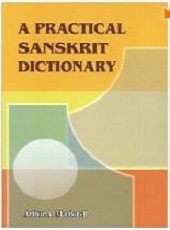
• A Practical Sanskrikt Dictionary,
by A. A. Macdonell, 1893,
http://www.sanskrit-lexicon.uni-koeln.de/scans/MDScan/index.php?sfx=jpg;
1929.
-
Nataraj ed., 1st in 2006, 2012.
-
https://dsal.uchicago.edu/dictionaries/macdonell/ 190516
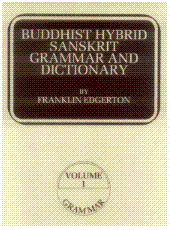
• The Buddhist Hybrid Sanskrit Grammar and
Dictionary, BHS, vol.2, by F. Edgerton,
pp. 627.
-
FEdgerton-BHSD<Ô> /
Bkp<Ô> (link chk 180627)
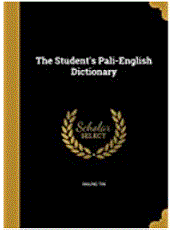
• The Student's Pali English dictionary ,
by U Pe Maung Tin, 1920.
- (ref: UPMT-PEDxxx).
Downloaded copies in TIL
HD-PDF and SD-PDF libraries:
-
UPMT-PaliDict1920<Ô> /
bkp<Ô> (link chk 190113)
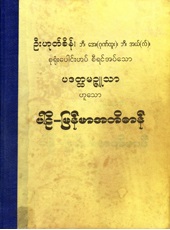
• Pali-Myanmar Dictionary
(in Pal-Myan), by U Hoke Sein,
- (ref: UHS-PMD). The dictionary in printed form is in TIL Research Library.
• Latin-English Vocabulary II, by Hans H Ørberg, 1998
-
HHOrberg-LinguaLatina<Ô> /
Bkp<Ô> (link
chk 190624)
Edited by U Kyaw Tun (UKT) (M.S., I.P.S.T., USA),
Daw Khin Wutyi, Daw Thuzar Myint, Daw Zinthiri Han
and staff of Tun Institute of Learning (TIL).
Not for sale. No copyright. Free for everyone.
Prepared for students and staff of TIL
Research Station, Yangon, MYANMAR
-
http://www.tuninst.net ,
www.romabama.blogspot.com
MC-indx.htm |
Top
MCpp-indx.htm
UKT 190216: See my note on Pseudo-Kha
{kSa.} क्ष
Skt-Dev has entries both with Pseudo-Kha and True-Kha , from p077F.htm , p078.htm , p079-1.htm ,
p079-2.htm , to p080.htm , whereas Pal-Lat (International Pali) has only the entries with True-Kha. To bridge the two,
I will have to look into ¤ The Student's Pali English dictionary , by U Pe Maung Tin, 1920. (ref: UPMT-PEDxxx).
Downloaded copies in TIL HD-PDF and SD-PDF libraries: Beginning pages:{ka.} p061,
{hka.} p080
- UPMT-PaliDict1920<Ô> / bkp<Ô> (link chk 190113)
{kSa.} :
 {kSa.Na.} :
Pal:
{kSa.Na.} :
Pal:
 {hka.Na.}
p077c3
 {kSa.ta.}
 {kSa.da.}
 {kSa.na.}
 {kSa.pa.}
 {kSa.ma.}
UKT 180129: This page is on "hanging fricatives" which is very foreign to Bur-Myan speakers. The word "fricatives", can mean either Sibilants or Thibilants. In Skt-Dev, there are three sibilants, the husher, the hisser, and what the speakers take as slightly hissing {þa.}. However, the Bur-Myan speakers recognize {þa.} as a Thibilant (without any hushing and hissing sound) similar to English <th> as in English "thin". Sanskrit and most modern Indic speakers cannot pronounce /θ/, which they pronounce as /s/.
By fricatives, we mean:
Skt-Dev: Husher श ś [ɕ] /ʃ/ ;
Hisser ष ṣ [ʂ] /s/; and hissing
sibilant स s [s] /s/.
BPal-Myan: Husher {Sha.} श /ʃ/;
Hisser {Sa.} ष /s/; and non-hissing thibilant
{þa.} स /θ/ .
UKT 180131: The special conjunct क्ष
is difficult to pronounce for me. My solution is to
equate it to Bur-Myan
{hka.}, adding a touch of /ʃ/. I use the same
method for transcription.
UKT notes :
• Jainism: the sky-clad and the white-clad
• Kstriya aka Khattiya
• Pseudo-Kha and True-Kha
• Shin Kicsi postulate : "The signification
is known by letters."
• Super-Tha'we'hto
{kSa.}*
*
{Sa.hswè:} 'hanging {Sa.}' formed with 'hanging
{Sa.}/
{S}' cf. Hanging consonants in Mon-Myan.
See my note on the conjunct formed with 'hanging{kSa.tRi.ya.} क्षत्रिय «kSatriya» the equivalent of Pal-Myan:
{hkût~ti.ya.} "the military class", whose "faith" is known as क्षत्रिय «kṣatriya darma», which reminds me of the Spartans of Ancient Greece: my childhood heroes.
{mín:myo:}, because anyone can become king, but still outside the
Many
The second unusual conjunct, the Pseudo-Za is in • जज्ञि [ gá-gñ-i ] = ज ज ् ञ ि 'a. germinating' which you'll meet on p098.htm .
p077c2-b18/ not online
• क्षण् [ kshan ]
- v. क्षन् [ ksan ]
UKT 190213: When
{kSa.} is followed by a "killed" consonant, the conjunct is sure to break down:
{k~Sa.} + viram + {Na.} --> {k·SûN}
{kSa.Na.}
: Pal:
{hka.Na.}
p077c2-b19/ p059-023
• क्षण [ kshan-a ]
= क ् ष ण
- m. (n1.) moment; opportunity; leisure; joyful moment, festival: -m,
for or in a moment; °--, in., ab. in a moment, immediately; lc. every moment;
kshanât--kshanât, at one moment - at another; kshanamkri, wait a moment; give
any one (g.) an opportunity (also dâ); -m labh, find an opportunity.
23)
© क्षण [ kshan-a ]
Skt: क्षण [ kshan-a ]
- m. (n1.) moment; opportunity; leisure;
joyful moment, festival: - Mac077c2
Pal:
{hka.Na.} - UHS PMD0342
- 
UKT from UHS: ¹. time-duration lasting a click of thumb, moment,
opportunity. ². m. digging
p077c2-b20/ p059-022
• क्षणदा [ kshana-dâ ]
- f. night: -kara, -krit, m. moon, -kara, m. night-walker,
Râkshasa; -drishta-nashta,
pp. appearing and disappearing in a moment.
22)
p077c2-b21/ p059-021
• क्षणन
[ kshan-ana ]
- n. hurting, wounding.
21)
p077c2-b22/ p059-020
• क्षणमात्र
[ kshana-mâtra ]
- n. only a moment: -m,
for a moment only, in. in a moment;
-vidhvamsin, a. collapsing
in a moment; -hîna, pp.
joyless.
20)
p077c3-b00/ p059-019
• क्षणान्तर
[ kshana‿antara ]
- n. space of a moment, little while:
lc. after a while, thereupon.
19)
p077c3-b01/ p059-045
• क्षणिक
[ kshan-ika ]
- a. (î) momentary:
-tâ, f., -tva,
n. abst. ɴ.; -in,
a. being at leisure.
45)
{kSa.ta.}
p077c3-b02/ p059-044
• क्षत [ ksha-ta ]
- pp. √kshan: â, f. violated girl; n. hurt, wound: -ga,
n. blood.
44)
p077c3-b03/ p059-090
• क्षति [ ksha-ti ]
- f. injury, loss, harm, damage, destruction: -mat, a. wounded.
90)
p077c3-b04/ not online
• [kshat-trí ]
- m. carver, distributor (of food); N. of various castes
p077c3-b05/ p059-072
• क्षत्र [ ksha-trá ]
- n. sg. & pl. dominion, power; powers that be; military (second) caste;
man of the second caste.
72)
p077c3-b06/ p059-071
• क्षत्रधर्म [ kshatra-dharma ]
- m. duty of the warrior caste; -dharman, a. fulfilling the duties of the
warrior caste; -bandhu, m. member of the second caste; -vidyâ,
f. science of the
warrior caste; -vriddhi, f. increase of military power.
71)
© क्षत्रधर्म
[kshatra-dharma]
Skt: क्षत्रधर्म
[kshatra-dharma]
- m. duty of the warrior caste;
- Mac077c3
BPal:
 {hka.tya.Dûm~ma.} - UHS PMD0344c1
UKT from UHS: duties of a
{hkût~ti.ya.}-king
See my note on Shin Kicsi postulate "The signification is known by letters."
p077c3-b07/ p059-062
• क्षत्रिय
[ kshatr-íya ]
= (क ् ष) (त ् र ि) (य)
- a. ruling; m. ruler;
man, â, f. woman, of the
military caste; n. sovereign
power, dominion: -‿anta-kara,
m. ep. of Parasurâma.
62)
© क्षत्रिय
[ kshatr-íya ]
Skt: क्षत्रिय
[ kshatr-íya ] - a.
ruling; m. ruler; man - Mac077c3
BPal:
{hkût~ti.ya.} - UHS PMD0343
UKT from UHS: mfn. ruler of
land & water, belonging to ruling
class, m. one who becomes king
{kSa.da.}
p077c3-b08/ not online
• क्षद्
[ kshad ]
- i. â. ksháda , carve;
slaughter
{kSa.na.}
p077c3-b09/ not online
• क्षन्
[ kshan ]
- viii. p. kshan-o , -u ,
hurt, wound; break; â. hurt or wound
oneself: pp kshatá , hurt,
wounded; broken, injured; destroyed;
violated.upa , pari , vi ,
pp. hurt, wounded
p077c3-b10/ not online
• क्षन्
[kshan]
- 3. pl. aor, √kshan
p077c3-b11/ p059-043
• क्षन्तव्य
[ kshan-tavya ]
- fp. to be forgiven: -m,
one should forgive some one (g.),
for (ab.).
43)
( end of old p077-2.htm )
{kSa.pa.}
p077c3-b12/ not online
•
क्षप्
[ kshap ]
- i. kshapa , practise abstinence
or mortification
p077c3-b13/ p059-042
• क्षप््
[ ksháp ]
- f. night.
42)
p077c3-b14/ not online
• [kshap-ana]
-¹. m. Buddhist or Jain mendicant; n. fasting, mortification;
². a.
destroying; m. destroyer; n. destroying; spending (time), waiting.
UKT 140414: Buddhist or Jain monks are not wanton destructionists. What they are destroying is their attachment to Greed, Anger, Sex, and Pride in their own body. They are therefore celibate, whereas the Hindus are for the family based on sexual relations. A praiseworthy wife to a Buddhist is one who is faithful to one husband, but to the Hindus, an example of a praiseworthy wife is Draupadi who was married to 5 men at the same time, giving birth a son for each husband.
p077c3-b15/ p059-041
• क्षपणक [ kshapana-ka ]
- m. mendicant (esp. naked Buddhist or Jain).
41)
See my note on Jainism: the sky-clad and the white-clad
Note that not all Jain monks are naked aka sky-clad
p077c3-b16/ p059-040
• क्षपणिक [ kshapan-ika ]
- m. boatman; a. destructive.
40)
p077c3-b17/ p059-039
• क्षपा [ kshap-&asharp; ]
- f. night: (â)-kara, -krit, m. moon; -kara,
m. night-walker, Râkshasa;
nocturnal beast or bird; -gala, m. night dew; -‿atyaya,
m. end of night,
day-break; -‿apaha, m. sun; -ramana, m. moon:
-sekhara, m. ep. of Siva;
-‿ardha, n. (?) midnight; -‿avasâna, n. end of night:
lc. on the morrow; -‿aha,
m. (?) day and night.
39)
p077c3-b18/ p059-038
• क्षपितव्य
[ kshap-i-tavya ]
- fp. to be spent (time).
38)
p077c3-b19/ p059-037
• क्षपेश [ kshapâ‿îsa ]
- m. moon.
37)
{kSa.ma.}
UKT 171121:
{kau:stu.Ba.} comes from
{Sta.} - the tenuis basic consonant. Note the position of
• √«kṣam»
- 'endure' - Whit028.
p077c3-b20/ not online
• [ ksham ]
- i. â. (p.) ksháma (iv. â. kshamya ), have patience; submit to (d.);
endure, put up with; pardon (g. or d. of person, ac. of thing); grant
anything (ac.) to (g.), allow to (pot.); show indulgence to
(ac.); be able to (inf.): pp. kahânta, patient; cs.
kahâmaya, ask any one's (ac.) pardon or indulgence for
(ac.)
p077c3-b21/ p059-036
• क्षम्् [ kshám ]
- strong base ksh&asharp;m, weakest kshm, earth.
36)
p077c3-b22/ p059-063
• क्षम [ ksham-á ]
- a. patient; enduring (--°); capable of, able to, equal to (in., lc.,
or --°);
endurable; suitable, useful, favourable (for, d., g., lc., inf., or --°;
inf. or --° after verbal ɴ.
having a passive sense): -tâ, f., -tva, n. capacity for, ability to (lc. or --°).
63)
p077c3-b23/ p059-060
• क्षमा [ksham-â]
- f. patience, forbearance, indulgence (towards, lc. or prati); tameness;
earth: -pati, m. king; -bhrit, m. mountain; king;
-mandala, n. orbis terrarum, whole earth; -liṅga‿âtma-pîdâ-vat, a. in which proof of
forbearance and loss on one's own part is
adduced (leg.); -vat, -sîla, a. patient, indulgent,
forbearing; compassionate.
60)
UKT 140414, 180129:
UKT 180129: With this note I remember my Jain friends in Deep River, Ont., CANADA in particular the Shars and Harshad Patal.
Hindu religionists being believers in Atta 'permanance' consider Buddhists and Jains to be their adversaries, because the latter would not believe in a creator. Since this is a Sanskrit dictionary, Macdonell has given the Hindu meanings. Here 'mendicant' means 'begger'. Little did the Hindus know (or care) that the Buddhist and Jain monks do not beg. They do a service to laity to earn merit by providing food. It is up to the laity to thank the monks!
mendicant - adj. 1. Depending on alms for a living; practicing begging. n. ¹. A beggar. ². A member of an order of friars forbidden to own property in common, who work or ³. beg for their living. - AHTD
UKT 110906, 180129 : The English word <mendicant> or <mendicant monk> applied to Buddhist and Jain clergy stems from the days the Westerner first coming into Burma and India. The Westerners had looked down on these holy men because they go on alms-round every morning. The <bowls> used for receiving alms were dubbed <begging bowls>. Little do the Westerner know that the monks are forbidden to beg. The monks receive the alms so that the laity can earn merit and it is the laity who has to thank the monk.
Another point I have to make is the Buddhist
monks must be fully clad, whereas the Jain
monks (in their parlance) are 'sky clad' and
are not 'naked'. Even then, there is another
sect of Jainism whose monks are clad in white
cloth: they are known as 'white clad' .
See Wikipedia:
-
https://en.wikipedia.org/wiki/%C5%9Av%C4%93t%C4%81mbara
180129
"The Śvētāmbara,
श्वेतांबर
or श्वेतपट
«śvētapaṭa» ... is one of the
two main sects of Jainism, the other
being the Digambara.
Śvētāmbara "white-clad"
is a term describing its ascetics'
practice of wearing white clothes, which sets
it apart from the Digambara
"sky-clad" Jainas, whose ascetic
practitioners go naked.
Śvētāmbaras, unlike Digambaras,
do not believe that ascetics must practice
nudity.
[1]
Śvētāmbaras also believe that women are able to obtain moksha. Śvētāmbaras maintain that the 19th Tirthankara, "ford-maker" Māllīnātha, was a woman.
Go back Jainism-note-b

UKT 151203, 160306, 171121, 180129:

You'll note that in • क ् ष
--> क्ष
{kSa.} /kə.sa/, we are running into
an unusual conjunct. This conjunct is
used in Skt-Dev for
© क्षत्रिय
[ kshatr-íya ] the equivalent of
Pal-Myan:
{hkût~ti.ya.} 'belonging to ruling class'.
Since only a few of this class becomes
kings and nobles ulers, and the majority becoming the
soldiers, this "class" should be
called the military, and the
{hkût~ti.ya.} are more properly defined as
'belonging to the military'. Their faith
is the Kshatriya dharma is the noble
"warrior faith" which reminds me
of the Spartans of Ancient Greece.
From: http://enacademic.com/dic.nsf/enwiki/758625 180129
Kshatriya dharma is the noble warrior faith. In earlier Hindu class system, there were four prevalent classes (varnas) namely :
# Brahmin (Hindu Priests)
# Kshatriya
# Vaishya
# Shudra.
Kshtariya were the Royal class which constituted of Kings, Nobles and Military Officers. They were the rulers and their dharma/ duty was to protect and govern cities across India.
Go back Ksatriya-note-b

UKT 140413, 171121, 180129, 190213:
Pseudo Kha क्ष = क ् ष , is used in many
Skt-Dev words in place of True Kha ख . It is a conjunct and
cannot be under virama
 {a.þût}. The hanging akshara
{Sa.}/
{S} is one of the three Skt-Dev fricatives, and is unknown in Bur-Myan and
Pali-Myan.
{a.þût}. The hanging akshara
{Sa.}/
{S} is one of the three Skt-Dev fricatives, and is unknown in Bur-Myan and
Pali-Myan.
Based on their abilities to impart the quality of "hissing"
{Sa.}/
{S}, and "hushing"
 {Sha.}/
 {Sh}, to other consonants, they may be reclassified as Approximants.
Since, it is going to be a major change to the Table of IPA (pulmonic for
BEPS) consonant table on the right, I'm waiting for input from my peers.
{Sh}, to other consonants, they may be reclassified as Approximants.
Since, it is going to be a major change to the Table of IPA (pulmonic for
BEPS) consonant table on the right, I'm waiting for input from my peers.
From the beginning of my
study of Skt-Dev, I have realized that
there are two special conjuncts one of which is
क्ष = क ् ष
{kSa.} (commonly written as «ksa») and it is used as a stand-in for Bur-Myan
{hka.}/
 {hk}. It is a source of confusion in
the name of an ancient city Pyu city Sri Ksetra
{hk}. It is a source of confusion in
the name of an ancient city Pyu city Sri Ksetra
 {þa.ré hkít~ta.ra} in Myanmarpré.
The first conjunct
{kSa.} क्ष = क ् ष
is a disyllabic conjunct.  {kya.}
(which cannot be under a viram)
formed from
{ka.}
and
{kya.}
(which cannot be under a viram)
formed from
{ka.}
and
 {ya.}.
UKT 190214: Note the terms monosyllabic and disyllabic are perceptional. It depends on your ability to pronounce with your mouth (or hear with your ear) it either as a single sound or as two sounds. All conjoined consonants are conjuncts, and all medials are listed under the term conjuncts. They all break open under a viram
First, I have to increase the number of Latin letters from 26 to 52 by getting rid of the distinction between capital and small letters. Still I need more.
I have to include Old English þ for <th> /θ/
{þa.}/
{þ}. Next, Spanish Ñ for Nya-major /ɲ/
{Ña.}/
{Ñ}, and ñ for Nya-minor /ɲ/
{ña.}/
{ñ}. Distinction between Na-major and Na-minor is easily done by using capital and small letter:
{Na.}/
{N}, &
{na.}/
{n}.
I was at my wits end for r1c5
{gna.}/
{ng} because of the absence of /g/ sound in Peguan dialect of Mon-Myan. My solution is to go after the nuclear vowel of the syllable by using a convention for nasal endings shown on the right, and separation of True-Nasals and Semi-Nasals.
Yet, I've to give up on the basic consonants of the c2 column of the Myanmar akshara-matrix. They remain as digraphs:
{hsa.}, {HTa},
{hta.}, and
{hpa.}. In traditional Bur-Myan, we do not meet any difficulty because none of them are needed as coda consonants. However, the situation changed when foreign sounds such as Lanka (found in Pal-Myan) and English & Sanskrit have to be included in BEPS.
{kSa.} क्ष is a typical disyllabic conjunct found in Skt-Dev. The
phoneme
{Sa.}/
{S} ष is not known in Bur-Myan, but for BEPS, I have to recognize its
presence. However, in order not to bring havoc for inter-transcription
between Burmese and English, I have used the same glyph for both
 {sa.}/
 {c}
(palatal plosive-stop) and
{Sa.}/
{S} (dental hissing fricative
or hisser) for coda consonants. They are
differentiated only in the coda.
{c}
(palatal plosive-stop) and
{Sa.}/
{S} (dental hissing fricative
or hisser) for coda consonants. They are
differentiated only in the coda.
One thing you must remember about medials and conjuncts in Bur-Myan is that they are very unstable, and usually breaks up whenever you check it with a killed consonant.
UKT 151206: There are at least two very troublesome Skt-Dev Pseudo-consonants. They are what I am calling Pseudo-Kha and Pseudo-Za. Whereas the True-Kha (or the Regular-Kha) can be under a virama, or be checked by a killed consonant.
 In Bur-Myan
 {moahk}
is the only or probably one of a very few, where a c2 (voiceless) is under a
viram. Mostly, it is usual to have a corresponding c1 (tenuis-voiceless) killed.
{moahk}
is the only or probably one of a very few, where a c2 (voiceless) is under a
viram. Mostly, it is usual to have a corresponding c1 (tenuis-voiceless) killed.
as in Moak
UKT 190214: Instead of
If, I were to use this scheme, I would have:
{HTa}/ ? {HT},
I still have to check more whether Pseudo-Kha and Pseudo-Za are unstable or not.
In Bur-Myan, we only have Aksharas and combinations that can be pronounced. It is the hall-mark of the language. However, in English (Eng-Lat) which writes in Alphabetic-letters, there are combinations which cannot be pronounced, such as <kn> as in <knee> and <mb> as in <plumber>. English solves this problem by "saying" that the letters k & b are silent.
Magadhi, the Tib-Bur language, is said to be so easy to pronounce that even animals can speak it, or at least hear and understand it. The male-oriented Indo-Europeans considering their women (females) to be almost equal to animals, would have their females and horses (and other animals like birds) speak the Prakrit Magadhi. It is only the male Teachers, Kings, and nobility, are supposed to be able speak such a refined language - Sanskrit .
The Sanskrit dramatists like Kālidāsa
 {hsa.ra ka-li.da-þa.} uses this concept: Poannars
 {braah~ma.Na. poaN~Na:} (Vaishnavite: Vishnu-worshippers: mostly Hindi-speakers
of north) as well sa
{braah~ma.Na. poaN~Na:} (Vaishnavite: Vishnu-worshippers: mostly Hindi-speakers
of north) as well sa
 {þi-wa. poaN~Na:} (Shaivite - Shiva-worshippers: mostly Tamil-speakers of
south),
and the nobility speak Sanskrit whilst females &
animals speak Prakrit. I still have to
learn enough Skt-Dev to read Sanskrit dramas
before I can confirm this notion. An example of
such a drama is the Cloud Messanger
मेघदूत
«meghadūta»:
{þi-wa. poaN~Na:} (Shaivite - Shiva-worshippers: mostly Tamil-speakers of
south),
and the nobility speak Sanskrit whilst females &
animals speak Prakrit. I still have to
learn enough Skt-Dev to read Sanskrit dramas
before I can confirm this notion. An example of
such a drama is the Cloud Messanger
मेघदूत
«meghadūta»:
See Wikipedia:
https://en.wikipedia.org/wiki/Meghad%C5%ABta
151206
or watch a cartoon clip in TIL HD-VIDEO from Meghaduta
मेघदूत
«meghadūta» 'Cloud Messenger' by
Kālidāsa
- Meghaduta-cartoon<Ô>
bkp<Ô> (link chk 190214)
 UKT 170412: For a long time, up to 140414,
I have no idea of what these Skt-Dev conjuncts were.
Then, I realized that, I must include new
phonemes into BEPS to handle Sanskrit and
English - the IE languages as in Skt-Dev:
Husher श /ʃ/, Hisser ष /S/,
and Sibilant-Tha स /s/. In Bur-Myan
we have only the Thibilant-Tha
UKT 170412: For a long time, up to 140414,
I have no idea of what these Skt-Dev conjuncts were.
Then, I realized that, I must include new
phonemes into BEPS to handle Sanskrit and
English - the IE languages as in Skt-Dev:
Husher श /ʃ/, Hisser ष /S/,
and Sibilant-Tha स /s/. In Bur-Myan
we have only the Thibilant-Tha
 {þa.} /θ/, whereas in Sanskrit, they have only the Sibilant-Tha. English
alone has both Sibilant and Thibilant.
{þa.} /θ/, whereas in Sanskrit, they have only the Sibilant-Tha. English
alone has both Sibilant and Thibilant.
Go back
Pseudo-True-Kha-note-b
Go back Pseudo-Kha-note-b

UKT 180131, 180409:
I opine that the Shin Kicsi postulate is applicable to languages of the same language group.
Therefore, when we bring together speeches of different language groups (Tib-Bur & IE) together, such as in the case of BEPS (Burmese, English, Pali, Sanskrit speeches written in Myanmar, Latin, and Devanagari scripts), we have to take the interplay of the the hyoid muscles used by members of different linguistic groups.
 My opinion is supported
by the following case:
My opinion is supported
by the following case:
Since Khattiya
{hkût~ti.ya.} is a caste - the caste (supposedly) lower in culture than Poanna
 {poaN~Na:} - a member of Khattiya caste can
be not only royalty and nobility, but also
the military officers and foot-soldiers,
क्षत्रधर्म
[ kshatra-dharma ] equated to
{hka.tya.Dûm~ma.} is applicable to every
member of the military itself.
{poaN~Na:} - a member of Khattiya caste can
be not only royalty and nobility, but also
the military officers and foot-soldiers,
क्षत्रधर्म
[ kshatra-dharma ] equated to
{hka.tya.Dûm~ma.} is applicable to every
member of the military itself.
Secondly, By meaning Skt-Dev
क्षत्रधर्म
[kshatra-dharma ] (IE) should be BPal-Myan
 {hkût~ti.ya. Dûm~ma.} (Tib-Bur). However,
it is
{hka.tya.Dûm~ma.}: we see a change in both
pronunciation and spelling. This, I think
is due to phonological difference between
Indo-European and Tibeto-Burman which is
due to the difference in hyoid muscles used.
Therefore when we apply the Shin Kicsi
postulate, we should take such differences
into consideration.
{hkût~ti.ya. Dûm~ma.} (Tib-Bur). However,
it is
{hka.tya.Dûm~ma.}: we see a change in both
pronunciation and spelling. This, I think
is due to phonological difference between
Indo-European and Tibeto-Burman which is
due to the difference in hyoid muscles used.
Therefore when we apply the Shin Kicsi
postulate, we should take such differences
into consideration.
 Super-Thwéhto - Thwéhto in
the center of Pali-Myan conjunct, as in the case of Shin Kic'si postulate, is difficult
to understand for the first-time learners of
Pali-conjuncts, which makes it necessary for
Romabama to formulate a Super-Thwéhto to use
occasionally, as in the translation of Kicsi motto.
Because of this remark Gautama Buddha praised his
monk as the unique grammarian. I contend
that this monk was from Tagaung area of
Upper-Myanmarpré which gives protection to the
culture of Magadha Mahajanapada, which was being
slowly destroyed by the Sanskrit-speaking Ponnar
{poaN~Na:} 'bramin'. The Buddha did not allow his
liturgy to be codified in Sanskrit. See:
• Language problem of primitive Buddhism, by
Chi Hisen-lin (季羡林 , 1911–2009)
Super-Thwéhto - Thwéhto in
the center of Pali-Myan conjunct, as in the case of Shin Kic'si postulate, is difficult
to understand for the first-time learners of
Pali-conjuncts, which makes it necessary for
Romabama to formulate a Super-Thwéhto to use
occasionally, as in the translation of Kicsi motto.
Because of this remark Gautama Buddha praised his
monk as the unique grammarian. I contend
that this monk was from Tagaung area of
Upper-Myanmarpré which gives protection to the
culture of Magadha Mahajanapada, which was being
slowly destroyed by the Sanskrit-speaking Ponnar
{poaN~Na:} 'bramin'. The Buddha did not allow his
liturgy to be codified in Sanskrit. See:
• Language problem of primitive Buddhism, by
Chi Hisen-lin (季羡林 , 1911–2009)
-
lang-probl.htm (link chk 190213)
Go back Kicsi-postulate-note-b
End of TIL file