vow-harmo.htm
collection by U Kyaw Tun, M.S. (I.P.S.T., U.S.A.). Not for sale. No copyright. Free for everyone. Prepared for students of TIL Computing and Language Center, Yangon, MYANMAR .
index.htm | |Top
lang-mean-indx.htm
Vowel harmony
Terminology
"Long-distance"
Features of vowel harmony
Underspecification
UKT Notes
• apophony
• metaphony
From Wikipedia: http://en.wikipedia.org/wiki/Vowel_harmony 090826
Vowel harmony is a type of long-distance assimilatory phonological process involving vowels that occurs in some languages. In languages with vowel harmony, there are constraints on what vowels may be found near each other.
The term vowel harmony is used in two different senses. [UKT ¶ ]
In the first sense, it refers to any type of long distance assimilatory process of vowels, either progressive or regressive. When used in this sense, the term vowel harmony is synonymous with the term metaphony.
In the second sense, vowel harmony refers only to progressive vowel harmony (beginning-to-end). For regressive harmony, the term umlaut is used. In this sense, metaphony is the general term while vowel harmony and umlaut are both sub-types of metaphony. The term umlaut is also used in a different sense to refer to a type of vowel gradation. This article will use "vowel harmony" for both progressive and regressive harmony.
Harmony processes are "long-distance" in the sense that the assimilation involves sounds that are separated by intervening segments (usually consonant segments). In other words, harmony refers to the assimilation of sounds that are not adjacent to each other. For example, a vowel at the beginning of a word can trigger assimilation in a vowel at the end of a word. The assimilation sometimes occurs across the entire word. This is represented schematically in the following diagram:
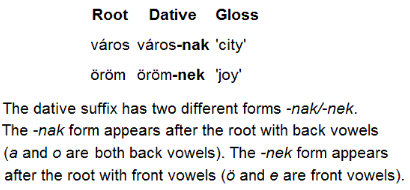
The vowel that causes the vowel assimilation is frequently termed the trigger while the vowels that assimilate (or harmonize) are termed targets. When the vowel triggers lie within the root or stem of a word and the affixes contain the targets, this is called stem-controlled vowel harmony (the opposite situation is called dominant). [1] This is fairly common amongst languages with vowel harmony and may be seen in the Hungarian dative suffix:
Vowel harmony often involves dimensions such as :

•
Vowel height
i.e. high, mid, or low vowels ,
[UKT: "close", "mid", or "open" , resp.]
•
Vowel backness
i.e. front, central, or back vowels
•
Vowel roundedness
i.e. rounded or unrounded ) [UKT: refers to lip rounding]
•
tongue root position
i.e. advanced or retracted tongue root, abbrev.: ±ATR ,
•
Nasalization
i.e. oral or nasal
¤ in this case, a
nasal consonant is usually the trigger
UKT: Bur-Myan (Burmese-Myanmar) syllables have the canonical form CVÇ where C is the onset consonant, V the peak vowel, and Ç the "killed" coda consonant. Because, the Bur-Myan aksharas have an inherent vowel which must be killed with an {a.þhût}, we are more concerned with the rime (peak vowel + "killed" coda consonant) than vowel and coda consonant separately.
In many languages, vowels can be said to belong to particular sets or classes, such as back vowels or rounded vowels. Some languages have more than one system of harmony. For instance, Altaic languages have a rounding harmony superimposed over a backness harmony.
Even amongst languages with vowel harmony, not all vowels need participate in the vowel conversions; these vowels are termed neutral. Neutral vowels may be opaque and block harmonic processes or they may be transparent and not affect them.[2] Intervening consonants are also often transparent.
Finally, languages that do have vowel harmony often allow for lexical disharmony, or words with mixed sets of vowels even when an opaque neutral vowel is not involved. van der Hulst & van de Weijer (1995) point to two such situations: polysyllabic trigger morphemes may contain non-neutral vowels from opposite harmonic sets and certain target morphemes simply fail to harmonize. [3] Many loanwords exhibit disharmony. For example, Turkish vakit, ('time' [from Arabic waqt]); *vakıt would have been expected.
See Neutralization, archiphoneme, underspecification for an explanation of archiphoneme and neutralization with an example of a Tuvan language archiphoneme involved in vowel harmony.
UKT: More in Wikipedia: http://en.wikipedia.org/wiki/Vowel_harmony 090826
From: http://en.wikipedia.org/wiki/Consonant_harmony 090826
Consonant harmony is a type of "long-distance" phonological assimilation akin to the similar assimilatory process involving vowels, i.e. vowel harmony.
There are several kinds of consonant harmony. One of the most commonly found, called sibilant harmony, requires all the sibilants of the word to belong either to the anterior class (s-like sounds) or the nonanterior class (sh-like sounds). Such patterns are found in Chumash, Navajo, Western Apache, Kinyarwanda languages, and elsewhere. For example, in Western Apache the verbal prefix si- is usually an alveolar fricative, as can be seen in the words below:
• siką̄ą̄ "a container and its contents are in position"
• sitłēēd "mushy matter is in position"
• siyį̄į̄ "a load/pack/burden is in position"
• sinéʼ "three or more flexible objects are in position"
• siłāā "a slender flexible object is in position"
• siʼą̄ą̄ "a solid roundish object is in position"
• sitsooz "a flat flexible object is in position"
• siziid "liquid matter is in position"
However, when si- occurs before a verb stem that starts with a post-alveolar affricate, the si- assimilates to the alveolar POA (Place of Articulation) (becoming shi-):
• shijaa "three or more solid rigid inanimate objects are in position"
Various
Austronesian languages exhibit consonant harmony among the
liquid consonants, with [r]
 {ra.} assimilating at a distance to
[l]
{ra.} assimilating at a distance to
[l]  {la.} or vice versa. Likewise, in Sanskrit, [n]
 {na.} is retroflexed to [ ɳ ]
 {Na.} if certain consonants precede it in the same word, even
at a distance.
{Na.} if certain consonants precede it in the same word, even
at a distance.
Guaraní language shows nasal harmony, by which certain affixes have alternative forms according to whether the root includes a nasal (vowel or consonant) or not. For instance, the reflexive prefix is realized as oral je- when preceding an oral stem like juka "kill", but as nasal ñe- when preceding a nasal stem like nupã "hit", where the ã makes the stem nasal.
Some Finnish speakers find it hard to pronounce both 'b' and 'p' in foreign words (e.g. pubi), so they voice (bubi) or devoice (pupi) the entire word. It should however be noted that the distinction between these consonants is not native to Finnish. [1]
UKT: End of Wikipedia http://en.wikipedia.org/wiki/Consonant_harmony 090826
From Wikipedia : http://en.wikipedia.org/wiki/Apophony 090915
In linguistics, apophony (also ablaut, gradation, alternation, internal modification, stem modification, stem alternation, replacive morphology, stem mutation, internal inflection) is the alternation of sounds within a word that indicates grammatical information (often inflectional)
Apophony is exemplified in English as the internal vowel alternations that produce such related words as :
• <sing> /sɪŋ/, <sang> /sæŋ/, <sung> /sʌŋ/, <song> /sɒŋ/
• <rise> /raɪz/, <raise> /reɪz/
• <bind> /baɪnd/, <bound> /baʊnd/
• <goose> /guːs/, <geese> /giːs/
The difference in these vowels marks variously a difference in:
• tense or aspect e.g.
<sing> /sɪŋ/, <sang> /sæŋ/, <sung> /sʌŋ/• transitivity e.g.
<rise> /raɪz/, <raise> /reɪz/• part of speech e.g.
<sing> /sɪŋ/, <song> /sɒŋ/
<bind> /baɪnd/, <bound> /baʊnd/• grammatical number e.g.
<goose> /guːs/, <geese> /giːs/
That these sound alternations function grammatically can be seen as they are often equivalent to grammatical suffixes (an external modification). Compare the following:
Present Tense | Past Tense
<jump> /ʤʌmp/ | <jumped > /ʤʌmpt/
<sing> /sɪŋ/ | <sang> /sæŋ/Singular | Plural
<book> /bʊk/ | <books > /bʊks/
<goose> /guːs/, | <geese> /giːs/
The vowel alternation between i and a indicates a difference between present and past tense in the pair sing/sang. Here the past tense is indicated by the vowel a just as the past tense is indicated on the verb jump with the past tense suffix -ed. Likewise, the plural suffix -s on the word books has the same grammatical function as the presence of the vowel ee in the word geese (where ee alternates with oo in the pair goose/geese).
Consonants, too, can alternate in ways that are used grammatically. An example is the pattern in English of verb-noun pairs with related meanings but differing in voicing of a postvocalic consonant:
Most instances of apophony develop historically from changes due to phonological assimilation that are later grammaticalized (or morphologized) when the environment causing the assimilation is lost. Such is the case with English goose/geese and belief/believe.
Apophony may involve various types of alternations, including vowels, consonants, prosodic elements (such as tone, syllable length), and even smaller features, such as nasality (on vowels).
The sound alternations may be used inflectionally or derivationally. The particular function of a given alternation will depend on the language.
Apophony often involves vowels. IE ablaut (also called IE vowel gradation) is a well attested example. The English example cited above demonstrates vowel ablaut. Another example is from Dinka language:
| Singular | Plural | gloss | vowel alternation |
|---|---|---|---|
| dom | dum | 'field/fields' | (o-u) |
| kat | kɛt | 'frame/frames' | (a-ɛ) |
The vowel alternation may involve more than just a change in vowel quality. In Athabascan languages, such as Navajo, verbs have series of stems where the vowel alternates (sometimes with an added suffix) indicating a different tense-aspect. Navajo vowel ablaut, depending on the verb, may be a change in vowel, vowel length, nasality, and/or tone. For example, the verb stem -kaah/-ką́ "to handle an open container" has a total of 16 combinations of the 5 modes and 4 aspects, resulting in 7 different verb stem forms (i.e. -kaah, -kááh, -kaał, -kááł, -ka’, -ká, -ką́).
| Imperfective | Perfective | Progressive- Future |
Usitative- Iterative |
Optative | |
|---|---|---|---|---|---|
| Momentaneous | kaah | ką́ | kááł | kááh | kááł |
| Continuative | ká | ką́ | kaał | kaah | kaał |
| Distributive | ka’ | ką́ | kaał | kaah | ka’ |
| Conative | kááh | - | - | - | - |
Another verb stem -géésh/-gizh "to cut" has a different set of alternations and mode-aspect combinations, resulting in 3 different forms (i.e. -géésh, -gizh, -gish):
| Imperfective | Perfective | Progressive- Future |
Usitative- Iterative |
Optative | |
|---|---|---|---|---|---|
| Momentaneous | géésh | gizh | gish | gish | géésh |
| Continuative | gizh | gizh | gish | gish | gizh |
| Semelfactive | gish | gish | gish | gish | gish/géésh |
Various prosodic elements, such as tone, syllable length, and stress, may be found in alternations. For example, Vietnamese language has the following tone alternations which are used derivationally:
| tone alternation | ||
|---|---|---|
| đây "here" | đấy "there" | (ngang tone-sắc tone) |
| bây giờ "now" | bấy giờ "then" | (ngang tone-sắc tone) |
| kia "there" | kìa "yonder" | (ngang tone-huyền tone) |
| cứng "hard" | cửng "(to) have an erection" | (sắc tone-hỏi tone) |
Albanian language uses different vowel lengths to indicate number and grammatical gender on nouns:
| [ɡuːr] "stone" | [ɡur] "stones" |
| [dy] "two (masculine)" | [dyː] "two (feminine)" |
English has alternating stress patterns that indicate whether related words are nouns (first syllable stressed) or verbs (second syllable stressed):
| noun | verb |
|---|---|
| <pérvert> /ˡpɜː.vɜːt/ | <pervért> /pə|ˡvɜːt/ |
| <ínsult> /ˡɪn.sʌlt/ | <insúlt> /ɪn|ˡsʌlt/ |
| <pérmit> /ˡpɜː.mɪt/ | <permít> /pə|ˡmɪt/ |
| <cónvict> /ˡkɒn.vɪkt/ | <convíct> /kənˡvɪkt/ |
Prosodic alternations are sometimes analyzed as not as a type of apophony but rather as prosodic affixes, which are known, variously, as suprafixes, superfixes, or simulfixes.
Consonant alternation is commonly known as consonant mutation or consonant gradation. Bemba language indicates causative verbs through alternation of the stem-final consonant. Here the alternation involves spirantization and palatalization:
| Intransitive Verb | Causative Verb |
|---|---|
| luba "to be lost" | lufya "to cause to be lost" |
| koma "to be deaf" | komya "to cause to be deaf" |
| pona "to fall" | ponya "to cause to fall" |
| enda "to walk" | ensha "to cause to walk" |
| lunga "to hunt" | lunsha "to cause to hunt" |
| kula "to grow" | kusha "to cause to grow" |
Celtic languages are well-known for their initial consonant mutations.
In IE linguistics, ablaut is the vowel alternation that produces such related words as <sing>, <sang>, <sung>, and <song>. The difference in the vowels results from the alternation (in the PIE language) of the vowel /e/ with the vowel /o/ or with no vowel. For a more detailed explanation see Indo-European ablaut.
To cite a few other examples of Indo-European ablaut, English has a certain class of verbs (i.e. strong verbs) in which the vowel changes to indicate a different grammatical tense-aspect.
| Infinitive | Preterite | Past Participle |
vowel alternation |
|---|---|---|---|
| <swim> /swɪm/ | <swam> /swæm/ | <swum> /swʌm/ | (i-a-u) phonetically: /ɪ-æ-ʌ/ |
| <fall> /fɔːl/ | <fell> /fel/ | <fallen> /ˡfɔː.lən/ | (a-e-a) phonetically: /ɔː-ɛ-ɔː/ |
| <drive> /draɪv/ | <drove> /drəʊv/ | <driven> /ˡdrɪv.ən/ | (i-o-i) phonetically: /aɪ-oʊ-ɪ/ |
As the examples above show, a change in the vowel of the verb stem creates a different verb form. (Note that some of the verbs also have a suffix in the past participle form.) (See also English grammar: Irregular verbs.) For a more detailed explanation of how strong verbs are formed in English and related languages, see Germanic strong verb.
In Indo-European linguistics, umlaut is the vowel alternation that produces such related words as foot and feet or tell and told. The difference in the vowels results from the influence (in Proto-Germanic or a later Germanic language) of an i or y (which has since been lost) on the vowel which (in these examples) becomes e.
To cite another example of umlaut, some English weak verbs show umlaut in the present tense.
| Infinitive | Preterite Past Participle |
vowel alternation |
|---|---|---|
| <bring> /brɪŋ/ | <brought> /brɔːt/ | (i-ou) phonetically: /ɪ-ɔː/ |
A-mutation and U-mutation are processes analogous to umlaut but involving the influence of an a (or other non-high vowel) or u respectively instead of an i.
Note that in Indo-European historical linguistics the terms ablaut and umlaut refer to different phenomena. They are not interchangeable.
The Germanic scholars who coined the terms ablaut and umlaut in the 19th century used them to distinguish two types of vowel alternation patterns with differing origins and differing reflexes in the modern languages. In this usage, umlaut is a specific case of vowel alternation that has developed from a historical instance of regressive vowel harmony. [UKT: I have included a file on vowel harmony in harmo.htm in this series. ]Indo-European ablaut is a different vowel alternation of uncertain origin. In purely descriptive (synchronic) terms, Germanic umlaut is a regular system that always involves vowel fronting, whereas in the modern languages ablaut appears to have no regularity.
When discussing synchronic grammars, later linguists have used ablaut to refer to morphological vowel alternation generally (which is unpredictable phonologically) and umlaut to refer to regressive vowel harmony (which is phonologically predictable). Ambiguity can of course be avoided by using alternative terms (apophony, gradation, alternation, internal modification) for the broader sense of the word.
The traditional distinction is retained by Indo-Europeanists. It is rather less important for descriptive studies, where for most purposes the vowel alternation in foot/feet is analogous to that in sing/sang/sung. However, the regularity of Germanic umlaut means that this distinction remains standard in textbooks for learners of German, Dutch and Scandinavian languages. (As an illustration, the preceding examples translate as follows into German: Fuß/Füße [Umlaut], singen/sang/gesungen [Ablaut].)
Stem modifications (i.e. apophony) may co-occur with other morphological processes, such as affixation. An example of this is in the formation of plural nouns in German:
| Singular | Plural |
|---|---|
| Buch "book" | Bücher "books" |
| Haus "house" | Häuser "houses" |
Here the singular/plural distinction is indicated through ablaut and additionally by a suffix -er in the plural form. English also displays similar forms with a -ren suffix in the plural and a -en suffix in the past participle forms along with the internal vowel alternation:
| child (singular) /ˈtʃaɪld/ | children (plural) /ˈtʃɪldrən/ |
| drive (infinitive) /ˈdraɪv/ | driven (past participle) /ˈdrɪvən/ |
A more complicated example comes from Chickasaw where the positive/negative distinction in verbs displays vowel ablaut along with prefixation (ak-) and infixation (-'-):
| Positive | Negative |
|---|---|
| hilhali "I'm dancing" | akhi'lho "I'm not dancing" |
The nonconcatenative root-and-pattern morphology of the Afro-Asiatic languages is sometimes described in terms of apophony. The alternation patterns in many of these languages is quite extensive involving vowels and consonant gemination (i.e. doubled consonants). The alternations below are of Modern Standard Arabic (the symbol < ː > indicates gemination on the preceding consonant):
| word | gloss | alternation pattern |
|---|---|---|
| katab | "to write" | (a - a) |
| kataba | "he wrote" | (a - a - a) |
| kaatab | "to correspond with" | (aa - a) |
| kattab | "to cause to write" | (a - ːa) |
| kuttib | "to be caused to write" | (u - ːi) |
| kitaab | "book" | (i - aa) |
| kutub | "books" | (u - u) |
| kaatib | "writer" | (aa - i) |
| kuttaab | "writers" | (u - ːaa) |
For other examples, see archaic plurals in Amharic, Broken plural, Triconsonantal root.
Other analyses of these languages consider the patterns not to be sound alternations, but rather discontinuous roots with discontinuous affixes, known as transfixes (sometimes considered simulfixes or suprafixes). Some theoretical perspectives call up the notion of morphological templates or morpheme "skeletons".
Note that it would also be possible to analyze English in this way as well, where the alternation of goose/geese could be explained as a basic discontinuous root g-se that is filled out with an infix -oo- "(singular)" or -ee- "(plural)". Many would consider this type of analysis for English to be less desirable as this type of infixal morphology is not very prevalent throughout English and the morphemes -oo- and -ee- would be exceedingly rare.
Another analytical perspective on sound alternations treats the phenomena not as merely alternation but rather a "replacive" morpheme that replaces part of a word. In this analysis, the alternation between goose/geese may be thought of as goose being the basic form where -ee- is a replacive morpheme that is substituted for oo.
• goose → g-ee-se
This usage of the term "morpheme" (which is actually describing a replacement process, and not a true morpheme), however, is more in keeping with Item-and-Process models of morphology instead of Item-and-Arrangement models. (See Morphology (linguistics) for further discussion of morphological models.)
Ablaut reduplication or ablaut-motivated compounding is a type of word formation of "expressives" in English (such as onomatopoeia). Examples of these include:
• tick-tock
• criss-cross
• cling-clang
• snip-snap
Here the words are formed by a reduplication of a base and an alternation of the internal vowel. (See English reduplication).
Some examples in Japanese:
• kasa-koso (rustle)
• gata-goto (rattle)
UKT: End of Wikipedia article.
Go back apophony-note-b
From Wikipedia: http://en.wikipedia.org/wiki/Metaphony 090916
In historical linguistics, metaphony is a general term for a class of sound change in which one vowel in a word is influenced by another in a process of assimilation.
Progressive metaphony, in which a vowel early in the word influences a subsequent vowel, can be distinguished from regressive metaphony, in which a vowel towards the end of the word influences a preceding vowel. (Progressive metaphony is sometimes called "left-to-right" metaphony, and regressive metaphony may be called "right-to-left" metaphony.)
Progressive metaphony is also called vowel harmony, and is discussed fully in the article under that heading. However, some linguists use the term "vowel harmony" for regressive metaphony too.
Examples of regressive metaphony are i-mutation and a-mutation. (On i-mutation in Germanic languages see also Germanic umlaut.)
Go back metaphony-note-b
End of TIL file