
HV-indx.htm
by U Kyaw Tun (UKT) (M.S., I.P.S.T., USA),
Daw Khin Wutyi, and staff of Tun
Institute of Learning (TIL).
Not for sale. No
copyright. Free for everyone.
Prepared for students and staff of
TIL Computing and
Language Center, Yangon, MYANMAR :
http://www.tuninst.net
Classes of vowel theories
Vowel theories
Muscles Controlling the
Tongue and Lips
Traditional description of vowels
Tongue constriction theories
Continuous vowel space theories
Cardinal vowels of Daniel Jones
Position
within vowel quadrilateral and vowel resonances
Systematic vowel
differences between languages
Vowel quality and resonances: head size
Lip rounding
Theory of Adaptive Dispersion
Phoneticians' judgement of Gaelic vowels (Ladefoged, 1967)
Passages worthy of note:
•
UKT notes :
• A. M. Bell
UKT: I still need time to check the facts which I have taken from my aging memory! Alas, all I have at present is snailnet not internet. - UKT101211
There are at least two classes of vowel theories which could be traced back to the ancient Indian linguists of the 7th century or older. Of course we should expect to see the hands of Yaska, Panini, Patañjali and Bhatrihari, and their Hindu religion (which considers the spoken language as derived from the Creator himself) in the linguistics.
The tongue constriction theories are older compared to continuous vowel space theories, first developed by A. M. Bell, the father of the inventor of the telephone. The Bells had deaf and mute members in their family whom they took pains to teach to speak. [UKT: fact to be checked.]
Vowel theories were first developed by Indian linguists who were Rishis leading lonely lives with their small families and dedicated students in the foothills of Himalayas. Many names have been lost but at least the names of four are known. Of them Panini who lived in the Iron Age of India was the most prominent . Panini was the author of the Eight Chapters of a prescriptive grammar. Those before Panini were Vedic scholars and their language was probably non-Sanskrit dubbed collectively as Prakrits. I presume the older Prakrits (at least those of northern India) belonged to Tibeto-Burman (Tib-Bur) linguistic group. Those in the south probably belong to the Austro-Asiatic group.
Panini and later linguists seemed to belong to the Indo-European (IE) linguistic group. Panini prescribed essentially how to convert the Prakrits into Sanskrit. Sanskrit after Panini is known as the Classical Sanskrit.
UKT: Since the tongue plays a very important part in the production of the vowels, we should know what the tongue is and what's its capabilities are. We should also know about the lips. The following is from Peter Ladefoged, Vowels and consonants: an introduction to the sounds of languages, vol. 1, p125. A Google book preview of this book is available online:
http://books.google.ca/books?id=cO9yDkqS1Y0C&pg=PA129&lpg=PA129&dq=A.+M.+Bell+-+phonetician&source=bl&ots=7kQMdBuByQ&sig=CLsimSItp7fU9rdztpOLaX3hWS0&hl=en&ei=37IDTdnPFcm3rAeFvI2RDw&sa
=X&oi=book_result&ct=result&resnum=4&ved=0CB4Q6AEwAw#v=onepage&q=A.%20M.%20Bell%20-%20phonetician&f=false 101212
[{p125begin}]
The tongue is just a bunch of muscles. If you want to see what these
muscles look like, the easiest way is to go down to the market and buy a
sheep's tongue. Sheep have fairly similar tongue to ours. (Buying an ox
tongue is not so useful. Cows have developed long tongues that they use to
pull grass out the ground, and put it in their mouths. Sheep eat more like
we do. They are polite enough to nibble grass without sticking their tongue
out.) ... just boil it for about an hour and let it cool before you examine
it.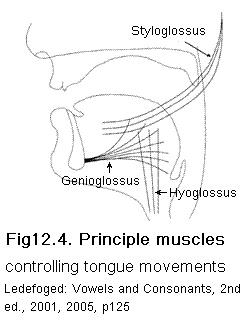
If you slice a tongue (human or sheep) from front to back and then again from side to side, you can see the fibers of the muscles. Figures 12.4 and 12.5 show how the muscles are attached to the jaw and the skull (which you won't see without buying a whole sheep's head). [UKT ¶]
See Fig.12.4: The principal muscles controlling the movements of the tongue - redrawn by UKT 101212. (page126 is not part of the preview.) Fig.12.5 A more realistic sketch is not reproduced here.
The principal muscle of the tongue is the genioglossus, which pulls the back and the root of the tongue towards the front of the mandible (the jawbone). The net effect of contracting the genioglossus muscle is that the tongue gets compressed within the jaw. The tongue is like a balloon filled with water. As the root is pulled forward the front has to go somewhere and so it moves up towards the hard palate. [{p125end/p126begin}]
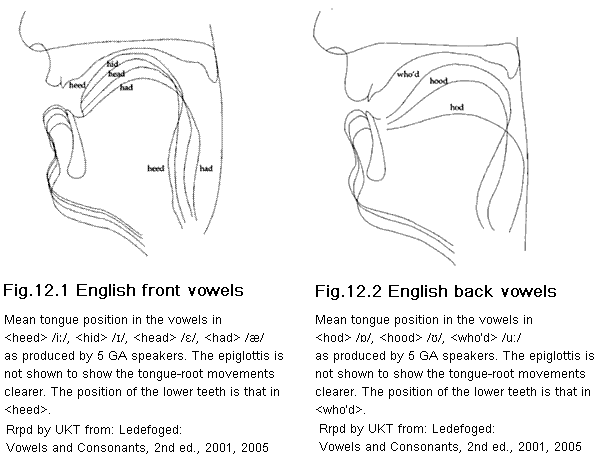
This is essentially what happens when you say /iː/ as in <heed> /hiːd/. [UKT¶]
UKT: The IPA /iː/ (note the triangular colon) is essentially the same as Romabama
{i:} (note the regular circular dot colon). In regular Bur-Myan, it is only the creak register
{i.} that is checked. However, in other languages the emphatic
{d} :
{i:d} . Thus the English <heed> /hiːd/ may be transcribed as
{hi:d} . You will note that I have designed Romabama transcription to be almost the same as the IPA. I am able to do it because the Myanmar script is a phonetic script like the IPA.
For our transcription work, we are more interested in rimes (i.e. vowel+coda).
In Bur-Myan, the coda consonant affects the pronunciation which is probably not recognized in English, making the rendering of English words in Myanmar script extremely difficult. We must also note that English written in Latin script (Engl-Lat) is not phonetic whereas Bur-Myan is. So it is necessary to use IPA as an intermediary.
"GA" in the figures means 'General American'.
You contract your genioglossus so that the body of the tongue gets squeezed within the jawbone, and part of it is pushed upwards. Producing the tongue shapes for the vowels in <hid> /hɪd/, <head> /hɛd/, <had> /hæd/ requires less activity of the genioglossus muscle, and also usually lowering of the jaw by means of muscles not shown in figures 12.4 and 12.5.
UKT: In Bur-Myan and Indic languages, when we describe the vowels we use the order /a/ /i/ /u/ /ɑ/ (starting from open-front), whereas in Eng-Lat (English-Latin) phonetics they use the order /i/ /a/ /ɑ/ /u/ (starting from close-front).
The styloglossus muscle, which is attached to a point on the skull just below the ear, pulls the tongue upwards and backwards. The hyoglossus muscle, which is attached to the hyoid bone in the neck, pulls the tongue back and down. These are the two muscles that are largely responsible for the tongue movements in <hod> /hɒd/ , <hood> /hʊd/, <who'd> /hu:d/. But, as with all tongue gestures, there are many ways to make similar movements.
UKT: My task here is to transcribe in Romabama the following (I am waiting for comments from my peers - 101213):
¤ <heed> /hiːd/ =
¤ <hid> /hɪd/: A possible candidate is derived from{hkít} - n. 1. extent, domain 2. age - MED064
={híd}
¤ <had> /hæd/ = ? {héd}
¤ <head> /hɛd/ ={hèd}
¤ <hod> /hɒd/ ={hau:d}
¤ <hood> /hʊd/ : Noting the similarity to IPA transcription of <put> /pʊt/ ={pwut}, and disimilarity to <but> /bʌt/ =
{bût}
={hwud} [NOT {hwûd}]
¤ <who'd> /huːd/ ={hu:d}
You can also control the height of the tongue within the jaw by contracting the mylohyoid muscle, which is shown in figure 12.6, a schematic view of the tongue cut from side to side at the level of the back teeth. (The muscles in this view are so entangled that it is difficult to make a realistic sketch.) The mylohyoid muscle is like a sling going from one side of the jaw to the other. Tightening the sling raises the body of the tongue. Some people vary the height of the tongue in <heed> /hiːd/, <hid> /hɪd/, <head> /hɛd/, <had> /hæd/ mainly by using the genioglossus muscle, others make more use of the mylohyoid muscle, and yet others control tongue shape in several different ways.
The muscles that are primarily responsible for moving the tip of the tongue
are the superior longitudinals. These muscles lie just under the surface on
either side of the tongue. When they contract they shorten the upper surface on
either side of the tongue, and thus cause the tip to curl upwards. The inferior
longitudinal [{p126end/p127begins}] muscles run along the underside of the tongue, near the styloglossus.
When they contract they bunch the tongue up.
The tongue is a very intricate mass of muscles -- there are many more than we will consider here -- so it is worth remembering that it is always difficult to be sure which muscles caused a particular speech movement. What matters most is the shape of the tongue rather than the particular muscles used. The muscles combine together in various ways to form particular shapes.
The principle muscle of the lips is the orbicularis oris, which circles round the lips. When this muscle contracts the corners of the lips are pulled together producing lip rounding. The degree of lip opening is also controlled by the raising and lowering of the jaw (using muscles not shown here), which affects the position of the lower lip.
Analyses of x-rays have shown that the tongue shapes in most vowels can be described as different combinations of the two basic movements shown in fig.12.7 . One of these movements determines the degree of raising of the tongue. The other is associated with the backward movement of the tongue. The tongue shapes required for nearly all the vowels of English can be made by using different combinations of these two movements. The exception is the vowel in American English <bird>, which requires some bunching of the tongue using the inferior longitudinal muscles.
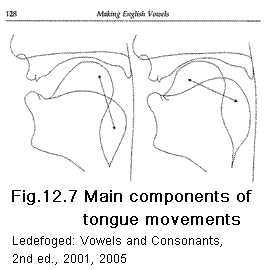 The basic movements shown in Fig.12.7 might be thought of as controlling the
height the highest point of the tongue and the degree of backness of the same
point. As you can see, they don't exactly do this. The two components of [{p127end/p128begin}]
tongue movements are not at right angles to one another and are not directly
related to moving the tongue in the vertical and horizontal directions. But if
we neglect this for the movement, we can think of vowels as differing in three
ways: tongue height, tongue backness, and lip opening. This technique for
describing vowels was started by the British speech teacher, Alexander Graham
Bell. Both father and son were excellent phoneticians, and used to give public
demonstrations of their skill. Alexander Graham would leave the room while his
father interviewed a speaker of some foreign language. Melville Bell would then
write down what was said in a phonetic transcription. Contemporary reports say
that when Alexander came back into the room he would astound the audience by
reading back his father's transcription and pronouncing the foreign language
'perfectly', often despite the fact that he did not know a word of it. I've put
the 'perfectly' in quotes because I know that people are sometimes full of
praise when I repeat, very imperfectly, phrases that they don't expect
foreigners to be able to say. I've put my phonetic ability to work a number of
times when I have been asked to make a speech in a foreign country. I begin with
a few phrases in the appropriate language that I have carefully learned from a
phonetic transcription of a native speaker - and then I lapse into English. As a
fellow phonetician once remarked to me: "I can pronounce French perfectly, but I
can't speak it. I know all the sounds of French, but unfortunately I don't know
any words."
The basic movements shown in Fig.12.7 might be thought of as controlling the
height the highest point of the tongue and the degree of backness of the same
point. As you can see, they don't exactly do this. The two components of [{p127end/p128begin}]
tongue movements are not at right angles to one another and are not directly
related to moving the tongue in the vertical and horizontal directions. But if
we neglect this for the movement, we can think of vowels as differing in three
ways: tongue height, tongue backness, and lip opening. This technique for
describing vowels was started by the British speech teacher, Alexander Graham
Bell. Both father and son were excellent phoneticians, and used to give public
demonstrations of their skill. Alexander Graham would leave the room while his
father interviewed a speaker of some foreign language. Melville Bell would then
write down what was said in a phonetic transcription. Contemporary reports say
that when Alexander came back into the room he would astound the audience by
reading back his father's transcription and pronouncing the foreign language
'perfectly', often despite the fact that he did not know a word of it. I've put
the 'perfectly' in quotes because I know that people are sometimes full of
praise when I repeat, very imperfectly, phrases that they don't expect
foreigners to be able to say. I've put my phonetic ability to work a number of
times when I have been asked to make a speech in a foreign country. I begin with
a few phrases in the appropriate language that I have carefully learned from a
phonetic transcription of a native speaker - and then I lapse into English. As a
fellow phonetician once remarked to me: "I can pronounce French perfectly, but I
can't speak it. I know all the sounds of French, but unfortunately I don't know
any words."
In the tongue constriction theories, which are older, the vowels were divided into:
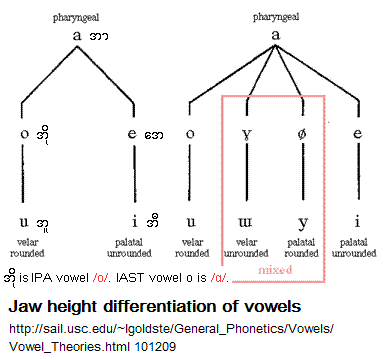
• Velar or pharyngeal or throat vowels -

• Palatal or mouth vowels -
• Bilabial or labio-velar or lip vowels -
They were presented together with their consonant counterparts.
Each vowel type is categorically distinct. For the Westerners who are not used to Indic languages, jaw height may be used to distinguish the vowels. However, for the Indic speakers, the jaw movement is minimal. Though I am not an Indic speaker (I speak Bur-Myan, of the Tib-Bur group), when I sing these vowels, my jaw remain at the same height without any movement.
By the 19th century, further differentiation of constriction types was acknowledged, by allowing the lip and tongue actions to "mix."
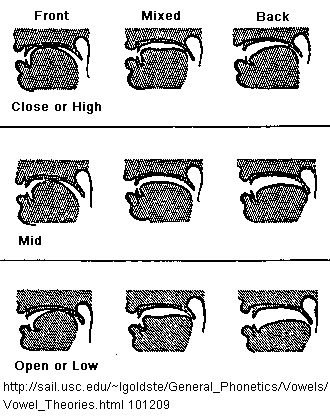
A. M. Bell developed a system for teaching speech to deaf children. He was haunted by inability to categorize the vowel in <Sir> within the tongue constriction theories.
Vowels are characterized as points in a 2-dimensional space (e.g., high vs. low, front vs. back). Bell invented central ("mixed") vowels (around 1867) which are both front and back. The diagrams on the right shows vocal tract shapes he imagined corresponding to his descriptive system:
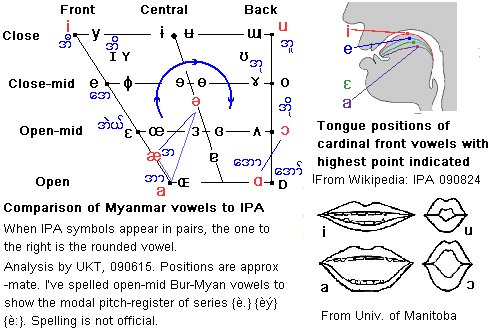
Vowels repesented as points in a quadrilateral that represent the positions of the highest point of the tongue during the production of the vowel.
• Close (high) - (Open) low
• front-back
Reference (cardinal) vowels on the periphery of the vowel quadrilateral were learned by rote from Jones. I am giving on the right the vowel quadrilateral of Daniel Jones for comparing IPA (International Phonetic Alphabet to Bur-Myan vowels)
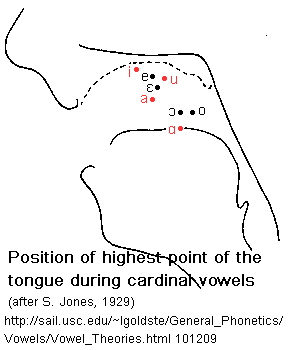 Vowels were assumed to be spaced at auditorily equal
intervals of tongue position. Daniel Jones' diagram (system) could be used
reliably and it gained popularity because it allowed the qualities
of vowels of newly discovered languages, discovered by the British colonialists
in the 18th to 19th centuries.
Vowels were assumed to be spaced at auditorily equal
intervals of tongue position. Daniel Jones' diagram (system) could be used
reliably and it gained popularity because it allowed the qualities
of vowels of newly discovered languages, discovered by the British colonialists
in the 18th to 19th centuries.
Even during Jones's time (1930-1950), however, it was known that the highest point of the tongue description did not reflect actual tongue positions, as measured by X-rays. See diagram. Vowels least affected by environment are known as quantal vowels and have been coloured red.

Sir Isaac Newton recognized the relation between vowel qualities and resonances.
He noted that he could hear a progression of different vowels as he poured beer into a flaggon.
Striking resemblance between position of vowels in CV quadrilateral (based on auditory judgments) whose axis are high-low and front-back, and position in a formant frequency graph (F1 vs. F2-F1)
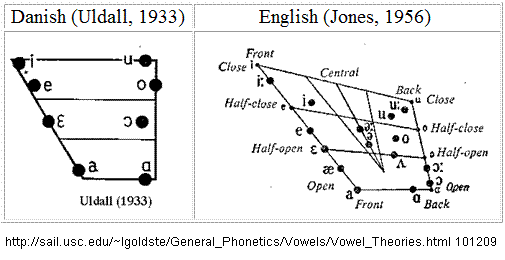
Before physical measurements could be made, vowels and consonants were studied by
linguists based on their hearing. A comparison of diagrams such as shown on the
right would be of little use in cross-linguistic study. Of course, auditory
studies would inevitably introduce the bias springing from the first language
(L1) interference of the foreigners much to the annoyance of the natives. No
matter how much phonetic training these foreigners had, their L1s (usually
Indo-European) would taint their judgments on foreign languages (e.g.
Burmese-Myanmar - a Tibeto-Burman language). Thus, they claim that Burmese has
diphthongs, whereas, since Burmese students on their first trip to the US found
it impossible to pronounce the English diphthongs in words such as <oil> and
<boy>, I must contend that Burmese is monothongal.
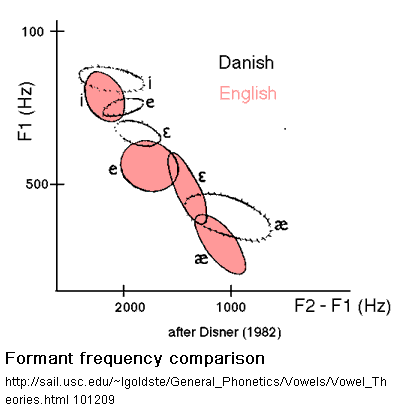
The foreign phoneticians also miss hearing the Pali-Myanmar
 {þa.} /θ/ which they
thought should be pronounced as /s/ as in Pali spoken in Sri Lanka. If only
formant frequency comparisons could be made, as for Danish and English vowels,
we would be able to settle the /θ/-/s/ controversy. Most of them fail to
note that Burmese-Myanmar is unique in being one of the few pitch-register
languages with three registers (creak, modal, emphatic), not related to Thai - a
tonal language.
{þa.} /θ/ which they
thought should be pronounced as /s/ as in Pali spoken in Sri Lanka. If only
formant frequency comparisons could be made, as for Danish and English vowels,
we would be able to settle the /θ/-/s/ controversy. Most of them fail to
note that Burmese-Myanmar is unique in being one of the few pitch-register
languages with three registers (creak, modal, emphatic), not related to Thai - a
tonal language.
 Individuals pronounce even the quantal vowels,
 {i} /i/,
 {a} /a/,
 {au}
/ɑ/,
{au}
/ɑ/,  {u}
/u/, across
languages differently. In fact the same individual
pronounce these vowels slightly differently in the same stretch
of speech, from day to day, depending on his or her health. When my grandsons
(both born outside the country of Myanmar and now living in Canada) speak to me in English as well as in
Burmese, or mixed, the quality of their vowels change constantly. And when they
are speaking in English to their Canadian friends, and me in the same sitting,
they - without effort constantly and unconsciously - change the quality of their
vowels contineously. This makes the representation of speech sounds, and vowels
in dedicated graphemes an
impossibility.
{u}
/u/, across
languages differently. In fact the same individual
pronounce these vowels slightly differently in the same stretch
of speech, from day to day, depending on his or her health. When my grandsons
(both born outside the country of Myanmar and now living in Canada) speak to me in English as well as in
Burmese, or mixed, the quality of their vowels change constantly. And when they
are speaking in English to their Canadian friends, and me in the same sitting,
they - without effort constantly and unconsciously - change the quality of their
vowels contineously. This makes the representation of speech sounds, and vowels
in dedicated graphemes an
impossibility.
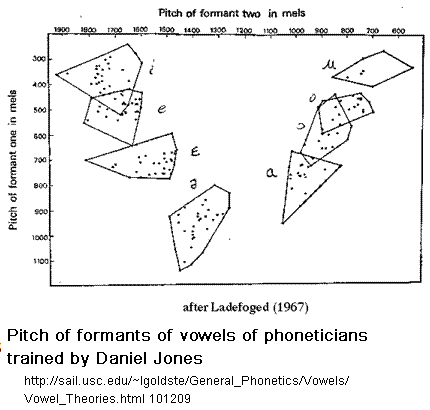
In actual measurements individuals differ in range of formant frequencies. Ranges of F1 and F2 associated with a single (even cardinal) vowel, differ across speakers, and even overlap. On the right is shown a study on a group of phoneticians trained by Daniels Jones:
We see that even the quantal vowels are pronounced differently. Therefore we have the problem of normalizing formants of speakers. There is no generally accepted normalization scheme and we left with using bilinguals or using a group of speakers in each language and taking the mean.

Vowels should not be characterized with only the dimensions of close-open and frontness-backness. We should add a third dimension: the lip rounding-spreading. To represent in three dimensions we have to use a three-dimensional diagram using a right-handed Cartesian system with x-, y- , and z- axes.
 Lip-rounding
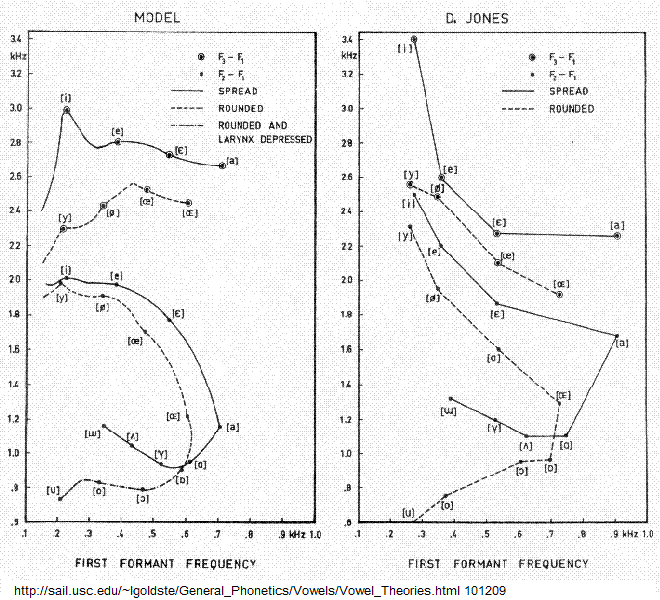
(opposite of lip-spread) effects the formant frequencies. See diagrams on
the left.
Lip-rounding
(opposite of lip-spread) effects the formant frequencies. See diagrams on
the left.
Note that formant frequency difference between front and back vowels is maximized when back vowels are round and front vowels are spread (unrounded).
It is probably because of this maximizing effect, Bur-Myan vowels are extremely easy to pronounce:
{i}
/i/
{a}
/a/
{au} /ɑ/
{u}
/u/
They can be pronounced with and without jaw movement. The above shows the modal register. In fact all the three registers (creak, modal, emphatic) of each vowel can be easily pronounced and easily distinguished. They are easily represented by IPA suprasegmentals:
{a.} /ă/;
{a:} /aː/
{au.} /ɑ̆/;
{au:} /ɑː/
{u.} /ŭ/;
{u:} /uː/
UKT: See also Adaptive dispersion in vowel perception, by Keith Johnson, Ohio State University, pdf format download 101210 in TIL library for M03-BEPS.
Developed by Lindblom, the Theory of Adaptative Dispersion states that the vowels are dispersed in the phonetic space (tongue position, rounding) in such a way as to maximize auditory differences among the vowels.
Same tongue shape, same position on cardinal vowel chart are associated with different formant frequencies. The relation between position in vowel quadrilateral and formant frequencies holds only for a given lip configuration (single "slice" through 3-dimensional vowel space).
When phoneticians listen to an audio recording of a vowel in an unknown language that is not found on the primary cardinal vowel "slice", they may not be able to tell whether the vowel is a front rounded or a back unrounded vowel -- they cannot separate position in the space from rounding. The result is confusion. However, because of the theory of adaptive dispersion, if a language has spread front vowels, we can be pretty sure that the back vowels would be rounded. This is the case of Bur-Myan.
-- from:
http://sail.usc.edu/~lgoldste/General_Phonetics/Vowels/Vowel_Theories.html
140202 :
(chk link 140202)
Since front-rounded and back-unrounded vowels are so auditorily similar that skilled phoneticians confuse them, we would expect that, if goals for vowels were acoustic, or auditory, there would be languages in which individual speakers vary as to which of these types they produce. This doesn’t appear to be the case.
-----Goldstein's texts below, to be incorporated into above-----
UKT 140202: The link below still works on: 140202.
http://sail.usc.edu/~lgoldste/General_Phonetics/Vowels/Vowel_Theories.html 140202
vowels on primary plane (14/15 judgments) high vowel not on primary plane 

Since front-rounded and back-unrounded vowels are so auditorily similar that skilled phoneticians confuse them, we would expect that, if goals for vowels were acoustic, or auditory, there would be languages in which individual speakers vary as to which of these types they produce.
This doesn’t appear to be the case.But front-back judgments seem to be dependent of state of lips.
Audio-visual experiment with phoneticians would probably yield different quality judgment depending on lips display.
but then in what sense is front-back strictly an auditory (or acoustic) property?This suggests that goals for vowel gestures are defined in terms of constrictor action, not the resulting sound.
A problem for the continuous vowel space theory
Individual differences among talkers of a given language include "reversals" of vowel height, measured either by tongue height or by F1 frequency:
UKT: I've
redrawn the pix on the right. I've resized and relabeled. - 101211
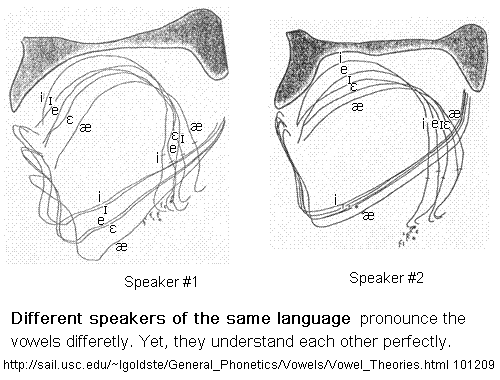
If vowel height is the relevant parameter on which vowel gestures contrast, how can different speakers order the same two vowels differently along this parameter? The speakers are mutually intelligible; they do not confuse the vowels.
Quantal theory of vowels (Wood, Stevens)
Return to more traditional theory, that vowels come in qualiatively distinct types.
Each type is defined by:
Types:
Measured area functions from a variety of languages show constrictions limited to these four locations:

With only four constriction locations, how are full range of vowels produced?
Other parameters along which vowels can contrast:
¤ high vs. low jaw position
¤ tense vs. lax tongue shape (bunching of tongue with
respect to jaw)
¤ round vs. unrounded lips
Resulting formant space:

Analysis of palatal vowels: /i I e E/
| |
lax tongue shape | |
| Jaw hi | |
|
| Jaw lo | |
|
Position of tongue with respect to palate, and therefore F1, will be similar for [e] and [I].
Modeling of palatal vowels using these parameters:

German palatal vowels

X-ray data from American English:

Problem with this theory of palatal vowels: tongue may compensate for jaw height, at least in case of mechanical pertubation (bite-block)

Muscles employed for four vowel types

Tongue as complex structure
Muscles shape bag and position it with respect to fixed surfaces.
Two types of muscles for positioning and shaping tongue:


Muscle function in shaping tongue
Contraction of muscle shortens length of bag along the dimension along which muscle runs.
Tongue will expand out in other dimensions to conserve volume.
Intrinsic muscles (primary for consonants)


Extrinsic muscles (primary for vowels)
Geniglossus

Styloglossus, hyoglossus

Palatoglossus, pharyngeal constrictors

Rounding
Swedish contrasts three high front vowels in rounding:
- [i] unrounded
- [y] rounding type 1 (protusion)
- [
] rounding type 2 (vertical compression)
(after Fant, 1975)
What is rounding?
Contact on sides between upper and lower lips
Length of side contact in rounded and unrounded vowels:
Advanced Tongue Root (ATR)

|

|
| |
|

|

|
| |
|
Note to myself: To understand vowels and consonants more, I have to go over the book by Peter Ladefoged, Vowels and Consonants, 2nd. edition, 2001, 2005. I have the ink-on-paper book in my possession. You may also go online and read the Google bookpreview:
http://books.google.ca/books?id=cO9yDkqS1Y0C&pg=PA129&lpg=PA129&dq=A.+M.+Bell+-+phonetician&source=bl&ots=7kQMdBuByQ&sig=CLsimSItp7fU9rdztpOLaX3hWS0&hl=en&ei=37IDTdnPFcm3rAeFvI2RDw&sa=X&oi=book_result&ct=result&resnum=4&ved=0CB4Q6AEwAw#v=onepage&q=A.%20M.%20Bell%20-%20phonetician&f=false 101212From Wikipedia: http://en.wikipedia.org/wiki/Alexander_Melville_Bell 101212
Alexander Melville Bell (1 March 1819 – 7 August 1905) was a teacher and researcher of physiological phonetics and was the author of numerous works on orthoepy and elocution. He was also the father of Alexander Graham Bell.[1]
Bell , Alexander Graham . 1847-1922 1. Scottish-born American inventor of the telephone. The first demonstration of electrical transmission of speech by his apparatus took place in 1876. Bell also invented the audiometer, an early hearing aid, and improved the phonograph. - AHTD
Alexander Melville Bell was born in Edinburgh, Scotland, and studied under and became the principal assistant of his father, Alexander Bell (1790–1865), an authority on phonetics and speech disorders. From 1843 to 1865 he lectured on speech elocution at the University of Edinburgh, and from 1865 to 1870 at the University of London. Melville married Eliza Symonds, the only daughter of a British naval surgeon.
In 1868, and again in 1870 and 1871, Melville lectured at the Lowell Institute in Boston, Massachusetts after having moved to Canada. In 1870 he became a lecturer on philology at Queen's College, Kingston, Ontario; and in 1881 he moved to Washington, D.C. at the suggestion of his son Graham, where he devoted himself to the education of the deaf by the use of Visible Speech in which the alphabetical characters of his linguistic invention were representative graphic diagrams for the various positions and motions of the lips, tongue, mouth, etc..., as well as other methods of orthoepy.
UKT: More in Wikipedia article.
Go back AM-Bell-note-b
End of TIL file.


