Update: 2011-12-31 06:57 PM +0630
intro02-1.htm
Daniel Jones. Edited by Peter Roach, James Hartman and Jane Setter. Cambridge University Press, 2003.
Scanned by Maung Kan Tun and edited by U Kyaw Tun, M.S. (I.P.S.T., U.S.A.). Not for sale. Prepared for students of TIL Computing and Language Center, Yangon, MYANMAR .
2.2
Vowels and diphthongs
Vowel qualities
Short and long - vowel length -
importance in Sanskrit
Checked and free - depends on the checking consonant
Tense and lax -
Vowels and diphthongs - contd
British English RP,
English [a] and Burmese {a},
American English GA
IPA Consonants - extended for BEPS
2.3
Consonants
(British English RP,
American English GA,
Burmese Consonants)
2.4
Non-English sounds
UKT notes
• General American (GA aka American English)
• Received Pronunciation (RP aka British English)
• vowel length (short and long vowels)
Contents of this page
DJPD16-roman08
UKT: What is a vowel and a diphthong? As usual why don't we start with AHTD?
vowel n. 1. A speech sound created by the relatively free passage of breath through the larynx
{a.þän-o:} and oral
{hkän-twing:} cavity, usually forming the most prominent and central sound of a syllable. -- AHTD
UKT: A vowel can be sung continuously. We have three pitch registers in Bur-Myan, a Tibeto-Burmese (Tib-Bur) language. For a vowel like the close front vowel,
{i.} (creak)
{i} (modal)
{i:} (emphatic), Eng-Lat has only two - the short < i > and the long < ī >. Eng-Lat is an Indo-European (IE) language belonging to the same linguistic family as Skt-Dev where the short vowel is represented by the vowel-letter इ and the long vowel ई. Thus for a comparison of this vowel in BEPS, first we have to make allowance for the Two-Three tone problem.
diphthong n. Linguistics 1. A complex speech sound or glide that begins with one vowel and gradually changes to another vowel within the same syllable, as (oi) in <boil > or ( ī ) in <fine>. -- AHTD
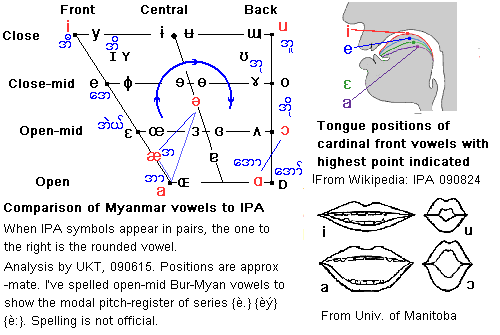
It is standard practice in phonetics to represent the quality of vowels and diphthongs by placing them on a four-sided figure usually known as the Cardinal Vowel quadrilateral (see Roach (2000), pp. 13-14). [UKT ¶]
UKT: My study of BEPS has shown that to describe the vowel fully we have to specify whether it is an checked or a free vowel. The terms "short" and "long" are ambiguous. See Wikipedia: http://en.wikipedia.org/wiki/Vowel_length 110310.
A checked vowel is a vowel checked by a consonant, where the rime (VC) has one or more consonants in the coda. A free vowel is just (V) alone as the rime where there is no coda consonant or "zero" coda.
The vowel quadrilateral is used in the vowel descriptions in the following section.
- by UKT 110311
We will look into three vowel qualities under the rubrics (general headings, or classifications):
• short and long,
• checked and free,
• tense and lax.
The vowel quality, short and length, was more important to Sanskrit (IE) than to Magadhi (probably Tib-Bur) the language of the Gautama Buddha. Sanskrit drew the ire of the Buddha when a couple of his monks suggested to him to set his teachings particularly the liturgy in Sanskrit. See Language Problem of Primitive Buddhism by Chi Hisen-lin, Journal of the Burma Research Society, XLIII, i, June 1960. This article is available on the Internet. The following are quotes from the article (with some of my editation such as removing the original footnotes and additions in Pal-Myan):
"What language was used by primitive Buddhism? This is a problem yet unsolved among the learned circles. Based upon some new materials I [C. Hisen-lin] wish to propose my personal views concerning this problem. In the Cullavagga, V. 33. 1, there is narrated the following story:
Now there were two Bhikkhus surnamed Yamelutekula, who were brothers born in a Brahman family. They had good voice and were expert in conversation. They came to the presence of the Blessed One, to whom they paid their homage and sat aside. After having taken their seat, the two Bhikkhus said to the Blessed One,
"Bhante, now the Bhikkhus with different family names and personal names, of different social ranks and families, have come to join the Order. With their own vernaculars they have marred the Buddha's words. Please permit us to express the Buddha's words in Sanskrit."
[UKT: What Sanskrit were they referring to? It seems there were two Sanskrits: the Vedic Sanskrit - the older one, and the Classical Sanskrit - formulated by the famous Indian phonetician (dubbed "grammarian") Pāṇini
{pa-Ni.ni.} in his work AstaDayi (sp ch?).
The Buddha reproached them, saying,
"You fools, how dare you say, 'Please permit us to express the Buddha's words in Sanskrit!' Fools, by doing so you could neither induce those who did not have faith in the Buddha to have faith in him, nor could you enhance the faith of those who already had it in the Buddha. You could only help those who did not believe in the Buddha and change the mind of those who already believed in him."
After having reprimanded them, he preached the Dhamma for them, and then said to the Bhikkhus,
"Bhikkhus, you are not allowed to express the Buddha's words in Sanskrit. Those who act contrarily will be considered as having committed the offence of Dukkata
{doak~ka.Ta.}."
And finally the Buddha said,
anujānāmi bhikkhave sakāya niruttiyā buddhavacanam pariyāpunitum
"
The direct reference to "short and long vowels" is found in C. Hisen-lin' article:
"In the Mahisasaka-vinaya, Vol. XXVI:
"There were two Brahman brothers who were versed in the Chandas-veda and later became monks in the Buddhist Order. They heard that the Bhikkhus were reciting the scriptures in an improper way, and said to them scornfully, "You venerable sirs have become monks for a long time, and yet you don't know the masculine and feminine genders, the singular and plural numbers, the present, past and future tenses, the long and short vowels, and the heavy and light accents. In such a way you are reciting the scriptures!" The Bhikkhus were ashamed to hear this remark, and the brothers went to the Buddha and reported the case to him. The Buddha said, "They are allowed to recite the scriptures in their own native tongue, only that they should not misunderstand the Buddha's meaning. NO one is allowed to mix the Buddha's word with a heretical language. One who acted contrarily would be considered as having committed the offence sthulatyaya." fn13-03 "
The footnote reads:
"fn13-03.
The Revised Taisho Edition of the Tripitaka, Vol. XXII, p.174. Cf.
the Mahisasaka-vinaya, Vol. VI
(The Revised Taisho Edition of the Tripitaka, Vol. XXII. p. 39): "The Bhikkhus
came to become monks from different countries, and their intonation for the
recitation of the scriptures was incorrect. Some laymen sneered at them and
said, 'How is it, monks, that you are under the direct instruction of the Buddha
and yet do not know the masculine and feminine genders and the singular and
plural numbers in grammar?' Upon hearing this the monks felt ashamed and told it
to the Buddha. On account of this event the Buddha assembled the monks and asked
them, 'Was it really so?' They replied, 'It was really so, sir.' Then the Buddha
reproached the laymen from a distance, saying, 'You fools, why should you have
sneered at these foreign monks, saying that their pronunciation and grammar are
incorrect in the recitation of the scriptures?"
fn13-03b "
UKT: I should add my conclusion to the C. Hisen-lin's article. Based on this
article I have come to consider the "Pali" as the western dialect and "Magadhi"
the eastern dialect of the region. The so-called International Pali aka
Pal-Lat is more akin to Sanskrit and the language of Sri Lanka, whereas the Pal-Myan
is related to the eastern Magadi and other Tib-Bur languages. In fact I propose
to call Pal-Myan as Magadhi instead of Pali. Extending my view further, I am of
the opinion that the Buddha spoke to his audience (for the most part the locals
comprising of women and lower-castes and not particularly to the high-caste
Brahmans) in a language similar to Pal-Myan with thibilant ( {þa.þän}) and lateral sounds (
 {la.þän}). -- I wait for opinions from my peers. -- UKT110311
From: http://en.wikipedia.org/wiki/Checked_and_free_vowels 110312
In phonetics and phonology, checked vowels are those that usually must be followed by a consonant in a stressed syllable, while free vowels are those that may stand in a stressed open syllable with no following consonant.
The terms checked vowel and free vowel originated in English phonetics and phonology. They are seldom used for the description of other languages, even though a distinction between vowels that usually have to be followed by a consonant and those that do not have to is common in most Germanic languages.
The terms checked vowel and free vowel correspond closely to the terms lax vowel and tense vowel respectively. [UKT ¶]
UKT: The above can be summarised:
• checked vowel ~ lax vowel - syllable terminates in an{a.þût} plosive stop consonant, e.g.
{pa.þût},
{ta.þût},
{ka.þût}
In regular Bur-Myan the
Thus {hka.þût}, {ga.þût}, {hsa.þût}, {za.þût}, {hta.þût}, {da.þût}, {hpa.þût}, {ba.þût} cannot be used. However, they are found in loan-words.
However many linguists prefer to use the terms checked and free as there is no clear cut phonetic definition of vowel tenseness, and since by most attempted definitions of tenseness /ɔː/ and /ɑː/ are considered lax, even though they behave in American English as free vowels.
Checked vowels is also used to refer to a kind of very short glottalized vowels found in some Zapotecan languages that contrast with laryngealized vowels. The term checked vowel is also used to refer to a short vowel followed by a glottal stop in Mixe, where there is a distinction between two kinds of glottalized syllable nuclei: checked ones, with the glottal stop after a short vowel, and nuclei with rearticulated vowels (a long vowel with a glottal stop in the middle).
In GA, the five checked vowels are:
The free vowels are:
The schwa /ə/ and rhotacized schwa /ɚ/ are usually considered neither free nor checked, since they cannot stand in stressed syllables at all.
UKT: The following is from Wikipedia: http://en.wikipedia.org/wiki/Tenseness 110311
You will also come across tense and lax vowels in American English (GA) in a later section.
In phonology, tenseness is a particular vowel quality that is phonemically contrastive in many languages, including English. It has also occasionally been used to describe contrasts in consonants. Unlike most distinctive features, the feature [tense] can be interpreted only relatively, that is, in a language like English that contrasts [ i ] (e.g. <beat>) and [ ɪ ] (e.g. <bit>), the former can be described as a tense vowel while the latter is a lax vowel. Another example is Vietnamese, where the letters ă and â represent lax vowels, and the letters a and ơ the corresponding tense vowels. Some languages like Spanish are often considered as having only tense vowels, but since the quality of tenseness is not a phonemic feature in this language, it cannot be applied to describe its vowels in any meaningful way.
In general, tense vowels are more close (and correspondingly have lower first formants) than their lax counterparts. [UKT ¶]
UKT: Close means occupying a higher position in the vowel quadrilateral. It implies that Bur-Myan
{é} is more close than
{èý}. You should also note that
{è.}
{è:} series. Note that the "checking consonant" in the modal is
{ya.þût} - a semivowel.
{ya.} does not really check the peak vowel. In fact
Tense vowels are sometimes claimed to be articulated with a more advanced tongue root than lax vowels, but this varies, and in some languages it is the lax vowels that are more advanced, or a single language may be inconsistent between front and back or high and mid vowels (Ladefoged and Maddieson 1996, 302–4). The traditional definition, that tense vowels are produced with more "muscular tension" than lax vowels, has not been confirmed by phonetic experiments. Another hypothesis is that lax vowels are more centralized than tense vowels. There are also linguists (Lass 1976, 1-39)) who believe that there is no phonetic correlation to the tense-lax opposition.
In many Germanic languages, such as RP English, standard German, and Dutch, tense vowels are longer in duration than lax vowels; but in other languages, such as Scots, Scottish English, and Icelandic, there is no such correlation.
Since in Germanic languages, lax vowels generally occur only in closed syllables, and so are also called checked vowels, whereas the tense vowels are called free vowels as they can occur even at the end of a syllable.
British English (BBC accent aka Received Pronunciation - RP) is generally described as having short vowels, long vowels and diphthongs. There are said to be seven short vowels, five long ones and eight diphthongs. At the end of this section some attention is also given to triphthongs.
Eng-Lat <a> and Bur-Myan {a}
by UKT
I find it easier to understand the English pronunciation by comparing the Eng-Lat vowels and diphthongs (moving vowels) to those of Bur-Myan. For a complete comparison, I will have to add vowels not used in English -- i.e. all vowels given by IPA.
It is always time to remind ourselves that my task is transliteration eventually leading to transcription between Burmese and English -- development of Romabama. It is important to note that the Burmese spoken language uses the Myanmar script which is an abugida where the consonant letters have an inherent vowel. This inherent vowel is described as "similar to" the short English <a> sound. However, what exactly is the English short a ?
After much study, I am of the opinion that the inherent vowel can be any three shown in the diagram: /ə/ (U0259), /æ/ (U00E6), and /a/ (U0061).
However for practical purposes, <a> will be taken as the "inherent vowel", e.g.
{ka.} with the IPA sound /ka/ .
It should be noted that Bur-Myan uses pure mono-phthongs and probably, rarely, diphthong. We should be careful by the word "diphthong" with a gliding sound. It is different from a "digraph" in which two vowel-graphemes <oo> or <au> appear together.
I feel that, Eng-Lat uses diphthongs mostly. My position has been disputed by some of my linguist friends. To come to an agreement I am now saying that English uses more diphthongs compared to Burmese which uses mostly monophthongs. My position is based on the common experience (my own experienceof Bur-Myan people in the US who cannot pronounce words like <oil>, <boy> and <cow>. To us, and even a common word like Eng-Latin <go> and Bur-Myan
{go:} are not exactly the same.
Bur-Myan speakers use pure vowels, whereas Eng-Lat speakers use more diphthongs than we would expect. This is the reason why my earlier attempts to transcript the Burmese language based on the English vowel system had failed.


See DJPD16-roman08-09.
One of the hallmarks of an abugida script is the "killed" consonant, where the inherent vowel of the consonant is "killed". The vowel killer is known as
{k}
क + viram --> क्Unlike the Eng-Lat syllable CVC, the Bur-Myan syllable has the form CVÇ, where Ç is the killed consonant. It is convenient to consider the canonical forms as C(VC) and C(VÇ) as made up of an onset-consonant and a rime. Thus by "vowel preceding a consonant" simply means a checked vowel.
In Bur-Myan, the vowel in the rime usually does not change in vowel length. [I will have to check this statement further. I am waiting for comments from my peers. --
| • Short vowels: | ||||||
| ɪ | e | æ | ʌ | ɒ | ʊ | ə |
| <pit> | <pet> | <pat> | <putt> | <pot> | <put> | <another> |
| /pɪt/ | /pet/ | /pæt/ | /pʌt/ | /pɒt/ | /pʊt/ | /əˈnʌð.əʳ/ |
UKT: An English word can consists of many phonemes. There can be cases where the phoneme count of the same word would be different from person to person. A Myanmar (person) brought up in Myanmar (country) is bound to miss some phonemes. There is also the possibility that he or she would "hear" phonemes that are not present.
|
• Long vowels |
||||
| iː | ɑː | ɔː | uː | ɜː |
| <bean> | <barn> | <born> | <boon> | <burn> |
| /biːn/ | /bɑːn/ | /bɔːn/ | /buːn/ | /bɜːn/ |
UKT: Bur-Myanmars find it almost impossible to pronounce diphthongs and triphthongs. The trick is to pronounce a diphthong as two distinct Burmese syllables (three in the case of a triphthong ). Thus <boy> is pronounced as:
{bo} —>
{bo-i} —>
{bo-eing} -->
{bweing} -->
{bweiw} :
{wa.þût} is not pronounced
My basis for transcription of <boy> to
¤ Eng-Lat <wine> /waɪn/
¤ Bur-Myan{þauw} - the older Bur-Myan spelling (found on inscriptions given below) is now changed to
{þau} .
¤ The closing invocation on Bur-Myan Buddhist pagoda and monastery inscriptions:{nût-lu þa-Du. hkau-se-þauw} 'may the devas and humans be able to say "well-done" '.
| • Diphthongs | |||||||
| eɪ | aɪ | ɔɪ | əʊ | aʊ | ɪə | eə | ʊə |
| <bay> | <buy> | <boy> | <no> | <now> | <peer> | <pair> | <poor> |
These vowels and diphthongs may be placed on the Cardinal Vowel quadrilateral as shown in Figs. 1 to 3. It should be noted that though each vowel (or diphthong starting-point) is marked with a black circle (●) (U025CF), it is misleading to think of this as a precise target; the point represents the centre of an area within which the typical vowel pronunciation falls.

A few comments on individual vowels and vowel symbols are needed. The pronunciation of any language is constantly changing, and a dictionary such as this one should reflect such changes. However, there is a general reluctance among users of phonemic transcription to change the symbols used too frequently, as this causes existing teaching materials and textbooks to become out of date. The following remarks apply chiefly to BBC pronunciation.
(a) The length of long vowels and diphthongs is very much reduced when they occur in syllables closed by the consonants /p/, /t/, /k/, /ʧ/, /f/, /θ/, /s/, /ʃ/. Thus /iː/ in <beat> has only about half the length of /iː/ in <bead> or <bee>; similarly /eɪ/ in <place> is much reduced in length compared with /eɪ/ in <plays> or <play>.
(b) The vowel /æ/, classified as a short vowel, is nevertheless generally lengthened before /b/ , /d/ , g , /ʤ/ , /m/ , n/. /Thus /æ/ in <bag> is considerably longer than /æ/ in <back> .The quality of this vowel is now more open than it used to be, and the symbol /a/ might one day be considered preferable. We have retained the /æ/ symbol partly because it is phonetically appropriate for the corresponding American vowel.
(c) The vowel /ʌ/ (U028C) [in Romabama /ʌ/ is represented by {û}] used to be a back vowel, and the symbol was chosen for this reason. This is no longer a back vowel, but a central one. Alternative symbols could be considered in the future.
UKT:
• According UNIL /ʌ/ is a back vowel.
• According to Simon-Fraser Univ, www.sfu.ca/person/dearmond/220/basic.sounds.English.220.gif (see the original) /ʌ/ is a "stressed lax mid-central neutral" vowel.
(d) Among younger speakers, the /uː/ (U0075 U02D0) vowel has moved to a more front quality, with less lip-rounding, particularly when preceded by /j/ (U006A) as in <use>.
(e) Among the diphthongs, there seems to be a progressive decline in the use of /ʊə/, with /ɔː/ taking its place (e.g. the pronunciation of the word <poor> as /pɔː/ is increasingly common).
UKT:
• The entry in DJPD16 for <poor>: / pɔːʳ , pʊəʳ (US) pʊr /
• To a Bur-Myan, <poor> sounds like something between{po:wa:} and
{pu:wa:}.
(f) Triphthongs create some problems. These three-vowel sequences are generally held to be composed of one of the diphthongs /eɪ , aɪ , ɔɪ , əʊ , aʊ/ plus a schwa (e.g. <layer> /leɪəʳ/; <fire> /faɪəʳ/). In British English many of these triphthongs are pronounced with such slight movement in vowel quality that it is difficult for foreign learners to recognise them; for example, the name <Ireland>, which is generally transcribed /ˈaɪə.lənd/, frequently has an initial syllable which sounds virtually indistinguishable from /ɑː/. It seems reasonable in this case to treat these sounds as being monosyllabic (e.g. the word <fire> /faɪəʳ/ is a single syllable), but in other words and names transcribed with the same symbols it seems necessary to insert a syllable division. This is usually done (1) when there is a morpheme boundary (e.g. <buyer> /baɪ.əʳ/) and (2) when the word is felt to be foreign (this includes many Biblical names originating from Hebrew, e.g. <Messiah> /məˈsaɪ.ə/ ).
Another problem with triphthongs is that before an /r/ consonant at the beginning of a following syllable, the distinction between /aɪə/ and /aɪ/ seems to be neutralised -- it seems to make no difference whether one represents <Irish>, <irate> as /ˈaɪə.rɪʃ/ , /aɪəˈeɪt/ or as /ˈaɪ.rɪʃ/ , /aɪˈeɪt/, since there is no regular distinction made in pronunciation. In general, the practice of this edition is to transcribe such cases as /aɪə-/.
UKT: Note that in /aɪə-/ schwa is italicized.
UKT: Generally speaking American English aka General American (GA) is more rhotic than RP .
[{DJPD16-roman09}]
American English is commonly described as having lax vowels, tense vowels, and
wide diphthongs. Generally speaking, lax vowels are lower and made with less
oral tension; they do not usually end syllables. Vowel length in GA is generally considered to be conditioned by phonological environment,
so the long/short distinction described for RP is not usually present,
though we have retained the length mark on the tense vowels /iː , ɑː
, ɔː , ɜː , uː/ in order to mark their relationship to
the English long vowels. Since the diphthongal movement in /eɪ/ and /oʊ/
is small in American pronunciation, these are treated as tense vowels. Vowels
preceding /r/ are notably influenced by rhotic colouring. Word spellings such
as <bird> /bɜːd/, <word> /wɜːd/, <curd> /kɜːd/, <earth>
/ɜːθ/, <jerk> /ʤɜːk/, which
now rhyme with /ɝ/ (U025D) in GA, at one time in history had
differing vowels. The retroflexed vowels /ɝ/ and /ɚ/ (U025A), stressed
and unstressed, are among those features that noticeably distinguish GA
from RP. All vowels occurring before /r/ within a syllable are likely to
become "r-coloured" to some extent.
| • lax vowels | ɪ | e | æ | ʌ | ʊ | ə | |
| • tense vowels | iː | ɑː | ɔː | ɜː | uː | eɪ | oʊ |
| • wide diphthongs | aʊ | aɪ | ɔɪ | ||||
| • retroflexed vowels ("r-coloured") | ɚ | ɝ |
There is an issue in the symbolization of the diphthong in the word <home>. This has for many years been represented as /əʊ/, but in earlier editions of this and others of Jones' works the symbolization /ou/ indicated a rounded initial vowel. This is still the preferred transcription for the GA diphthong. In order to preserve compatibility with other works, we have chosen to use /əʊ/ for RP and /oʊ/ for GA, though it can be argued that the latter symbolization would be suitable for both.
UKT: Entry for <home> in DJPD16: /həʊm/ (US) /hoʊm/
The GA /æ/ vowel is somewhat closer than RP /æ/, and seems to be evolving into an even closer vowel in many speakers. It is used in the same words as RP /æ/ and also in most of the words which in RP have /ɑː/ when there is no letter [r] in the spelling, e.g. <pass> /pɑːs/ , <ask> /ɑːsk/. The quality of GA /ɑː/ is similar to the RP /ɑː/ vowel; it is used in some of the words which have /ɑː/ in RP when there is no letter [r] in the spelling (e.g. <father> /ˈfɑːð.ər/, <calm> /klæm/ ). It also replaces the RP short /ɒ/ vowel in many words (e.g. <hot> /hɒt/ , <top> /tɒp/ , <bother> /ˈbɒð.ər/ ): <bother> rhymes with <father> /ˈfɑːð.ər/. GA /ɔː/ is more open in quality than RP /ɔː/ . It is used where RP has /ɔː/ (e.g.<cause> /lɔːz/ , <walk> /wɔːk/ ), and also replaces RP short /ɒ/ in many words, e.g. <long> /lɒŋ/ , <dog> /dɒg/ . GA /uː/ is similar to RP /uː/ , but is also used where RP has /juː/ after alveolar consonants (e.g. <new> /njuː/ , <duty> /djuːti/ ).
 See
DJPD16-roman10
See
DJPD16-roman10
UKT: Western phoneticians usually mix up the onset and the coda consonants. It is because, their script is an alphabet. However, the Eastern phoneticians using the abugida system do not have this luxury. The onset consonants had intrinsic vowels, but the coda consonant have had their intrinsic vowels killed by the viram or {a.þût} .
Examples of nasals in the coda :
<sum> /sʌm/
<sun> /sʌn/
<sung> /sʌŋ/
Examples of plosives in the onset :
<pin> /pɪn/
<bin> /bɪn/<tin> /tɪn/
<din> /dɪn/<kin> /kɪn/
<gum> /gʌm/
Examples of fricatives in the onset :
<fine> <vine> <think> <this> <seal> <zeal> <sheep> <measure> <how>
Examples of affricates in the onset :
<chain> /ʧeɪn/
<Jane> /ʤeɪn/
Examples of approximants in the onset :
<light> /laɪt/
<right> /raɪt/
<wet> /wet/
<yet> /jet/
These consonants can be arranged in table form as shown below. The layout of the symbols follows the principle that, where there are two consonants which differ only in voicing, they are placed side by side with the voiceless one to the left.

UKT: Some authors (notably North American) use non-IPA symbols. I have constructed the following table based on the table from Simon Fraser University, Canada www.sfu.ca/person/dearmond/220/basic.sounds.English.220.gif (see the original) to show the different labeling and the non-IPA symbols:
/ʧ/ = /č/{kya.} (by pronunciation, closer to /
/ /{hkya.}/), /ʤ/ = /ǯ/
{gya.},
/ʃ/ = /š/{rha.}, /ʒ/ = /ž/, /j/ = /y/
It is interesting to note that for sometime there was a controversy on how to spell /ʃ/ (or /š/). Some Myanmar scholars were of the opinion that it should be spelled{thhya.} derived from the consonant r6v5
{tha.} /θ/. Others were of the opinion that it should be spelled
{ra.}. In the end (in the 1980's, the Myanmar-sar Commission (MLC) put an end to the controversy by adopting
{sha.} in which case it would be in sync with Eng-Lat.

(a) Certain types of consonant have a distinction such as that between /t/and /d/; this is commonly classed as a distinction between voiceless and voiced consonants, but the distinction is in fact much more complex. Consonants usually classed as voiceless are /p/ , /t/ , /k/ , /f/ , /θ/ , /s/ , /ʃ/ , /h/ , /ʧ/, with voiced partners /b , d , g , v , ð , z , ʒ , ʤ/. Since the presence or absence of VOICING is often less important than some other phonetic features, it has been suggested that instead the terms FORTIS (equivalent to voiceless) and LENIS (equivalent to voiced) should be used. These terms imply that the main distinguishing factor is the amount of energy used in the articulation (fortis consonants being made with greater energy than lenis). These terms are not used in this dictionary, since the usefulness of this terminology is uncertain. Some of the characteristics of the two types of consonant are set out below.
(b) English /p , t , k/ are typically accompanied by ASPIRATION (i.e. an interval of breath before the following vowel onset), especially when initial in a stressed syllable. Thus, <pin> is distinguished from <bin> very largely by the aspiration accompanying /p/.However, in the syllable-initial sequences /sp- , st- , sk-/ , /p , t , k/lack such aspiration. When /l/,/j/, /w/or /r/ immediately follow /p/ , /t/ , /k/, they are devoiced and are pronounced as fricatives. Another characteristic of /p, t, k/ that is not marked in transcriptions is glottalization; when one of these consonants is followed by another consonant it is now usual to find that a glottal closure precedes the /p/, /t/or /k/, particularly if the syllable in which they occur is stressed. Thus the pronunciation of <captain>, <rightful>, <Yorkshire>, which are phonemically /ˈkæp.tɪn/, /ˈraɪt.fəl/, /ˈjɔːk.ʃəʳ/,could be shown (using the symbol [ʔ] for glottal closure) as [ˈkæʔp.tɪn], [ˈraɪʔt.fļ], [ˈjɔːʔk.ʃəʳ]. Similarly, in American English <mountain> has one pronunciation that could be represented as [maʊ̃.ʔn̩ ].
UKT:
• English /p/ is close to Burmese{pa.} (but not quite) and /b/ to
{ba.}. Burmese-Myanmar has a consonant in between the two --
{hpa.} -- which we do not hold to be aspirated form of
• Click on ņ to see the representation given in the original book. )
( c ) Voiceless consonants have a shortening effect on sounds preceding them within a syllable. Thus in the words <right> and <ride> ( /raɪt/ and /raɪd/) the diphthong is noticeably shorter in the first word than in the second; in the words <bent> and <bend>(/bent/ and /bend/), both the vowel /e/ and the nasal consonant /n/ are shorter in the first word. This length difference is not always easy to observe in connected speech.
(d) The consonant /l/ has two different allophones in BBC English, the so-called "clear" and "dark" allophones. The "clear" one (which has an /ɪː/-like quality) occurs before vowels, the "dark" one (which has an /uː/-like quality) before consonants or before a pause.
UKT:
• English-Latin seems to have only one lateral consonant: the /l/ phoneme. The tongue is in contact with the alveolar ridge as for /t d n/({ta.}
{da.}
{na.}) but the sides of the tongue are lowered to allow the passage of air, e.g.:
<lip> /lɪp/
<pill> /pɪl/• The Burmese-Myanmar equivalent
{la.}, by combining with medial formers
{wa.} and
{ha.}, can generate more laterals.
{lya.}
{lwa.}
{lha.}
{lhya.}
{lhwa.}
• The paucity of laterals in English makes it almost impossible to transcribe Burmese-Myanmar in English-Latin.
• The main difference between English-Latin and Burmese-Myanmar languages can be easily seen in the respective writing systems. English uses the alphabet system but Myanmar like Indic language scripts uses the abugida system. Myanmar syllable structure is CVÇ where Ç is the consonant with its inherent vowel {a.} killed. Modern Burmese-Myanmar do not have a killed
{l}, but Romabama has to reuse the killed
{pil}
(e) The consonants /ʃ/, /ʒ/, /ʧ/, /ʤ/, /r/ are usually accompanied by lip-rounding.
(b )American English
The consonants of the American English model, at the phonemic level, may be represented by the same broad scheme used for British English above. Similarly, many of the distinguishing phonetic traits discussed for British English hold for American English as well: initial /p, t, k/ are normally aspirated except when immediately preceded by /s/. Glottalization preceding and, at times, replacing the plosives occurs often in rapid speech. There are, of course, numerous phonetic and phonological differences between British and American English, as there are within regional and social varieties within the two political entities. Two differences receive sufficient attention and have attained sufficient generality within the two varieties that they are represented here. One is phonetic: the " flapped" medial /t/(as in <butter>)is transcribed as /t̬/ (see Section 2.1 above); the other is phonological: the presence (in American English) of postvocalic /r/(as in <farmer> /ˈfɑːr.mɚ/ ). It should also be noted that the difference between "clear" and "dark"/l/is much less marked in American than in the BBC accent, so that even prevocalic /l/in American pronunciation sounds dark to English ears.
Consonants (Pulmonic)
IPA (revised to 1993, corrected 1996). See
table given by IPA.

by UKT
The Burmese consonants that could be easily related to the English consonants are the following plosives and fricatives.
| Bilabial plosives |
|
|||||||||||||
| Alveolar plosives |
|
|||||||||||||
| Velar plosives |
|
|||||||||||||
| Alveolar fricatives |
|
The main difference between the Myanmar triads and the English pairs is
the lack of a middle consonant in each of the pairs of the English plosives. Transcribers
usually add an [h] after or before the English letter:
 = ph ,
 = ht,
= kh ,
= ht,
= kh ,
 =
hs , Romabama is more consistent by the placing the [h] before the English
letter. In Romabama [h] following the first letter always indicates {ha.hto:}.
=
hs , Romabama is more consistent by the placing the [h] before the English
letter. In Romabama [h] following the first letter always indicates {ha.hto:}.
In the section on
British English consonants, it is stated that "When /l/,/j/, /w/or /r/
immediately follow/p , t , k/, they are devoiced and are pronounced as fricatives.
" In Myanmar the first consonant is the primary consonant, the second, and/or
third following it are considered to be conjunct formers. Only four consonants can
act as conjunct formers:
{ya.} /j/ (corresponding to the English letter "y"),
{ra.}/r/,
{ha.} /h/ and
{wa.} /w/as
 {ya.pin.},
 {ra.ris},
 {ha.hto:} and
 {wa.hswè:}.
The second letter has its shape changed. The following are the some of the conjuncts formed from
{pa.}:
{wa.hswè:}.
The second letter has its shape changed. The following are the some of the conjuncts formed from
{pa.}:
{pa.} +
{ya.} -->
 {pya.}
{pa.} +
{ra.} -->
 {pra.} (normally pronounced as {pya.}) ; the rhotic
 {pRa.} is found in Sanskrit
{pa.} +
{wa.} -->
{lwa.}
{pa.} +
{ha.} --> not allowed
 {ta.} /t/, and
{ka.} /k/ can also form conjunct. The conjunct behaves as a single consonant: not as
two distinct phonemes. However, devoicing does not takes place as in English.
No strict comparison can be made between the English /l/and its closest Burmese /la./
because of the absence of the 'LL' sound in English: a sound that is found in Welsh as a
voiceless lateral fricative /ɬ/(U026C). See
Non-English sounds.
That sound is present in Burmese as a derived consonant, / la. ha. hto: /
represented in Romabama as /lha./or as <Hla> in Burmese names.
{ta.} /t/, and
{ka.} /k/ can also form conjunct. The conjunct behaves as a single consonant: not as
two distinct phonemes. However, devoicing does not takes place as in English.
No strict comparison can be made between the English /l/and its closest Burmese /la./
because of the absence of the 'LL' sound in English: a sound that is found in Welsh as a
voiceless lateral fricative /ɬ/(U026C). See
Non-English sounds.
That sound is present in Burmese as a derived consonant, / la. ha. hto: /
represented in Romabama as /lha./or as <Hla> in Burmese names.
Most of the Myanmar syllables are of the form CVÇ
(consonant-vowel-consonant). The consonant in the
CODA
together with the vowel preceding it (
RHYME) is known in Myanmar as

 {a.thut}/ˈəθʌt/. Of the five keyboard English vowels available
[a, e, i, o, u] the most suitable vowel seems to be the English 'short' [a] --
of course, there are bound to be exceptions. See Pronouncing the
letter A .
{a.thut}/ˈəθʌt/. Of the five keyboard English vowels available
[a, e, i, o, u] the most suitable vowel seems to be the English 'short' [a] --
of course, there are bound to be exceptions. See Pronouncing the
letter A .
In addition to the phonemes of English described above, most English speakers are aware of, and often attempt to pronounce, some sounds of languages other than English. The number of such sounds is small, since most foreign words and names are Anglicised so that they are pronounced with English phonemes. We find the voiceless velar fricative [x] in the Gaelic languages of Scotland and Ireland in words such as <loch> and names such as <Strachan>. The same sound is often used by English speakers for the German sound which is written [ch] (e.g. 'Bach' [bɑːx]) and the Spanish sound spelt [ j ] (e.g. <Badajoz> [ˌhæd.əˈxɒθ]). The voiceless lateral fricative [ɬ] is found (always represented in spelling with 'll') in Welsh words and names such as <Llanberis> ; we give the pronunciation of this sound as hl to indicate that it may be pronounced as a voiceless [ɬ] (U026C) (as many British English speakers do), but alternatively as a voiced one: thus /hlænˈber.ɪs/.The dictionary lists a few names with more than one of these sounds (e.g. <Llanelli> ). Most non-Welsh speakers are unlikely to pronounce more than one [ɬ]sound in a word, so we give the pronunciation as /θl/ for [ ll ]sounds after the initial one.
The other case which needs special attention is the pronunciation of French nasalised vowels. Many English speakers attempt to produce something similar to the French vowels /ɛ̃/, /ɑ̃/, /ɔ̃/ , /œ̃in words such as 'vin rouge', 'restaurant', 'bonmarche', 'Verdun'.
Although many speakers do not get close to the French vowels, the principle adopted here is to use symbols for English vowels, with added nasalisation. The equivalents are:
French-Latin --> English-Latin
ɛ̃ --> æ
ɑ̃ --> ɑ̃ː
ɔ̃ --> ɔ̃ː
œ̃ --> ɜ̃ː
UKT: It has been noted by many Myanmars studying French that, transcription of the French sounds in Burmese is far better than transcription in English.
From Wikipedia: http://en.wikipedia.org/wiki/General_American 110310
General American (GA), also known as Standard American English (SAE), is a major accent of American English. The accent is not restricted to the United States. Within American English, General American and accents approximating it are contrasted with Southern American English, several Northeastern accents, and other distinct regional accents and social group accents like African American Vernacular English.
UKT: More in the Wikipedia article.
Go back GA-note-b
From Wikipedia: http://en.wikipedia.org/wiki/Received_Pronunciation 110310
Received Pronunciation (RP), also called the Queen's (or King's) English, Oxford English, or BBC English, is the accent of Standard English in England, and to a lesser extent in the other countries of the British Isles, with a relationship to regional accents similar to the relationship in other European languages between their standard varieties and their regional forms. Although there is nothing intrinsic about RP that marks it as superior to any other variety, sociolinguistic factors have given Received Pronunciation particular prestige, especially in the early to mid 20th century. However, since the 1960s, a greater permissiveness towards allowing regional English varieties has taken hold in education and the media in the United Kingdom; in some contexts Received Pronunciation is now perceived negatively.


UKT: More in Wikipedia article.
Go back RP-note-b
From Wikipedia: http://en.wikipedia.org/wiki/Vowel_length 110310
In linguistics, vowel length is the perceived duration of a vowel sound. Often the chroneme, or the "longness", acts like a consonant, and may etymologically be one such as in Australian English. While not distinctive in most dialects of English, vowel length is an important phonemic factor in many other languages, for instance in Arabic, Croatian, Czech, Estonian, Hindi, Sanskrit, Fijian, Finnish, Japanese, Hawaiian, Hungarian, Slovene, Classical Latin, Classical Nahuatl, Lombard, German, Dutch, Latvian, Old English, Samoan, Lao, Thai, and Vietnamese. It plays a phonetic role in the majority of dialects of English English, and is said to be phonemic in a few other dialects, such as Australian English and New Zealand English. It also plays a lesser phonetic role in Cantonese, which is exceptional among the spoken variants of Chinese.
Many languages do not distinguish vowel length, and those that do usually distinguish between short vowels and long vowels. There are very few languages that distinguish three vowel lengths, for instance Luiseño. Some languages, such as Finnish, Estonian and Japanese, also have words where long vowels are immediately followed by more vowels, e.g. Japanese hōō "phoenix" or Estonian jäääär "ice edge".


UKT: Traditional English orthography usually confuses me.
Traditional English phonics teaching, at the preschool to first grade level, often used the term "long vowel" for any pronunciation that might result from the addition of a silent E (e.g., <like>) or other vowel letter as follows:

"... more accurate distinctions are tense/lax (see tenseness) or free/checked (see checked and free vowels)."
UKT: I usually rely on the distinction of checked vowels, - the vowel sound being checked by a stop consonant, and free vowels - the vowel sound can be sung continuously. In Bur-Myan examples of checked vowels are
{a.},
{u.},
{au.}, and free vowels,
{a},
{u},
{au}. It is usually the "short" vowels that are checked by plosive tenuis stops,
{sa.},
{Ta.},
{pa.}.
Go back vow-length-note-b
End of TIL file