 {wän}
वं
{wän}
वं  {wa.}
व [ note similarity to
{wa.}
व [ note similarity to
 {ba.} ब ]
 {wïn~ga.} वङ्ग - Bengal [Geogr.]
 wa-163b1-5.htm
from: Online Sanskrit Dictionary, February 12, 2003 . http://sanskritdocuments.org/dict/dictall.pdf 090907
Downloaded, set in HTML, and edited by U Kyaw Tun, M.S. (I.P.S.T., U.S.A.), and staff of TIL Computing and Language Centre, Yangon, Myanmar. Not for sale. No copyright. Free for everyone.
index.htm | Top
SED-semivow-r6-indx.htm
{wän}
वं {wa.}
व [ note similarity to
{ba.} ब ]
{wïn~ga.} वङ्ग - Bengal [Geogr.]
UKT notes
• Pronunciation of व : labial or labio-dental
• Vānara - Hanuman and man-made bridge
{wän}
वं
•
वंद
(va.nda)
Skt:
वंद
(va.nda) - Worship - OnlineSktDict
•
वंदे
(va.nde)
Skt:
वंदे
(va.nde) - (Vr. Pr.I. P.Sing.AP) bow; salute - OnlineSktDict
•
वंश
(va.nsha)
Skt:
वंश
(va.nsha) - family - OnlineSktDict
Skt: वंश vaṃśa - m. family dynasty - SpkSkt
Pal: vaṁsa - m. a bamboo, race, lineage, dynasty, history - UPMT-PED185
•
वंशसंहारः
(va.nshasa.nhaaraH)
Skt:
वंशसंहारः
(va.nshasa.nhaaraH) - (m) genocide - OnlineSktDict
• वंशहीन
(va.nshahiina)
Skt: वंशहीन
(va.nshahiina) - without family - OnlineSktDict
{wa.} व
See my note on pronunciation of
• वः (vaH)
Skt: वः (vaH) - your - OnlineSktDict
•
वक्तारम्
(vaktaaram.h)
Skt:
वक्तारम्
(vaktaaram.h) - the man who speaks or utters - OnlineSktDict
• वक्तुं (vaktuM)
= व क ् त ु ं
Skt: वक्तुं
(vaktuM) - to say - OnlineSktDict
• वक्तृ (vaktRi)
Skt: वक्तृ
(vaktRi) - orator - OnlineSktDict
Skt: वक्तृ vaktṛ - m. orator - SpkSkt
• वक्त्र (vaktra)
Skt: वक्त्र
(vaktra) - the mouth - OnlineSktDict
• वक्त्रं (vaktraM)
Skt: वक्त्रं
(vaktraM) - face - OnlineSktDict
•
वक्त्राणि
(vaktraaNi)
Skt:
वक्त्राणि
(vaktraaNi) - the mouths - OnlineSktDict
• वक्र (vakra)
Skt: वक्र
(vakra) - Retrograde - OnlineSktDict
Skt: वक्र vakra - adj. retrograde [planets]. n. apparent
retrograde motion of a planet - SpkSkt
¤ वक्रग vakraga
Skt: वक्रग vakraga - adj. having a retrograde motion [planets] -
SpkSkt
¤ वक्रगत vakragata
Skt: वक्रगत vakragata adj. having a retrograde motion -
SpkSkt
• वक्रगति
(vakragati)
Skt: वक्रगति
(vakragati) - not straight - OnlineSktDict
Skt: वक्रगति vakragati f. apparent retrograde motion or
retrogression - SpkSkt
¤ वकृत vakṛta
Skt: वकृत vakṛta - adj. entering on an apparently retrograde course -
SpkSkt
¤ वक्रता vakratā
Skt: वक्रता vakratā - f. retrograde motion - SpkSkt
•
वक्रतुण्डाय
(vakratuNDaaya)
Skt:
वक्रतुण्डाय
(vakratuNDaaya) - to one who has crooked limb or part (the twisted
broken tusk) - OnlineSktDict
• वक्रा (vakraa)
Skt: वक्रा
(vakraa) - (adj) curved, crooked - OnlineSktDict
• वक्रासन
(vakraasana)
Skt: वक्रासन
(vakraasana) - the curved posture - OnlineSktDict
{wïn~ga.} वङ्ग
• वङ्ग (va.nga)
Skt: वङ्ग
(va.nga) - Bengal - OnlineSktDict
Skt: वङ्ग vaṅga
m. Bengal [Geogr.] - SpkSkt
Pal: vaṅga - m. Bengal, cotton,
cutaneous complaints - UPMT-PED186
Pal:
{wïn~ga.} -
 - UHS-PMD0840
• वचः (vachaH)
Skt: वचः
(vachaH) - words - OnlineSktDict
• वचन (vachana)
Skt: वचन (vachana) - talk
- OnlineSktDict
• वचनं (vachanaM)
Skt: वचनं
(vachanaM) - word - OnlineSktDict
• वचने (vachane)
Skt: वचने
(vachane) - (loc.sing) in words or speech
- OnlineSktDict
• वचसा (vachasaa)
Skt: वचसा
(vachasaa) - with words - OnlineSktDict
• वच्मि (vachmi)
Skt: वच्मि
(vachmi) - vachAmi or shall speak - OnlineSktDict
• वज्र (vajra)
= व ज ् र
Skt: वज्र
(vajra) - one of the channels in the spine, a thunderbolt,
diamond - OnlineSktDict
• वज्रमणी
(vajramaNii)
Skt: वज्रमणी
(vajramaNii) - diamond - OnlineSktDict
• वज्रं (vajraM)
Skt: वज्रं
(vajraM) - the thunderbolt - OnlineSktDict
• वज्रम् (vajram.h)
Skt: वज्रम्
(vajram.h) - (n) diamond - OnlineSktDict
• वज्रासन
(vajraasana)
Skt: वज्रासन
(vajraasana) - the thunderbolt posture - OnlineSktDict
• वज्रोली
(vajrolii)
Skt: वज्रोली
(vajrolii) - the thunderbolt contraction - OnlineSktDict
•
वञ्चन
(vaJNchanaa)
= व ञ ् च न
Skt: वज्न्चना
(vaJNchanaa) - cheating - OnlineSktDict
Skt: वञ्चन - vañcana
- m. cheating - SpkSkt
*Pal: {vañceti} - v. to deceive, delude - UPMT-PED186
*Pal:
 {wiñ~sa.na.}
/ {wiñ~sa.na} -
{wiñ~sa.na.}
/ {wiñ~sa.na} -
 - UHS-PMD0843
¤ व्यंसन vyaṃsana = व ् य ं स न
Skt: व्यंसन vyaṃsana - n. cheating - SpkSkt
• वटवृक्षः
(vaTavRikShaH)
Skt: वटवृक्षः
(vaTavRikShaH) - (m) a banyan tree - OnlineSktDict
¤ वर्तका vartakā
Skt: वर्तका vartakā - f. quail - SpkSkt
*Pal: vaṭṭakā - f. a quail - UPMT-PED186
• वत्स्य
(vatsya)
Skt: वत्स्य
(vatsya) - reside - OnlineSktDict
• वद् (vad.h)
Skt: वद्
(vad.h) - to-talk - OnlineSktDict
• वद (vada)
Skt: वद
(vada) - please tell - OnlineSktDict
• वदंति (vada.nti)
Skt: वदंति (vada.nti)
- (Vr.Pr.IIIP.pl.PP) tell; speak - OnlineSktDict
• वदति (vadati)
Skt: वदति (vadati)
- (1pp) to speak - OnlineSktDict
Pal: vadati - v. (√vad) to speak, declare
- UPMT-PED187
• वदन (vadana)
Skt: वदन (vadana) - face - OnlineSktDict
• वदनम् (vadanam.h)
Skt: वदनम्
(vadanam.h) - (n) mouth - OnlineSktDict
• वदनैः (vadanaiH)
Skt: वदनैः
(vadanaiH) - by the mouths - OnlineSktDict
• वदन्ति (vadanti)
Skt: वदन्ति
(vadanti) - say - OnlineSktDict
• वदसि (vadasi)
Skt: वदसि
(vadasi) - You tell - OnlineSktDict
•
वदिष्यन्ति
(vadishhyanti)
Skt:
वदिष्यन्ति
(vadishhyanti) - will say - OnlineSktDict
• वद्यपक्ष
(vadyapakSha)
Skt: वद्यपक्ष
(vadyapakSha) - Dark half of the lunar month - OnlineSktDict
• वधः (vadhaH)
Skt: वधः (vadhaH) - (m) murder
- OnlineSktDict
• वधू (vadhuu)
Skt: वधू (vadhuu) - (f) bride
- OnlineSktDict
Pal: vadhū - f. a bride, girl, daughter-in-law - UPMT-PED187
• वन (vana)
Skt: वन (vana) - forest - OnlineSktDict
Pal: vana - n. a wood, forest, water - UPMT-PED187
• वनं (vanaM)
Skt: वनं (vanaM) - forest - OnlineSktDict
UKT: there seemed to be confusion between two words: वन and वान
वन relating to 'forest' and वान relating to 'monkey' . We need to differentiate between these two words in connection with Vānara वानर the most prominent among who is Hanuman.
• वनचर (vanachara)
Skt: वनचर
(vanachara) - animal - OnlineSktDict
•
वनस्पतिशास्त्रम्
(vanaspatishaastram.h)
Skt:
वनस्पतिशास्त्रम्
(vanaspatishaastram.h) - botany - OnlineSktDict
¤ वनस्पतिविज्ञान
vanaspativijñāna
Skt: वनस्पतिविज्ञान
vanaspativijñāna - n. botany - SpkSkt
• वन्तः (vantaH)
Skt: वन्तः
(vantaH) - subject to - OnlineSktDict
• वन्द् (vand.h)
Skt: वन्द्
(vand.h) - to bow down - OnlineSktDict
• वन्द (vanda)
Skt: वन्द
(vanda) - Worship - OnlineSktDict
• वन्दते (vandate)
Skt: वन्दत
(vandate) - (1 ap) to salute - OnlineSktDict
• वन्दित (vandita)
Skt: वन्दित
(vandita) - praised, saluted - OnlineSktDict
• वन्दे (vande)
Skt: वन्दे
(vande) - worship - OnlineSktDict
• वन्हिः (vanhiH)
= व न ् ह ि ः
Skt: वन्हिः
(vanhiH) - fire - OnlineSktDict
• वपति (vapati)
Skt: वपति
(vapati) - (1 pp) to sow - OnlineSktDict
Pal: vapati - to sow, shave - UPMT-PED188
• वपुः (vapuH)
Skt: वपुः
(vapuH) - body - OnlineSktDict
Pal: vapu - n. the body - UPMT-PED188
¤
वपुष
vapuṣa
Skt: वपुष
vapuṣa
adj. wonderful, beautiful - SpkSkt
• वमति (vamati)
Skt: वमति
(vamati) - (1 pp) to vomit - OnlineSktDict
Pal: vamati - v. to vomit, eject - UPMT-PED188
From: Charles Wikner, Practical Sanskrit Introductory , 1996, Chapter 3, p21
http://sanskritdocuments.org/learning_tutorial_wikner/index.html 091030
A semivowel ( antaḥstha ) arises when one of the basic vowels moves to the a sound ; i moving to a gives rise to the sound ya , similarly ṛ moving to a produces ra , l to a produces la and u to a produces va . [UKT ¶ ]
As a moving to a will not produce a new sound there are only four semivowels. These are considered to be between vowels and consonants and so are called antaḥstha ('stand between') and are naturally voiced (ghoṣa) . They are formed by slight contact ( īṣatspṛṣṭa ) and thus allow a restricted flow of air through the mouth .
The first three of these ya , ra , and la are similar to the English sounds in <yum> , <rum> and <luck>, but do pay attention to the mouth position. The derivation of the last semivowel ( antaḥstha ) although transliterated as va produces a sound akin to the English wa : this latter pronunciation accords with the grammatical tradition and makes the rules of sandhi (euphonic combination) easier to grasp. [UKT ¶ ]
Other traditions pronounce this as the English va in which case its mouth position making use of both teeth and lips is called dantoṣṭhya [labio-dental].
UKT: Since व (semi-vowel) and ब (bilabial) exchanges positions in many IE (Indo-European) languages, we need to know more of ब ( {ba.}). The following is from William Dwight Whitney (1827–1894) Sanskrit Grammar (presumably) Sanskrit Grammar: Including Both the Classical Language, and the Older Dialects, of Veda and Brahmana (1879, 2d edn. 1889) (quoted from Wikisource downloaded file: Sanskrit Grammar-Chapter II Wikisource.mht).
57. The व् v is pronounced as English or French <v> (German <w> ) by the modern Hindus — except when preceded by a consonant in the same syllable, in which case it has rather the sound of English <w> ; and European scholars follow the same practice (with or without the same exception).
a. By its whole treatment in the euphony of the language, however, the v stands related to an u-vowel precisely as <y> to an i-vowel. It is, then, a v only according the original Roman value of that letter — that is to say, a w-sound in the English sense; though (as was stated above for the y ) it may well have been less markedly separated from u than English <w> , or more like French ou in oui etc. But, as the original w has in most European languages been changed to <v> (English) , so also in India, and that from a very early time: the Paninean scheme and two of the Prātiçākhyas (VPr. and TPr.) distinctly define the sound as made between the upper teeth and the lower lip — which, of course, identifies it with the ordinarily modern v-sound. As a matter of practice, the usual pronunciation need not be seriously objected to; yet the student should not fail to note that the rules of Sanskrit euphony and the name of “semivowel” have no application except to a w-sound in the English sense: a v-sound (German w) is no semivowel, but a spirant, standing on the same articulate stage with the English th-sounds and the f .
58. The v is classed as a labial semivowel by the Hindu phonetical authorities. It has a somewhat greater frequency than the y .
a. In the Veda, under the same circumstances as the y (above, 55 a), v is to be read as a vowel, u .
b. As to the interchange of v and b , see above, 50 a.
50. The numerical relation of the labials are a little peculiar. Owing to the absence (or almost entire absence) of b in Indo-European, the Sanskrit b also is greatly exceeded in frequency by bh, which is the most common of all the sonant aspirates, as ph is the least common of the surd. The nasal m (notwithstanding its frequent euphonic mutations when final: 212 ff.) occurs just about as often as all the other four members of the series together.
a. From an early period in the history of the language, but increasingly later, b and v exchange with one another, or fail to be distinguished in the manuscripts. Thus, the double root-forms bṛh and vṛh, bādh and vadh, and so on. In the Bengal manuscripts, v is widely written instead of more original b.
[UKT: The following is my observation: Bilabial /b/ as semivowel /v/ by UKT in the previous folder.] -- Caveat: the contents of this section is likely to be changed after more study.
 Voiced bilabial /b/
{ba.}, especially when it has become a medial, either as
Voiced bilabial /b/
{ba.}, especially when it has become a medial, either as
 {bya.} or
 {bra.} is used to represent Skt /v/ as Bur-Myan
{wa.}. We find a similar situation in when going from English to German to
Burmese where e.g. Eng <folk> --> Ger <volk> --> {bauk} in the name of the
German car Volkswagen transcribed as {bauks-wak-gaung:}.
{bra.} is used to represent Skt /v/ as Bur-Myan
{wa.}. We find a similar situation in when going from English to German to
Burmese where e.g. Eng <folk> --> Ger <volk> --> {bauk} in the name of the
German car Volkswagen transcribed as {bauks-wak-gaung:}.
The second time I have come to notice this change is in transcribing the word
for 'consonant' from Pali-Latin vyañjana to Bur-Myan
 {byæÑ:}.
The observation on this type of change has given rise to my own hypothesis on the shape of graphemes relating to similarity in pronunciation which I have dubbed Shape of Grapheme Hypothesis . e.g. v व - b ब .
Go back pronun-wa1-ba1-note-b
From Wikipedia: http://en.wikipedia.org/wiki/Vanara 100508
Vānara (Skt: वानर ) popularly refers to the race of ape-like humanoids in the Hindu epic Ramayana who were brave and inquisitive by nature. The term Vanara can be described as forest-dweller (vane carati iti vanara). The epic Mahabharata describes them as a forest-dwelling tribe, and mentions their being encountered by Sahadeva, a Pandava general who led a military campaign to south India.
Vanaras are created by Brahma and other gods to help Rama in battle against Ravana. They are powerful and have many godly traits. Taking Brahma's orders, the gods began to parent sons in the semblance of monkeys (Ramayana 1.17.8). The Vanaras took birth in bears and monkeys attaining the shape and valor of the gods and goddesses who created them (Ramayana 1.17.17-18).[1] After Vanaras were created they began to organize into armies and spread across the forests, although some, including Vali, Sugriva, and Hanuman, stayed near mount Riskshavat. The Vanaras began to procreate in the forests.
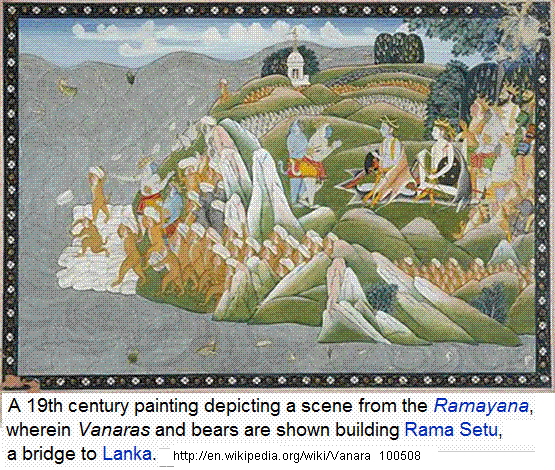
According to the Ramayana, the Vanaras lived primarily in the region of Kishkindha in present-day southern India, in the midst of Dandaka Forest, where Lord Rama met them during his search for Sita.[2] The Vanaras helped Rama in his search, and also in battle against Ravana, Sita's abductor. As described in the epic, the characteristics of the Vanara include being amusing, childish, mildly irritating, badgering, hyperactive, adventurous, bluntly honest, loyal, courageous, and kind.[3]
• Lord Hanuman,
devotee of Lord Rama
• Anjana,
Hanuman's mother
• Kesari,
Hanuman's foster father
• Sugriva,
king of
Kishkindha, son of
Surya
•
Vali, Sugriva's brother, and a son of
Indra
• Angada, son
of Vali, helped Rama find his wife
Sita
•
Tara, wife of Vali Created by
Brihaspathi
•
Gandhamadana, incarnation of
Kubera
• Nala, incarnation of
Vishwakarma
• Neela
UKT: End of Wikipedia article.
The following is from: NASA Images Find 1,750,000 Year Old Man-Made Bridge,The Hindustan Times, 10-10-2. http://www.rense.com/general30/nasa.htm 110917
WASHINGTON (PTI) -- The NASA Shuttle has imaged a mysterious ancient bridge between India and Sri Lanka, as mentioned in the Ramayana.
The evidence, say experts matter-of-factly, is in the Digital Image Collection.
The recently discovered bridge, currently named as Adam's Bridge and made of a chain of shoals, 30 km long, in the Palk Straits between India and Sri Lanka, reveals a mystery behind it.
The bridge's unique curvature and composition by age reveals that it is man-made. Legend as well as Archeological studies reveal that the first signs of human inhabitants in Sri Lanka date back to the primitive age, about 1,750,000 years ago and the bridge's age is also almost equivalent.

http://www.hindustantimes.com/news/181_81164,0003.htm
Courtesy NASA Digital Image Collection
UKT: More in the original article.
Go back vaanara-note-b
End of TIL file
