


p000.htm
• A Practical Sanskrikt Dictionary,
by A. A. Macdonell, 1893,
http://www.sanskrit-lexicon.uni-koeln.de/scans/MDScan/index.php?sfx=jpg;
1929.
-
Nataraj ed., 1st in 2006, 2012.
-
https://dsal.uchicago.edu/dictionaries/macdonell/ 190516
• The Buddhist Hybrid Sanskrit Grammar and
Dictionary, BHS, vol.2, by F. Edgerton,
pp. 627.
-
FEdgerton-BHSD<Ô> /
Bkp<Ô> (link chk 180627)
• The Student's Pali English dictionary ,
by U Pe Maung Tin, 1920.
- (ref: UPMT-PEDxxx).
Downloaded copies in TIL
HD-PDF and SD-PDF libraries:
-
UPMT-PaliDict1920<Ô> /
bkp<Ô> (link chk 190113)
• Pali-Myanmar Dictionary
(in Pal-Myan), by U Hoke Sein,
- (ref: UHS-PMD). The dictionary in printed form is in TIL Research Library.
• Latin-English Vocabulary II, by Hans H Ørberg, 1998
-
HHOrberg-LinguaLatina<Ô> /
Bkp<Ô> (link
chk 190624)
Edited by U Kyaw Tun (UKT) (M.S., I.P.S.T., USA),
Daw Khin Wutyi, Daw Thuzar Myint, Daw Zinthiri Han
and staff of Tun Institute of Learning (TIL).
Not for sale. No copyright. Free for everyone.
Prepared for students and staff of TIL
Research Station, Yangon, MYANMAR
-
http://www.tuninst.net ,
www.romabama.blogspot.com
MC-indx.htm |
Top
MCpp-indx.htm

UKT 181023: Nasals come close to vowels, and a study of nasals is a study of a subset of vowels.
•
Vowels - the backbone of a language :
acoustic phonetics
Vowels < a > < æ > and < ə >
: < é >
Back vowel /ɔ/
Formants
My substitute for
machine analysis
• Vocal vowels : a demonstration with "duck calls"
Africate consonants
•
Vowel sounds : vocal folds cords
Voiceless nasals
Codas or syllable-endings /
Onsets or syllable-beginnings
• Abugida-Akshara system of writing : different from
Alphabet-Letter system
Nuclear vowel vs. Inherent vowel [to be written]
 {þän-SkRRi.ta.} language
-- UKT 130828, ..., 190121, 200325

I realized long ago that the main difficulty
in inter-transcription between Burmese (Bur-Myan)
and English (Eng-Lat), is the problem of vowels.
Vowels are the backbone of a language. Bur-Myan
is non-rhotic, whereas British English is
somewhat rhotic, but the American English is more
rhotic. Then I ran into the highly rhotic vowel pair,
 {iRRi.} ऋ «ṛ» and
 {iRRi} ॠ «ṝ». The members of this pair are differentiated by the length of time
to utter them: "short" = 1 eye-blink, and "long" = 2 blnk.
{iRRi} ॠ «ṝ». The members of this pair are differentiated by the length of time
to utter them: "short" = 1 eye-blink, and "long" = 2 blnk.
In the above transcription of the word "Sanskrit", you'll notice a curious basic
consonant,
 {Ska.} ष्क «ska». This, and others of its kind
 {Sta.},
 {Spa.},
 {Sna.},
 {Sma.},
... , are unknown in Bur-Myan, but present in Eng-Lat. I've to postulate them
into BEPS, for the more urgent need of transcripting English into Burmese. I've
defined them as "Lisping consonants".
{Sma.},
... , are unknown in Bur-Myan, but present in Eng-Lat. I've to postulate them
into BEPS, for the more urgent need of transcripting English into Burmese. I've
defined them as "Lisping consonants".
In Skt-Dev, we meet more rhotic sounds than what we are used to
Pal-Myan. In fact Pal-Myan does not have the
highly rhotic vowel ऋ {iRRi.}, but has to
make-do with less rhotic representation of the
Ra'ric
 {ra.ric} sounds.
To the Westerners, differentiation into
short- and long-vowels is NOT important,
whereas in the Indic languages and
Bur-Myan, they are of prime importance.
Based on this idea of vowel duration,
measured in time-duration you take to
blink your eye, we can find which vowels
can form
 {þa.wuN} 'similar pairs' or beautifully
matched pairs, and, which when paired form
{þa.wuN} 'similar pairs' or beautifully
matched pairs, and, which when paired form
 {a.þa.wuN} 'dissimilar' or ill-matched pairs. The
idea of pairing is the same as in modern idea of
contrastive vowels and can be explained by Daniel
Jones' two-dimensional vowel quadrilateral. With
the inclusion of Skt-Dev, I had to explain the
highly rhotic vowel ऋ {iRRi.} (and its sign
ृ {RRi.}) by addition of lateral-rhotic
dimension.
{a.þa.wuN} 'dissimilar' or ill-matched pairs. The
idea of pairing is the same as in modern idea of
contrastive vowels and can be explained by Daniel
Jones' two-dimensional vowel quadrilateral. With
the inclusion of Skt-Dev, I had to explain the
highly rhotic vowel ऋ {iRRi.} (and its sign
ृ {RRi.}) by addition of lateral-rhotic
dimension.
Below, I have given how the standard IPA vowel quadrilateral aka trapezium is presented, and how I have first compared the Romabama vowels to IPA based on the presentation on DJPD16-xx. I have inserted Bur-Myan vowels in approximate positions. I have also shown the tongue positions and lip shapes, and have shown how IPA symbols are related to Burmese, Mon, and Sanskrit - languages covered by BEPS.


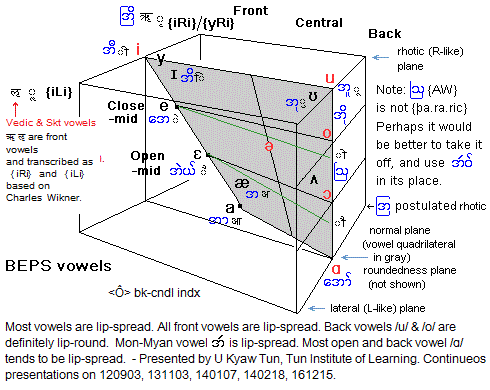
Inclusion of Skt-Dev, necessitates a three-dimensional representation to include very rhotic (common), and lateral (not so common) Skt-Dev vowels.

 Realizing that it is the vowels, more so than
consonants, that are responsible as to how we
speak and hear, I have included Chinese from an
entirely different linguistic group. See:
Realizing that it is the vowels, more so than
consonants, that are responsible as to how we
speak and hear, I have included Chinese from an
entirely different linguistic group. See:
-
https://en.wikipedia.org/wiki/Chinese_vowel_diagram
180624
I have also included vowels from southern
California English for comparison. See:
-
https://en.wikipedia.org/wiki/California_English
180624
For the front vowels, /a/, /ɛ/, /e/, /i/,
Bur-Myan has four,
 {a},
{a},
 {è:},
{è:},
 {é},
{é},
 {i}. English has only three: <a>,
<e>, <i>. Instead of
having two mid-vowels, it has only one,
<e>. However, we should note that
pronunciation-wise, there are not many English
words with vowel-sound /a/, instead we find
many with /æ/. Note a & e must
be written as a ligature æ , not separately.
{i}. English has only three: <a>,
<e>, <i>. Instead of
having two mid-vowels, it has only one,
<e>. However, we should note that
pronunciation-wise, there are not many English
words with vowel-sound /a/, instead we find
many with /æ/. Note a & e must
be written as a ligature æ , not separately.
ARTICULATORY SETTINGS
The three vowels <a>, <æ> and <ə> form a sort of a group. The vowel <a> is considered "long", and <æ> "short". Whereas the mid-central vowel <ə> is any-body's guess. For Bamah <a> (front vowel), English uses <ɔ> (back vowel).
 Do not think that the positions taken up by
the vowels, say "short /i/" represented
by /ɪ/ would be same at least between
dialects of American English. You will notice
that in the Californian dialect, /ɪ/ is
lower than /e/. Call in another language, say
Chinese, and, you are in a complete mess!
It is the reason why I have to confine myself
to languages of BEPS. I have to go into
Mon-Myan, because both Bamah (Burmese) and Mon use
the same basic script. Though the two languages
belong to different language groups, Bur-Myan
to Tib-Bur (Tibeto-Burman) and Mon-Myan to Aus-Asi
(Austro-Asiatic) group related to Dravidian
languages, and mutually non-understandable in
speech, Burmese and Mon can still be related
through Pal-Myan meanings.
Do not think that the positions taken up by
the vowels, say "short /i/" represented
by /ɪ/ would be same at least between
dialects of American English. You will notice
that in the Californian dialect, /ɪ/ is
lower than /e/. Call in another language, say
Chinese, and, you are in a complete mess!
It is the reason why I have to confine myself
to languages of BEPS. I have to go into
Mon-Myan, because both Bamah (Burmese) and Mon use
the same basic script. Though the two languages
belong to different language groups, Bur-Myan
to Tib-Bur (Tibeto-Burman) and Mon-Myan to Aus-Asi
(Austro-Asiatic) group related to Dravidian
languages, and mutually non-understandable in
speech, Burmese and Mon can still be related
through Pal-Myan meanings.
 The only firm conclusion I can arrive so far
is that vowels of all languages lie within
the vowel quadrilateral, and that
"long" vowels are further away from
the center than the "short" vowels.
The questions of closeness & openness,
and front-ness & back-ness is a matter of
differing opinions and nothing else. Graphical
representation of vowels in writing (scripts)
is just a guide to listening (sounds), and your
judgement is a good as that of an authority.
The only way to learn a language is to listen
how various "native" speakers speak.
The only firm conclusion I can arrive so far
is that vowels of all languages lie within
the vowel quadrilateral, and that
"long" vowels are further away from
the center than the "short" vowels.
The questions of closeness & openness,
and front-ness & back-ness is a matter of
differing opinions and nothing else. Graphical
representation of vowels in writing (scripts)
is just a guide to listening (sounds), and your
judgement is a good as that of an authority.
The only way to learn a language is to listen
how various "native" speakers speak.
 With the above background, when I came across
Georgian, I am simply flabbergasted!
With the above background, when I came across
Georgian, I am simply flabbergasted!
• Georgian Alphabetic-letter 'Tan' U10D7 თ /t/,
- cf. Myan Akshara-consonant{ta.} /ta./
• Georgian Alphabetic-letter 'In' U10D8 ი /i/,
cf. Myan Akshara-vow{i.} /i/; vow-sign
{i.}-sign changing to Georgian-vowel :
• Georgian Alphabetic-letter 'An' U10D0 ა /a/~/ɑ/
cf. Myan Akshara-vowel{a.} &
{au:}
You must not forget that my training is Chemistry and Chemical Engineering. I am not a linguist, nor a phonetician and I must leave it to my betters to solve the linguistic problems. I am presenting only what I have found. With my background as a Skeptical Chemist, with Robert Boyle as my model, my analysis must be very stringent.
 Now, here's something that would have pleased
my analytic-minded scientists of the 19th-20th
centuries: How hollow plastic models of the
human vocal track turn the squawk of a duck
call into vowel sounds.
Now, here's something that would have pleased
my analytic-minded scientists of the 19th-20th
centuries: How hollow plastic models of the
human vocal track turn the squawk of a duck
call into vowel sounds.
UKT 181022: By "duck" and "duck hunting" is meant the flying water-fowl. See:
- https://en.wikipedia.org/wiki/Waterfowl_hunting 181022
From:
http://www.exploratorium.edu/exhibits/vocal_vowels/vocal_vowels.html 150817


"Here is the sound source. It's really a
re-packaged duck call! Notice the reed above
the curved wooden surface. Air blows past the
reed (from right to left) causing it to vibrate
and produce a buzzing sound".
Let's listen to how ducks "speak"
duck-call-mp3<)) (link chk
200524)
and you can laugh your heads off.
laugh-mp3<))
(link chk 200524)
I don't aim for unifying speeches. Speeches are under the Curse of the Babel.
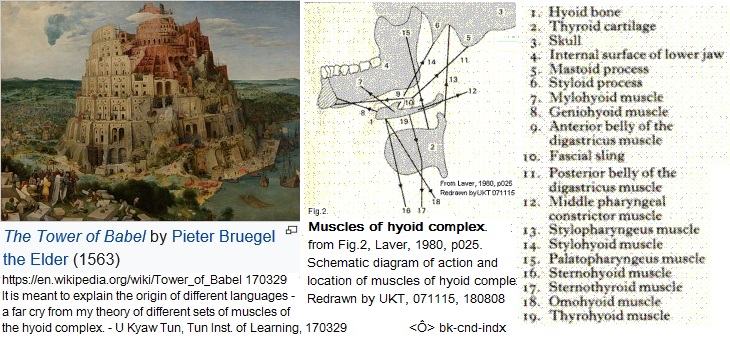
 I just aim for unifying the scripts through Romabama
 {ro:ma. ba.ma}. My aim is the aim of the
Buddhist-linguist Shin Kic'si,
{ro:ma. ba.ma}. My aim is the aim of the
Buddhist-linguist Shin Kic'si,
 {shin kic~sæÑ} praised by the Gautama Buddha. I'm
following in his foot-steps as King Asoka must have
done, about 250 years after the Buddha.
{shin kic~sæÑ} praised by the Gautama Buddha. I'm
following in his foot-steps as King Asoka must have
done, about 250 years after the Buddha.
To get a full understanding of the back vowel /ɔ/, known as "open-o",
I need to study Mon-Myan.

Both Mon speech and Burmese speech uses the same
basic Myanmar script, similar to French and
English speeches using the basic Latin script.
Myanmar script is unique in being the only language
based on circularly rounded circles, except perhaps
Georgian script : თ [Georgian Consonant
Letter Tan] & ი
[Georgian Vowel Letter In].
Mon-Myan and Bur-Myan are completely different languages. They even belong to different language groups. Mon belongs to Austro-Asiatic language group and Burmese to Tibeto-Burman group.
Listen to how Mon-Myan speakers sing their vowels :
- row#1vow<)) (link chk 200325)
- row#2vow<)) (link chk 200325)
Yet, because speakers of both languages are by
Theravada religion, they think the same way. They
eat the same diet, and treat their women-folk the
same with what might amount to reverence.
They place their mothers in place of honour, and
treat their wives almost the same as themselves.
To them the land they live on is their Mother-land.
In a way both are maternalistic societies -- a
trait which they probably acquired from the Pyus
who had worshipped the Mother Goddess - the Devi.


UKT 180624: The Mother-goddess Devi to us is very different from the one degraded to the status of the servile wife of the Shaivite omnipotent Siva.
How the vowel-sounds are produced by a living human being could not be observed directly until recently, because they are produced in the voice-box deep down the throat.
I came to know about it only after studying the
Principles of Phonetics and Phonology
-- still an ongoing topic for me. See my presentation,
¤ Human voice, Phonetics and Phonology -
HV-indx.htm (link chk 200325)
Unfortunately I have not looked into my
presentation for a long time and it is
now full of errors. In the presentation
you will come across
How sound is produced and heard
[former hv6.htm] -
snd-hear.htm (link chk 200325)
I am giving a section from it below:
As the inset figure illustrates, the vibrations of the vocal folds are the source of speech. The buzzing produced these vibrations is passed through the vocal tract, which serves as a resonant filter, damping certain frequencies and intensifying others. The result is the characteristic sound we identify as speech.
To hear what the buzzing of the vocal folds sounds are like before it enters the vocal tract, click (link chk 200325)
• excitation Krauss-excit<))
To hear the filtering action of the vocal tract, click
• vocal tract filter Krauss-filter<))
To hear the resultant speech, click
• speech Krauss-speech<))UKT131002, 160109: The above sound clips were in .AIF format. They have
been changed into .MP3 format by Daw Khin Wutyi on 160109
 To be more effective in teaching, how the
teacher articulated the sounds should also
be seen. In an article by Ruth Campbell,
The processing of audio-visual speech ,
Phil. Trans. R. Soc. B (2008) 363, 1001–1010,
download 160110, and stored in TIL HD-PDF and
SD-PDF libraries
To be more effective in teaching, how the
teacher articulated the sounds should also
be seen. In an article by Ruth Campbell,
The processing of audio-visual speech ,
Phil. Trans. R. Soc. B (2008) 363, 1001–1010,
download 160110, and stored in TIL HD-PDF and
SD-PDF libraries
- RCampbell-AudioVisual<Ô> /
Bkp<Ô> (link chk 200325)
Ruth Campbell states in 6. Complementarity and Redundancy in the Speech
Stream:
"To summarize, audio-visual processing is more effective than auditory processing of natural speech for two reasons. First, some segmental contrasts can be seen clearly, thus aiding speech comprehension, especially where those segments are acoustically confusable. Second, many features of an utterance can be perceived by both ear and eye: the audible and the visible patterns are highly correlated, reflecting the underlying dynamics of speech production. ..."
UKT 190421: After associating with teachers all my life, I notice that the most effective teachers are those who speak slowly, letting the student see the movements of his lips. Of course, hand-motions, and motions of the whole face of the teacher should be seen. I enjoy teaching a small class of 10 to 20. What I've failed to note is the McGurk effect .
See, Wikipedia: https://en.wikipedia.org/wiki/McGurk_effect 190421, 200326
"The motor theory of speech perception is the hypothesis that people perceive spoken words by identifying the vocal tract gestures with which they are pronounced rather than by identifying the sound patterns that speech generates. [1] [2] [3] [4] [5] [UKT ¶]"It originally claimed that speech perception is done through a specialized module that is innate and human-specific. Though the idea of a module has been qualified in more recent versions of the theory, [5] the idea remains that the role of the speech motor system is not only to produce speech articulations but also to detect them.
"The hypothesis has gained more interest outside the field of speech perception than inside. This has increased particularly since the discovery of mirror neurons that link the production and perception of motor movements, including those made by the vocal tract. [5]
If you're at the TIL research station you can watch the McGurk effect, by BBC
- McGurk-effect-audiovisual<Ô> / Bkp<Ô> (link chk 200326)
UKT 190421: The McGurk-effect acts differently on speakers of different languages. Wikipedia article of 190421 states: "People of all languages rely to some extent on visual information in speech perception, but the intensity of the McGurk effect can change between languages. Dutch, [36] English, Spanish, German, Italian and Turkish [37] language listeners experience a robust McGurk effect, while it is weaker for Japanese and Chinese listeners. [38]
Though audio-visual teaching is more effective, in
general, we can only hear (as in teaching by radio).
Worse, when both hearing and seeing is impossible as
making sense of an old language by looking at the
written script only - such as Pali of 2000 years ago
by modern Bur-Myan speakers - our understanding of the
meaning is bound to be full of errors. Even in the
case of the wife writing (or texting on her cell-phone)
to her husband in the next town, the husband can get
the wrong meaning. The remedy we use in Bur-Myan is to
use to use words coupled as


 {sa.ka:hpo-sa.ka:ma.}. Thus to differentiate the
meaning of "hot", we use
{sa.ka:hpo-sa.ka:ma.}. Thus to differentiate the
meaning of "hot", we use

 {pu-shûp} (for taste) and
 {pu-eik} (for weather).
We should realized that it is not only the articulations of speech sounds (carried by sound-waves) by the speaker, and the full hearing by the hearer that are important, but also the visual cues seen (carried by light-waves) produced by the speaker, and seen by the hearer, to get at the correct meaning of message. Augmented with the body-language, conveying ideas by speaking-hearing, and seeing the facial-movements are very important in teaching. Teaching via machines are less effective than by a live teacher in small classes.
- UKT 180728 :
I've been on the subject of Formant
/fɔːm(ə)nt/
 {fo-mín.} for quite sometime, and I need to update my knowledge from time
to time. The following is from:
http://person2.sol.lu.se/SidneyWood/praate/whatform.html 180728
{fo-mín.} for quite sometime, and I need to update my knowledge from time
to time. The following is from:
http://person2.sol.lu.se/SidneyWood/praate/whatform.html 180728

• A formant is a concentration of acoustic energy around a particular frequency in the speech wave. There are several formants, each at a different frequency, roughly one in each 1000Hz band. Or, to put it differently, formants occur at roughly 1000Hz intervals. Each formant corresponds to a resonance in the vocal tract.
• Formants can be seen very clearly in a wideband spectrogram, where they are displayed as dark bands. The darker a formant is reproduced in the spectrogram, the stronger it is (the more energy there is there, or the more audible it is):
From Hyperphysics: http://hyperphysics.phy-astr.gsu.edu/hbase/Music/vowel.html 181022, 200325
Five illustrations should be reproduced:
1. Forming the vowel sounds
2. Formation of vowel sounds
3. Vocal formants
4. Vowel formants
5. Representative vowel formant frequencies
Now that we have seen an example of continuous speech, we have to know how acoustic phoneticians are studying the individual vowels produce by various human subjects -- of different age groups, of different sexes, and of different linguistic groups.
Take note that the same vowel can sound differently in time-duration, pitch, and emphasis by the same person even during a short speech. The same vowel as uttered by the same person as individual vowel, in continuous speech and in singing.
The hearer depending on his L1 heard the same vowel differently. Relying on a group of trained phoneticians to judge the vowels is helpful only in a cursory study of a language. And you should remember that representing vowels in a diagram such as the quadrilateral of Daniel-Jones is an approximation at best.
UKT 200326: Because continuous speech by the same speaker can vary, it is very difficult to prove the identity of a speaker from a recorded telephone speech. Formant measurement is now a tool in forensic phonetics. See Variability of Formant Measurements by Philip Harrison, 2004, in TIL HD-PDF and SD-PDF libraries:
- PHarrison-VariabilityFormant<Ô> / Bkp<Ô> (link chk 200326)
"Abstract: One of the main types of analysis conducted by forensic phoneticians is forensic speaker identification. This involves providing an opinion as to the identity or non-identity of speakers across different recordings for legal purposes. One of the aspects of the analysis is the measurement and comparison of formant frequencies."
UKT: It brings back to my mind The Gulag Archipelago (Russian: Архипелаг ГУЛАГ), by Aleksandr Solzhenitsyn.
The present-day study of vowels depends on the instrumental measurement of sound waves. We need to pin down the vowels for designing computer sounds and for invention of artificial speech to teach a new computer and humanoid robots. A human subject is asked to "sing" a vowel and his voice-sound is recorded. From the analysis, quantities known as Formants are derived. The quantities that are measured are F1, F2, and F3.
Below is a comparison of vowels in F1 and
F2. Again an excerpt from:
How sound is produced and heard [former
hv6.htm] -
snd-hear.htm (link chk 200325.
Formants can be used to differentiate the vowels such as
{o} and
{au:}. These two vowels are of interest to my friend from MLC, U Tun Tint and me, because MLC transcribes the Bur-Myan
When I told my friend U (Dr.) Tun Tint of MLC that in Romabama, the transliteration for
{lûm:pau-ka. lu} would do it." And he is right! It is usual for male Burmese friends of the same age to address each other using the prefix
{ko} (such as how I address him --
{ko htwan: tín.}). If I were to write to him in English, I would address him as Ko Tun Tint.
The explanation for how this confusion had come about is on the way the English vowels /o/ and /ɑ/ are generally pronounced. The first three formants for /o/ and /ɑ/ are quite similar, and when we pronounce
{AU:}, foreigners might heard it as /o/. But to us, they sound as /ɑ/, and hence the Romabama transcription is
- UKT 181022, 190121, 200325
Ancient phoneticians of the East, mostly dedicated
individuals devoted to acquiring a knowledge such
as speech sounds had to rely on close observation of
how speech is produced. They are known as Rishis or
 {I.þi.} (following the northern-India usage) or
 {ra.þé.} (following the southern-India usage).
Remember, northern-India (principally Magadha
{ma-ga.Da.}), and northern-Myanmarpré (principally Taguang
{ta.kaún:} and Old Pagan) had extensive foot-links across the mountains since prehistoric times.
It is my conjecture that the ancient phoneticians
probably had humans trained to be
"computers" from childhood to assist them in
their research since the days of Indus-Sarasvati
civilization - an ancient civilization that had no formal
writing system. I base my conjecture on:
-
https://en.wikipedia.org/wiki/Human_computer
180625
"The term "computer",
in use from the early 17th century (the first known
written reference dates from 1613),
[1] meant "one who computes": a person
performing mathematical calculations, before electronic
computers became commercially available. ... The
approach was taken for astronomical and other complex
calculations. Perhaps the first example of organized
human computing was by the Frenchman Alexis Claude Clairaut
(1713–1765), when he divided the computation to determine
the time of the return of Halley's Comet with two
colleagues, Joseph Lalande and Nicole-Reine Lepaute.
[3]"
- https://en.wikipedia.org/wiki/Computer_(job_description)
200327
"The term "computer",
in use from the early 17th century (the first known
written reference dates from 1613),
[1] meant "one who computes": a person
performing mathematical calculations, before electronic
computers became commercially available. "The
human computer is supposed to be following fixed rules;
he has no authority to deviate from them in any detail."
[2] Teams of people, often women from the late
nineteeth century onwards, were used to undertake long
and often tedious calculations; the work was divided
so that this could be done in parallel. The same
calculations were frequently performed independently
by separate teams to check the correctness of the
results.
Since the end of the 20th century, the
term "human computer" has also been applied
to individuals with prodigious powers of
mental arithmetic, also known as
mental calculators.

 Now,
let's look at the writing system (if it did exist) of Indus-Sarasvati
civilization of Ancient India. And also at Rongorongo script of Easter Island in
the middle of Pacific Ocean which is probably related to Indus script. Both
these ancients scripts have defied decipherment. In the case of Indus script,
the question has been asked whether it is a form of recording speech, or a
logographic representation of ideas. I have suggested that it is ideographic,
based on the presence of Swastika, and included dots. The dots represent may
represent the circularly rounded script of Myanmar akshara, and that the arms of
the Swastika has closed to form a square, which is still used in Myanmarpré as
an Yan to expel evil. I have suggested that our Nan'ka'reín Mèdaw and the
Pashupati seal from Indus-Sarasvati civilization are related.
Now,
let's look at the writing system (if it did exist) of Indus-Sarasvati
civilization of Ancient India. And also at Rongorongo script of Easter Island in
the middle of Pacific Ocean which is probably related to Indus script. Both
these ancients scripts have defied decipherment. In the case of Indus script,
the question has been asked whether it is a form of recording speech, or a
logographic representation of ideas. I have suggested that it is ideographic,
based on the presence of Swastika, and included dots. The dots represent may
represent the circularly rounded script of Myanmar akshara, and that the arms of
the Swastika has closed to form a square, which is still used in Myanmarpré as
an Yan to expel evil. I have suggested that our Nan'ka'reín Mèdaw and the
Pashupati seal from Indus-Sarasvati civilization are related.
Read Is the Indus script indeed not a writing system?, by Parpola, Asko ,
2008
-
AParpola-IndusScript<Ô> /
Bkp<Ô> (link
chk 200327)
I further conjecture that the ancients finally devised a system of one-to-one mapping of speech to sound and produced the Akshara-system (Abugida-Akshara). The mapping must not be changed - ever lasting not changing as Atta the Creator-god itself. The present-day Bur-Myan, though an Abugida-Akshara system still had the aim of a one-to-one mapping, but is imperfect.
However, there had been short-cuts as in the Alphabetic
(Alphabet-Letter) system of Eng-Lat, and
French-Lat. Because the one-to-one mapping is not present,
the present-day Western phoneticians have to develop the
IPA (International Phonetic Alphabet) which is after all
is an Abugida-Akshara system. Sad to say IPA is not ASCII,
and I have develop my Romabama
{ro:ma.ba.ma} which is ASCII compatible
suitable for email and the Internet.
 I rely on the dictionaries of vocabularies developed by
the ancients to comparison of speeches of various
peoples, and arrive at the Basic vowels of BEPS for
comparing Bamah, English, Pali and Sanskrit speeches.
I rely on the dictionaries of vocabularies developed by
the ancients to comparison of speeches of various
peoples, and arrive at the Basic vowels of BEPS for
comparing Bamah, English, Pali and Sanskrit speeches.
Here you must note that I do not place much value on the Christian missionaries out to translate the English bible for the natives and their modern disciples. Their main goal is to convert the natives to Christianity - not to study the language.
-- UKT 131002, ... , 190121, 200325
Refer to: Source Filter Theory, General Phonetics, Louis Goldstein ( louisgol@usc.edu), Ling 580, Fall 2013. ,
http://sail.usc.edu/~lgoldste/General_Phonetics/Source_Filter/SFa.html 131002
https://annex.exploratorium.edu/exhibits/vocal_vowels/vocal_vowels.html 200325
See also
- LGoldsteinCAFowler-ArticulatPhonologPublic<Ô> / Bkp<Ô> (link chk 190121)
"The goals of the theoretical work that we describe here are twofold. We intend first to develop a realistic understanding of language forms as language users know them, produce them and perceive them. Second we aim to understand how the forms might have emerged in the evolutionary history of humans and how they arise developmentally, as a child interacts with speakers in the environment."
 As
a child, living in the country side, far away
from large cities, had brought me into contact
with hunters from the villages. I remember playing
(blowing on), bird-whistles made of baked clay
from the potteries of Twenté town near Yangon city. Living with Nature
has its charms, which have now been denied to
the city kids who have only imitations in form
of computers and internet to play with.
As
a child, living in the country side, far away
from large cities, had brought me into contact
with hunters from the villages. I remember playing
(blowing on), bird-whistles made of baked clay
from the potteries of Twenté town near Yangon city. Living with Nature
has its charms, which have now been denied to
the city kids who have only imitations in form
of computers and internet to play with.
Let's listen to how ducks "speak" duck-call-mp3<)) (link chk 190121)
My father, U Tun Pe, at that time was fond of sports
hunting. He went into the forests of Di-saing
 {di-hseïn} at the mouth of Toe River
 {to:mric} to hunt moderately large game animals.
The tropical rain forest was dense, and was the
habitat of leopards, but not tigers. The streams
were the home of crocodiles. Snakes? There were
plenty. They did not bother us - show them the
proper respect. And like all creatures including
the humans, they didn't want to be bothered. They
warned you when you were encroaching on their
territory. They are more humane than the human-terrorist!
{to:mric} to hunt moderately large game animals.
The tropical rain forest was dense, and was the
habitat of leopards, but not tigers. The streams
were the home of crocodiles. Snakes? There were
plenty. They did not bother us - show them the
proper respect. And like all creatures including
the humans, they didn't want to be bothered. They
warned you when you were encroaching on their
territory. They are more humane than the human-terrorist!
My father was then the Public Health Inspector of both Kungyangon North and South townships - probably the largest in the Hanthawaddy district. Public-health-wise, the village headmen had to report to him. He spent almost half of every month touring the villages by country boat and bullock cart. On day-trips, I, a child under 6, used to accompany him.
My father owned a double-barrel gun, licensed by the Deputy Commission ICS U Kyaw Khaing himself who was my father's classmate at Insein Govt. High School. The British-Burma administrators at that time, just at the end of Saya San rebellion, were very strict in issuing gun-licenses, but U Kyaw Khaing had allowed his friend the highest number of cartridges that he could use each month.
My father on his hunting trips, had to employ the local professional hunters who were mostly Buddhist Karens. Through them I came to know people who could make animal calls just with their bare hands.
The most prominent example of such a person
in history was Nga Zin, the sharp-shooting
hunter of Pagan period, who by making such
a sweet bird call that the rebellious Raman
 {ra-mûn}
fleeing down the Irrawaddy river, opened his
cabin-window on the raft. While Raman was
looking for the bird, the hunter shot him in
the eye (most likely with a cross-bow), and
killed him on the spot. Then Bur-Myan historians, who hated him, changed his
name to
{ra-mûn}
fleeing down the Irrawaddy river, opened his
cabin-window on the raft. While Raman was
looking for the bird, the hunter shot him in
the eye (most likely with a cross-bow), and
killed him on the spot. Then Bur-Myan historians, who hated him, changed his
name to

 {gna. ra-mûn kûn:} [
- prefix for a criminal;
- blind]. That was the end of
the Mon rebellion in which King Sawlu
{gna. ra-mûn kûn:} [
- prefix for a criminal;
- blind]. That was the end of
the Mon rebellion in which King Sawlu

 {sau:lu:mín:} (king
from 1078 to 1084), the son of King Anawrahta,
was executed by Raman. Raman was the son of
the wet-nurse of Sawlu, the breast-feeding
mate, and play-mate of King Sawlu.
{sau:lu:mín:} (king
from 1078 to 1084), the son of King Anawrahta,
was executed by Raman. Raman was the son of
the wet-nurse of Sawlu, the breast-feeding
mate, and play-mate of King Sawlu.
There is a question nagging me after I
started learning Mon-Myan the spoken language
which is mutually not understandable to
Bur-Myan speakers. Was King Anawrahta's
household completely bilingual in Bur-Myan
and Mon-Myan? Why did King Anawrahta had
a Mon wet-nurse instead of a Burman
for his infant son Prince Sawlu? Was
Anawrahta himself, a half-Mon half-Burman?
What was the ethnicity of Anawrahta's father
King Kunzaw
 {kwum:hsau
mín:}? [
- tax-collector] - a Mon in the
employ of King Taungthugyi
{kwum:hsau
mín:}? [
- tax-collector] - a Mon in the
employ of King Taungthugyi  {taung-þu-kri:
mín:} [
{taung-þu-kri:
mín:} [ - farmer]. Why did both Kunzaw and his
mother became ma'nes
- farmer]. Why did both Kunzaw and his
mother became ma'nes
 {nût} - protector spirits - after their deaths?
It is inconceivable that they died in sorrow -
a condition of mental state at the time of
death. They must have died with extreme love
and attachment - another mental state - to
their immediate family. Kunzaw became the
Lord with the White Umbrella
{nût} - protector spirits - after their deaths?
It is inconceivable that they died in sorrow -
a condition of mental state at the time of
death. They must have died with extreme love
and attachment - another mental state - to
their immediate family. Kunzaw became the
Lord with the White Umbrella
 {hti:hpru-hsaung: nût} (#09/37*), and his
mother the
{hti:hpru-hsaung: nût} (#09/37*), and his
mother the
 {hti:hpru-hsaung: mèý-tau} (#10/37*)
during the reign of their progeny King
Anawrahta
{hti:hpru-hsaung: mèý-tau} (#10/37*)
during the reign of their progeny King
Anawrahta
 {a.nau-ra.hta mín:} .
* List number of
(all following links chk 190121)
-- flk-ele-indx.htm
and proceed to Ch.07. Thirty-seven Lords: list - ch07-nat-list.htm
and proceed to ch07-0922.htm
Now, you will have to forgive me for running away with my imaginations! I must get back to my ducks and duck-whistles.
AH<))
EE<))
EH<))
OH<))
OO<))
AH approx.{a}, EE approx.
{i}, EH approx.
{é}, OH approx.
{au}, OO approx.
{u} . (all links chk 200326)
The above 5 sounds are from http://sail.usc.edu/~lgoldste/General_Phonetics/Source_Filter/SFa.html 131002
Each picture shows the shape of your vocal tract when you say a different vowel. We've reproduced the plastic models next to the diagram for your convenience. Note that while the plastic models are straight, the vocal tract is bent almost 90 degrees in the middle.In North America, Canada and the U.S., duck hunting as a sport was quite popular when I first came to study at the Institute of Paper Chemistry, Appleton, Wis. Paper making is a forest-product industry, and many of my class mates were avid duck shooters. They showed me how they hunted ducks, and one of them had asked me to shoot just once - not at a flying duck, but at a clay-pigeon. I made a direct hit and my score was 100 percent. When offered to do a second time, I refused. That might have brought my score to 50% ! That was the one and only time in my life, that I have ever fired a gun. North American old timers can make duck-whistles from wood. And now the duck whistles are made of plastic.

 The length of a vowel is measured qualitatively
by the measure of the speaker's eye-blink (blk)
or mata
The length of a vowel is measured qualitatively
by the measure of the speaker's eye-blink (blk)
or mata
 {mût~ta.}. A Skt-Dev short vowel is 1 blk long,
and a long vowel is 2 blk. The corresponding
vowels in Bur-Myan are the three pitch-registers:
creak 1 blk, modal 2 blk, and emphatic 2 blk with
emphasis.
{mût~ta.}. A Skt-Dev short vowel is 1 blk long,
and a long vowel is 2 blk. The corresponding
vowels in Bur-Myan are the three pitch-registers:
creak 1 blk, modal 2 blk, and emphatic 2 blk with
emphasis.
Romabama has to compromise the two as
shown on the right. To integrate Mon-Myan,
Romabama has to introduce a short-creak 1/2 blk:
 {a:.}. However, in
 Bur-Myan this sound is
represented by
Bur-Myan this sound is
represented by
 {aa.}. Note the three-dots {:.} which has been
borrowed from Tamil, ஃ visarga.
{aa.}. Note the three-dots {:.} which has been
borrowed from Tamil, ஃ visarga.
Eng-Lat is missing in one front vowel and two back vowels, and also three nasals which makes inter-transcription between Burmese and English very difficult. Romabama attempts to overcome such problems by making what engineers call a "happy medium" which nobody likes but which has to be accepted for utility sake!
- UKT 20032 :
 Affricate consonants are between plosives and fricatives,
exemplified by {sa.} च .
Affricate consonants are between plosives and fricatives,
exemplified by {sa.} च .
"It is a phoneme which combines a plosive with an immediately following
fricative or spirant sharing the same place of articulation, e.g. ch as in
chair and j as in jar . --
https://www.lexico.com/en/definition/affricate 200326
From Wikipedia: https://en.wikipedia.org/wiki/Affricate_consonant 200325
"An affricate is a consonant that begins as a stop e.g.
{ga.} and releases as a fricative e.g.,
{ya.pín.}, generally with the same POA (place of articulation) (most often coronal). It is often difficult to decide if a stop and fricative form a single phoneme [monosyllabic] or a consonant pair [disyllabic]. [1] English has two affricate phonemes, /t͡ʃ/ and /d͡ʒ/, often spelled ch and j , respectively. "
In Bur-Myan ch and j appear as medials [monosyllabic]:
 {hkya.} and
 {gya.}. Since both are conjuncts, they break down under a virana {a.þût}. Since
we need them as basic consonants in BEPS, I have to rewrite them as:
{gya.}. Since both are conjuncts, they break down under a virana {a.þût}. Since
we need them as basic consonants in BEPS, I have to rewrite them as:
 {ch.}/
 {c}, and
 {ja.}/
 {j}.
{j}.
- UKT 150819, ... , 181022, 200326

Refer to: Human voice, Phonetics and Phonology - HV-indx.htm (link chk 200326)
and proceed to: Alpha and Beta [former hv2.htm] - AlphabetLetter.htm (link chk 200326)
Where in the mouth the consonants are produced
can be easily seen. These places are known as
Points of Articulation (POA). The most easily
recognizable part in an open mouth is the Uvula
'little grape' or
 {lhya-hkïn} (MLC MED2006-468). The moving part from
which Uvula 'little grape' or
{lhya-hkïn} is hanging is known as the velum.
{lhya-hkïn} (MLC MED2006-468). The moving part from
which Uvula 'little grape' or
{lhya-hkïn} is hanging is known as the velum.
UKT 181022: Lack of dental fricatives in Bur-Myan has lead to innovations for
{sha-hkín}.
Bur-Myan
But the vowels are produced deeper in the throat in the larynx. How the vowels are produced by a living human being could not be observed directly until recently, because they are produced in the voice-box deep down the throat.
The organ that is responsible for vowel-sound production in the larynx are the vocal-folds in the sound-box. They the source of human-speech. They have been termed vocal-cords, and people have misunderstood them to be like cords or strings of a guitar. A guitar-string vibrates and produces a sound - a mechanical sound, but a human vocal-folds vibrate and produce human speech.
Animations downloaded from:


-
http://www.ims.uni-stuttgart.de/phonetik/EGG/page5a.htm
recent 150820
• Right: quiet breathing • Left: speaking
During normal breathing the glottal area is more open
(about 1 sq-cm) while during phonation the area is
much reduced (0.05 to 0.1 sq-cm.). During speaking
(phonation), the movements are more complex. The
terms used are:
ab·duct v. tr. 2. Physiology To draw away from the midline of the body
or from an adjacent part or limb.
ad·duct v. tr. Physiology 1. To draw inward toward the median axis of the body
or toward an adjacent part or limb.

 Until the invention of the Video Laryngoscope, there
was no way to see where the vowels were produced in
a living person. I came to know about it only after
I have studied the Principles of Phonetics and
Phonology -- still an ongoing topic for me. See my
presentation, HUMAN VOICE
Until the invention of the Video Laryngoscope, there
was no way to see where the vowels were produced in
a living person. I came to know about it only after
I have studied the Principles of Phonetics and
Phonology -- still an ongoing topic for me. See my
presentation, HUMAN VOICE
- HV-indx.htm (link chk
200326),
and proceed to How sound is produced and heard
[former hv6.htm]
- human-snd.htm (link chk
200326).
UKT 181023: See downloaded paper on Glottography, by P. Mitra, 2004 in TIL HD-PDF and SD-PDF libraries:
- PMitra-Glottography<Ô> / Bkp<Ô> (link chk 190121)
"Speech is produced by the acoustic excitation of the vocal tract by an air stream derived from the lungs and pulsed at a rate that is determined by the vibration of the speaker's vocal folds. The frequency of vocal fold vibration determines the pitch of the voice, which is directly correlated to intonation [1]. The manner in which the vocal folds vibrate contributes to the sound quality produced by the speaker."
Yet it is possible that the ancient Eastern
phoneticians, like Panini

 {hsa.ra pa-Ni.ni.}, might have studied the
vowels in speech by placing their sensitive fingers
around the throat to feel the vibrations while
their human subject - most probably the investigator
himself - had been speaking.
{hsa.ra pa-Ni.ni.}, might have studied the
vowels in speech by placing their sensitive fingers
around the throat to feel the vibrations while
their human subject - most probably the investigator
himself - had been speaking.
UKT 181023: Ancients phoneticians or grammarians, like Pāṇini
Such Rishis are still found in modern Myanmarpré, just like the one " perfecting the abilities of the human body" gazing into the mid-day sun, who could be seen on the platform of the Shwédagon Pagoda. For these pursuit one needs a "concentrated mind" and the "ability to control his bodily functions such as breathing, ability to stand a long duration without nutriments. I have been one of those and could stand long hours of fasting for as much as 150 hours taking only water. My experience was, at the end of 140 hours, my intestines and large bowel started bleeding passing on black tarry stools. I carried on for 10 more hours to fulfill my "vow", and came out of the session feeding the body with small sips of water containing palm sugar. My personal physician had thought I would surely die, but I knew I would survive.
During such session, one has to use the Yogic practice of breath control. During that time, the mind becomes very sharp and I could record my thoughts clearly. Siddhartha Gaudama (who became the Buddha) went into such sessions nearly killing himself. Because of his acute mind he discovered the Four Noble Truths, and Anatta Principle. I presume Pāṇini
It is said that the "vowel sound is a free-flowing sound" which can be either laminar flow (voiceless or vl.), or turbulent (voiced or vd.) within one "puff" of air coming out of the glottis.
Bur-Myan and most of the languages
have only voiced basic vowels, but there
are some languages which have voiceless
vowels (Wikipedia
http://en.wikipedia.org/wiki/Vowel
071230).
See also: Voiceless nasal sounds in three Tibeto-Burman languages, by
Katia Chirkova, Patricia Basset, Angelique Amelot, 2019
- KChirokovaEtAl-VlNasalsTibBur<Ô> / Bkp<Ô> (200326)
"Our study (i) contributes to a better understanding of voiceless nasals as a
type of sound; (ii) provides a first-ever instrumental description (acoustic and
aerodynamic) of the voiceless nasal glottal fricative [ ], as attested in a
number of Tibeto-Burman languages of Southwest China; and (iii) suggests a
possible phonetic basis for the observed dialectal and diachronic variation
between voiceless nasals and [ ] in some Tibeto-Burman languages.
What has been touted as voiceless
Bur-Myan vowels in
http://www.phonetics.ucla.edu/vowels/chapter12/burmese.html
150819, 181023
are not basic vowels, but vowels of
monosyllabic medials, which are present in
Bur-Myan.
Skt-Dev does not have these sounds. Since the Western phoneticians had started their study of the sound systems of India and Burma - Burma at that time-period in history was considered by the Westerners to be just a province of India - they must have had come to wrong perceptions.
UKT 150923: It is interesting to note that when the British-India participated in the Olympic Games at one time, there was a weight-lifter from Burma, U Zaw Waik by name.

He hailed from Natsingoan
{nût sín koan: rwa} village in North Kungyangon township. U Zaw Waik was in the team. It was said that he had to parade at the opening ceremony wearing an Indian turban ! What an insult to the proud Burmese of my father's generation. I am sorry I can no longer check the facts I was told.
Leaving aside the Indian turban, see the following:
- https://www.sports-reference.com/olympics/athletes/we/u-zaw-weik-1.html 180625
"U Zaw Weik competed for India* in weightlifting at the 1936 Olympics, but he was a native of Burma, now called Myanmar. He began lifting weights for training in 1929 and quickly became the top lifter in that nation, breaking British Empire records in 1933 through 1935, when he won the All-India Weightlifting and Bodybuilding Contest in Kolkata. After the 1936 Olympics Weik and his mentor, U Shein, visited England and London's Hyde Park inspired them, seeing the freedom of speech enjoyed by the British people. They realized that colonial rule deprived the Burmese of their fundamental rights and they returned to Burma with a nationalistic goal. Weik worked alongside the leaders of the independence movement to resist British Imperialism. Weik also established the Burma Olympic Association in 1946, and served as their director after Burmese independence was achieved in 1948. Prime Minister of Burma, U Nu, awarded him an Honorary Bachelor of Arts degree and the title of Wunna Kyaw Htin."
* UKT 180626: the facts given above are misleading. #1. U Zaw Weik never competed for India: India as well as Burma were part of British-India. The flag shown is simply wrong.A CIVIL SERVANT IN BURMA , by Sir Herbert Thirkell White, K.C.I.E., 1913, in TIL HD-PDF and SD-PDF libraries
- HTWhite-CivilServ<Ô> / Bkp<Ô> (link chk 190121)
states, in Chapter 1: Introductory, on p1: "Burma is a Province of the Indian Empire. It is not, as some suppose, a Crown Colony administered directly under the Colonial Office. Nor is it, as others do vainly talk, a foreign State where Britain is represented by Consuls. It is the largest, yet the least populous, of Indian Provinces, more extensive even than undivided Bengal."Sir Herbert continues, in Chapter 1: Introductory, on p8: "I found Burma a bright and pleasant land, green and forest-clad, with a climate healthier on the whole than the average climate of Indian plains ; its people singularly human, cheerful, and sympathetic ; its officers of all ranks companionable and friendly. My own considered opinion is that, in many respects, Burma was one of the best provinces for a public servant."
 The
examples of Bur-Myan - not Pal-Myan - cited are the
The
examples of Bur-Myan - not Pal-Myan - cited are the
 {ha.hto:}-sounds,
and true basic vowels. Transliterated into Bur-Myan:
{ha.hto:}-sounds,
and true basic vowels. Transliterated into Bur-Myan:
Voiced:
{na.}, ---
{Ña:},
(r5c5) (r4c5) ------ (r2c5) (r1c5)
true-nasals -------- semi-nasalsVoiceless:
{mha.},
{nha},
{Ñha:},
{gnha.} - conjuncts: break up under Virama
The examples given for r2c5 is not exactly correct
because of the long-lost akshara
Nya-major
{Ña.}/
 {Ñ} which is not found in any language that I've
come across. What is present is
Pal-Myan is palatal affricate
{Ñ} which is not found in any language that I've
come across. What is present is
Pal-Myan is palatal affricate
 {ña.}/
 {ñ}. This has led me to the discovery that Nya-major
{Ña.}/
{Ñ} is a palatal approximant by the side of velar approximant
{ñ}. This has led me to the discovery that Nya-major
{Ña.}/
{Ñ} is a palatal approximant by the side of velar approximant
 {ya.}/
 {ý}. See my modified table of Consonants
given below.
{ý}. See my modified table of Consonants
given below.

UKT 181024: The first two
However, in the Bur-Myan and Pal-Myan akshara tables there are two contenders for r2c5, Nya-major
Pal-Myan
{ñ~ña.}
which leads us to curious way in which words like Pyin'nya 'education'{píñ~ña} is pronounced
Burmese taken together with Pali has many such arbitrary rules, and we are required to use mnemonics such arbitrary rules. For BEPS-Myanmar and Romabama, I've no option but to improvise as in the case of the modified consonantal table given above.
Since r1c5 & r2c5 have properties different from r4c5 & r5c5, I've to come up with new terms "semi-nasals" for the first pair, and "true-nasals" for the second. The first semi-nasal is so different from the rest that it is
{ng} (a nasal). Notice the change of position between g and n - a hypothesis after a study of Mon-Myan Peguan dialect which is more akin to Bur-Myan that Martaban dialect. See the observations of British scholars such as Haswell and Temple:
# Grammatical notes and Vocabulary of the Peguan Language, by J.M. Haswell, Rangoon, American Mission Press, 1874
- MV1874-indx (link chk 190121)
- in TIL HD-PDF and SD-PDF libraries
- JMHaswell-PeguanGrammVocab<Ô> / Bkp<Ô> (link chk 190121)
# Notes on the transliteration of Burmese alphabet into Roman characters, and vocal and consonantal sounds of the Peguan or Talaing language, by R.C. Temple, Rangoon 1876, in TIL HD-PDF and SD-PDF libraries
- RCTemple-Translit-Bur<Ô> 1876 / Bkp<Ô> (link chk 190121)
 After leaving the glottis, the signal carrying air
puff has to travel upwards along the pharynx which
opens into the mouth (oral) cavity and slightly
further up into the nose (nasal) cavity. The flow
can be modified by placing restrictions to the path,
as in the flow of water in a concertina-like
plastic-piping system. The restrictions can be
"valves" and/or "weirs". The
modification is also brought about by changes in
the "shape" and/or "length" of
the pipe. Never compare the vocal system to a system
of rigid metal pipes with trap-door-like valves.
After leaving the glottis, the signal carrying air
puff has to travel upwards along the pharynx which
opens into the mouth (oral) cavity and slightly
further up into the nose (nasal) cavity. The flow
can be modified by placing restrictions to the path,
as in the flow of water in a concertina-like
plastic-piping system. The restrictions can be
"valves" and/or "weirs". The
modification is also brought about by changes in
the "shape" and/or "length" of
the pipe. Never compare the vocal system to a system
of rigid metal pipes with trap-door-like valves.
See Mechanical model of speech production
- http://www.haskins.yale.edu/featured/heads/simulacra/riesz.html 150819
UKT 150819: Though a wrong model because of the rigid structure, it could still reproduce "human like" sound with a good operator. The functions of parts are explained in the article.
The air from the lungs passes through the glottis where the vocal folds (not like strings: the term "vocal cords" is wrong) are. They are situated just below where the tract of pharynx splits into the trachea and the esophagus. Air coming past the vocal folds are in little puffs.
 It should be noted that as with all valves used in
fluid flow, the soft palate can be completely open
or tightly shut, or somewhere in between. We should
always remember that there is a pronunciation
difference between rapid speech (used by common people)
as opposed to careful speech (as used by lawyers,
politicians and public speakers). The nasal/oral
opposition concerns not only the consonants but vowels
as well.
It should be noted that as with all valves used in
fluid flow, the soft palate can be completely open
or tightly shut, or somewhere in between. We should
always remember that there is a pronunciation
difference between rapid speech (used by common people)
as opposed to careful speech (as used by lawyers,
politicians and public speakers). The nasal/oral
opposition concerns not only the consonants but vowels
as well.
John Laver (1980, p.70) writes:
"The physiology of the velopharyngeal system has been the subject of research by many workers, though largely from other disciplines than general phonetics. The facts about the action of the groups of muscles that serve to open and close the velum are reasonably well established. ... We are thus obliged to accept that different speakers may achieve auditorily (and perhaps articulatorily) similar results by physiologically different means. This is very likely to be true not only of the velopharyngeal mechanism, but of the entire speech apparatus. ... It is to be stressed that the velum does not move like a hinged trap door -- as is so often claimed in various books. In reality, the palate represents the anterior portion of the complex velopharyngeal valve, which functions mainly as a circular sphincter. " -- The Phonetic Description of Voice Quality by John Laver, Univ. of Edinburgh, Cambridge Univ. Press. 1980, p70-75, part of the book available in http://www.ling.mq.edu.au/ling/units/sph302/papers/laver_1980_nasal.pdf 071029
 As the inset figure illustrates, the opening
& closing of the vocal folds produces vibrations.
These vibrations give rise to patterns of compression
and rarefaction of the air around in the form of a
longitudinal wave.
As the inset figure illustrates, the opening
& closing of the vocal folds produces vibrations.
These vibrations give rise to patterns of compression
and rarefaction of the air around in the form of a
longitudinal wave.
This is what we called a sound wave. And thus the
vocal folds are the source of speech.

The vibrations can be represented in the form a waveform with in two dimensions of time (vertical) and intensity (horizontal). As the puff of air passes through the vocal tract which acts as a resonant filter, certain frequencies are damped and others intensified, the waveform is changed. The inset figure is the waveform of a continuous speech with many syllables.
To hear what the buzzing of the vocal folds in continuous speech sounds like before it enters the vocal tract, click (all following links chk 200327)
• excitation - Krauss-exit-mp3<))
To hear the filtering action of the vocal tract, click
• vocal tract filter - Krauss-filter-mp3<))
To hear the resultant speech, click
• speech - Krauss-speech-mp3<))
 A syllable has its own wave form, e.g. a
syllable with /iː/ (long - 2 blk). You
can see how an Australian English speaker
would pronounce a word h_d with the
/iː/ nuclear vowel. The onset
consonant h is quite different from
the coda d . The nuclear vowel
i is the most prominent. - from:
-http://clas.mq.edu.au/speech/acoustics/waveforms/speech_waveforms.html
150819
A syllable has its own wave form, e.g. a
syllable with /iː/ (long - 2 blk). You
can see how an Australian English speaker
would pronounce a word h_d with the
/iː/ nuclear vowel. The onset
consonant h is quite different from
the coda d . The nuclear vowel
i is the most prominent. - from:
-http://clas.mq.edu.au/speech/acoustics/waveforms/speech_waveforms.html
150819
In the production of human speech-sounds, there are two ways in which air can flow, depending on the position of the soft palate (velum). The soft palate acts like a valve which can completely shut off or open the nasal resonators, or stay in half way positions. However, because of the involvement of more than one pair of muscles in lowering and raising the velum, the action is far more complex than opening or closing a mechanical valve.

Onset
{Na.},
Coda{N},--
{n},--
{m}
Solely because I couldn't find a suitable Letter to stand for
In producing the nasal-codas, (with killed-nasal consonants /ŋ, ɲ, ɳ, n, m/ or
{ng},
{ñ}*,
{N},
{n},
{m}, the soft-palate is
lowered opening the nasal resonator. Remember,
nasal-codas are mute. They become syllables
only when preceded by a vowel such as {a.}. The air then flows
through both the nasal channels (nose: there are
two) and the oral channel (mouth).
* UKT 180626: I have now determined that Bur-Myan Nya-major
In producing onset sounds, there can only be two nasals:
{na.} and
{ma.}.
In the production of oral sounds (with both oral consonants and nasal consonants such as:
column#1:
{ka.} /k/,--
{ta.} /t/,--
{pa.} /p/
column#2:{hka.} /kʰ/,
{hta.} /tʰ/,
{hpa.} /pʰ/
column#3:{da.} /d/,-
{ba.} /b/
column#4:{Ga.},------
{Da.},---
{Ba.} - no IPA equivalents
the soft-palate is raised shutting off the nasal resonator, and air flows only through the mouth. However, in the case of nasals, the soft-palate is open, and air flows through the nose and mouth.
column#5:
*UKT 180627: ThoughUKT 180627: In addition to ŋ (velar), ɲ (palatal), ɳ (retroflex), Bur-Myan has {än} /ûn/ - a nasal without a definite POA, because of which I specify the shortage as 3+1.
English-speakers cannot pronounce the velar ŋ properly, and what they could not do, they simply silence it, and pronounce <gnome> as /nəʊm/ US /noʊm/ and <gnat> /næt/.
They now have silent-letters, such as <knee> /niː/ and <knight> /naɪt/. See: a compilation by Julie Peters in HD-PDF and SD-PDF libraries
- JPeters-SilentLetters<Ô> / Bkp<Ô> (link chk 190121)
-- UKT 130828, ... , 180624, 200327
Writing or editing a dictionary on Indic & Myanmar languages is a mess until one keep in mind that the mediums of writing. English uses Alphabet-Letter system, whereas Indic & Myanmar languages use Abugida-Akshara system. The target languages which we have in mind are primarily Sanskrit (Skt-Dev), Pali (Pal-Myan) and Burmese (Bur-Myan). Other akshara languages such as Mon-Myan and Bangla-Bengali (Ban-Ben) may be included later.
The two writing systems, the Abugida-Akshara and the Alphabet-Letter, are entirely different. In all akshara systems, you must differentiate between the speech or the acoustics of the language, and the script or the glyphs the marks you make on palm leaves or paper. To make a durable presentation, the marks are made on stone (inscriptions), or durable metals such as gold and silver. The marks are made by writing with a stylus or a pen. The marks are made more visible by rubbing in lamp-black into the scratches, or when a pen is used regular ink is employed.
Writing on palm leaves with a stylus is still practiced in Myanmarpré by astronomers-astrologers for each person giving the exact time of date, day and time of birth based on the Myanmar luni-solar calendar. Since, the date depends on a particular luni-solar calendar, which has seen changes during the long history of the country, the positions of the planets, and the asterisms are calculated and recorded. Do not forget that the Western calendar has been changed within our living memory, and changes to the dates of birth of historical persons, and historical events have to be specified in BC or AD. Similarly, the time-keeping devises have been changed and so when recording the "hour, minute, and second" of birth, the time-keeping system must be specified. The Western historians are only now beginning to realize the utility of such a system for keeping track of historical events which could be checked by modern day astronomy.
Astrology or the art of prediction depends on observable cyclical repetitions of events. You can leave the magic associated with gods and goddesses aside as I usually do. The two cycles that I take note of are the 60-yr and 30-yr cycles and their multiples. See also: Technical analysis - https://en.wikipedia.org/wiki/Technical_analysis 180624
"A core principle of technical analysis is that a market's price reflects all relevant information impacting that market. A technical analyst therefore looks at the history of a security or commodity's trading pattern rather than external drivers such as economic, fundamental and news events. It is believed that price action tends to repeat itself due to the collective, patterned behavior of investors. Hence technical analysis focuses on identifiable price trends and conditions. [25] [26] "UKT Personal note 180624: Migrating to Canada, after 33-34 yrs of serving our mother-land Myanmarpré, both my wife and I found ourselves unemployable. Then, I studied the stock market trends and traded on stocks and options using my own research in technical analysis. Though not 100% predictable, my method worked. It eventually led to the founding of Tun Investment Limited (TIL) incorporated in the Province of Ontario. I finally had to stop trading because it became a burden to my aging heart.
The basic unit of an Alphabet is a Letter
which is mute, but the basic unit of an
Abugida is an Akshara whether in speech or
script. Akshara is a syllable. And so the word
 {þûd~da}, loosely translated as 'Grammar',
gives us the system of speech-sounds which
has been extended to script.
{þûd~da}, loosely translated as 'Grammar',
gives us the system of speech-sounds which
has been extended to script.
The primary speech sounds we will concentrate
on in an Abugida-Akshara system are the
vowels
 {þa.ra.} and the consonants
 {byæÑ:}.
vowel:
सर «sara» 'short vowel', स्वर «svara» 'vowel' - SpkSktconsonant:
व्यञ्जन «vyañjana» 'consonant' - SpkSkt
Vowels are of two kinds: the free vowel, and the bound vowel (bounded in a consonant when it is known as the inherent vowel). For comparing different languages of BEPS, we will concentrate on the short vowel 1 blk of cardinal vowels of the Daniel Jones.
Free vowels
front vowels: /a/
back vowels: /u/{u.} उ «u»; /ɑ/
Bound vowels in
front vowels:{ki.} कि «ki»
back vowels:{ku.} कु «ku» ;
{kau:} को «ko»
The Abugida-Akshara writing system is described under the rubric Abugida. The term Abugida is a relatively new introduced by Peter T. Daniels only in 1990.
Even now, Akshara system of writing is not well understood thanks to sources like Wikipedia: http://en.wikipedia.org/wiki/Abugida 130828 which does not mention the term "syllable" - the basic unit of the system.
I came across the different systems of writing in the website Ancient Scripts a long time ago. http://www.ancientscripts.com/ 130828. Unfortunately, the format has been changed from the much simpler format which to me was more informative than the present one.
Though the basic unit of the Abugida-Akshara
system is the syllable, there are difference
in writing them. An importance difference
between Skt-Dev and Bur-Myan vowels are in
split-vowels. Skt-Dev has no split-vowels.
An Indic script that has split-vowels is
Bangla-Bengali:

English speakers might be surprised to know that Eng-Lat a3so has split-vowels in the so-called Magic-E, in which the coda-consonant is placed between the basic vowel and the ending-E, changing the pronunciation, e.g.
<kit> --> <kite>
Old notes from various old TOCs
 {hswè:byæÑ:}
- UKT 181127
Hanging-on consonants
{hswè:byæÑ:} are very common in Mon-Myan.
For the time being I'm treating them as a di-syllables. See Section 5 on Myanmar
languages & culture, in particular
# Basic Mon-Myanmar (Martaban)
Language (in Burmese) by Naing Maung Toe,
Rangoon, 2007, p.047 in TIL HD-PDF and SD-PDF
libraries
-
NaiMgToe-MonBur<Ô> /
Bkp<Ô> (link chk 180327)
See also:
# Grammatical notes and Vocabulary of the
Peguan Language, by J.M. Haswell, Rangoon,
American Mission Press, 1874
-
JMHaswell-PeguanGrammVocab<Ô> /
Bkp<Ô> (link chk 180327)
Entries on r1c5 (of akshara-matrix), the semi-nasals as
onsets are missing in Pal-Myan, and U Hoke Sein
has jumped from r1c4
{Ga.} to r2c1
 {sa.}/
 {c}. However for comparison with Bur-Myan and
Néwari-Dev, I have inserted a dedicated file,
on r1c5
{gna.}-onset - the semi-nasal.
{c}. However for comparison with Bur-Myan and
Néwari-Dev, I have inserted a dedicated file,
on r1c5
{gna.}-onset - the semi-nasal.
Both phoneme and grapheme of r1c5
are problematical because Mon-Myan it is written
and pronounced as
 {gné}. It is nasal only in the coda:
 {ng} as in English word <king> where
g is silent. See
{gna.}/
{ng}
p090-1B.htm
{ng} as in English word <king> where
g is silent. See
{gna.}/
{ng}
p090-1B.htm

Though
Hanging-consonants
{hswè:byæÑ:} are more numerous in Mon-Myan, Bur-Myan (ancient Pagan
& Tavoyan-dialect) also has two: Hanging-La
 {la.hswè:} and Hanging-Wa
 {wa.hswè:}. Now the first problem is what is the hanger-on /l/: is it La-major
 {La.}, or La-minor
 {la.}? Since in both Bur-Myan and Mon-Myan, the hanger-on is La-minor
{la.}, the vowel should be spelt with La-minor
{la.}.
{la.}? Since in both Bur-Myan and Mon-Myan, the hanger-on is La-minor
{la.}, the vowel should be spelt with La-minor
{la.}.
The second problem is because of transcription in Skt-Dev, because of which I'd considered it
to be similar to have a wrap-around similar the Rhotic:
/ ऋ
ऌ / =
 . However, Dr. Pankaja Rajagopal,
(Shaale.com: School of Traditional Indian Arts and Literature), states
that there is no R-sound, and the wrap-around problem is solved. Now we are
only left with the first problem.
. However, Dr. Pankaja Rajagopal,
(Shaale.com: School of Traditional Indian Arts and Literature), states
that there is no R-sound, and the wrap-around problem is solved. Now we are
only left with the first problem.
Because of the presence
ऌ in Védic, the hanger-on might be La-major
{La.}, and the vowel is
 {iLLi.}
 See: Dr. Pankaja Rajagopal,
(Shaale.com: School of Traditional Indian Arts and Literature) in TIL HD-VIDEO libraries : - Lesson 103. Vowels in Sanskrit -
Lesson103<Ô> -
Lesson103<))
See: Dr. Pankaja Rajagopal,
(Shaale.com: School of Traditional Indian Arts and Literature) in TIL HD-VIDEO libraries : - Lesson 103. Vowels in Sanskrit -
Lesson103<Ô> -
Lesson103<))
"I said there are 9 vowels in Sanskrit. ... अ इ उ / ऋ
ऌ / ए ऐ ओ औ ".
UKT: In Pali-Myan, there are 8 vowels:
{a.}
 {a},
{a},
 {I.}
{I.}
 {I},
{I},
 {U.}
{U.}
 {U} /
{U} /
 {É},
{É},
 {AU} or
 {ou}
{ou}
In these vowels, there can be variations with different time duration.
Since the number of vowels in a speech is different, I've no choice but to
increase the number of vowels in BEPS
 {bín~pa-þak} to 16.

Go back Hanging-on-note-b
- UKT 150708
Macdonell, Monier-Williams and Childers use an older form of Devanagari script. A full set of vowels and consonants used are presented below.


Go back Old-Dev-note-b
*UKT 160306: There are two unusual conjuncts
to bedevil you - the Pseudo-Kha and the
Pseudo-Za which are not present in Pal-Myan.
You'll find the Pseudo-Za as a
"hanging-on" conjunct in Mon-Myan,
which has led me to suggest that Bur-Myan
Nya'gyi
 {Ña.} is a Palatal-Approximant, and that
the sole occupant of r2c5 is Nya'lé
{Ña.} is a Palatal-Approximant, and that
the sole occupant of r2c5 is Nya'lé
 {ña.}. For "hanging-on"
conjuncts, see Fundamentals of Mon
Speech & Script (in Bur-Myan),
by Nai Maung Toe, p046 or pdf051/251, in
Mon-Myan Language: Speech and Script -
MonMyan-indx.htm >
MonMyan-NMgToe-Mon-Bur<Ô>
(link chk 170610)
{ña.}. For "hanging-on"
conjuncts, see Fundamentals of Mon
Speech & Script (in Bur-Myan),
by Nai Maung Toe, p046 or pdf051/251, in
Mon-Myan Language: Speech and Script -
MonMyan-indx.htm >
MonMyan-NMgToe-Mon-Bur<Ô>
(link chk 170610)
Go back PseudoKhaPseudoZa-note-b
UKT 160303, 200425:
Two rhotic sounds not present in
Bur-Myan, and Pali-Myan:
#1 Repha, & #2 deriv. of highly
rhotic Skt-Dev vowel-pair ऋ {iRi.}
(1 blk) & ॠ {iRi} (2 blk)
are the most troublesome in finding
corresponding words between in Pali and
Sanskrit.
1. Repha on short a ,
कर्क «karka»
'white, good'
What about "Lepha" ? :
Lepha on short a , e.g.
कल्क «kalka»
'wicked, sinful'
- {ka.}
p063.htm {ga.}
p082.htm {sa.}
p092.htm
2. Rhotic vowel-pair:
formed from Skt-Dev highly rhotic vowel
Skt-Dev pair ऋ {iRi.} (1 blk) &
ॠ {iRi} (2 blk)
- {ka.}
p072.htm/ {ga.}
p085.htm {sa.}
p095.htm
We can make several general observations at this time of my understanding of BEPS:
#1. Skt-Dev, generally spoken as "Sanskrit" - a typical IE (Indo-European) language - is the most rhotic language in BEPS.
#2. GA (General American), commonly referred to as "American English" is less rhotic than Sanskrit, but more so than RP (Received Pronunciation), usually referred to as "British English" is slightly rhotic, but more so than Bur-Myan, possibly on par with Pal-Myan and Mon-Myan, the Arakanese dialect of Bur-Myan.
#3. Bur-Myan, a typical Tib-Bur (Tibeto-Burman) language, is definitely non-rhotic. However, Myanmar Buddhist males - myself included - because of their earlier monastic training tend to include rhotic sounds in words spelled with consonant {ra.} /ɹ/.
Rhotic Vowel-Pair in Sanskrit ऋ {iRRi.} - ॠ {iRRi}. (vow-signs: ृ ॄ )
In the ink-on-paper pages,
 {kRRi.}-words derived from the highly
rhotic vowel
{kRRi.}-words derived from the highly
rhotic vowel
 {iRRi.} ऋ is first found on
p072.htm. It threw me off my track
completely because I was only familiar
with Ra'ric and Repha words. Remember
{kRRi.} कृ is derived from
highly rhotic Skt-Dev rhotic-vowel
{iRi.} ऋ which has nothing
to do with
{iRRi.} ऋ is first found on
p072.htm. It threw me off my track
completely because I was only familiar
with Ra'ric and Repha words. Remember
{kRRi.} कृ is derived from
highly rhotic Skt-Dev rhotic-vowel
{iRi.} ऋ which has nothing
to do with
 {ra.} र and Repha, i.e. it
is not Ka-ra'ric-loan-tin
{ra.} र and Repha, i.e. it
is not Ka-ra'ric-loan-tin
 {kri.} .
BEPS dealing with 4 entirely different
languages, spoken by speakers of two
different language groups -- the IE
and Tib-Bur speakers, using two different
speech-to-script systems -
the Alphabet-Letter and Abugida-Akshara
- is a complete mess. In this mess,
Romabama has to differentiate Pal-Myan
{kri.} (slightly rhotic) from Skt-Myan
 {kRi.} (highly rhotic). The hearer can
differentiate the two sounds. The problem
is to differentiate in script form. In
Romabama, the difference is shown by the
length of the hood. The original p072.htm
contains both and it has confused me,
because of which I now split the page into two:
p072.htm and
p072R.htm.
{kRi.} (highly rhotic). The hearer can
differentiate the two sounds. The problem
is to differentiate in script form. In
Romabama, the difference is shown by the
length of the hood. The original p072.htm
contains both and it has confused me,
because of which I now split the page into two:
p072.htm and
p072R.htm.
Go back Rhotic-sounds-note-b
- UKT 120218, 140416, 170418, 170707:
UKT 170418: I still need to rewrite the following.
 What happens when a highly rhotic
fully-voiced sound is put next to
unusual sounds as in
What happens when a highly rhotic
fully-voiced sound is put next to
unusual sounds as in
¤ गृध्य 'coveted' = (ग ृ) (ध ् य) = गृ ध्य {gRi.Dya.}
¤ गृध्र 'vulture' = (ग ृ) (ध ् र) = गृ ध्र {gRi.Dra.}
To get to a solution I have to ignore the English transliterations and the IPA phonetics and rely on Romabama and Bur-Myan phonology.
Next to
 {ga.} ग is the velar non-nasal onset
 {gna.} and its killed form the nasal coda
 {-ín} /ŋ/. It is present as syllable
onset only in Bur-Myan and Néwari, but in
Engl-Lat, Pal-Myan and Skt-Dev, it is
found as the coda.
{-ín} /ŋ/. It is present as syllable
onset only in Bur-Myan and Néwari, but in
Engl-Lat, Pal-Myan and Skt-Dev, it is
found as the coda.
In Mon-Myan, r1c5-akshara is written as
 {ng~ra} and pronounced as "gné".
Haswell, in Consonants in
Grammatical notes and Vocabulary
of the Peguan Language, 1874:
{ng~ra} and pronounced as "gné".
Haswell, in Consonants in
Grammatical notes and Vocabulary
of the Peguan Language, 1874:
-
MV1874-indx >
has-conso.htm
has clearly written that its pronunciation
is "gn" or "ng".
English probably has this phoneme as
attested by its spellings of <sign>
/sɑɪn/ and <sing>
/sɪŋ/. The English word
<sign> /sɑɪn/ and
the Bur-Myan
 {seing:}/{seín} sound the same. Because of this,
it has been suggested that Romabama should
have 2 transcriptions:
{seing:}/{seín} sound the same. Because of this,
it has been suggested that Romabama should
have 2 transcriptions:
for onset:
for coda:
Note the coda{a.þût} as
However,
{nga.} is present as syllable codas in
both Pal-Myan and Skt-Dev. An example
in English is the word <king>
where <ng> is the digraph representing
the coda consonant. In Sanskrit it is present
similar to the Bur-Myan
 {kín:si:} and I had written the
as {king:si:}. In this particular
case, the problem can also be traced to
the English-digraph ng .
{kín:si:} and I had written the
as {king:si:}. In this particular
case, the problem can also be traced to
the English-digraph ng .
 Unable to solve the problem fully, and
ignoring the g coloration, I decided
on ignoring it altogether, and came up with
the idea of changing the preceding vowels:
Unable to solve the problem fully, and
ignoring the g coloration, I decided
on ignoring it altogether, and came up with
the idea of changing the preceding vowels:
The velar nasal
{nga.} as onset is quite prominent in Bur-Myan.
It is voiced. The Western phoneticians,
particularly Peter Ladefoged, have mistakenly
identified its derivative
 {ngha.} [IPA: /ŋ̊/] as the voiceless
counterpart.
{ngha.} is not counted as a basic akshara
in Bur-Myan.
{ngha.} [IPA: /ŋ̊/] as the voiceless
counterpart.
{ngha.} is not counted as a basic akshara
in Bur-Myan.
See:
¤
http://en.wikipedia.org/wiki/Peter_Ladefoged 120218
¤
http://en.wikipedia.org/wiki/Voiceless_velar_nasal#CITEREFLadefogedMaddieson1996
120218
With the inclusion of Mon-Myan my study, I was faced with the task of rebalancing my aim of making Romabama an intermediary language for use by all speakers of Indic & Myanmar languages. After some time, I am forced to accept that although, Mon uses the basic Myanmar akshara, it is from a different linguistic group -- the Aus-Asi (Austro-Asiatic). And, its phonology is very different from that of Tib-Bur group. I have to admit that Romabama as it is, cannot be used for Mon-Myan transcription. However, if the subject matter is the same, such as Pali of Theravada Buddhism, we can still understand:
- example from Bur-Myan
{ûn~ta.rèý} 'danger, harm' -- MED2006-627,
- example from Mon-Myan ◄{ûn~ta.raè} ► 'Pali: misery' -- Haswell026.
My next target language would be Nepali which uses the basic Devanagari akshara, and Néwari which once uses the Asokan. Would I live long enough for it? I am already 83.
It is interesting to see the effect of partial checking of the vowels by killed nasals and killed approximants. We must note that since the intrinsic vowel of the consonants have already been taken out, the vowel that is being checked is the one preceding the coda,
¤ Transcription problem:
Skt-Myan spellings
and their Romabama equivalents are tentative.
Moreover, they are just guides to guide
me with my Sanskrit pronunciation.
I have no one else in mind. For
transformation I have to remember the most
troublesome four graphemes, थ स श ष.

Going
through English transliteration usually
makes me confused. I need someone to
check on these. Though my headers have Skt-Dev spelling, I have removed all
English transcriptions. - UKT111119
¤ Pronunciation problem:
There are two Sanskrit sounds very foreign to Bur-Myan ears: the
repha sound, and the sound of highly rhotic vowel ऋ. To solve this problem, I
assume that :
1. Sanskrit was a northern Indian language of the same geographical region - just south of the Himalayas - as Magadha the mother-tongue L1 of Gautama Buddha. This area had been the area of Tib-Bur (Tibeto-Burman) languages before the incursion of IE (Indo-European) languages and Dravidian languages.
2. Both Sanskrit and Magadha came under the influence of the Dravidian languages from SriLanka and southern India. Thus Magadha became Pali with a Lankan accent, and Sanskrit came to have a southern flavour. Thus I hold that the International Pali which was derived from SriLanka was not the language of the Buddha.
3. The sounds of the language of Gautama Buddha [of northern India] is similar to Bur-Myan: both being Tib-Bur languages.
4. The sounds of Vedic Sanskrit [which in most probability originated in
northern India] is similar to Hindi-Devanagari. Based on this
assumption, to improve my pronunciation I am concentrating some unusual words
(for me) by watching Hindi videos. The ones I have watched are no longer
available on the internet:
-- on the word (name) of Karna for repha :
-- on the word (name) of Krishna for the highly rhotic ऋ :
-- on the word क्षत्रिय «ksatriya»
=
 {kSa.tri.ya.] (Pal:
 {hkût~ti.ya.}]
for the rhotic-sibilant kS क्ष
which I have dubbed the pseudo
 {hka.}
-- on the word Shakti, and the names of other goddesses
Go back velars-note-b
- UKT 171129, 180224, 181127, 190227, 190302:
{hswè:byæÑ:}:
In BEPS
 {ba.ín~pa-þak}- basic aksharas, the last consonant
of row #1, the velar Gna/Nga /ŋ/ is:
{gna.}-onset/
{nga.}-coda (as in the English <sign>
and <sing>). It is a semi-nasal,
unlike r4c5
{na.}/
{n} which is a true nasal .
{ba.ín~pa-þak}- basic aksharas, the last consonant
of row #1, the velar Gna/Nga /ŋ/ is:
{gna.}-onset/
{nga.}-coda (as in the English <sign>
and <sing>). It is a semi-nasal,
unlike r4c5
{na.}/
{n} which is a true nasal .
 {kSa.}:

The very first entry with Pseudo-Kha given by
Macdonell is कक्ष [ káksha ]
= क क ् ष on
 {Sa.}/
 {S} in Bur-Myan. Skt-Dev Pseudo-Kha belongs to the
class of Hanging-on consonants
{hswè:byæÑ:} found in Mon-Myan. If you can pronounce
it as a monosyllable (which I can't), you can class
it as a "medial", which most people other
than Bur-Myan speakers cannot pronounce properly.
{S} in Bur-Myan. Skt-Dev Pseudo-Kha belongs to the
class of Hanging-on consonants
{hswè:byæÑ:} found in Mon-Myan. If you can pronounce
it as a monosyllable (which I can't), you can class
it as a "medial", which most people other
than Bur-Myan speakers cannot pronounce properly.
 {kya.} and
{gya.}:
{kya.} and
{gya.}:
The Ya'pin-sounds
 {ya.pín.þûn} - are not present in Skt-Dev, but for
the benefit of Bur-Myan readers, and for those who
cannot pronounce my middle name KYAW,
I've to include the medial-sounds. This necessitates
the splitting of original p063.htm & p082.htm
into two each resulting in
p063-2.htm
in
{ka.} series, and
p082-2.htm
in
{ga.} series as given below.
{ya.pín.þûn} - are not present in Skt-Dev, but for
the benefit of Bur-Myan readers, and for those who
cannot pronounce my middle name KYAW,
I've to include the medial-sounds. This necessitates
the splitting of original p063.htm & p082.htm
into two each resulting in
p063-2.htm
in
{ka.} series, and
p082-2.htm
in
{ga.} series as given below.
¤ Personal note: Because almost all people outside Myanmarpré cannot pronounce my name, I've to make an official name change when I became a Canadian citizen. Then, I started globe-hopping between Canada and Myanmarpré. My name in my Canadian passport is Joe Kyaw Tun, which eventually became /gyo-gyau/ - the "Fried Dove" to the Myanmar immigration officials. I laugh because I may not cry: my retort "If you call me that, you'll have to give me the Myanmar-palm beer also". So far, I got only smiles and laughs in return.
 {kra.} and
 {gra.}
The so-called Ya'yic-sounds
 {ya.yic þûn} in Bur-Myan - are actually rhotic.
As such they should be called Ra'ric-sounds
{ya.yic þûn} in Bur-Myan - are actually rhotic.
As such they should be called Ra'ric-sounds
 {ra.ric þûn}. Notice that the glyph
 {ra.} has a long foot or tail hanging down. What
we mean by
{ra.ric} is that the akshara to be modified is
"wrapped around with the tail of {ra.}".
There are different kinds of Ra'ric-sounds
{ra.ric þûn} in BEPS:
{ra.} has a long foot or tail hanging down. What
we mean by
{ra.ric} is that the akshara to be modified is
"wrapped around with the tail of {ra.}".
There are different kinds of Ra'ric-sounds
{ra.ric þûn} in BEPS:
Note the viram position in Repha formation:
च र ् क --> चर्क
च ् र क --> च्रक
The case of English, Hindi & Sanskrit,
compared to Bamah, Nepali, Newari, & Pal-Myan
There are many entries of True-Kha
{hka.} in Nepali (Ne) compared to those in Sanskrit.
The following are the pages from Turner's dictionary,
Downloaded from:
- R L Turner, 1931 : Remember to go online
first -
-
http://dsal.uchicago.edu/dictionaries/turner/
(link chk 170705)
Downloaded pages in TIL non-PDF libraries:
- Turn-NepalDict-indx<Ô>
/ Bkp<Ô> (link chk
190405)
There are more
{hka.} entries in Turner's Nepali dictionary than in Macdonell's Sanskrit
dictionary
r1c2:
in Turner's Nepali dictionary
p111-2.htm
p112.htm
p113.htm
p114.htm
p115.htm
p116.htm
p117.htm
p118.htm
p119.htm
p120.htm
p121.htm
p122.htm
p123.htm
p124.htm
p125.htm
p126.htm
p127.htm
p128.htm
p129.htm
p130.htm
p131.htm
p132.htm
Similarly, there are more
 {Ga.} in Nepali
r1c4:
in Turner's Nepali dictionary
p153.htm
p154.htm
p155.htm
p156.htm
p157.htm
p158.htm
p159.htm
p160.htm
p161.htm
We will also look into Turner's Nepali dictionary:
r2c2:
 in Turner's Nepali dictionary
p189.htm
p190.htm
p191.htm
p192.htm
p193.htm
p194.htm
p195.htm
p196.htm
p197.htm
p198.htm
p199.htm
p200.htm
p201.htm
p202.htm
p203.htm
p204.htm
and Turner's Nepali dictionary: the glyphs
 ,
,
 ,
,
 ,
,
 are borrowed from Mon-Myan
r2c4:
,
,
,
in Turner's Nepali dictionary
/
p225.htm /
/
p226.htm
p227.htm
p228.htm
p229.htm
p230.htm
p231.htm
p232.htm
p233.htm
p234.htm
p235.htm
p236.htm
p237.htm
p238.htm
Sanskrit roots from W. D. Whitney, downloaded in both single- and double-file
formats are TIL HD-PDF & SD-PDF libraries:
-
WDWhitney-RootsVerbFormSinglePage<Ô> /
Bkp<Ô> (link chk 190405)
- WDWhitney-RootsVerbFormDoublePage<Ô> /
Bkp<Ô> (link chk 190405)
Checking for root √ : in Macdonell's
{ka.} entries
√katth, 'boast'. Whit016 entered in Mac
p060-3.htm and
p061.htm
√kad, 'destroy'. - Whit016
in
p062.htm
√kan, kā, 'be pleased, enjoy'. - Whit0017 in
p062.htm
√kam , 'love' - Whit0017 - entd in
p062.htm
√kamp, 'tremble'. - Whit017
- entd in
p063.htm
Temp stop at √kruç, 'cry out' - Whit026 in
p077.htm
UKT 170605, 190405:

The Roots, Verb-Forms and Primary
Derivatives of the Sanskrit Language,
by William Dwight Whitney, 1885,
Preface: "This work is intended
especially as a Supplement to the
author's Sanskrit Grammar (Leipzig, 1879),
giving, with a fullness of detail that was
not then practicable, nor admissible as
part of the grammar itself, all the
quotable roots of the language, with the
tense and conjugation-systems made from them,
and with the noun and adjective (infinitival
and participial) formations that attach
themselves most closely to the verb ; and
further, with the other derivative noun
and adjective-stems usually classed as
primary: since these also are needed, if
one would have a comprehensive view of the
value of a given root in the language. And
everything given is dated, with such
accuracy as the information thus far in
hand allows — whether found in the language
throughout its whole history, or limited
to a certain period. ..."
UKT 171228: This work is intended especially as a Supplement to Sanskrit Grammar (Leipzig, 1879), because of which I cannot utilize all that is given. I am now giving in this dictionary, only the root, without other additions. Formerly, I've given what I've downloaded and cut into individual entries: they are no longer under Bk-Cdn-index. They are stored together with ~~Macdonell-cuts sub-directory "ROOTS".
UKT 170607: Trying to relate Sanskrit roots to Pali roots is very difficult. I'm also try relating from Pali to Sanskrit using the following from ¤ Pali Roots: from http://obo.genaud.net/backmatter/glossology/pali_roots.htm
Downloaded txt in TIL non-PDF library
- PaliRoots<Ô> (link chk 190405)
End of TIL file


