p090-2.htm
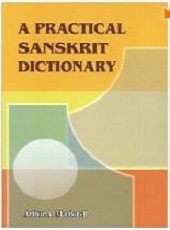
• A Practical Sanskrikt Dictionary,
by A. A. Macdonell, 1893,
http://www.sanskrit-lexicon.uni-koeln.de/scans/MDScan/index.php?sfx=jpg;
1929.
-
Nataraj ed., 1st in 2006, 2012.
-
https://dsal.uchicago.edu/dictionaries/macdonell/ 190516
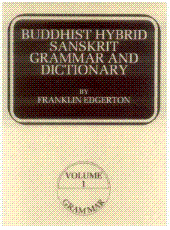
• The Buddhist Hybrid Sanskrit Grammar and
Dictionary, BHS, vol.2, by F. Edgerton,
pp. 627.
-
FEdgerton-BHSD<Ô> /
Bkp<Ô> (link chk 180627)
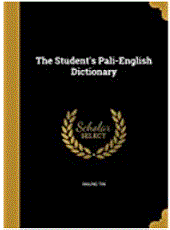
• The Student's Pali English dictionary ,
by U Pe Maung Tin, 1920.
- (ref: UPMT-PEDxxx).
Downloaded copies in TIL
HD-PDF and SD-PDF libraries:
-
UPMT-PaliDict1920<Ô> /
bkp<Ô> (link chk 190113)
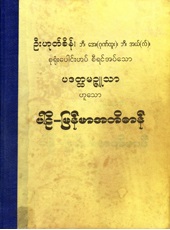
• Pali-Myanmar Dictionary
(in Pal-Myan), by U Hoke Sein,
- (ref: UHS-PMD). The dictionary in printed form is in TIL Research Library.
• Latin-English Vocabulary II, by Hans H Ørberg, 1998
-
HHOrberg-LinguaLatina<Ô> /
Bkp<Ô> (link
chk 190624)
Edited by U Kyaw Tun (UKT) (M.S., I.P.S.T., USA),
Daw Khin Wutyi, Daw Thuzar Myint, Daw Zinthiri Han
and staff of Tun Institute of Learning (TIL).
Not for sale. No copyright. Free for everyone.
Prepared for students and staff of TIL
Research Station, Yangon, MYANMAR
-
http://www.tuninst.net ,
www.romabama.blogspot.com
MC-indx.htm |
Top
MCpp-indx.htm

Row-2 consonants: Palatals
UKT 170708: Both IAST & IPA transliterations are confusing: only Romabama (transcription for Bur-Myan of Tib-Bur language group) is used. However, I will use IPA sound symbol /.../ whenever necessary.
More Complications in Palatals
UKT 190401: The first member of Palatals, row #2,
{sa.}/
{c} has some hissing sound in it. Because of it, it is usually confused with Dental fricative hisser
{Sa.}/
{S} which is not found in Bur-Myan. Moreover, Bur-Myan is totally non-rhotic, just the opposite of Skt-Dev and southern-Indian languages such as Tamil and Telugu. Pali-Myan comes in between: I've to show the differences using the differences in the shape of Ra'ric
{ra.ric.}. Add to it that, there is Nya'major
{Ña.}/
{Ñ} (usually placed in r2c5 cell in Bur-Myan & Mon-Myan), and Nya'minor
{ña.}/
{ñ} (placed in r2c5 in Pali-Myan), and the common English way of using NY
{n~ya.} for the /ñ/ , which makes row#2 the most complicated in BEPS languages.
{sa.} /
{c} - Palatal plosive-stop in Pal-Myan, but Palatal
affricate in Skt-Dev

p090-2c1
 {sa.ka.}
 {sa.ki.}
 {sa.kau:}
 {sa.kRa.}
चक्र
= च क ् र :
differentiate from कृ
= क ृ
{sa.kRa.}
चक्र
= च क ् र :
differentiate from कृ
= क ृ
by noting the vowel-signs क
् र , see
p072R.htm
p090-2c2
 {sa.kRi.}: not
 {kRRi.}
 {sa.kRu.}
 {sa.kRé}
UKT 180524: See my note on Ra'ric sounds
 {sa.kSa.} : Pseudo-Kha
 {kSa.}.
UKT 200116: Don't get confused with look-alikes
{sak~Sa.},
{sak~hka.}
p090-2c3
 {sa.gna.} /
 {sín}
--> Kinsi
{sín}
--> Kinsi
 {sïn~}
 {sa.ña.} /
 {síñ} .

UKT 190331: Both
{sæÑ} /si/
 {sa.Ta.} /
 {sûT}
{sûT}
 {sa.Na.} /
 {sûN}
{sûN}
Note: क ् र --> क्र derived from र
------- क र ् --> कर् derived from र
------ क ृ --> कृ --- derived from ऋ / ृ
Use only Romabama transliteration. IAST and IPA transliterations are misleading. Romabama is a compromise for BEPS which has to make allowances for Mon-Myan. Remember I am dealing with 3 entirely different language groups: Austro-Asiatic (Aus-Asi), Indo-European (IE), and Tibeto-Burman (Tib-Bur).
UKT notes :
•
Bhairava - the déva-god of destruction,
counterpart of Kali Maa.
•
Partridge
•
Silent <k> and <g> letters
in English
•
What is Romabama
 {ro:ma.ba.ma}
{sa.} /
{c} : Palatal plosive-stop in Pal-Myan, but Palatal
affricate in Skt-Dev

UKT 141017, ..., 190331, 200116: The second row, r2, of the Akshara-matrix is controversial because the aksharas have hissing sounds to some extent, resulting in a mix up of Fricatives, Affricates and Plosive-stops. I feel like walking a tight-rope with Phonologies of IE (Skt-Dev) , Tib-Bur (Bur-Myan, Pali-Myan & Old Magadhi), and Aus-Asi (Mon-Myan) languages. My comments on this row may change as my study progresses. Moreover, though you may have control over how you utter a sound with your vocal organs, you have no control over how you hear it.
p090-2c1-b00/ p066-004
• च [ ka ] / च्
- encl. cj. (te, que) and; also;
even, just; but, yet; if (= ked): ka--ka,
both--and, as well--as, scarcely--when;
although--yet: with negative, neither--nor;
ka--na ka or tu, although--yet not;
na ka--ka, although not--yet; with vâ, either,
or; ka‿eva ka‿api, and also;
anyak ka, api ka, kim ka, tathâ ka, moreover,
likewise (adding a similar saying);
ka gives interrogatives (q.
v.) an indefinite sense.
4)
{sa.ka.}
p090-2c1-b01/ not online
• चक् [ kak ] :
be careful where you put the viram
च्क = च ् क
- tremble, only pp. kakita , trembling; frightened,
startled; intimidated; -m , ad. with alarm. ud , pp.
ukkakita , looking up startled. pra , pp. trembling ;
frightened, startled.
p090-2c1-b02/ p066-003
• चकार [ ka-kâra ]
- m. the conjunction and.
3)
p090-2c1-b03
• चकास् [ ka-kâs ]
- ii. p. kakâs-ti , shine; cs. cause to shine
 {sa.ki.}
p090-2c1-b04/ p066-002
• चकित [ kak-ita ]
-->
 {sa.ki.ta.}
- pp.; n. trepdation, fright.
2)
 {sa.kau:}
p090-2c1-b05/ p066-001
• चकोर [ kakora ]
- m. kind of partridge, Perdix rufa, supposed to feed on moon-beams:
hence an eye
that gazes on a face of moonlike beauty is so called; its eye is supposed to
turn red at the sight
of poisoned food; -vrata, n. manner of the kakora, entranced gaze (drinking the
beauty of a
moonlike face); -dris, f. fair-eyed maiden; -‿akshî, f. id.
1)
See my note on partridge
p090-2c1-b06/ p066-031
• चकोराय [ kakorâ-ya ]
- den. behave like the kakora.
31)
p090-2c1-b07/ p066-030
• चक्कलक [ kakkala-ka ]
- n. four slokas connected in sense.
30)
 {sa.kRa.} चक्र = च क ् र
UKT 180525: Differentiate चक्र = च क ् र , from कृ = क ृ by noting the vowel-signs क ् र , see p072R.htm
p090-2c1-b08/ p066-029
• चक्र [ ka-kr-a ]
= च क ् र
Skt: चक्र [ ka-kr-a ]
- n.; V. sts. m. [runner: intv. √kar] wheel; potter's wheel; discus
(esp. of
Vishnu); oil-press; circle; circling in the air (of birds); mystical circular
diagram; multitude, host,
flock; troop; sphere (fig.); (wheel of) dominion; m. ruddy goose; N. of several
men; N. of a
mountain; &isharp;, f. wheel. - Mac090c1
29)
BPal:
 {sak~ka.} -- UHS-PMD0378
UKT from UHS: n. wheel, carriage wheel, chariot wheel, wind-mill,
circle, sphere of influence, armed-force.
Bur:
 {sa.kra} - MLC-MED2006-102
-- n. ¹. circle. ². chariot of Universal monarch. ³. powerful weapon.
4. auspicious sole marks of Gautama Buddha's feet. 5.
Wheel of Law (teachings) of the Gautama Buddha [popularly known as the "Four
Noble Truths" which are natural (non-Axiomatic) laws discovered by the Buddha.
6. toy windmill, pin wheel. 7. Swastika.
p090-2c1-b09/ not online
• [kakra-goptri],
- m. du. wheel guard (man running beside a chariot); -dhara, m.
wheel-bearer; ruler; discus-wielder, ep, of Vishnu; serpent; N. of a locality; -nâbhi,
f. nave of a wheel; -nâman, m. ruddy goose; -nâyaka,
an. leader of a troop; -pura,
n. N. of town; -bhanga, m. breaking of a wheel; -bhânu,
m. N. of a Brâhman; -bhrit,
m. discus-wielder, ep. of Vishnu; -bhrama, m. revolution of the potter's wheel;
a turning like a wheel; -matha, m. N. of a monastic college; -mardikâ,
f. N. of
a princess; -melaka, N. of a locality; -rakuha, m. du. = kakra-gophtri ;
-vat, a.
having wheels; m. oil-presser; -vad-gati, a turning like a wheel;
-varti-tâ, f.
sovereign, dominion; -vartin, a. moving on wheels; m. who turns the wheel of
dominion, sovereign of the world; ruler of (-°); chief of (g., -°); -varman,
m.
N. of a king; -vâka, m., î, f. ruddy goose; the male and female, regarded as a pattern of conjugal love, are supposed to pass the night apart, during which
their plaintive cries are heard; poets frequently refer to the pangs suffered by
them in separation; -vâka-maya, a. conisting of kakravâkas; -vâkin,
a. filled
with karravâkas; -vâta, m. whirlwind; -vâla, n. ring, circle;
m. n. group, multitude; m. fabulous mountain-range encircling the earth fabulous
mountain-range encircling the earth (which is regarded as a disc); -vriddhi,
f. compound interest; -vyûha, m. circular battle-array; -senâ,
f. N.
of a princess.
p090-2c2-b01/ p066-029
• चक्राङ्किता [
kakra‿aṅkitâ ]
- f. N. of a plant; -‿aṅga, m. goose; ruddy goose; -‿aṅganâ,
f. female of the kakravâka.
28)
p090-2c2-b02/ p066-027
• चक्राण [ ka-kr-âná ]
- pf. pt. Â. of √kri.
27)
p090-2c2-b03/ p066-026
• चक्रायुध [ kakra‿âyudha ]
- m. ep. of Vishnu or Krishna; -‿âhva, m. ruddy goose;
-‿âhvaya, m. id.
26)
p090-2c2-b04/ p066-025
• चाक्रि [ ká-kr-i ]
- a. making, producing (ac.).
25)
 {sa.kRi.} : not
 {kRRi.}
p090-2c2-b05/ p066-024
• चक्रिका [ kakr-ikâ ]
- f. troop; intrigue; artifice; -in, a. having wheels; driving;
m.
discus-bearer, ep. of Krishna; oil-presser; serpent; -íya, a. driving;
travelling.
24)
p090-2c2-b06
• चक्रीकृ [ kakrî-kri ]
Skt: चक्रीकृ [ kakrî-kri ]
-- make circular; stretch to the full (bow); -bhû , be draw to the full
(bow) - Mac090c2
Skt: चक्रीकृ - to make round or circular, curve or bend (a bow) -
SktDic-MWilliams
p090-2c2-b07/ p066-023
• चक्रीवत् [ kakrî-vat ]
- a. having wheels; m. driver; wagon; ass.
23)
 {sa.kRu.}
p090-2c2-b08/ p066-022
• चक्रुस्् [ka-kr-us], -˚क्रे [ -kr-e ]
- etc. pf. of √kri, do.
22)
 {sa.kRé}
p090-2c2-b09/ p066-021
• चक्रेश [ kakra‿îsa ]
- m. sovereign ruler: -tâ, f. sovereign dominion; -‿îsvara,
m. ep. of
Vishnu and of Bhairava; sovereign ruler: -tva, n. abst. ɴ.
21)
See my note on Bhairava - the déva-god of destruction
 {sa.kSa.} : Differentiate Pseudo-Kha
 {kSa.} from
 {Ska.}
UKT 160225, 190401: Don't get confused with
{sak~Sa.} -->
{sak~hka.}
BPali equiv., written with True-Kha{hka.}, should be
{sa.hka.}, however there are no such entries in UHS PMD.
Look for:
-
-{sak~hku.} - UHS-PMD0379 'eye' .
p090-2c2-b10/ not online
• चक्ष् [ ka-sh KA-KSH]
= च क ् ष ्
-
kásh-te, (E. also P.) appear; see, look at; announce, tell, say, abhi,
look at, behold; inspect; regard favourably. ava,
look down upon (ac.); behold. â, look upon; declare, propound;
tell; call, say about (ac.); address; state; designate, mean; name, call.
prati‿â, decline; repulse; refute; answer (ac.); vi‿â,
recite; explain, elucidate, sam-â, report; declare, pari, overlook,
disregard; reject; prohibit; name. pra, tell; declare; regard as; name,
call; cs. illumine. prati, see, perceive; expect, vi, appear,
shine; perceive, behold, regard; announce. sam, behold; consider; report
fully.
p090-2c2-b11/ p066-020
• चक्षण [ káksh-ana ]
- n. appearance, sight.
20)
p090-2c2-b12/ p066-019
• चक्षणि [ kaksh-áni ]
- m. illuminator.
19)
p090-2c2-b13/ p066-018
• चक्षन् [ káksh-an ]
- n. eye; -as, n. brightness, brilliance; seeing, being seen (d. =
inf.);
eye, sight, glance; -u, m. eye.
18)
p090-2c2-b14/ p066-017
• चक्षुर्विषय [ kakshur-vishaya ]
- m. range of the eye, sight.
17)
p090-2c2-b15/ p066-016
• चक्षुःश्रवस्् kakshuh-sravas, -˚श्रुति [ -sruti ]
- m. serpent (using the eyes as ears).
16)
p090-2c2-b16/ p066-015
• चक्षुष्पति [ kakshush-pati ]
- m. lord of all eyes; -patha, m. eye-shot, sight; -prîti,
f. delight of
the eye; -mat, a. possessing eyes or vision, seeing; representing the eye:
-tâ, f., -tva, n. vision.
15)
p090-2c3-b01/ p066-050
• चक्षुष्य [ kakshush-ya ]
- a. fit for or pleasing to the eye; lovely; being before the eyes of
(in.); dear to (in.).
50)
p090-2c3-b02/ p066-049
• चक्षुस् [ kaksh-us ]
- a. seeing; n. eye; sight; vision; glance.
49)
p090-2c3-b03/ p066-048
• चक्षूराग [ kakshû-râga ]
- m. feast to the eyes.
48)
 {sa.gna.}
:
{sa.gna.}
:
 {sín}
--> Kinsi
{sín}
--> Kinsi
 {sïn~}
p090-2c3-b04

•
च्कुण [kaṅ-kun-a] : transliteration by UKT - may be in error
- m. N. of a man
p090-2c3-b05/ p066-047
• चङ्क्रम [ kaṅ-kram-a ]
-->
 {sín-kRa.ma.}
- m., â, f. walk; -ana, a. walking about; n. id.
47)
© चङ्क्रम [ kaṅ-kram-a ]
Skt:
- m., â, f. walk - Mac090c3
BPal:
 {sïn~ka.ma.}
- UHS-PMD0380
{sïn~ka.ma.}
- UHS-PMD0380
UKT from UHS: m. stroll to and fro to relax
p090-2c3-b06/ p066-046
• चङ्ग [ kaṅga ]
- a. thoroughly acquainted with, very fastidious about (--°), (-tâ,
f. abst. ɴ.); m. N.
46)
 {sa.ña.}
/
{sa.ña.}
/
 {síñ}
{síñ}
UKT 160226:
Both{sæÑ}
p090-2c3-b07

• [ kañk ]
- i. p. kañka hop, leap, dance; tremble, flicker
p090-2c3-b08/ p066-045
• चञ्चरिन् [ kañ-kar-in ]
- m. bee; -îka, m. id.
45)
p090-2c3-b09/ p066-044
• चञ्चल [ kañ-kal-a ]
- a. moving to and fro, unsteady, fickle: -tva, n. instability,
fickleness.
44)
p090-2c3-b10/ p066-043
• चञ्चला [ kañ-kal-â ]
- f. lightning; -ita, pp. caused to tremble.
43)
p090-2c3-b11/ p066-042
• चञ्चा [ kañkâ ]
- f. basket-work: -purusha, m. man of straw, scarecrow.
42)
p090-2c3-b12/ p066-041
• चञ्चु [ kañk-u ]
- a. known or celebrated for, versed in (--°), (-tâ, f., -tva,
n.
cleverness); m. N.; f. (also û) beak, bill: (ûbrev;)-puta,
n., (u)-putaka, -putî,
f. hollow of the beak.
41)
 {sa.Ta.}
/
{sa.Ta.}
/
 {sûT}
{sûT}
p090-2c3-b13/ not online
• चट् [ kat ]
- i. p. kata , take place, occur : get into, betake oneself to (lc.):
be attached to (lc.): katita , attached to (-°),
ud , depart; cs. kâtaya , drive out; dispel
p090-2c3-b14/ p066-040
• चटक [ kat-aka ]
- m. sparrow; N. of a poet; â, f. female sparrow.
40)
p090-2c3-b15/ not online
• चटचट् [kata-kat ]
-- p. crackle: -âya , â. id.
p090-2c3-b16/ p066-039
• चटत्कृति [ katat-kriti ]
- f. crackling.
39)
p090-2c3-b17/ not online
• चटु [kat-u]
-- m. (?) blandishment
p090-2c3-b18/ p066-038
• चटुल [ katu-la ]
- a. trembling, quivering; unsteady; inconstant; amiable, courteous; n.
pl. attentions.
38)
p090-2c3-b19/ p066-037
• चटुलाय [ katulâ-ya ]
- den. Â. walk delicately.
37)
p090-2c3-b20/ p066-036
• चटूपमा [ katu‿upamâ ]
- f. complimentary simile.
36)
 {sa.Na.}
/
{sa.Na.}
/
 {sûN}
{sûN}
p090-2c3-b21/ p066-035
• चण [ kana ]
- a. --°, known or celebrated for (-tva, n. abst. ɴ.); m. chick-pea:
-ka, m. chick-pea.
35)

p090-2c3-b22/ p066-034
• चण्ड [ kánda ]
-->
 {sûN~ða.}
Skt: चण्ड [ kánda ]
- a. (â, î) burning; violent; impetuous; passionate, enraged, wrathful;
fierce, cruel: -m, ad. passionately, in a rage; â, î,
f. the grim goddess, ep.
of Durgâ. - Mac090c3
34)
Nep: चण्ड caṇḍa
- s. Hot-tempered, fierce. [lw. Sk. id.] -- Turn-Nep164
BPal:
{sûN~ða.} -- UHS-PMD0380
UKT from UHS: mfn.
extreme coarseness & cruelty.
m. person of extreme anger
[likened to an ogre]
UKT 190401: Notice the word
Also note the derivative:{sûN~ða-la.} "caste of cemetery workers" - MED2006-122
My caution to translators: Be careful how you translate: Don't compare a Hero to a Grave-digger.
p090-2c3-b23/ p066-033
• चण्डकर [ kanda-kara ]
- m. (hot-rayed), sun.
33)
p090-2c3-b24/ p066-032
• चण्डकराय [ kanda-karâ-ya ]
- den. Â. appear like the sun
32)
(p090-2end)
-- UKT 140831, 170716
 Whenever I come across the English words
such as <god> & <Lord>,
I have to find what it means in the story
associated with it. First let's look into what the
English word means to human individuals in everyday situation from the present
times back into historical times.
Whenever I come across the English words
such as <god> & <Lord>,
I have to find what it means in the story
associated with it. First let's look into what the
English word means to human individuals in everyday situation from the present
times back into historical times.
Google defines:
Lord
noun: ¹. someone or something having power, authority, or influence; a master or ruler as in "lord of the sea".
synomyms: master, ruler, leader, chief, superior, monarch, sovereign, king, emperor,
prince, governor, commander, suzerain, liege, liege lord, etc.
exclamation: Lord ¹. used in exclamations expressing surprise or worry, or for emphasis as in "Lordf, I'm cold!"
verb: lord 3rd person present; lords past tense: lorded gerund or present participle:
------ lording ¹. archaic confer the title of Lord upon.
----------------- ². act in a superior and domineering manner toward (someone)
----------------- - synonyms: order about/around, dictate to, domineer, ride roughshod over, pull rank on,
-------------------- tyrannize, have under one's thumb, etc.
I usually define Lord or god as: someone (he, she, or it - real or imaginary) who you respect or fear.
 From the story I can say that,
Bhairava, भैरव
From the story I can say that,
Bhairava, भैरव
 {Bè:ra.wa.} "Terrible" or
"Frightful",
is an imaginary entity who is feared - just a bogeyman in modern
times. He is a Shaivite-Hindu déva
{Bè:ra.wa.} "Terrible" or
"Frightful",
is an imaginary entity who is feared - just a bogeyman in modern
times. He is a Shaivite-Hindu déva
 {dé-wa.}
which is not exactly the same as Theravada-déva, and has nothing to do with the
Bur-Myan
{dé-wa.}
which is not exactly the same as Theravada-déva, and has nothing to do with the
Bur-Myan
 {nût}. However, as a surface meaning I can translate it as
 {nût-hso:} because of his epithets
'terrible' and 'frightful'. He should not
be described as
{nût-hso:} because of his epithets
'terrible' and 'frightful'. He should not
be described as
 {Bu.ra:}, or
 {boad~Da.}.
From Wikipedia: http://en.wikipedia.org/wiki/Bhairava 120212
Bhairava, भैरव
{Bè:ra.wa.} "Terrible" or
"Frightful",
[1]),
sometimes known as Bhairo or
Bhairon or Bhairadya or
Bheruji (In Rajasthan),
Kaala Bhairavar
(கால பைரவர்)
or Vairavar
(In Tamil), is the fierce manifestation
of Lord Shiva Déva associated with annihilation.
[2]
He is one of the most important deities
of Rajasthan, Tamil Nadu and Nepal who
originated in Hindu mythology and is
sacred to Hindus, Buddhists (Tibetan) and Jains alike.
See Indian esoteric Buddhism: a social history of the Tantric movement by Ronald M. Davidson , from Columbia Univ. Press, 2002, 497 pdf pages and it is in the TIL HD-PDF and SD-PDF libraries
- RMDavidson-IndianEsotericBuddhism<Ô> / Bkp<Ô> (link chk 190401)We find on pdf 196/497:
" The terrifying Bhairavacarya, with the assistance of Harsa’s legendary ancestor Puspabhuti, seeks to obtain success in the magical powers of the sorcerers/vidyadharas...."Davidson mentions Heruka in his book in many places. Read also Wikipedia:
- https://en.wikipedia.org/wiki/Heruka 170717
"Heruka (Sanskrit; Wylie: khrag 'thung), is the name of a category of wrathful deities, enlightened beings in Vajrayana Buddhism that adopt a fierce countenance to benefit sentient beings."UKT 141013, 170716: Shiva Déva & Kali Dévi forms a pair of husband & wife supposed to represent male and female aspects of Energy which can be both creative and destructive. The Theravada Buddhists cannot comprehend such pairing involving sexual union. To the Theravada Buddhists, Brahma are asexual (no differentiation into male and female), however to the Hindu Maha-Brahma (or just Brahma) is a male-déva. He is supposed to be married to Maa Saraswati who in Burmese-Theravada tradition is Thurathati Mèdaw
{þu-ra.þa.ti mèý-tau} is a pure virgin and looked upon as the embodiment of Knowledge and treated as a mother-goddess
{mèý-tau} 'Mother'.
Bhairava is depicted ornamented with a range of twisted serpents, which serve as earrings, bracelets, anklets, and sacred thread ( yajnopavita). He wears a tiger skin and a ritual apron composed of human bones. [3] Bhairava has a dog (Shvan) as his divine vahana (vehicle). Bhairavi, a fierce and terrifying aspect of the Devi who is virtually indistinguishable from Kali, with the exception of her particular identification as the consort of the Bhairava.
Bhairava himself has eight manifestations:
1. Kala Bhairava,
2. Asitanga Bhairava,
3. Samhara Bhairava,
4. Ruru Bhairava,
5. Krodha Bhairava,
6. Kapala Bhairava,
7. Rudra Bhirava and
8. Unmatta Bhairava. [UKT ¶]
Kala Bhairava is conceptualized as the Guru of the planetary deity Saturn. Bhairava is known as Vairavar in Tamil where he is often presented as a Grama Devata or folk deity who safeguards the devotee on all eight directions (ettu tikku). Known in Sinhalese as Bahirawa, he protects treasures. Lord Bhairava is the main deity worshipped by the Aghora sect.
The origin of Bhairava can be traced to the conversation between Lord Brahma
Déva and Lord Vishnu recounted in "Shiv Maha-Puran" where
Lord Vishnu Déva asks Lord
Brahma Déva who is the supreme creator of the Universe. Arrogantly, Brahma Déva tells
Vishnu Déva to worship him because he (Brahma) is the supreme creator. [UKT ¶]
This angered Shiva who in reality is the creator of all. [UKT ¶]
UKT 141013, 170516, 170716: To wade through the confusion of Hinduism, you must realized that there are three separate 'religions'.
1. Vaishnavism - worship of the Vishnu - the religion of the intruders IE (Indo-European) speakers from the north-west.
2. Shaivism - worship of Shiva-déva brought in by the dark-skinned intruders Aus-Asi (Austro-Asiatic speakers) from the south. Shaivism spreads throughout India principally by Adi Shankara who was responsible for destruction of Buddhism in 8th century AD in Nepal - the birthplace of Gautama Buddha.
See: http://krishna.org/lord-chaitanya-defeats-the-buddhists/ - 140216, 140831
Search the Net for Adi Shankara, the Shaivite Brahmana-Poanna.3. Shaktism - worship of Shakti
{shak-ti.} शक्ति = श क ् त ि. I take it to be derived from the worship of various mother-goddesses
{mèý-tau} of the original inhabitants of the land. However, with the rise of Shaivism, these mother-goddesses are supposed to be the wives of Shiva-déva making him to be the most promiscuous déva of the land.
See Wikipedia: https://en.wikipedia.org/wiki/Shakti 170710UKT 170716: There were attempts to sort out who among the dévas was the supreme one in looking after the affairs of the human world. The sorting out was done by a human rhisi named Bhagu
{Ba.gu. ra.þé.}, who was one of the Védic rishi revered by Gautama Buddha mentioned in Viniya Pitika of the Mahavagga (I.245). The rishi found Vishnu-déva sleeping with his wife, and the rishi kicked him on his chest. Next, he found Shiva-déva having sex with his wife. The rishi cursed him to be worshipped by his followers with an image of lingam (penis) stuck in the yoni (vagina) of his wife.
Wikipedia continue: Shiva then incarnated in the form of Bhairava to punish Brahma. Bhairava beheaded one of Brahma's five heads and since then Brahma has only four heads. When depicted as Kala Bhairava, Bhairava is shown carrying the decapitated head of Brahma. Cutting off Brahma's fifth head made him guilty of the crime of killing a Brahmin, and as a result, he was forced to carry around the head for years and roam as Bhikshatana, a mendicant, until he had been absolved of the sin.
In another version, when Brahma sees the cosmic confusion while creation of universe and ponders how to settle it. He created Saraswati from his imagination ('Manasaputri'). She issued as Shatarupa. She presented him with the wealth of knowledge and wisdom. But Brahma was infatuated with her beauty and pursued her. He sprouted a fifth head to gaze at her continuously. [UKT ¶]
The horrified goddess took multiple forms to escape his eye, but Brahma continued to take a complementary form and chase her. This unlawful lust caused an imbalance in the universe and Lord Shiva took the form of Bhairava to put an end to such incest. He confronted Brahma and cut off his fifth head which brought him to his senses. He then performed a yagna to purify himself, reciting mantras with his four heads for salvation.
In the form of the frightful Bhairava, Shiva is said to be guarding each of these Shaktipeeths. Each Shaktipeeth temple is accompanied by a temple dedicated to Bhairava.
UKT: More in the Wikipedia article.
Go back Bhairava-note-b
-- UKT 141013: Bur-Myan for <pheasant> is
 {ric}.
See MLC MED2006-407. I still have to get the name for <partridge>.
{ric}.
See MLC MED2006-407. I still have to get the name for <partridge>.
par·tridge n. pl. partridge or par·tridg·es ¹. Any of several plump-bodied Old World game birds, especially of the genera Perdix and Alectoris, related to the pheasants and grouse. ². Any of several birds, such as the ruffed grouse or the bobwhite, similar or related to the partridge. -- AHTD
From Wikipedia: http://en.wikipedia.org/wiki/Partridge 120211
 Partridges
are birds in the pheasant family, Phasianidae. They are a non-migratory Old
World group.
Partridges
are birds in the pheasant family, Phasianidae. They are a non-migratory Old
World group.
These are medium-sized birds, intermediate between the larger pheasants and the smaller quails. Partridges are native to Europe, Asia, Africa, and the Middle East. Partridges are ground-nesting seed-eaters.
According to Greek legend, the first partridge appeared when
Daedalus
threw his nephew,
Perdix, off a roof in a fit of jealous
rage. See Wikipedia:
-
https://en.wikipedia.org/wiki/Daedalus 170710
- https://en.wikipedia.org/wiki/Perdix_(mythology) 170710
"Daedalus [the inventor who built a pair of wings for his son ] was so
envious of his nephew's accomplishments that he took an opportunity, when they
were together one day on the top of a high tower, to push him off. But Athena
[Goddess of Learning similar to Saraswati Maa], who favors ingenuity, saw
him falling and arrested his fate by changing him into a bird called after his
name, the Perdix (partridge). This bird does not build its nest in the trees,
nor take lofty flights, but nestles in the hedges, and mindful of his fall,
avoids high places. For this crime, Daedalus was tried and banished."
-
https://en.wikipedia.org/wiki/Icarus 170710
"Often depicted in art, Icarus and his father attempt to escape
from Crete by means of wings that his father constructed from feathers and wax.
Icarus' father warns him first of complacency and then of hubris ['pride'],
asking that he fly neither too low nor too high, ..."
Partridges famously appear as part of the first gift listed in the Christmas carol, "The 12 Days of Christmas". As such, "A partridge in a pear tree" is sung as the last line of each chorus.
Go back partridge-note-b
UKT 180524, 190401: In the following, be careful
of pronunciation of:
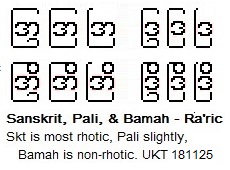
highly rhotic Sanskrit:
{kRRi.}
rhotic Pali:{kRi.}
non-rhotic Bamah-Irrawaddy dialect:{kri.}
Note:
{kræÑ.} is used.
 I'd
thought highly of the differences in Syllabicity, but I'm now finding that
Rhoticity and its representation is more than simple vowel-lengths measured in
eye-blinks. Though in Bur-Myan
I'd
thought highly of the differences in Syllabicity, but I'm now finding that
Rhoticity and its representation is more than simple vowel-lengths measured in
eye-blinks. Though in Bur-Myan
 {ra.ric}-form is non-rhotic, Pali-Myan and Skt-Myan are rhotic: Sanskrit ऋ - the
rhotic-/i/ is the most rhotic. Romabama for BEPS has to come up with {i.},
{iRi.}, and {iRRi.}. To describe ऋ as the "vocalic-R" had led me astray for
a long time: it is totally unconnected to consonant R. Be sure to follow the length of the
hood in pronouncing the different degrees of Rhoticity.
{ra.ric}-form is non-rhotic, Pali-Myan and Skt-Myan are rhotic: Sanskrit ऋ - the
rhotic-/i/ is the most rhotic. Romabama for BEPS has to come up with {i.},
{iRi.}, and {iRRi.}. To describe ऋ as the "vocalic-R" had led me astray for
a long time: it is totally unconnected to consonant R. Be sure to follow the length of the
hood in pronouncing the different degrees of Rhoticity.
Go back Raric-note-b
-- UKT 120218
Pronouncing the velar-plosive-stops /k/ and /g/ before
the dental sounds in Modern English is a problem. I have
found a similar situation in the pronunciations of Sanskrit
[क ् ष = क्ष] and
Pali [चक्-
[The following presentation needs Myanmar graphemes, however, since they do not appear in emails, I have given their equivalents in Devanagari. Also note that Bur-Myan
{sa.} stands for both palatal plosive-stop [च] /c/ and dental fricative-sibilant [ष] /s/. However, they are differentiated in Romabama as {sa.} for [च] and {Sa.} for [ष]. ]
In
{sa.kSa.} [च-क ् ष], we have two syllables,
{sa.} [च] and {kSa.} {kSa.}
This reminds me of cases of a velar-before-dental in English <know> and <gnome>. In modern English both <k> and <g> are made 'silent'. Such silent letters are not permissible in the akshara-system which is a very rigid phonetic system preceding the International Phonetic Association (IPA) by thousands of years.
Since क्ष «ks» is not readily pronounceable
for Bur-Myan and presumably for Pal-Myan, it is pronounced as {hka.} [ख] {hka.}
An interesting point is what happens when the two syllables
are pronounced very rapidly as in continuous speech. This amounts to the graphemes
moving closer. The {kSa.} conjunct in
{sa.kSa.} is broken apart, and
the pronunciation becomes:
{hka.} {sak~hka.}
[चक्-
Go back silent-k-g-in-English-note-b
 {ro:ma.ba.ma}
UKT 141013:
This file, p090-2.htm, is important for
transcription of English (written in Latin
script) into English (written in Myanmar akshara).
MLC gives only transliteration which gives
the wrong pronunciation.
Romabama (Eng-Myanmar) (pronounced as
 {ro:ma.ba.ma} 'backbone of Burmese
speech') takes care of vowel sounds in phonologies of both Burmese and
English, and is a transcription. Romabama is NOT Romanization of Burmese.
It is subservient to my beloved circularly-rounded Myanmar Akshara - the
unifying script of my mother land!
{ro:ma.ba.ma} 'backbone of Burmese
speech') takes care of vowel sounds in phonologies of both Burmese and
English, and is a transcription. Romabama is NOT Romanization of Burmese.
It is subservient to my beloved circularly-rounded Myanmar Akshara - the
unifying script of my mother land!
To come up with a usable ASCII transcription, my wife (Daw Than Than) and I had to study Phonetics online from Univ. of Lausanne (UNIL) - UNIL-indx.htm (link chk 141013). At that time we had already served our birth-country for over 33 years and retired with good service records, after which we migrated to Canada and have taken up Canadian citizenships.
I went further and studied LANGUAGE ACQUISITION AND TEACHING -
LAT4M.htm (link chk
141013) based on
Principles of Language Learning and Teaching, 4th. ed., by H. Douglas
Brown
-
n-Brown4-indx.htm (link
chk 141013).
Realizing that Phonetics is too narrow, I studied Human voice,
Phonetics and Phonology
-
indx-HV.htm
(link chk 141013)
I concentrated on The Phonetic Description of Voice quality, John Laver, Univ. of Edinburgh. Cambridge Univ. Press, First published 1980. ISBN 0 521 231 760. Realizing that unless I can pin down the vowels by instrumental analysis, I studied the nature of sound waves which I had studied in Physics in my undergraduate days. From the sound waves produced by a speaker we can come up with Formants . Whenever possible I looked into Formants F1 & F2 . My sincere thanks to Professor Russell of University of Manitoba, http://www.umanitoba.ca/faculties/arts/linguistics/russell/138/sec4/formants.htm 080103
What the human phoneticians can do is always tainted by their L1, and my underlying philosophy is what a Chemical Engineer turned Linguist, Benjamin Whorf had come up with, which simply put is "We are the prisoners of our own cultures". See Sapir-Whorf Hypothesis .
Go back What-Romabama-note-b
End of TIL file
