p088-.htm
• A Practical Sanskrikt Dictionary,
by A. A. Macdonell, 1893,
http://www.sanskrit-lexicon.uni-koeln.de/scans/MDScan/index.php?sfx=jpg;
1929.
- Nataraj ed., 1st in 2006, 2012.
-
https://dsal.uchicago.edu/dictionaries/macdonell/ 190516
• The Buddhist Hybrid Sanskrit Grammar and
Dictionary, BHS, vol.2, by F. Edgerton,
pp. 627.
-
FEdgerton-BHSD<Ô> /
Bkp<Ô> (link chk 180627)
• The Student's Pali English dictionary ,
by U Pe Maung Tin, 1920.
- (ref: UPMT-PEDxxx).
Downloaded copies in TIL
HD-PDF and SD-PDF libraries:
-
UPMT-PaliDict1920<Ô> /
bkp<Ô> (link chk 190113)
• Pali-Myanmar Dictionary
(in Pal-Myan), by U Hoke Sein,
- (ref: UHS-PMD). The dictionary in printed form is in TIL Research Library.
• Latin-English Vocabulary II, by Hans H Ørberg, 1998
-
HHOrberg-LinguaLatina<Ô> /
Bkp<Ô> (link
chk 190624)
Edited by U Kyaw Tun (UKT) (M.S., I.P.S.T., USA),
Daw Khin Wutyi, Daw Thuzar Myint, Daw Zinthiri Han
and staff of Tun Institute of Learning (TIL).
Not for sale. No copyright. Free for everyone.
Prepared for students and staff of TIL
Research Station, Yangon, MYANMAR
-
http://www.tuninst.net ,
www.romabama.blogspot.com
MC-indx.htm |
Top
MCpp-indx.htm
 {gRa.} : contd.
 {gRa.ha.} : contd.
p088-1c1
p088-1c2
 {gRa.hi.}
 {gRa.hé}
 {gRa}
{gRa}
 {gRa-Ba.}
 {gRa-ma.}
 {gRa-wa.}
p088-1c3
 {gRa-þa.}
 {gRa-ha.}
{gRa-hi.}
 /
/
 {g~la} : Bur-Myan {la.} as hanger needs extra space: if
this is objectionable, use Mon-Myan form
.
{g~la} : Bur-Myan {la.} as hanger needs extra space: if
this is objectionable, use Mon-Myan form
.
 /
/
 {g~lè:} ग्लै
 /
/
 {g~lau} ग्लौ
Orphans
• ग्रन्थिशमन granthisamana [ granthi-samana ]
- n. (bringing a garment to an end with a knot =) money knot.
UKT notes :
•
Esoterism : Burmese
native beliefs and customs
¤
Esoterism and Exoterism
¤
Mahaboat :
 {ma.ha-Boat} : Native Astrology
¤
Navagraha Puja
 {groh-kri: ko:loän: pu-zau pwè:}
---- vs
Nine-Gods Puja
 {Bu.ra: ko:hsu pu-zau pwè:}
•
Bur-Myan and Néwari-Dev :
Tib-Bur languages with onset
 {gna.} -
non-nasal
{gna.} -
non-nasal
IE languages have only coda

{-ing} --> { ín} -
nasal
Note: the problem with r1c5 is also
due to the English language not having a
single letter to represent this sound: it
has to use a digraph. Unable to get rid of
this problem, I have to change the nuclear
vowel as well as the coda-constant.
 {gRa.ha.}
UKT 160117: The meaning of
Burmese Astrology Mahaboat
p088-1c1-b01/ p064-112
• ग्रह [ gráh-a ]
- a. (--°) seizing, holding; gaining;
perceiving; m. seizer, esp. Râhu, who seizes
and thus eclipses Sun and Moon; planet (which
seizes men by magical influence: generally
reckoned to be five in number: Mars, Mercury,
Jupiter, Venus, and Saturn, or seven: the same
+ Râhu and Ketu, or nine: the same + Sun and
Moon); demon of disease; imp; crocodile; booty;
vessel* (for drawing Soma); draught** (of Soma);
organ (of which eight are enumerated); seizure,
grasp, grip; draught (of a fluid); theft,
robbery; insistence on (lc., --°), endeavour;
receipt; welcome; mention; perception,
understanding.
112)
© ग्रह graha [ gráh-a ]
= ग ् र ह -->
{gRa.ha.}
Skt: [ gráh-a ]
-- a. (--°) seizing, holding; gaining; perceiving;
m. seizer, esp. Râhu, who seizes and
thus eclipses sun and moon; planet (which
seizes men by magical influence) -- Mac088-1c1
BPal:
 {ga.ha.} - UHS-PMD0362
UKT from UHS:
¹. home (implying marital bondage).
². to grab, to seize (eclipse of Sun,
and Moon by Rahu).
UKT 140919, 170629:
- From this idea of गृह «gṛha» "seizing", the astrological planets are known in Bur-Myan as Seizers{groh} .
- * vessel (for drawing Soma); ** draught (of Soma), makes me wonder why "seize" and "Soma" have been connected. Does it imply the "intoxicating power" of Soma, as Soma - the substance befuddles (or seizes) the reasoning power of the mind?
p088-1c1-b02
• ग्रहग्रस्त [ graha-grasta ]
- pp. possessed by a demon.
111)
p088-1c1-b03
• ग्रहण [ grah-ana ]
- a. holding (--°); n. gráhana, seizing, holding, capturing; eclipse;
obtaining, receiving; buying; reverberation; catching, absorbing; putting on
(clothes), assuming (a body); undergoing; pronouncing, mentioning; using an
expression, employment, word mentioned; learning; perception, understanding;
taking to mean.
110)
p088-1c1-b04
• ग्रहणचतुर [ grahana-katura ]
- a. expert in seizing; -dvaya, n. eclipse of sun and (or) moon;
-sambhava,
a. arising from the taking away (of, g.); -‿anta, a. done with learning;
-‿antika, a. id.
109)
p088-1c1-b05
• ग्रहणीय [ grah-anîya ]
- fp. to be accepted or pondered.
108)
p088-1c2-b00
• ग्रहपीडन [ graha-pîdana ]
- n., -pîdâ, f. calamity caused by Râhu, eclipse; -maya,
a. (î)
consisting of planets; -yagña, m. sacrifice to the planets; -yuti,
f.
conjunction of the planets; -yuddha, (pp.) n. conflict --, opposition of the
planets; -yoga, m. = graha-yuti; -varsha, m. planetary year;
-samâgama, m.
conjunction of the planets; -‿agre-sara, m. ep. of the Moon (chief of the
Planets).
103)
UKT 170629: by "planets" is meant the anthropomorphic astronomical planets of the solar system, because of which I have capitalized the words.
{gRa.hi.}
p088-1c2-b01
• ग्रहिल [ grah-ila ]
- a. sensible to (--°); sensitive; frantic.
102)
p088-1c2-b02
• ग्रहीतव्य [ grah-î-tavyã ]
- fp. to be taken, received, -drawn (fluid); -î-tri, m. seizer; receiver;
purchaser; perceiver; hearer.
101)
{gR.hé}
p088-1c2-b03
• ग्रहोक्थ [ graha‿uktha ]
- n. hymn recited while drawing Soma.
100)
{gra}
{gra-Ba.}
p088-1c2-b04
• ग्राभ [ grâbhá ]
- m. seizer; handful.
99)
p088-1c2-b05
• ग्राम
[ gr&asharp;-ma ]
= ग ् र ा म -->
{gRa-ma.}
- m. inhabited place, village; community, clan; host; multitude,
aggregate of (--°); scale in music: pl. inhabitants, people.
98)
BPal:
 {ga-ma.} - UHS PMD0363
UKT from UHS: community, village
p088-1c2-b06
• ग्रामकाम [ gr&asharp;ma-kâma ]

- a. desirous of a village; fond of village life; -kukkuta, m. (village=)
tame cock; -ghâta, m. plundering of a village; -karyâ, f. village ways = sexual
enjoyment; -kaitya, m. sacred tree of the village; -gâta, pp. grown in a village
or in cultivated soil; -nî, m. leader of a host; chief of a community; *barber
(chief person in a village); -tâ, f. number of villages; -dasa‿îsa,
m. chief of
ten villages; -dharâ, f. N. of a rock (supporting villages); -dharma,
m. village
custom; -nivâsin, a. dwelling in villages, tame (birds); -pishta,
pp. ground at
home; -yâgaka, -yâgin, a. sacrificing (through avarice) for all members of the
community (whether admissible or not); -vâsin, a. living in villages, tame
(animal); m. villager; -vriddha, m. old man of the village;
-sîmâ, f. village
field; -sûkara, m. domestic hog.
124)
© -nî,
- m. leader of a host; chief of a community; *barber (chief person in a
village);
*UKT 180510: In my childhood days - long before radio, TV, and cell-phone texting, men of the village went to the barber shop to have their hair cut or to have their moustache and beard trimmed, and talked with the barber, in connection with the current news, including the favourite subject of men - sex. The barber, thus became the chief disseminator of news, gossip, and knowledge in general.
p088-1c2-b07/ not online

• [grâma‿agni]
- village -, = ordinary fire; -‿adhipa, m. headman of a
village; -‿antá , m. village boundary : lc. in the
...
p088-1c2-b08
• ग्रामिक [ grâm-ika ]
- m. village chief; -ín, a. ruling a community; m. villager; peasant: (i)-putra,
m. peasant-boy.
123)
p088-1c2-b09
• ग्रामीण [ grâm-îna ]
- n. rustic, illiterate; m. villager, peasant; -eya-ka, m. villager.
122)
{gra-ma.}
p088-1c2-b10
• ग्राम्य [ grâm-yá ]
- a. referring to, coming from, prepared in or inhabiting villages; tame;
cultivated; raised by cultivation; rustic, coarse; m. villager; domestic animal;
n. sensuality.
121)
p088-1c2-b11
• ग्राम्यकुक्कुट [ grâmya-kukkuta ]
- m. domestic cock; -tâ, f., -tva, n. coarse diction;
-dharma, m.
villager's duty; sensuality; -mriga, m. (domestic animal), dog; -sûkara,
m.
domestic hog.
120)
{gra-wa.}

p088-1c2-b12
• ग्रावन् [ gr&asharp;-van ]
- m. rock, stone, esp. for pressing Soma.
119)
UKT 180510: Pressing stone for pressing out water from a pulp. I've in mind how rice starch powder and Tha'nethka powder are manufactured on small scale in Myanmarpré. In the case of rice, husked rice grains soaked in water is rubbed between two horizontal stone-disks one of which is rotating above the other. The resulting soggy pulp is then put into strong cotton bags, which are tightly tied. A large stone - the pressing stone - is placed over the bag and water is pressed out overnight. The rice powder which is still wet and taken out of the bag and sun-dried. It is the same procedure used for Tha'netkha except that the originally the tha'nethka is the form of a cut branch - wood still covered with bark - is held against a rotating grind-stone which is sprayed with water to keep the temperature down. The result is a soggy pulp, water from which is pressed out as in the case of rice.
p088-1c3-b00
• ग्रावग्राभ [ grâva-grâbhá ]
- m. (handling the Soma stones), a priest, later grâvastut;
-stút, m. a
kind of priest; -stotra, n. invocation of the pressing-stones at noon:
î-ya, a.
relating to the invocation of the pressing stones.
118)
{gra-þa.}
p088-1c3-b01
• ग्रास [ grâs-a ]
- m. swallowing; eclipse; mouthful, morsel; food; --°, a.
swallowing; -pramâna, n. size of a morsel; -‿âkkhâdana,
n. sg. food and
clothing.
116)
p088-1c3-b02/ not online
• [grâsî-kri ]
- swallow
{gra-ha.}
p088-1c3-b03
• ग्राह [ grâh-á ]
- a. (î) seizing, holding, taking, receiving (--°); m. id.;
mentioning; whim; beast of prey, crocodile, shark, serpent.
115)
p088-1c3-b04
• ग्राहक [ grâha-ka ]
- a. (ikâ) receiving; apprehending, perceiving; m. bailiff; policeman;
buyer: -tva, n. power of comprehension; -krikara, m. decoy partridge;
-vihamga,
m. decoy-bird.
114)
p088-1c3-b05
• ग्राहयितव्य [ grâh-ay-i-tavya ]
- (cs.) fp. to be caused to undertake (ac.).
113)
{gra-hi.}
p088-1c3-b06
• ग्राहिन् [ grâh-in ]
- a. (--°) seizing, holding; catching; containing; receiving,
gaining, keeping; buying (with in. of price); searching through; perceiving;
pondering; -yã, fp. to be seized, -clasped; -apprehended; -obtained; -accepted;
-insisted on; -perceived, -comprehended; -learned; -understood; -recognised,
-regarded.
70)
 {gri}
{gri}
UKT 170629:
{ra.} र ) is orthographically different from
{gRRi} गॄ (2 blk) derived from rhotic Skt-Dev vowel-pair ऋ {iRi.} (1blk); ॠ {iRi} (2 blk). Refer to
¤ p044-2-p062c2 - MCv2pp-indx.htm > p056-2.htm (link chk 170623)
p088-1c3-b07
• ग्रीव [ grî-va ]
- m., &asharp;, f. [√grî, swallow], neck.
86)
p088-1c3-b08
• ग्रीष्म [ grîsh-má ]
- m. summer, hot season: -samaya, m. summer time.
85)
BPal:
 {gi.mha-na. ma-þa.} - UHS PMD0365c2
UKT from UHS - m. summer month
 {grè}
{grè}
p088-1c3-b09
• ग्रैव [ graiva ]
- n. neck-chain (of an elephant).
84)
p088-1c3-b10
• ग्रैवेय [ graiv-eya ]
- m. n. id.: -ka, n. id.; necklace; -ya, a. relating to the neck.
132)
p088-1c3-b11
• ग्रैष्म
[ graíshma ]
- a. referring to the hot season;
i-ka, a. id.
131)
{g~la}
UKT 180511, 190326: Hanging
{la.} is not present in modern Bur-Myan. However, we need it BEPS.
Bur-Myan {la.} as hanger needs extra space: if this is objectionable, use Mon-Myan form
p088-1c3-b12/ not online
• [ glap ]
- i. p. glapá , be distressed at (in.).
p088-1c3-b13
• ग्लपन [ glap-ana ]
- n. relaxation; withering.
130)
p088-1c3-b14
• ग्लपय [ gla-paya ]
- cs. of √glai.
129)
p088-1c3-b15/ not online

• [ glapsa ]
= grapsa
p088-1c3-b16/ not online
• ग्लह् [ glah ]
-- i. â. glaha , play at dice (with, in. or ac.)
p088-1c3-b17
• ग्लह [ gláh-a ]
- m. game of dice; throw (at dice); stake; die; dice-box; contention,
wager; prize; -ana, n. throwing of dice.
128)
p088-1c3-b18
• ग्लान [ glâ-na (pp. √glai) ]
- n., -°�� -ni, f. lassitude; inertness; diminution;
-vín, a. inert;
-snu, a. relaxed; withered; sick.
127)
{g~lè:} ग्लै
p088-1c3-b19/ not online

• ग्लै [ glai ]
- i. p. glãya ( e. also â ) and ii. p. glâ-ti , be
loath or averse (with in. or d.) ; be relaxed, exhausted, or
vexed; repine : pp. glána , ...
{g~lau} ग्लौ
p088-1c3-b20/ not online
• ग्लौ [ glau ]
- lump, goitrous excrescence
- UKT 170627


UKT 170627: "Western esotericism (also called esotericism and esoterism) is a scholarly term for a wide range of loosely related ideas and movements which have developed within Western society. They are largely distinct both from orthodox Judeo-Christian religion and from Enlightenment rationalism."
- https://en.wikipedia.org/wiki/Western_esotericism 170627
Whenever we look into this subject, we come across Jewish Kabbalah 'Tree of Life'. Now, let's compare this idea into the Burmese Native Customs. See also
¤ Folk Elements in Buddhism -- flk-ele-indx.htm - update 130218
Esoterism includes many beliefs and
customs:
¤
Esoterism and Exoterism
¤ Mahaboat
 {ma.ha-Boat} : Native Astrology
¤ Navagraha Puja
 {groh-kri: ko:loän: pu-zau pwè:}
¤
Bur-Myan and Néwari-Dev
- UKT 170626
Can we say that recitation of Theravada
Buddhist Parritta
 {pa.rait}, not only in Myanmarpré but in
most of Theravada countries, amounts to
Exoteric Buddhist practise ? Moreover, there
is a similar word Esoteric: what is the
difference between the two. With my limited
understanding, I take the Theravada
Paritta recitation for protection to be
more open - not with hidden meanings - being
excerpts from sermons of Gautama Buddha. On
the other hand, Esotericism is from
Mahayana with hidden meanings to be
revealed only by masters to the respective
students.
{pa.rait}, not only in Myanmarpré but in
most of Theravada countries, amounts to
Exoteric Buddhist practise ? Moreover, there
is a similar word Esoteric: what is the
difference between the two. With my limited
understanding, I take the Theravada
Paritta recitation for protection to be
more open - not with hidden meanings - being
excerpts from sermons of Gautama Buddha. On
the other hand, Esotericism is from
Mahayana with hidden meanings to be
revealed only by masters to the respective
students.
From: Paritta Pali: Protective Verses, by Sayadaw Silananda, 1998
- http://www.tathagata.org/sites/default/files/ParittaSutta%20v2.1%20-%20Sayadaw%20U%20Silananda.pdf 170629.
Downloads in TIL PDF libraries:
- Silananda-ParittaSutta<Ô> / Bkp<Ô>
Introduction p03
"The Sutta [such as
Āṭānāṭiya]
chanted for protection, etc., is also
known as Paritta which means “the Sutta
that protects those who chant and who
listen to it against dangers, calamities,
etc., from all around.” Through the ages
other Suttas were added to the list of
'Suttas for chanting.' Thus we find in
Milindapañha and the Commentaries by the
Venerable Buddhaghosa the following nine
Suttas mentioned as Parittas: Ratana
Sutta, Metta Sutta, Khandha Sutta, Mora
Sutta, Dhajagga Sutta,
Āṭānāṭiya
Sutta, Arigulimala Sutta, Bojjhaṅga
Sutta and Isigili Sutta.
"The collection presented here includes the first eight Suttas and in addition, Mangala Sutta, Vaṭṭa Sutta and Pubbaṇa Sutta, thus comprising altogether eleven Suttas, with further addition of introductory verses at the beginning of each Sutta. These are the eleven Suttas chanted everyday in every monastery and nunnery and in some houses of lay people in all Theravada Buddhist countries. This collection is known in Myanmar as 'The Great Paritta', not because the Suttas in this collection are long ones, but probably because they have great power, if chanted and listened to in a correct way, could ward off dangers and bring in results."
See also: Indian Esoteric Buddhism : a social history of the Tantric movement, by R. M. Davidson, 2012
Downloaded pdf copies in TIL libraries
- RMDavidson-IndianEsoterism<Ô> / Bkp<Ô> (link chk 170630)
p083
 "...
We note the donative inscriptions
concerning of Balaputradeva of Suvarnadvipa
to Nalanda in the ninth century, of the
King Kyanzittha of Pagan in 1084,
1112, and the repairs of Letyamengnan
of Arakan between 1112 and 1167, all
these latter concerning the Mahabodhi
temple in Bodhgaya. [fn.35] Yet the
foreign interest is notable for two
factors — their involvement is for the
purpose of revitalization or repair, and
it is not done by merchants or those with
guild affiliation. Indeed, the principal
sense we get of international merchant
involvement with Buddhism from the eighth
to the tenth centuries is that found in
Nepal and Tibet. This is especially
visible during the period of the Tibetan
Royal Dynasty’s interest in Buddhism and
their extensive ties to sites in Central
Asia, which they secured through military
prowess. [fn36] By the tenth to eleventh
centuries, the improved economic climate
evidently stimulated mercantile
construction of Buddhist institutions
once again, as is evident in inscriptions
in Bihar and around Vatapi. [fn.37]
..."
"...
We note the donative inscriptions
concerning of Balaputradeva of Suvarnadvipa
to Nalanda in the ninth century, of the
King Kyanzittha of Pagan in 1084,
1112, and the repairs of Letyamengnan
of Arakan between 1112 and 1167, all
these latter concerning the Mahabodhi
temple in Bodhgaya. [fn.35] Yet the
foreign interest is notable for two
factors — their involvement is for the
purpose of revitalization or repair, and
it is not done by merchants or those with
guild affiliation. Indeed, the principal
sense we get of international merchant
involvement with Buddhism from the eighth
to the tenth centuries is that found in
Nepal and Tibet. This is especially
visible during the period of the Tibetan
Royal Dynasty’s interest in Buddhism and
their extensive ties to sites in Central
Asia, which they secured through military
prowess. [fn36] By the tenth to eleventh
centuries, the improved economic climate
evidently stimulated mercantile
construction of Buddhist institutions
once again, as is evident in inscriptions
in Bihar and around Vatapi. [fn.37]
..."
From: Hokai in Blog , posted 2011 Nov. 22.
- https://www.hokai.info/2011/11/esoteric-vs-exoteric/ 170629
Esoteric and Exoteric forms of Buddhadharma are difficult to separate, since their historical development is closely related. The tradition of Secret Mantra is not esoteric just in the sense that its inner teachings have been kept secret among initiates. Exoteric texts, which are publicly available, also contain the essence of esoteric teachings, but these can only be fully understood through direct experience, developed in training under guidance of a qualified master. Pith instructions that contain the accumulated wisdom of masters through centuries are conveyed as secret oral instructions. Additional esoteric understanding is preserved in commentaries, ritual manuals, as well as records of oral transmission. Relative secrecy is supposed to prevent misunderstanding and misuse, and thereby to protect teachings from corruption.
Esoteric Dharma is secret in yet another way. Deep knowledge pointed out in the teachings – whether explicitly in esoteric sutras, or implicitly in exoteric ones – cannot be revealed as ordinary knowledge, because the most profound mysteries, which are direct manifestations of Buddhahood, can only be known by the awakened mind.
Formally, esoteric Dharma has distinct sutras and commentaries, distinct ethical principles (skt. samaya), distinct methods of spiritual cultivation, as well as distinct lineages of transmission. However, esoteric Dharma is inextricably bound with general Mahayana, their teachings not being mutually exclusive. Real differences between esoteric and exoteric were sometimes exaggerated for sectarian purposes.
{ma.ha-Boat} : Native Astrology

UKT 170628: Daw Hla Than, one of my best friends, has referred me to the little book on Mahaboat written by one of her ex-students. In the Mahaboat system
{ké-tu.} केतु is the King of the Planets. She, Ma Hla Than, has now passed away. We have shared many interests together including astrology: gone but never will be forgotten.
See: http://www.jupitersweb.com/mahabote-part-one.html 170402 .
- UKT 160118, 170628
The Astronomical travelling luminaries
(including one dark "planet")
are connected to the 8 points of compass,
7 days of the week, and 8 animals.
Astrologically, these
"astronomical-planets" are
supposed to have influence on the mundane
affairs of Man, his health, and the economy
and politics of the country of his residence.
Thus they are called Gra'ha or Seizers.
(Note: I have spelled the astronomical
planets with small letter-p and the
Astrological Planets with cap-letter-P.):

1. Sun (North-east, Sunday Planet lord of Ga'loan-Bird),
2. Moon (East, Monday Planet lord of Tiger-Feline),
3. Mars (South-east, Tuesday Planet lord of Lion-Feline),
4. Mercury (South, Wednesday-morning Planet lord of Tusker-Elephant),
5. Saturn (South-west, Saturday Planet lord Naga-Serpant),
6. Jupiter (West, Thursday Planet lord of Mouse-Rodent ),
7. Rahu (South-west, Wednesday-evening Planet lord of Tuskless-Elephant)
8. Venus (North, Friday Planet lord of Guinea-pig-Rodent),
Unlike the Greek-Roman male-, female-, hermaphrodite-gods, all the Planet lords are males with characteristics of the animal over which he influenced. For my astrological predictions, I base the effects of the Planets on the sexuality of Greek-Roman gods and goddesses, and the known animal behaviour of the animals.
The Planets are not Déva or Asura of Buddhism and Hinduism, but protectors in an earlier folk-religion. They are not tutelary gods. They are not to be feared, nor are they to be insulted.
The indigenous Folk Astrology of Myanmarpré,
Ma'ha'boat
{ma.ha-Boat} - unlike Védic Astrology,
particularly the present-day Hindu Astrology
- is based the behaviour of the Planets.
Each human individual, of maximum 108 years
of life span, would be influenced by a
particular Planet and not in any way
"seized" by him.
Bur-Myan speakers of Theravada Buddhist
faith, do not worship the Planets let alone
their animals. We try to supply them food,
flowers and light during our worship of the
Nine-Gods Puja. We worship the
Buddha and his saints in our
 {Bu.ra: ko:hsu}
 {pu-zau pwè:}. We invoke or
call up the Planets with our Mantras
(which they must obey) to enjoy the provisions
given to them. At the end of the ceremony,
we ask them to leave which is Bur-Myan is
'expulsion' by reciting another set of Mantras
(which they must obey). It should be compared
and differentiated from the worship of Hindu
Navagraha
{pu-zau pwè:}. We invoke or
call up the Planets with our Mantras
(which they must obey) to enjoy the provisions
given to them. At the end of the ceremony,
we ask them to leave which is Bur-Myan is
'expulsion' by reciting another set of Mantras
(which they must obey). It should be compared
and differentiated from the worship of Hindu
Navagraha
 {na.wa.gra.ha.}
नवग्रह
= न व ग ् र ह .
See
http://en.wikipedia.org/wiki/Navagraha
130116
{na.wa.gra.ha.}
नवग्रह
= न व ग ् र ह .
See
http://en.wikipedia.org/wiki/Navagraha
130116
The 108 years of human life-span are divided as:
Sunday, 6 years;
Monday, 15 yr.;
Tuesday, 8 yr.;
Wednesday, 17 yr.;
Saturday, 10 yr.;
Thursday, 19 yr.;
Rahu, 12 yr.;
Friday, 21 yr.
Each human individual, depending on the year according to Burmese lunar calendar, and the day of birth could begin his life in a time-duration of any Planet. For example, a person may begin in life in Monday-Planet life of 15 yr. He might be born at exactly 12th yr - 5th month point and would remain in it for 2 yr. and 7 mm., and then pass on to Tuesday Planet life. Mahaboat is very simple and you can learn it in a few days and set up your own shop.
According to my now-departed friend Daw Hla Than aka Bogyi (Captain in Burma Air Force) Ma Hla Than, Mahaboat is purely indigenous to Myanmarpré. It is also practiced in Cambodia and Thailand.
See: ¤ Folk Elements in Buddhism -- flk-ele-indx.htm > ch02.htm (on Nine Gods) (link chk 160118)
Go back Mahaboat-note-b
{groh-kri: ko:loän: pu-zau pwè:}
{Bu.ra: ko:hsu pu-zau pwè:}- UKT 170628, 190326
Refer also to ¤ Nine Gods in Folk Elements in Buddhism by Dr. U Htin Aung, former Rector of Rangoon Univ.
- flk-ele-indx.htm > ch02.htm (link chk 190326)
First and foremost, the two ceremonies
are different.
Nine-planet worship
{groh-kri: ko:loän: pu-zau pwè:} is Hindu, whereas Nine-Buddha
{Bu.ra: ko:hsu pu-zau pwè:}-worship is Buddhist.
UKT 190329: It is unfortunate that the Bur-Myan word
{Bu.ra:} is mis-interpreted as the English word "God". The two are not synonymous. Here, we should equate
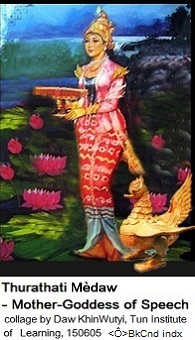 Secondly,
the Planet-god (or ruler of a planet) is an
entity who is not a Buddha. Both are worthy
of "worship". The Planet-god is
worshipped out of fear, whereas the Buddha
and his Arahats are worshipped out of respect.
Secondly,
the Planet-god (or ruler of a planet) is an
entity who is not a Buddha. Both are worthy
of "worship". The Planet-god is
worshipped out of fear, whereas the Buddha
and his Arahats are worshipped out of respect.
In the Theravada Buddhist ceremony, Five
Great Gods or
 {nût-kri: gna:pa:} are also worshipped.
According to Dr. Htin Aung, the Five
Great Gods are Hindu, whereas I contend
that they are Tib-Bur Mother-goddesses
Mèdaws
{nût-kri: gna:pa:} are also worshipped.
According to Dr. Htin Aung, the Five
Great Gods are Hindu, whereas I contend
that they are Tib-Bur Mother-goddesses
Mèdaws
 and their attendants. That the first is
a female, Mèdaw Thurathati, shows that
they are not Hindus. The Hindu Poannars
and their attendants. That the first is
a female, Mèdaw Thurathati, shows that
they are not Hindus. The Hindu Poannars
 {poaN~Na:} 'bramin' - the Hindu religionists
- would never have a female heading a group.
{poaN~Na:} 'bramin' - the Hindu religionists
- would never have a female heading a group.
Bur-Myan speakers of Theravada Buddhist
faith, do not worship the Planets or
Planet-gods
 {groh} let alone their animals. We supply
them food, flowers and light during our
worship of the Nine-Gods Puja. We
invoke or call up the Planets
with our Mantras
{groh} let alone their animals. We supply
them food, flowers and light during our
worship of the Nine-Gods Puja. We
invoke or call up the Planets
with our Mantras
 {mûn~tûn} (which they must obey) to
enjoy the provisions given to them. At the
end of the ceremony, we ask them to leave
which in Bur-Myan is 'expulsion' by
reciting another set of Mantras (which
they must obey). It should be compared and
differentiated from the worship of Hindu
Navagraha
{mûn~tûn} (which they must obey) to
enjoy the provisions given to them. At the
end of the ceremony, we ask them to leave
which in Bur-Myan is 'expulsion' by
reciting another set of Mantras (which
they must obey). It should be compared and
differentiated from the worship of Hindu
Navagraha
 {na.wa.gRa.ha.}
नवग्रह
= न व ग ् र ह ".
{na.wa.gRa.ha.}
नवग्रह
= न व ग ् र ह ".
See http://en.wikipedia.org/wiki/Navagraha 130116, 160118
 In the Hindu ceremony, the householders actively
participated in the ceremony instructed by the
Puja master dressed in white.
In the Hindu ceremony, the householders actively
participated in the ceremony instructed by the
Puja master dressed in white.
UKT 170627, 190327:
~~HD-nonPDF > SND-Skt-Dev > NavagrahaPuja<)) / Bkp<)) (link chk 170627, broken link 190327)
Also watch videos on Navagraha Stotram with Skt-Dev text, from 2 sources, in TIL HD-VIDEO and SD-VIDEO libraries in Hindu section
- NavagrahaSktTxt<Ô> / Bkp<Ô> (link chk 190327)
- NavagrahaSktEngTxt<Ô> / Bkp<Ô> (link chk 190327)
Try to pick out the names of all Nine Planets:
Chandra 'Monday'; Mangal 'Tuesday';
Budh 'Wednesday-morning'; Guru 'Thursday';
Shukra 'Friday'; Shani 'Saturday';
Surya 'Sunday'; Rahu 'Wednesday-evening';
Ketu 'in Bur-Myan the King of Planets'.
Listen carefully, and you will hear a lot
of Skt-Dev, ॐ «OṀ» (ending
with closed lips). It is the equivalent to
 {OÄN} (ending with open lips) which is from
Hinduism.
{OÄN} (ending with open lips) which is from
Hinduism.
In purely Buddhist recitation
there is no
{OÄN}. ॐ «OṀ». Notice the Dot-above
 {þé:þé:tïn}. There many
'dot-above' sounds because of which I hold
that these Mantras were Tib-Bur in origin.
I hold that the Vedic language before Panini
was Tib-Bur, which Panini formalized into
Classical Sanskrit.
{þé:þé:tïn}. There many
'dot-above' sounds because of which I hold
that these Mantras were Tib-Bur in origin.
I hold that the Vedic language before Panini
was Tib-Bur, which Panini formalized into
Classical Sanskrit.
Go back Astrology-Esoterism-note-b
**UKT 160222, 170627, 190327:
Skt-Myan sound is definitely rhotic,
whereas Bur-Myan
 {gra.} is non-rhotic. It is
pronounced exactly like Bur-Myan
monosyllable
{gra.} is non-rhotic. It is
pronounced exactly like Bur-Myan
monosyllable
 {gya.}. However,
{gra.} is slightly rhotic in both
Pali-Myan, and the dialect of Arakan
coastal area. I am in need of a glyph
to represent the Skt-Myan rhotic sound.
Representing it with
{gya.}. However,
{gra.} is slightly rhotic in both
Pali-Myan, and the dialect of Arakan
coastal area. I am in need of a glyph
to represent the Skt-Myan rhotic sound.
Representing it with
 {g~ra.} is not possible as it would
play havoc in Mon-Myan. Skt-Dev solves
this problem using a repha. For highly
rhotic close sound Skt-Dev uses a special
vowel letter, ऋ {iRi.}, and sign
ृ. This close vowel is not present
in Bur-Myan and Pali-Myan. Skt-Dev does
not have an open vowel letter
corresponding to ऋ {iRi.}, and
sign ृ.
{g~ra.} is not possible as it would
play havoc in Mon-Myan. Skt-Dev solves
this problem using a repha. For highly
rhotic close sound Skt-Dev uses a special
vowel letter, ऋ {iRi.}, and sign
ृ. This close vowel is not present
in Bur-Myan and Pali-Myan. Skt-Dev does
not have an open vowel letter
corresponding to ऋ {iRi.}, and
sign ृ.
It is interesting to note that U Hoke Sein
in his PMD0352 to 0374 does not list
any words with
{gra.}. However, U Tun Myint in his
UTM-PDMD043 to 044, lists some. To solve
this problem of rhoticity I have to
propose the following two series, going
from non-rhotic to rhotic :
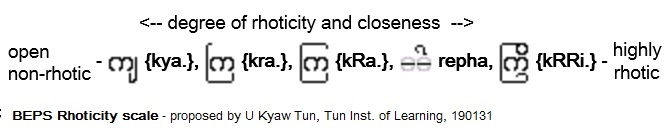
Close front-vowel corresponding to IPA /i/ with dummy /k/
{kyi.} क्यि ,
{kri.},
{kRi.} क्रि , repha ,
{kRRi.} ऋ
Non-rhotic{kyæÑ.} &
{kræÑ.} : killed Nya-major is allowed only in Bur-Myan, not in Pal-Myan
After struggling with rhoticity in BEPS for some years, I've finally adopted a ron-rhotic to highly rhotic scale:
What we generally take to be Pal-Myan
in Astrology and
Indigenous Bur-Myan Medicine is actually
derived from Skt-Dev: they should be
termed Skt-Myan. Now that we have realized Bur-Myan is non-rhotic, Pal-Myan
is slightly rhotic, and Skt-Dev is highly rhotic, the question remains: What about Néwari and Old Magadhi?
See: English to Nepal Bhasa
Dictionary by Sabin Bhuju
सबिन भुजु ,
2005
-
SBhuju-NewarDict<Ô> /
bkp<Ô> (link chk 160221)
Being both Tib-Bur languages
Bur-Myan and Néwa-Dev have words
beginning with {nga.} ङ,
e.g. for <fish> न्या ; ङा
Mon-Myan
 {gRa.} is similar to Skt-Dev, but Bur-Myan
is similar to Pali-Myan.
{gRa.} is similar to Skt-Dev, but Bur-Myan
is similar to Pali-Myan.
Beware of possible mix-ups.
Go back Bur-Myan-Newari-Dev-note-b
End of TIL file