p072R.htm
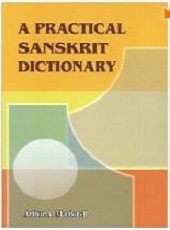
• A Practical Sanskrikt Dictionary,
by A. A. Macdonell, 1893,
http://www.sanskrit-lexicon.uni-koeln.de/scans/MDScan/index.php?sfx=jpg;
1929.
-
Nataraj ed., 1st in 2006, 2012.
-
https://dsal.uchicago.edu/dictionaries/macdonell/ 190516
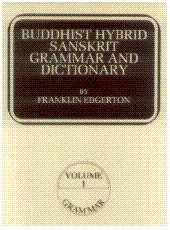
• The Buddhist Hybrid Sanskrit Grammar and
Dictionary, BHS, vol.2, by F. Edgerton,
pp. 627.
-
FEdgerton-BHSD<Ô> /
Bkp<Ô> (link chk 180627)
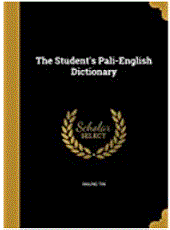
• The Student's Pali English dictionary ,
by U Pe Maung Tin, 1920.
- (ref: UPMT-PEDxxx).
Downloaded copies in TIL
HD-PDF and SD-PDF libraries:
-
UPMT-PaliDict1920<Ô> /
bkp<Ô> (link chk 190113)
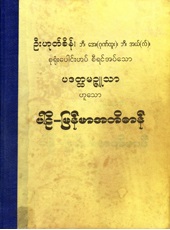
• Pali-Myanmar Dictionary
(in Pal-Myan), by U Hoke Sein,
- (ref: UHS-PMD). The dictionary in printed form is in TIL Research Library.
• Latin-English Vocabulary II, by Hans H Ørberg, 1998
-
HHOrberg-LinguaLatina<Ô> /
Bkp<Ô> (link
chk 190624)
Edited by U Kyaw Tun (UKT) (M.S., I.P.S.T., USA),
Daw Khin Wutyi, Daw Thuzar Myint, Daw Zinthiri Han
and staff of Tun Institute of Learning (TIL).
Not for sale. No copyright. Free for everyone.
Prepared for students and staff of TIL
Research Station, Yangon, MYANMAR
-
http://www.tuninst.net ,
www.romabama.blogspot.com
MC-indx.htm |
Top
MCpp-indx.htm
 {kRRi.}
कृ : formed from Skt-Dev highly
rhotic vowel Skt-Dev pair
ऋ {iRRi.} (1 blnk) &
ॠ {iRRi} (2 blnk)
{kRRi.}
कृ : formed from Skt-Dev highly
rhotic vowel Skt-Dev pair
ऋ {iRRi.} (1 blnk) &
ॠ {iRRi} (2 blnk)
UKT 180114, 190120: The 'killed' Nya-major,
{Ñ}, is an integral part of the native spelling. The 'break up' of Nya-major under the virama,
~
{ñ~ña.} as in
{piñ~ña} 'education, was a foreign incursion in the Pagan Period with the introduction of Pali and Sanskrit from Lanka.
See my note onSanskrit - the dead language
p072c3
 {kRRi.ki.}
कृकि
{kRRi.ki.}
कृकि
 {kRRi.sa.}
कृच
{kRRi.sa.}
कृच
 {kRRi.Na.}
कृण
{kRRi.Na.}
कृण
 {kRRi.ta.}
कृत
{kRRi.ta.}
कृत

 Caveat:
For a Bur-Myan speaker, you are now in
uncharted waters of Skt-Dev
pronunciations. From Akshara-to-Akshara
transformation, you may know the
signification or meaning (in the words
of Shin Kic'si), but you still need to be
familiar with the (modern) Skt-Dev
pronunciations. And so, if you are on a TIL
research computer, watch and listen to the
downloaded files in TIL HD-VIDEO library
Caveat:
For a Bur-Myan speaker, you are now in
uncharted waters of Skt-Dev
pronunciations. From Akshara-to-Akshara
transformation, you may know the
signification or meaning (in the words
of Shin Kic'si), but you still need to be
familiar with the (modern) Skt-Dev
pronunciations. And so, if you are on a TIL
research computer, watch and listen to the
downloaded files in TIL HD-VIDEO library
-
SktDevGramLect01-indx.htm
(link chk 180123)
-
SktDevGramLect02-indx.htm
(link chk 180123)
and listen to 109. GuNitakshara
गुणिताक्षराणि
«guṇita akshara» 'augmented akshara'
in Sanskrit
-
Lesson109<Ô>-
Lesson109<)) (link chk 180123)
UKT notes :
• Avādāna-kalpalatā : Tibetan
Buddhism
• Krita Yuga
कृत युग
 {kRRi.ta. yu.ga.) : aka
Satya Yuga - the Golden Age
{kRRi.ta. yu.ga.) : aka
Satya Yuga - the Golden Age
• Soan
 and Bilu
 : misrepresented ethnic tribes of humans.
Soans are still supposed to be present in Yaw
 {yau:}, the area of
Pondaung-Ponnya {poän-taún poän-Ña} range.
{yau:}, the area of
Pondaung-Ponnya {poän-taún poän-Ña} range.
This note on Soan and Bilu
is an expansive article and will be
moved ¤ Folk Elements in Buddhism
--
flk-ele-indx.htm >
ch05-magus.htm (link chk 170616).
•
Sanskrit - the dead language -
pronunciation-wise
 {kRRi.} कृ :
UKT 170605:
and about
See also Rhotic-open-vowel and Soans and Bilus
UKT: I need to rewrite this note.
p072c1-b24/ not online
UKT 190122: Some of Macdonell's entries are very long, which needs to be broken up
© कृ [¹. kri ] (skri after upa, pari, sam), VIII.
- [káro] strong, [kuru] weak; V.+ I. kára, II. kár, V. krinò; make, do; fashion, build; perform, fulfil;
See: √¹kṛ (skṛ), 'make'. - Whit0021√¹ kṛ (skṛ), 'make'. - Whit021
√² kṛ, kir, 'scatter'. - Whit022
√³ kṛ, 'commemorate'. - Whit022
• कृ [¹. kri ]
(skri after upa, pari, sam), VIII.
- [káro] strong,
[kuru] weak; V.+ I.
kára, II. kár, V.
krinò; make, do; fashion,
build; perform, fulfil; produce; execute;
effect; conclude (friendship),
display, show, exercise; prepare, cook;
compose; cultivate; make anything
out of (in. ab.); do anything
to or for (g., lc.); make any one
anything (2 ac.); do violence to
(ac.); perform the usual action
with (ac.); used thus with
great latitude, e.g.
¶01. udakam kri, offer the usual oblation of water (allied
with this is the use of kri in the periphr. pf. with an abst. ɴ. in
â);
utter, pronounce, use; describe; fix, determine; pass (time); await (a moment);
procure for (g., lc.); assume (shape, voice: Â.); place on or in, direct to (in.
lc.), turn the mind or thoughts, give the
¶02. heart (manas, buddhim, matim, bhâvam)
to, resolve on (d., lc., inf. or oratio recta sub-note01 with iti); appoint to (lc.);
commission; act, fare; sacrifice; do anything with, make use of (in. and kim?);
avail, be of use (with kim?); with
¶03. adverbs in î (e.g. atithi-),
û (e.g. mridû-), make, turn into ; with -sât, reduce to, turn
into; vase kri, subdue; hridi-, take to heart, remember;
hridayena-, love; evam kritavâ, for this reason;
tathâ-, yathâ‿uktam-,
do so, consent; cs. kâraya, cause to make (2 ac.),
¶04. cause to be made
by (in.); cause to be prepared; cause to be made (2 ac.); cause to be placed in
(lc.); cause to be performed; cause to be cultivated; -to be put or buried;
order to make, -to prepare, -to practise: often = simple verb; des. kikirsha,
wish to do, -perform,
¶05. -establish; intend; strive after. ati, transgress.
adhi, place at the head of, appoint to (lc.); put forward, make a
subject of discussion: pp. entrusted with, appointed to (lc., -°);
concerned in (lc.). anu, imitate (ac.); equal, rival (ac., g.), equal (ac.) in
(in.) apa, take away, remove; injure (ac. g., lc.); cs. id. prati‿apa, take
vengeance on (g.) abhi, do, make;
¶06.
des. wish to do, undertake. aram,
prepare; serve, satisfy (d.). alam, prepare, produce; adorn (Â. adorn oneself);
do violence to (g.). abhi‿-, upa‿-, adorn, sam-alam,
id.; violate. ava, direct downwards. â, bring hither;
produce; appropriate (g.); cs. call; ask for (2 ac.); des. intend to
perform. apa‿â, remove, drive away, dispel, counteract, repel;
¶07. give up,
desist from; pay. upa‿â, bring near, fetch, deliver; grant; prepare for a
sacred rite; consecrate. ni‿â, keep back. nir-â, set apart; put
away, remove; drive away; reject, repel; deny. vi‿â, separate,
distinguish; explain. sam-â, unite, keep together. upa, confer;
offer, present; serve, do a service to,
¶08. oblige (g., lc.); Â. cherish.
upa-skri, prepare, compose; equip, adorn; care for (ac.): pp.
furnished with (in.) prati‿upa, repay; do a service in return. ni,
bring done, humble, overcome: pp. humbled; dejected; mortified. vi-ni,
mortify; injure; defraud. nis, remove; prepare; seek out; cure; expiate.
¶09.
pari-shiri, prepare; adorn, deck, furnish with (in.). puras, place in front;
show, display; appoint to (lc.); choose, prefer; honour; gd. -kritya,
regarding, about, on account of (ac.); pp. accompanied with (-°). pra, do;
fashion, make; perform; show, cause; make into (2 ac.);
¶10. marry (a wife, a girl);
violate, pollute (a gril); appoint to (lc.);
put forward; make the subject of discussion;
buddhim or manas -, apply
one's heart to, make up one's mind to
(d., lc.), resolve; pp. begun;
accomplished; mentioned, under discussion;
in question; cs. cause to prepare.
vi-pra, injure; harass; obstruct.
prati, make (ac.) out of
(ac.) in
¶11. opposition; repay (good and evil) with
ac. of thing and d., g., lc. of person;
resist; make good, repair; pay; des. wish
to take revenge on (ac., lc.) for (ac.). vi,
make different, change, alter; compare;
disfigure, destroy, mutilate; develop;
be hostile to (g., lc.); become unfaithful
to (lc.): Â., ps. be changed
or modified; become alienated or disloyal;
¶12. pp. changed, altered, qualified;
mutilated, deformed, disfigured; unnatural,
repulsive; cs. cause to change one's
sentiments. pra-vi (for vi-pra);
pp. sinned. sam (generally
-skri ), put together, unite;
accumulate; prepare; invest (with the sacred
thread); hallow (a girl at a wedding subnote02 or the
dead with sacred fires); adorn, polish, form
grammatically: pp. sam-skrita,
hallowed†, invested; adorned, polished,
elaborate, refined, Sanskrit. prati-sam,
repair.
sub-note01. oratio recta [ōrātio 'speech' + rēctus 'straight, direct, honest']
- http://www.yourdictionary.com/oratio-recta 170304subnote02 . The Hindu wedding ceremony is called Vivaha samskar ( विवाह «vivāha» 'wedding, marriage'; संस्कार «saṃskāra» 'sacrament') . - http://www.hinduwebsite.com/hindumarriage.asp 170608 .
Skt-Dév transliteration by SpkSkt.
List of words with prefix
कृ «kṛ» from SpkSkt
(these to be moved to appropriate entries)
• कृपते
«kṛpate» { kṛp} - verb6 .
pity, be weak, mourn, long for, lament
• कृपात्मन्
«kṛpātman» - adj.
tender-hearted
• कृपया
«kṛpayā» - adverb.
compassionately
• कृपया
«kṛpayā» - Please
• कृपाकर
«kṛpākara» - m.
extremely compassionate,
mine of compassion
• कृपालु
«kṛpālu» - adj. pitiful,
compassionate, kind, merciful
• कृपालुता
«kṛpālutā» - f.
compassion
• कृपाहीन
«kṛpāhīna» - adj.
pitiless, unfeeling
• कृपायते
«kṛpāyate» {kṛpāya}
- verb. have pity, mourn, grieve,
lament
• कृपयति
«kṛpayati» - verb. implore
• कृपायति
«kṛpāyati» {kṛpāya}
- verb. praise
√¹kṛt, 'cut'. - Whit022
√²kṛt, 'spin'. - Whit023
p072c2-b01/
• कृ [². kri ]
- pt. kakrát , intv.,
kar-kri , remember,
mention with praise (g.)
( end of old p072-3.htm )
 {kRRi.ka.}
कृक
{kRRi.ka.}
कृक
• कृक «kṛka»
Skt: कृक «kṛka» - m. navel, throat, larynx, ... - SpkSkt
IPal: {kakka} - m. paste, soap, sediment ; adj. white. - UPMT-PED061
p072c2-b02/ p055-264
• कृकर
[ kri-kara ]
- m. kind of partridge; a vital
air causing hunger.
264)
p072c2-b03/ p055-270
• कृकलास
«kṛkalāsa »
Skt: कृकलास
[krikalâsá] - m. lizard;
chameleon. -- Mac072c2
(p072c2end)
270)
Skt: कृकलास
«kṛkalāsa » - m. chameleon,
lizard -- SpkSkt
IPal: {kakaṇṭaka} - m. a chameleon. - UPMT-PED061
BPal:
 {ka.kûN~Ta.ka.} - UHS-PMD0275
- 
UKT from UHS: m. chameleon

UKT 170323: The above
{ré poat-þín} 'newt'. The amphibians, including frogs are once plentiful in Myanmarpré, but are fast disappearing due to agricultural pesticides. I have seen them while stationed at Taunggyi College (now University) in 1980s. They are considered by the natives of Shan State to have medicinal properties and dried animals were available in the Taunggyi bazaar. Since, the Myanmar species are lake species, I've shown what is available to me from Wikipedia. See:
- https://en.wikipedia.org/wiki/Newt 170323
- https://en.wikipedia.org/wiki/Yunnan_lake_newt 170323
p072c2-b03.1/ p055-271
• काशः
«kāśaḥ» शकः शम् [काश्-अच्]
Skt: काशः
«kāśaḥ» - a kind of grass
used for mats, roofs, &c. ... --
Apte:SktGram
271)
Skt: «kāśa» - Roth finds this
word, which denotes a species of grass
(Saccharum spontaneum) used for mats, etc.,
in one passage of the Rigveda, but the
reading is uncertain. The word has this
sense in the Taittirīya Aranyaka. --
VedicIndxOfNamesAndSubjects:SktGram
See downloaded pdf of Vedic Index of Names and Subjects (vol 2?), by A A Macdonell, 1854 in HD-PDF and SD-PDF libraries: - AAMacdonell-VedicIndx<Ô> / Bkp<Ô> (link chk 180121)
p072c3-b00/ p055-272
• कृकवाकु
[ krika-v&asharp;ku ]
- m. cock; peacock.
272)
p072c3-b01/ not online
• कृकषा [krikashâ}
Skt: कृकषा [krikashâ}
- f. kind of bird - Mac072c3
Skt: कृकषा - f. a
kind of bird (equals
kaṅkaṇa-hārikā-)
- MWilliams:SktDic
p072c3-b02/ not online
• कृकालिक [krikâlika]
Skt: कृकालिक [krikâlika]
- f. kind of bird - Mac072c3
Skt: कृकालिका «kṛkālikā» -
f. kind of
bird - SpkSkt
{kRRi.ki.}
कृकि
• कृकिन «kṛkin»
BHS: «kṛkin»
- n. of legendary king -- FE-BHS190
IPal: {kiki} - f. *diva, m. the blue jay. UPMT-PED073
BPal:
 {ki.ki.} - UHS-PMD0316
read with UHS-BEPD0653
{ki.ki.} - UHS-PMD0316
read with UHS-BEPD0653
- 
UKT from UHS: blue jay
{kRRi.sa.}
कृच
p072c3-b03/ p.55-257
• कृच्छ्र
[ krikkhrá ]
= कृ च ् छ ् र
- a. distressing, grievous, dire; severe, dangerous; wretched, miserable:
-m, ad. miserably; m. n. difficulty, distress, trouble, misery; danger; penance;
kind of minor penance; °--, -tas, in., ab. with difficulty, with much ado.
257)
p072c3-b04/ p055-245
• कृच्छ्रकर्मन्् [ krikkhra-karman ]
- n. distress, trouble; -kâla, m. time of distress or danger;
-gata, pp.
distressed, endangered; practising penance; -tâ, f. dangerousness;
-patita, pp.
fallen into distress; -prâna, a. whose life is in danger; eking out one's
existence with difficulty; -sâdhya, fp. difficult of accomplishment.
245)
p072c3-b05/ p055-244
• कृच्छ्रातिकृच्छ्र [ krikkhra‿atikrikkhra ]
- m. du. ordinary and extraordinary penance; sg. kind of penance.
244)
p072c3-b06/ p055-243
• कृच्छ्राब्द
[ krikkhra‿abda ]
- m. kind of one year's penance.
243)
p072c3-b07/ not online
• [kri-ñ]
- the root of kri (gr.).
{kRRi.Na.}
कृण
p072c3-b08/ p055-242
• कृणोतन
[ kri-no-tana ]
- V. 2 pl. impv. of
√kri, do.
242)
(end of old p072-4.htm )
{kRRi.ta.}
कृत
p072c3-b09/ not online
• कृत्
[kri-t] -->
 {kRRait}
Skt:
कृत् [kri-t]
- (-°) a, making, producing, causing,
performing; m.. composer, maker,
fashioner; primary norminal suffix (attached
to roots); primary noun -- Mac072c3
BPal:
 {ka.ta.} - UHS-PMD0318
- 
UKT from UHS:
{ka.ta.} - mfn. doing, dressing
BPal:
 {ka.rait~hta.}
-  - UHS-PMD0299
UKT from UHS:
¤
{ka.rait~hta.} - (request) do
p072c3-b10/ not online
• कृत् [¹. krit ]
- vi. p. krintá ( e. also â. and i.p.
karta ), cut, cut off, out; up or down; extract; cleave; pp. kritta
, cut; cut, torn or hewn off; ...
p072c3-b11/ not online
• कृत् [². krit ]
- vii. p. krinâtti , spin
p072c3-b12/ p055-241
• कृत [ kri-tá ]
- pp. made, done, performed;
prepared, ready; acquired; well done, all
right; --°, relating to: -m, done!
= it shall be done at once; w. in.
away with, enough of; n. deed,
work, action; benefit (-m vid,
be conscious of benefits received); stake
(in play); booty; die or side of a die
marked with 4 ; first or golden age.
241)
UKT 180121: See my note on Krita Yuga कृत युग
p072c3-b13/ p055-255
• कृतक
[ krita-ka ]

- a. artificial, feigned, false;
adopted (son): -m, feignedly,
-tva, n. quality of being
artificially produced; -kartavya,
a. having fulfilled his task;
-karman, n. an accomplished
deed; a. having fulfilled one's duty;
255)
¶1. -kârin, a. doing a thing;
-kârya, n. an attained
object; a. having accomplished his
object; satisfied: -tva, n.
abst. ɴ.; -kâla, m.
appointed time; -kritya,
a. having done his duty; having
attained his object, satisfied (as to,
lc.):
¶2.
-tâ, f. satisfaction;
-kriya, a. having performed
a sacred rite; pious; -kshana,
a. having an appointed time,
i.e. waiting impatiently for
(lc., ac. w. prati, inf., --°);
-kshobha, a. shaken;
-ghna, a. ignoring benefits,
¶3. ungrateful: -tâ, f.,
-tva, n. ingratitude;
-kûda, a. having received
the tonsure; -ganman, a.
planted; -gña, a. recognising
benefits, grateful: -tâ, f.
gratitude.
© कृतक
krta-ka
-->
 {kRRi.ta.ka.}
Skt: कृतक
[krita-ka] - a. artificial,
feigned, false; adopted (son): - Mac072c3
BHS: «kṛtaka» - adj. (perhaps
essentially identical with Skt. «kṛtaka»,
but with ... -- FE-BHS0190
BPal:
 {kait~ti.ma.}
-
 - UHS-PMD0318
UKT from UHS: mfn. made
[meaning not occurring in Nature], son
[child] by adoption.
UKT 140401: Kaittima adoption by
Bur-Buddhist customary law and by
India-Hindu law are quite different.
See: Aurasa
 {au:ra.þa.} child - p060-2.htm (link chk
180115)
{au:ra.þa.} child - p060-2.htm (link chk
180115)
©
कृतकर्मन् «kṛtakarman»
Skt:
-karman, n. an accomplished
deed; a. having fulfilled one's duty; - Mac072c3
Skt:
कृतकर्मन् «kṛtakarman»
- adj. able, clever, one who has done his work or duty. n. act
that has been accomplished - SpkSkt
© कृतज्ञ « kṛtajña »
Skt: -gña, a. recognising
benefits, grateful: - Mac072c3
Skt: कृतज्ञ « kṛtajña » - mfn.
knowing what is right, correct in conduct, acknowledging
past services or benefits , mindful of former aid or favours, grateful
-- Monier-Williams
BHS: «kṛtajña» - n. of a previous incarnation of Śākyamuni, hero of
Avādāna-kalpalatā ... -- FE-BHS0190
IPal: «kataññu» - adj. grateful; °ñutā,
f. gratitude - UPMT-PED064
BPal:
 {ka.tiñ~ñu.ta} - UHS-PMD0284
UKT from UHS- f. gratitude
UKT 140406: See my note on Avādāna-kalpalatā from Digital Sanskrit Buddhist Canon University of the West @ 1409 Walnut Grove Ave., Rosemead, CA 91770 . Surfing further I came across: (Skt: kṛtajña; P: kataññu) in the Google search index on John Ross Carter, 2012, "In the Company of Friends"
See also Wikipedia: - https://en.wikipedia.org/wiki/Avadana 170323
© कृतजन्मन् «kṛtajanman»
Skt:
Skt: कृतजन्मन् «kṛtajanman» -
adj. produced, born, generated - SpkSkt
p072c3-b14/ p055-253
• कृततीर्थ [ krita-tîrtha ]
- a. to which a stair has been made; -tvara, a. hastening;
-dâra, a.
married; -dâsa, m. one who offers himself as a slave for a fixed time;
-dîrgha-rosha,
m. protracted wrath; -dhî, a. clever; resolved on (inf.);
-dhvag, a. furnished
with banners; -nâsaka, a. ungrateful; -nâsana, a. id.; -niskaya,
a. convinced;
firmly resolved on (d., lc., inf., --°); resolute; -niskayin, a. resolute.
253)
© कृततीर्थ «kṛtatīrtha»
Skt: कृततीर्थ [krita-tîrtha]
- a. to which a
stair has been made; -- Mac072c3
Skt: कृततीर्थ «kṛtatīrtha» -
adj. rendered accessible or easy, an adviser, who
frequents them, furnished with a passage, one fertile in expedients, one who has
visited holy places -- SpkSkt
( end of new p072.htm )
-- UKT 140406, 170323, 180225
To claim that I am a practicing Myanmar Theravada Buddhist and a skeptical scientist at the same time without knowing anything of the Tibetan Buddhism is a shameful thing for me. Of course, I, as a human being can not know everything, yet I must have a broad knowledge.
I have come to know of Avādāna-kalpalatā only recently. You can get a slew of Skt-Dev writings with a Buddhist flavour in Tibetan Buddhism.
See: Early Buddhist Texts Home Page , relating to Hinayana ("Therawada" to Southern Buddhists), Mahayana texts.
- https://www.ancient-buddhist-texts.net/Reference/Early-Buddhist-Texts/06-EBT-Avadana.htm 180225
See also: Wikipedia: https://en.wikipedia.org/wiki/Sanskrit_Buddhist_literature 170323
The following is an excerpt on the history of Sanskrit manuscripts from Digital Sanskrit Buddhist Canon University of the West @ 1409 Walnut Grove Ave., Rosemead, CA 91770 :
"We have come to know through our understanding of Buddhist history that an enormous amount of Buddhist literature was created in Sanskrit, beginning right after the Buddha’s Mahaparinirvana, continuing up to the 12th century AD in India. Out of this vast literature, comprising several thousand texts, only a portion was translated into Tibetan between the 7th and 15th centuries and into Chinese between the 2nd and 11th centuries. Unfortunately, with the passage of time, the great treasure of Buddhist literature in Sanskrit was lost or destroyed due to various developments over the course of history."
From Wikipedia: - https://en.wikipedia.org/wiki/Avadana 170323
Avadāna, Skt अवदान
«avadāna», Pali
 {a.pa.da-na.}, Bur
 {a.pa.daan},
[1] is the name given to a type of
Buddhist literature correlating past lives'
virtuous deeds to subsequent lives' events.
While including accounts from the Pali
language Vinaya Pitaka ("Basket of
Discipline"), this literature also
includes a large number of Sanskrit
collections, of which the chief are the
Mahāsaṅghika's Mahāvastu
("Great Book"), and the
Sarvāstivāda's
Avadānaśataka (Century of
Legends) and Divyāvadāna
(The Heavenly Legend). These latter
collections include accounts relating to
Buddha Gautama and the third-century BC
"righteous ruler," Ashoka.
[2]
{a.pa.daan},
[1] is the name given to a type of
Buddhist literature correlating past lives'
virtuous deeds to subsequent lives' events.
While including accounts from the Pali
language Vinaya Pitaka ("Basket of
Discipline"), this literature also
includes a large number of Sanskrit
collections, of which the chief are the
Mahāsaṅghika's Mahāvastu
("Great Book"), and the
Sarvāstivāda's
Avadānaśataka (Century of
Legends) and Divyāvadāna
(The Heavenly Legend). These latter
collections include accounts relating to
Buddha Gautama and the third-century BC
"righteous ruler," Ashoka.
[2]
• अवदान «avadāna» - n. great or glorious act, achievement, mindfulness, caution, ... - SpkSkt
¤ अवधानं करोति «avadhānaṃ karoti» - v8. - care - SpkSkt
Amongst the most popular avadānas of Northern Hinayāna Buddhism are:
• the story of Sudhana, preserved in the Mahāvastu under the title Kinnarī jātaka, amongst others, who falls in love with a kinnarī and saves her life.
• the Vessantara jātaka, the story of the compassionate prince who gives away everything he owns, including his wife and children, thereby displaying the virtue of perfect charity.
• the Suvannasankha jātaka [3]
Though of later date than most of the canonical Buddhist books, avadānas are held in veneration by the orthodox, and occupy much the same position with regard to Buddhism that the Puranas do towards Hinduism. They act in a similar way to other texts describing past deeds or past lives held in other traditions in the region, such as the aforementioned Puranas, the Dasam Granth and Janamsakhis of Sikhism, and the Kalpa Sutra of Jainism.
Go back Avādāna-note-b
UKT 170323:

You can make a die of many shapes. The above is obviously a four-sided die in the shape of a tetrahedron - not a regular die which is a cube. Shown in the inset is the tetrahedral-die, the kind that the Hindu God must have played.
The First Epoch of Hinduism is known as
Krita Yuga कृत युग
{kRRi.ta. yu.ga.) aka
Satya Yuga सत्य युग - the Golden Age.
See Wikipedia:
https://en.wikipedia.org/wiki/Satya_Yuga 170608
"The Satya Yuga सत्य युग «satya yuga», also called Sat Yuga,
Krta Yuga and Krita Yuga in Hinduism [UKT: cow worshippers],
is the first of the four Yugas, the "Yuga (Age or Era) of Truth",
when humanity is governed by justice gods [UKT: Justice
in accordance with the teachings of Buddhas - the enlightened beings:
dévas & brahmas are still blinded by Ignorance.] and
every manifestation or work is close to the purest ideal and humanity will
allow intrinsic goodness to rule supreme. It is sometimes referred to as the
"Golden Age". The Satya Yuga lasts 1,728,000 years. The goddess Dharma
(depicted in the form of cow), which symbolises morality, stood on all four
legs during this period. Later on in the Treta Yuga, it would become three,
followed by two in the Dvapara Yuga. Currently, in the immoral age of Kali,
it stands on one leg.
[1]
From: http://hinduism.enacademic.com/436/Krita_Yuga 170323
All of the YUGAS, or ages, in the Indian tradition, refer to throws in an ancient game of dice. Krita (“the one that made it!”) is the best throw — a 4.
The Krita Yuga, which like all ages has appeared an infinite number of times and will return an infinite number of times, is also called Satya Yuga, or the age of truth. It is 1,728,000 years long. In Krita Yuga the highest virtue is said to be MEDITA-TION. In this age, BRAHMA is god. Eternal DHARMA is said to have all its four feet in this age, while in the others it progressively has three, two, and one. In the Krita age there is no distinction between the best and worst of creatures. Their life, happiness, and attractiveness are all equal. They are also free of sorrow, completely good, and enjoy solitude, rather than crowds. They are devoted to MEDITA-TION, active in spiritual restraints and austerities, and act always without self-interest. They are always joyful and have no permanent homes, but live in the mountains or by the oceans.
From : https://en.wikipedia.org/wiki/Yuga 170323
Yuga in Hinduism is an epoch or era within a four age cycle. A complete Yuga starts with the Satya Yuga, via Treta Yuga and Dvapara Yuga into a Kali Yuga. Our present time is a Kali Yuga, which started at 3102 BCE with the end of the Mahabharata war.
Go back KritaYuga-note-b
{soan:} and Bilu
{Bi-lu:} - UKT 170611, 180123
Soans are still supposed to be present in Yaw
{poän-taún poän-Ña} range. See: Section 08
¤ Geography{pa.hta.wi-wín} - geog-indx : and from that indx - fossil.htm
¤ Geology -{Bu-mi.bé-Da.} - geol-indx : and from the indx - Geologic time scale (GTS) and (GPTS)
Note my use of Mauk'cha-Weik'cha which is different from that used by MLC. Romabama convention is simple: one-circle akshara use Mauk'cha; two-circle akshara use Weik'cha. MLC has no simple rule and they have to recite a Mnemonic to remember their rule:
{hkín gu gnau: / dau: poän wa. / mauk hkya. ré:pa kra.//}. I am using Romabama convention for
{gyain-hpau.},
{gyín:hpau}, and
{þain:pau}.

The Chingpaw is usually pronounced as
¤ Language Change in Political Systems of Highland Burma - a study of Kachin social structure, by E. R. Leach, London, 1954, 1964
- ERLeach-PolSysHighlandBurma<Ô> / Bkp<Ô> (link chk 180115)
¤ Some documented cases of Linguistic change - excerpts from the above book
- ERLeach-LangChangeHiglandBurma<Ô> / Bkp<Ô> (link chk 180115)Note: Putao
{pu-ta-o mro.} is the northern-most town in Myanmarpré.
Wikipedia - https://en.wikipedia.org/wiki/Putao 170612
"Hkamti Long (also Khamti Long) is the former name of one of the outlying Shan States. [2] It was a princely state around the city of Putao settled by the Hkamti Shan people. The name means "Great Place of Gold" in the Hkamti Shan language. [3] Nowadays, there are Rawang and Lisu people which are already regarded as Kachin nationalities."From Putao, you can see the highest snow-capped peak, Hkakabo Razi
{hka-ka.bo ra-zi}, in Myanmarpré among the snowy ranges of the eastern Himalayas. It is probably the highest in SEAsia and is 5,881 m. (19,295 ft.) high. See Wikipedia:
- https://en.wikipedia.org/wiki/Hkakabo_Razi 170612
 A
fact that is generally overlooked is that northern Myanmarpré had close contacts
with north-eastern India, and that there is no need to use the sea-routes. I
quote from
Political Systems of Highland Burma - a study of Kachin social
structure, by E. R. Leach, London, 1954, 1964, p038: "One of the facts that
can be taken as established for certain is that the Chinese were familiar
with various routes from Yannan to India as early as the first century AD. We
cannot be quite certain what these routes were, but, since there are only a very
limited number of passes though the main mountain ranges, routes cannot have
differed very greatly from those we know of today."
A
fact that is generally overlooked is that northern Myanmarpré had close contacts
with north-eastern India, and that there is no need to use the sea-routes. I
quote from
Political Systems of Highland Burma - a study of Kachin social
structure, by E. R. Leach, London, 1954, 1964, p038: "One of the facts that
can be taken as established for certain is that the Chinese were familiar
with various routes from Yannan to India as early as the first century AD. We
cannot be quite certain what these routes were, but, since there are only a very
limited number of passes though the main mountain ranges, routes cannot have
differed very greatly from those we know of today."
UKT 170609: The following are from J. G. Scott's
I still have to work on The Upper Burma Gazetteer in
PDF libraries (link chk on 180115)
Ref1.
- JGScott-GazettUpperBurShanPt1v1<Ô> /
Bkp<Ô>
Ref2. -
JGScott-GazettUpperBurShanPt1v2<Ô> /
Bkp<Ô>
Ref3.
- JGScott-UpperBurGazett5vol<Ô> /
Bkp<Ô>
Ref4.
- JGScott-UpperBurGazettChap10<Ô> /
Bkp<Ô>
Ref1. Ch07p389-01
 (The Upper Burma Gazetteer, Chap. VII p389mid )
Besides these parent and cognate tribes of Chingpaw there are a number of miscellaneous
tribes extending beyond latitude 25° north
[Ref: Myitkyina 25°23'N 97°24'E], up to the
twenty-eighth parallel, of whom little or
nothing is known, but whom the Kachins regard
as being indirectly connected with them.
These are: -
 (1) The Khangs
 {hkeín:}, who are said to live on the
other side of the Chindwin beyond Bisu,
and who, Mr. George thinks, may be
perhaps identified with some Chin
{hkeín:}, who are said to live on the
other side of the Chindwin beyond Bisu,
and who, Mr. George thinks, may be
perhaps identified with some Chin
 {hkín:} tribe. They are also found
north-east of the Bor Khamti country
and originally separated from the
Khenungs on the Salween
{hkín:} tribe. They are also found
north-east of the Bor Khamti country
and originally separated from the
Khenungs on the Salween
 {þän-lwín mric} from Khumongs on the west.
Mr. Errol Grey says that they have a
distinct language and are less feminine
in type than the Khumongs, with whom
they are much mixed up, though they
occupy separate villages. (The Upper
Burma Gazetteer, Chap. VII
p389end-p390begin)
{þän-lwín mric} from Khumongs on the west.
Mr. Errol Grey says that they have a
distinct language and are less feminine
in type than the Khumongs, with whom
they are much mixed up, though they
occupy separate villages. (The Upper
Burma Gazetteer, Chap. VII
p389end-p390begin)
(2) The Kaphawks . - Some of these
accompanied the Khangs across the Chindwin
 {hkyín-twín: mric}, while others remained
to the east of Hkamti Long. With them are
related --
{hkyín-twín: mric}, while others remained
to the east of Hkamti Long. With them are
related --
 (3) The Kaluns , who are said to
differ in some way. These are probably
the Kalangs, a naked tribe spoken
of by Major Fenton, who calls them wild
and uncivilized and says they eat their
aged relations to spare them unnecessary
misery.
(3) The Kaluns , who are said to
differ in some way. These are probably
the Kalangs, a naked tribe spoken
of by Major Fenton, who calls them wild
and uncivilized and says they eat their
aged relations to spare them unnecessary
misery.
 (4) The Tarens or Tarengs
are found on the border of the Chinese
State of Santa and in Hkamti Long. They
wear clothes something after the Chinese
style, and are well known in Upper Burma
as coolies under the name of Maingthas .
They are a distinct tribe, with a language
and customs of their own, and are renowned
for the excellence of their dhas
(4) The Tarens or Tarengs
are found on the border of the Chinese
State of Santa and in Hkamti Long. They
wear clothes something after the Chinese
style, and are well known in Upper Burma
as coolies under the name of Maingthas .
They are a distinct tribe, with a language
and customs of their own, and are renowned
for the excellence of their dhas
 {Da:}. They appear to be great travellers
and itinerant merchants. During the cold
weather they desert their villages and
scatter over the adjacent countries
returning at the beginning of the rains.
{Da:}. They appear to be great travellers
and itinerant merchants. During the cold
weather they desert their villages and
scatter over the adjacent countries
returning at the beginning of the rains.
 The name Maingtha is a simple
Burmese perversions of the Shan form
Tai Mong Hsa, that is to say, Shans from
the two Hsa and La Hsa. [UKT 170329:
I would transcribe Maingtha as
The name Maingtha is a simple
Burmese perversions of the Shan form
Tai Mong Hsa, that is to say, Shans from
the two Hsa and La Hsa. [UKT 170329:
I would transcribe Maingtha as
 {mreín-þa} 'forester'.]. There they
call themselves and are called by their
Chinese neighbours Ngachang or
Achang (see Ethnology Chapter) and
appear to be called Paran by the
Kachins round about. Their dress, religion,
and customs are those of the Chinese-Shans
{mreín-þa} 'forester'.]. There they
call themselves and are called by their
Chinese neighbours Ngachang or
Achang (see Ethnology Chapter) and
appear to be called Paran by the
Kachins round about. Their dress, religion,
and customs are those of the Chinese-Shans
 {rhûn:ta.roat}. They are Buddhists and their language a curious mixture. Captain
H. R. Davies estimates that about 30% of the words appear to be connected with
Burmese and 12% with Shan. The latter have probably been borrowed from the
surrounding Shans as names for things of which they knew nothing until they
encountered the Shans and were converted to Buddhism. [UKT ¶]
{rhûn:ta.roat}. They are Buddhists and their language a curious mixture. Captain
H. R. Davies estimates that about 30% of the words appear to be connected with
Burmese and 12% with Shan. The latter have probably been borrowed from the
surrounding Shans as names for things of which they knew nothing until they
encountered the Shans and were converted to Buddhism. [UKT ¶]
 Mr. Errol Grey speaks of meeting
Turengs on his way to the country of the
Khumongs, above latitude 27°15' and about longitude 97°30' . The Turengs,
he says, are the great blacksmiths of that neighbourhood, just as the Ngachang
are for the country round Hotha and Latha. They make all the dhas
{Da:}
and daggers worn by the Singpho and Hkamti Shans, and these under the name of
Hkamti dhas form one of the chief articles of trade between the Hkamti
valley and Assam. [UKT ¶]
Mr. Errol Grey speaks of meeting
Turengs on his way to the country of the
Khumongs, above latitude 27°15' and about longitude 97°30' . The Turengs,
he says, are the great blacksmiths of that neighbourhood, just as the Ngachang
are for the country round Hotha and Latha. They make all the dhas
{Da:}
and daggers worn by the Singpho and Hkamti Shans, and these under the name of
Hkamti dhas form one of the chief articles of trade between the Hkamti
valley and Assam. [UKT ¶]
The iron is found in the hills forming the boundary between the Turengs and the Khumongs. "It is of excellent quality and the knives are very durable." The dhas are made in four varieties, "the streaked, the indented, the white, "and the black dhas." [UKT ¶]
Mr. Errol Grey refers to a Tureng Dhu or Chief who
visited him and gave a list of the Singpho tribes, amongst which appeared
Marans, Marips, Laphars (no doubt Ledais ),and Darengs or Tullings,
who presumably are the Tarengs themselves. He also says "a range of snows,
separating (The Upper Burma Gazetteer, Chap. VII p390end-p391begin)
the Tisang from the Tamai," which is said to be the eastern limit of the Tureng
Singpho country. The Tamai is the local name for the eastern branch of the
Irrawaddy
 {É-ra-wa.ti mric}. This would place the Turengs in about longitude 98° and about
latitude 27°30'. Prince Henri d'Orleans found that many of the tribesmen, called
by their neighbours Kiutzu (from the fact that they inhabited the Kui Kiang
valley, a branch of the 'Nmai kha ), styled themselves Turong or
Tulong.
{É-ra-wa.ti mric}. This would place the Turengs in about longitude 98° and about
latitude 27°30'. Prince Henri d'Orleans found that many of the tribesmen, called
by their neighbours Kiutzu (from the fact that they inhabited the Kui Kiang
valley, a branch of the 'Nmai kha ), styled themselves Turong or
Tulong.
UKT 170613: I was intrigued why Prince d'Orleans, a Frenchman, was among the Kachins. I then found out he was leading an expedition to open up a railroad link from Hanoi, then occupied by the French colonialists, to Mandalay still independent under King Mindon. It has been claimed that the British who had gobbled up two thirds of the Burmese Kingdom, made frantic arrangements to annex the whole country. Then in 1886 they did make up a false excuse and annexed the whole country.
(5). The
Khenungs, according to Mr. Errol Grey, come from the valley of the
Salween
{þän-lwín mric}, where their country bounds that of the Khunnongs or Khumongs on
the east above latitude 27°.
 Their dress is said to be a short pair of trousers
reaching to the knee, tied round the waist by several coils of a plaited
cotton string and two or three coats of various lengths, the outermost of which
is made of wool and reaches down to the calf of the leg. The plait their hair
into a queue after the Chinese fashion and wear hats made of felt, conical in
shape, with a broad brim much turned up. Their influence extends from the Salween
{þän-lwín mric} to the Tamai or N'mai Kha. They exercise authority over
several Khunnong villages in the Tisang valley, paying two yearly visits, when
they announce their arrival by blowing on a gourd reed, presumably something
like the Ken of the La'hu, the A'kha, and the Luang Prabang Tai. "The
Khunnongs, immediately on hearing its sound, rush out to meet them, and
conducting them into their villages feast them on the best they have." (Report
on the Bor-Khampti country). The tribute paid seems to consists chiefly of
bees-wax, a common offering among the Wa. also.
Their dress is said to be a short pair of trousers
reaching to the knee, tied round the waist by several coils of a plaited
cotton string and two or three coats of various lengths, the outermost of which
is made of wool and reaches down to the calf of the leg. The plait their hair
into a queue after the Chinese fashion and wear hats made of felt, conical in
shape, with a broad brim much turned up. Their influence extends from the Salween
{þän-lwín mric} to the Tamai or N'mai Kha. They exercise authority over
several Khunnong villages in the Tisang valley, paying two yearly visits, when
they announce their arrival by blowing on a gourd reed, presumably something
like the Ken of the La'hu, the A'kha, and the Luang Prabang Tai. "The
Khunnongs, immediately on hearing its sound, rush out to meet them, and
conducting them into their villages feast them on the best they have." (Report
on the Bor-Khampti country). The tribute paid seems to consists chiefly of
bees-wax, a common offering among the Wa. also.
(06). The Khunnongs, [UKT:
I will refer to them as Khunnong - the metal workers and write a note on
the Bawdwin mines
of Burmah Corporation from the point of view of a B.Sc. Chemistry Honours
graduate of 1955 who was invited to serve the company as chief chemist at Bawdwin. ] also called Kumongs or Khumongs,
are found above latitude 27° 30' between the Nam Kiu, the western branch of the
Irrawaddy
{É-ra-wa.ti mric}, and the Salween
{þän-lwín mric}, that is to say, east of Hkamti Long [Putao ], called Bor Khampti by Mr.
Errol Grey. Their neighbours on the east are the Khenungs and on the south the
Kachins called Khakhus by the Kachins within the administrative line. They are
mentioned in the Mong Kawn (Mogaung
] also called Kumongs or Khumongs,
are found above latitude 27° 30' between the Nam Kiu, the western branch of the
Irrawaddy
{É-ra-wa.ti mric}, and the Salween
{þän-lwín mric}, that is to say, east of Hkamti Long [Putao ], called Bor Khampti by Mr.
Errol Grey. Their neighbours on the east are the Khenungs and on the south the
Kachins called Khakhus by the Kachins within the administrative line. They are
mentioned in the Mong Kawn (Mogaung
 {mo:kaún:mro.})
Shan Chronicle as one of the eight races forming the kingdom and Ney Elias
identifies them with the Mishmis whom the Assamese divide into Miju and
Chullicotta Mishmis.
{mo:kaún:mro.})
Shan Chronicle as one of the eight races forming the kingdom and Ney Elias
identifies them with the Mishmis whom the Assamese divide into Miju and
Chullicotta Mishmis.
UKT 170613: The word "Hkamti"
{hkûn:ti:} is intriguing: other words may be added to it. Example
"Singkaling Hkamti is a large clean village of about sixty houses and capital of the State of the same name. There is a pagoda (temple) and a kyaung (monastery) with many saffron-robed monks. The Sawba, or prince, a pleasant young man who smoked eternal perfumed cigarettes, sent down his chief minister to welcome us. After staying here two days in the forlorn hope of the Government launch coming for us, as previously arranged, we left on the 18th for Homalin, half the party, as before, going in the boats. Camping each night at a Shan village as we progressed down the river we arrived at Homalin on March 25. Homalin is the headquarters of one of the subdivisions of the upper Chindwin district." - excerpt from Royal Geographical J. vol 89, 1937, of an article "From the Brahmaputra to the Chindwin", by E. T. D. Lambert, p309-326
- RoyalGeogJV89AsiaPtS<Ô> / Bkp<Ô> (link chk 180115)
See also:
https://en.wikipedia.org/wiki/Kingdom_of_Pong 190124
"The Kingdom of Pong or Pong kingdom (1st century AD - 1479
) was an ethnically
Tai state that controlled several smaller states along the
frontier
of what is now
Myanmar and
Assam."
Also, Hsenwi State Chronicle by J. G. Scott, 1897 in TIL HD-PDF and SD-PDF
libraries
-
JGScott-HsenwiStateChronicle<Ô> /
Bkp<Ô>
(link chk 190124)
 The
late General Woodthorpe speaks of them as Kummungs [alt. sp. for: Khunnong - the metal workers] and describes them as "an
extremely gentle, pleasing-looking people, small in stature, rather fair in
complexion, with their hair cut short in a fringe on the forehead." He thinks their language somewhat resembles Singpho, "about 5%
of the words being identical."
They are a timid people and as a consequence (The
Upper Burma Gazetteer, Chap. VII p391end-p392begin)
are oppressed on all sides - by the Khenungs on the east, the Singphos on the
south, and the Hkamti Shans on the west, and pay tribute to all of them. Both
men and women wear the hair cut in a fringe across the forehead and hanging
loose behind as far as the shoulders, but not below. This is exactly the style
of coiffure of many of the Tame Wa and as the hair is very coarse and tangled it
gives them a particularly wild appearance. Their dress in the hills consists of
a loin-cloth only, but those who have come under the influence of the Hkamti
Shans have adopted the Tai dress. The woman wear
a short petticoat coming to the knees, and in the cold weather a cloth is thrown
loosely round the shoulders, but for the greater part of the year they go naked
to the waist. Like all the hill tribes they are dirty in their habits, but are
more particular than most about their food. Their houses are built on piles and
in place of thatch they use bamboo leaves for roofing. Near Hkamti Long some
villages have cattle and even a few buffaloes. As with all the hill tribes, they
are divided into numerous clans, whose dialects differ according to their
distance from one another. Of these the chief mentioned are --
The
late General Woodthorpe speaks of them as Kummungs [alt. sp. for: Khunnong - the metal workers] and describes them as "an
extremely gentle, pleasing-looking people, small in stature, rather fair in
complexion, with their hair cut short in a fringe on the forehead." He thinks their language somewhat resembles Singpho, "about 5%
of the words being identical."
They are a timid people and as a consequence (The
Upper Burma Gazetteer, Chap. VII p391end-p392begin)
are oppressed on all sides - by the Khenungs on the east, the Singphos on the
south, and the Hkamti Shans on the west, and pay tribute to all of them. Both
men and women wear the hair cut in a fringe across the forehead and hanging
loose behind as far as the shoulders, but not below. This is exactly the style
of coiffure of many of the Tame Wa and as the hair is very coarse and tangled it
gives them a particularly wild appearance. Their dress in the hills consists of
a loin-cloth only, but those who have come under the influence of the Hkamti
Shans have adopted the Tai dress. The woman wear
a short petticoat coming to the knees, and in the cold weather a cloth is thrown
loosely round the shoulders, but for the greater part of the year they go naked
to the waist. Like all the hill tribes they are dirty in their habits, but are
more particular than most about their food. Their houses are built on piles and
in place of thatch they use bamboo leaves for roofing. Near Hkamti Long some
villages have cattle and even a few buffaloes. As with all the hill tribes, they
are divided into numerous clans, whose dialects differ according to their
distance from one another. Of these the chief mentioned are --
(a) The Pangsu Khunnongs -- These are said to be subject to the Hkamti people of Mungelung (i.e., Langnu and Langdaol), to whom they give the following items of tribute: --
Korisa, bamboo shoots
Two dhas
One chunga (bamboo) of tenga pani
Twelve seers of tobaco
Three chityas (mats)
One seer of ganja hemp for making clothes
One load of dried fish from the Tisang riverThese Khunnongs moreover act as porters for the Hkamti people on their journeys to Sadiya and elsewhere, besides building and repairing their houses and stockades. Finally it is asserted that they supply the Hkamti Shans with temporary wives when required. It is reckoned that this Pangsu clan has altogether about 1,000 houses.
(b) The Pushu Kunnongs , who are said to be subject to the Choja (Chief) of Padao in Hkami Lông. Each head of a household in the Bor Hkamti country, according to Mr. Errol Grey, has so many houses told off to him and the Khunnongs have to render service and furnish supplies. The tribute seems to be identical (The Upper Burma Gazetteer, Chap. VII p392end-p393begin ) with that paid by the Pangsu clan. The number of houses among the Pushu is estimated at about eight hundred.
(c) The Nogmun Khunnongs, who are said to be subject to Man Chi in Hkamti Lông country, and pay a similar tribute and render similar services.
Colonel Macgregor says that the Khunnongs used to live nearer to the Chinese towards the east and close to the Lamas (whom the Hkamti peoplle call the Hpangs) on the north, but they were so much oppressed by both, especially by the Lamas, that they placed themselves under the protection of the Tai of Hkamti Lông. They are a hard-working people and, like the Tarengs, have a great reputation as blacksmiths. The dhas are noted; they are shorter and thicker in the blade than those used by the Kachins. Mr. Errol Grey says: --
"I saw a blacksmith at work this evening forging these blades. His anvil was a large flat stone and his hammer a round one with a slightly flat head. A splint of bamboo about thirty-six inches in length was bent into the form of a pair of tongs, and the formed and the free ends of the tongs, being lashed well together, served both to keep the stone in its place and also as a handle to the hammer thus made. This hammer weighed about twenty pounds, and was used in the first process of forging only, the finishing touches to be given by a small light iron hammer with a long head. I did not see that any steel was used, but was told that the small pieces of iron that flew off on all sides from the red-hot blade in the process of forging were collected and added to the iron, serving the purposes of steel."
 The
Khunnongs [- the metal workers] also extract silver, which is found at Nogmun to the east of the Nam Tisang. Colonel Macgregor says the ore is
melted out in an iron vessel over red hot charcoal; a draught is kept up
by "blow-pipes " on opposite sides, and the melted silver is carried away by
means of an iron pipe. "The Khunnongs trade with the Burmese to the south." They
may have traded with Burma at one time, but of late years their trade does not
seem to have extended beyond Hkamti. Mr. Errol Grey also notes that they make
their own cloth out of the fibres of the hemp plant [UKT:
The
Khunnongs [- the metal workers] also extract silver, which is found at Nogmun to the east of the Nam Tisang. Colonel Macgregor says the ore is
melted out in an iron vessel over red hot charcoal; a draught is kept up
by "blow-pipes " on opposite sides, and the melted silver is carried away by
means of an iron pipe. "The Khunnongs trade with the Burmese to the south." They
may have traded with Burma at one time, but of late years their trade does not
seem to have extended beyond Hkamti. Mr. Errol Grey also notes that they make
their own cloth out of the fibres of the hemp plant [UKT:
 {pín-ni}].
"In appearance the cloth resembles fine canvas."
{pín-ni}].
"In appearance the cloth resembles fine canvas."
UKT 170614: I remember an old Bur-Myan song:

{pin pin-ni hkyau: rè nè./ yau: hta.Bi.//
pait ïn~kyi mha lé/ krwé twé si-lo. //}It seems that
{pín-ni} and
{ka.wé píñ~ña}. The area of Yaw is the area of Pondaung-Ponnya range.
See ¤ Geography, Geology, Fossils -- geo-indx.htm > fossil.htm (link chk 180123)I have read over 40 years ago about Milarepa (1052-
1135) [an adapt in
The story tells how the Black Magician of
- https://en.wikipedia.org/wiki/Geography_of_Bhutan 170615
- https://en.wikipedia.org/wiki/Milarepa 170615UKT 170615: Bawdwin mines . I have heard of the Bawdwin mines of Burmah Corporation since I was a child of 4 or 5. My mother Daw Hla May had a childhood friend who was Aunty Eva to me. Aunty Eva's brother-in-law, a one Mr. Thompson had worked at Namtu the principal site of the mines. I have heard of the workers' hair becoming white due to the poisonous air at the smelter. As a side-note I must add: Mr. Thompson, his wife Daw Kyin Yoan and their two young children, a girl of my age known to me as Tiny, and a younger boy, all lost their lives trekking from Namtu through the Hukong valley to escape into the British-held India at the start of WWII. They simply disappeared together with many war-refugees from Burma. Gone but not forgotten.
The poisonous air is due to the chemical elements arsenic and lead in the mineral ores released as fumes during smelting. The name Bawdwing
{Bau-twín:} comes from Baw 'pure silver', and Dwin 'hole in the ground'. (
{gnwé} is silver alloyed with copper to make it harder.). See an article by J D Hoffmann on Bawdwin Mines in the Mining Magazine, Mar1916, in TIL pdf libraries:
- JDHoffmann-BawdwinMine<Ô> / Bkp<Ô> (link chk 180115)
J D Hoffmann, on p139 wrote: "According to Maclaren (1913 unpublished material), from the 5th to the 13th centuries the vicinity of the mines was probably in the hands of the Shans. Early records mention in detail the finding of gold in the 7th and 8th centuries, but no mention is ever made of silver. This omission would strongly indicate that the Shans, who were never real miners, did not work the Bawdwin mines. Following the Mongol invasions information is lacking as to the country taken and retained by the Chinese, but it is probable that Bawdwin was not occupied by them until the invasion of 1343 A.D. (the last king of Pagan Kingdom, Narathihapate Sithu died on 1 July 1287 - https://en.wikipedia.org/wiki/Narathihapate 170616) The Chinese, according to one inscription, started work at Bawdwin during the Ming dynasty in 1412. No doubt the Shan power terminated about this date, and the Chinese invasions of 1582 A.D. deferred their getting another footing. It may be inferred that the mines were worked exclusively by the Chinese from the 15th century on. Recent Chinese records show that the Bawdwin mines were worked from 1796 to 1851. During this period the mines were within what was nominally Shan territory and the Chinese paid a very small royalty to the King of Burma. The mines appear to have been governed by a president (Ta-Yeh) and a vice president (Erh-Yeh) elected by the miners. The first European to mention the mines was Michael Symes in 1795. He stated that they were at Badowem, six days journey from Bamoo (Bhamo)."The chief metals found at the mines are Lead (highly poisonous), Zinc and Silver in the form of sulphides with small amounts of arsenides, and the air is loaded with Arsenic (highly poisonous) vapours.
Being metal workers, the Khunnongs - the metal workers - would have knowledge of the poisons and their antidotes, and they would be able to bring on sudden sickness and death to their enemies. It would be because of this they are supposed to be Black Magicians the masters of
- - https://en.wikipedia.org/wiki/Milarepa 170615.
Go back Bawdwin-mines-note-b
 (7). The Murus exist on the authority of Colonel Macgregor and he saw only
one of them on his visit to the valley of the Nam Kiu (The Upper Burma
Gazetteer, Chap. VII p393end-p394begin ) (the
Irrawaddy). They are said to inhabit the hills north of the Hukawng valley and
to trade with the Chinese. "The Mooroos are a miserably poor race, and go about
almost naked. I was informed that often they are on the point of starvation and
are driven to eating all sorts of roots. The specimen of a Mooroo whom I saw at
Langnu was certainly a wretched one. With the exception of a small loin-cloth
and a very large coating of dirt, he possessed no garment. He came and stared at
us like a wild animal and then suddenly turned on his heels and fled."
(7). The Murus exist on the authority of Colonel Macgregor and he saw only
one of them on his visit to the valley of the Nam Kiu (The Upper Burma
Gazetteer, Chap. VII p393end-p394begin ) (the
Irrawaddy). They are said to inhabit the hills north of the Hukawng valley and
to trade with the Chinese. "The Mooroos are a miserably poor race, and go about
almost naked. I was informed that often they are on the point of starvation and
are driven to eating all sorts of roots. The specimen of a Mooroo whom I saw at
Langnu was certainly a wretched one. With the exception of a small loin-cloth
and a very large coating of dirt, he possessed no garment. He came and stared at
us like a wild animal and then suddenly turned on his heels and fled."
It is possible that these Muru are the Kumans about whom Mr. George learnt details from "the Amber Mines pôngyi." The monk said the men wore nothing but a breech clout tied with a string, and the women a scanty kirtle kept in place by a rattan girdle. He added that they crouched round fires to keep themselves warm at night and consequently very often had large blisters on breast, back, and arms. Besides these, according to Kachin information given to Major Fenton, there are --
 (8).
The Sôn
{soan:} and Bilu
{Bi-lu:} people, who live beyond the
Khunnongs.
(8).
The Sôn
{soan:} and Bilu
{Bi-lu:} people, who live beyond the
Khunnongs.
UKT 190125: Remember the Masters of the Right-hand Path are called wizards
{waiz~za}, and the Masters of the Left-hand Path are known as
{ka.wé}. Eating dog-meat seems to be prevalent in the high-lands, since it is said to promote body-heat, and I've heard from the Myanmar soldiers (including my own brother-in-law), that on rare occasions, they had to eat it to withstand the cold. However, the dog is not the house-hold dog, but those specially bred to be eaten.
The ogres
{Bi-lu:}
eat dogs, and the Kachins north of the confluence and in Hkamti Long trade with
them in that animal. This race would hardly be worth mentioning if it were not
for the Bilu city which used to exist near Mohnyin, according to Mong
Yang and Mông Kawng history. [UKT ¶]
UKT 170609: My interest in
{Bi-lu:mro.} 'Ogre city' (in Kachin state),
{Bi-lu: hkyaún:} 'Ogre creek' (in Kayah state), and
{Bi-lu: kywûn:} (in Mon state).
Now turning to mythology on Pandavas, Bhima had a son named Ghatotkacha घटोत्कच «ghaṭōtkaca» by the Rakshasi Hidimbi. His maternal parentage made him half-Rakshasa and gave him many magical powers. He was hair-less, which in Bur-Myan esoteric practise means he was a
{ka.toän:Bi-lu:} who would eat raw flesh, human or otherwise. His weapon is a crude cudgel. An adapt Left-Hand Practitioner could by means of an appropriate
{ ín: } could place a
The Sôn, according to the Kachins, are clever workers in iron, which they get in their own country .
These eight tribes seem to have very little resemblance to the Kachins.
Go back Soan-Bilu-note-b
End of TIL file

