histearth.htm
A collection from Wikipedia:
-
https://en.wikipedia.org/wiki/History_of_Earth
180309, 190515
and other websites.
The downloaded Wikipedia article is in TIL HD-nonPDF and SD-nonPDF libraries, in
Webarchive .MHT section:
-
HistEarth<Ô>
/
Bkp<Ô> (link chk 190606)
Collection downloaded and edited by U Kyaw Tun (UKT)
(M.S., I.P.S.T., USA), and staff of Tun Institute
of Learning (TIL) . Not for sale.
No copyright. Free for everyone.
Prepared for students and
staff of TIL Research Station,
Yangon, MYANMAR
-
http://www.tuninst.net ,
www.romabama.blogspot.com
index.htm | |Top
earth-indx.htm
Titan Impact Hypothesis : to differentiate from Giant Impact Hypothesis
1.0.0. Eons
2.0.0.
Geologic time scale : see also - timescale.htm
(link chk 190520)
3.0.0.
Solar System formation
4.0.0.
Hadean and Archean Eons
: see also : geol-indx
> hadean.htm &
archean.htm (link chk 190520)
4.1.0.
Formation of the Moon
4.2.0.
First
continents
The following is now linked to new version of the original page.
Don't go on line to new version.
Take from The downloaded Wikipedia article is in TIL HD-nonPDF and SD-nonPDF libraries, in
Webarchive .MHT section:
-
HistEarth<Ô>
/
Bkp<Ô> (link chk 190606)
4.3.0.
Oceans and atmosphere
4.4.0.
Origin of life
4.4.1.
Replication first: RNA world
4.4.2.
Metabolism first: iron–sulfur world
4.4.3.
Membranes first: Lipid world
4.4.4.
The
clay theory
4.4.5.
Last universal ancestor
5.0.0.
Proterozoic Eon
5.1.0.
Oxygen revolution
5.2.0.Snowball
Earth
5.3.0.
Emergence of eukaryotes
5.4.0.
Supercontinents in the Proterozoic
5.5.0.
Late Proterozoic climate and life
6.0.0.
Phanerozoic Eon
6.1.0.
Tectonics, paleogeography and climate
6.2.0.
Cambrian explosion
6.3.0.
Colonization of land
6.4.0.
Evolution of tetrapods
6.5.0.
Extinctions
6.6.0.
Diversification of mammals
6.7.0.
Human evolution
6.7.1.
Civilization
6.7.2.
Recent
events
7.0.0.
See also
8.0.0.
Notes
9.0.0.
References
10.0.0.
Further
reading
11.0.0.
External links
From Wikipedia: - https://en.wikipedia.org/wiki/History_of_Earth 180309, 190515
The history of Earth concerns the development of planet Earth from its formation to the present day. [1] [2] [UKT ¶]
Our Earth is a planet in the Solar System. The planets are classified into 2 groups. Those that are within the Asteroid Belt are the Inner Planets, and those outside Outer Planets.
See downloaded video is in the Geology section of TIL HD-VIDEO and SD-VIDEO libraries:
- InnerOuterPlanets<Ô> / Bkp<Ô> 9.38MB (link chk 190606)
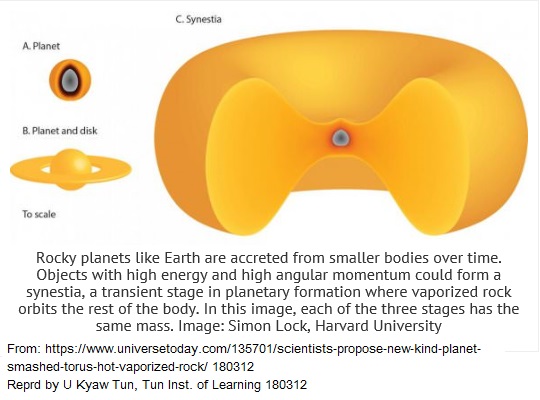
UKT 180314: To differentiate the newer torus theory from the older conventional Giant Impact Hypothesis we should call it as the Titan Impact Hypothesis or the Impact of Titans Hypothesis.
See Wikipedia: https://en.wikipedia.org/wiki/Synestia 180312
"A synestia is a rapidly spinning donut-shaped mass of vaporized rock. In computer simulations of giant impacts of rotating objects a synestia can form if the total angular momentum is greater than the co-rotational limit. [1] Beyond the co-rotational limit the velocity at the equator of a body would exceed the orbital velocity. [2] In a synestia this results in an inner region rotating at a single rate with a loosely connected torus orbiting beyond it. [3]"For Greek mythology Selene - not Roman - see:
- https://en.wikipedia.org/wiki/Selene 180311
"Selene, Ancient Greek Σελήνη 'Moon' is the Titaness of the Moon [In Hindu mythology Titan is Asura - an enemy of god Déva). Selene is the daughter of Titan parents Hyperion (father) and Theia (mother). Selene is sister of Sun Helios, sister of Dawn Eos"For Greek mythology - Gaia, see:
- https://en.wikipedia.org/wiki/Gaia 180311
(edited) "In Greek mythology, Gaia Ancient Greek Γαῖα, a poetical form of Γῆ Gē, "land" or "earth" [1])"
I consider them to be just anthropomorphic entities.My wish is not to belittle any religion whether ancient or modern. Our ancestors had worshipped them, and out of my respect for our forefathers, I consider them worshipping Axiomatic entities. To me, Gods and Titans of Ancient Greek and Roman religions are Axioms - not for me question whether they are real or not, just as I consider YHVH (Judaism), God (Christianity), and Allah (Islam) to be Axioms: they are all worshipfuls. In Bur-Myan, all entities which are worth worshipping, whether out of fear or respect, are all Nat
{nût}.
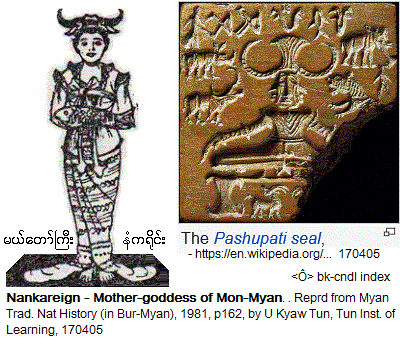
There is another class of such entities in Bur-Myan beliefs and in Hinduism. They are the Mothers or Maatas, e.g. Mother-Myanmar
{a.mi.mrûn-ma} representing Myanmarpré the country, and Bharat-Mata aka Mother-India representing the country of India. All living things on them - animals and humans, and, men and women of every faith and religion are their children.
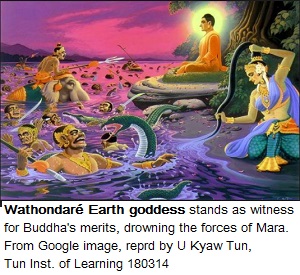
Gaia is the Mother Earth [2] and one of the Greek primordial deities. She is the ancestral mother of all life: the primal Mother Earth goddess Wathondare
{wa.þoan~da.ré}. Gautama Buddha called on her with his earth-touching posture (mudra) to stand as his witness for all the good-deeds he had done. Goddess Wathondare
When Theia hit Earth [Gaia], a portion of the planet [Gaia] came off and eventually hardened into the Moon. This theory does a better job than others of explaining the similarities in chemical compositions of the Earth and the Moon* ... Theia could have been made of ice ... the giant impact hypothesis [ is just] -- a hypothesis. [How similar to mythologies! ]
* The similarities in chemical composition is only from the known samples of Lunar soil collected from Moon-landings of 1969 to 1976 on the visible side of the Moon by the US and Soviets. Now, in Jan 2019, that the Chinese has made a landing on the side which is always hidden from the Earth, we might have to conclude differently.
Incidentally, the Chinese call their Moon-probe Chang'e, and the Indians call theirs Chandra-yaan. Both these names mean the same thing, Moon{sûn~da}.

 See downloaded videos in TIL HD-VIDEO and SD-VIDEO
libraries, section Geology remembering that
they are just hypotheses.
See downloaded videos in TIL HD-VIDEO and SD-VIDEO
libraries, section Geology remembering that
they are just hypotheses.
- The History of the Earth: How our Planet formed
- documentary
- HistEarthHowFormed<Ô> /
Bkp<Ô>
379MB (link chk 190523)
Note: This video from National Geographic is fully animated only in the
first part, even though the voice continues as a lecture.
UKT 180309: Being a history, we need to know its
timescale in years, month and days. However,
because what we are dealing here are long
duration in time, we will start with
"years", "thousands of year",
"millions of year", and "billions
of year". We'll therefore define the
"year" first:
"A year is the orbital period of the
Earth moving in its orbit around
the Sun." -
https://en.wikipedia.org/wiki/Year 180310
Wiki article on Year continues:
" SI prefix multipliers
[SI units stands for
Système international d'unités in French]:
" • ka * (for kiloannus)
-- a unit of time equal to one thousand,
or 103, years, or
1 E3 yr, [or, 1x10^3 yr] ...
" • Ma (for megaannus) --
a unit of time equal to one million,
or 106, years, or 1 E6 yr,
[or, 1x10^6 yr] ...
" • Ga (for gigaannus)
-- a unit of time equal to 109 years,
or 1 E9 yr, one billion years,
[or, 1x10^9 yr] ...
UKT 190513: To be in conformity, I'll capitalize ka * --> Ka ."
For example, the formation of the Earth occurred approximately 4.54 x10^9 (Ga aka billion) yr ago.
UKT 180310, 190515
From Wikipedia article in TIL HD-nonPDF and SD-nonPDF libraries, Webarchive, .MHT section:
- HistEarth<Ô> / Bkp<Ô> (link chk 190606)
The history of Earth is divided into four great Eons, starting 4.540 x10^9 yr ago with the formation of the planet. Each Eon saw the most significant changes in Earth's composition, climate and life. Each Eon is subsequently divided into Eras, which in turn are divided into Periods, which are further divided into Epochs.
UKT 190606: For convenience sake and for ease of remembering, I like to express in:
Eon in x10^9 yr > Era in x10^9 or x10^6 yr
> Period in x10^6 yr > Epoch in x10^6 or x10^3 yr
1. Hadean Eon, 4.54 x10^9 - 4.00 x10^9 yr. The Earth is formed out of debris around the solar protoplanetary disk. There is no life. Temperatures are extremely hot, with frequent volcanic activity and hellish-looking environments (hence the eon's name, which comes from Hades). The atmosphere is nebular. Possible early oceans or bodies of liquid water. The Moon is formed around this time probably due to a protoplanet's collision into Earth.
UKT 190606: The phrase "The atmosphere is nebular" is ambiguous. The English word "nebular" means:
neb·u·la n. pl. neb·u·lae or neb·u·las 1. Astronomy a. A diffuse mass of interstellar dust or gas or both, visible as luminous patches or areas of darkness depending on the way the mass absorbs or reflects incident radiation. b. See galaxy . 2. Pathology a. A cloudy spot on the cornea. b. Cloudiness in the urine. 3. A liquid medication applied by spraying. [Middle English nebule cloud, mist from Latin nebula; See nebh- in Indo-European Roots.] neb 'u·lar adj.I would have used "The atmosphere is cloudy and misty". It is a useless phrase: it does not give the pressure. Atmospheric pressure is important for the presence of water in liquid phase .
2. Archean Eon, 4.000x10^9 – 2.500x10^9 yr. Prokaryote life, the first form of life, emerges at the very beginning of this eon, in a process known as abiogenesis. The continents of Ur, Vaalbara and Kenorland may have existed around this time. The atmosphere is composed of volcanic and greenhouse gases.
UKT 190521: A prokaryote is a unicellular organism that lacks a membrane-bound nucleus, mitochondria, or any other membrane-bound organelle. [1] The word prokaryote comes from the Greek πρό (pro) "before" and κάρυον (karyon) "nut or kernel". [2] [3] Prokaryotes are divided into two domains, Archaea and Bacteria. -- https://en.wikipedia.org/wiki/Prokaryote 190521
Watch downloaded videos in TIL HD-VIDEO and SD-VIDEO libraries, section Biology for a brief introduction to cell structure
- CellStructure<Ô> / Bkp<Ô> 73.7 MB (link chk 190610)UKT 190606: From molten rock the surface was beginning to solidify to form land masses. Ur, Vaalbara and Kenorland are such continents. Look up for:
¤ Ur in - https://en.wikipedia.org/wiki/Ur_(continent) 190606
¤ Vaalbara in - https://en.wikipedia.org/wiki/Vaalbara 190606
¤ Kenorland in - https://en.wikipedia.org/wiki/Kenorland 190606
Evidence of these three are found in the cratons or shields.
The continent Ur is important to us because a part from it is found as a craton in northern India.
"The largest preserved parts of Ur are now in India: Aravalli आरवल्लि , Dharwar, Bundelkhand, and Singhbhum."
3. Proterozoic Eon, 2.50 x10^9 – 0.54 x10^9 yr. The name of this eon means "early life". Eukaryotes, a more complex form of life, emerge, including some forms of multicellular organisms. [UKT ¶]
Bacteria begin producing oxygen [through photosynthesi], shaping the third and current of Earth's atmospheres. Plants, later animals and possibly earlier forms of fungi form around this time. The early and late phases of this eon may have undergone "Snowball Earth" periods, in which all of the planet suffered below-zero temperatures. The early continents of Columbia, Rodinia and Pannotia, in that order, may have existed in this eon.
4. Phanerozoic Eon, 541x10^6 yr – present . Complex life, including vertebrates, begin to dominate the Earth's ocean in a process known as the Cambrian explosion. Pangaea forms and later dissolves into Laurasia and Gondwana, which in turn dissolve into the current continents. Gradually, life expands to land and familiar forms of plants, animals and fungi begin appearing, including annelids, insects and reptiles, hence the eon's name, which means "visible life". Several mass extinctions occur, among which birds, the descendants of non-avian dinosaurs, and more recently mammals emerge. Modern animals -- including humans -- evolve at the most recent phases of this eon.
see - timescale.htm (link chk 190516)
UKT 190516: The following is mostly my own.
The topic "Geologic Time Scale" involves our notion of Time. So what is Time itself. It is both a philosophical and scientific question.
Now, read Wikipedia: -
https://en.wikipedia.org/wiki/Philosophy_of_space_and_time 190516
Let's leave the Egyptian thinker,
Ptahhotep
(c. 2650–2600 BC), and the Vedas (late 2nd millennium BC) aside, and see what
Saint Augustine of Hippo (13 November 354 – 28 August 430 AD) has to say:
"What then is Tyme? If no one asks me, I know: if I wish to explain it to
one that asketh, I know not."
To get closer to our modern times, read Wikipedia:
https://en.wikipedia.org/wiki/Theory_of_relativity 190516
and ponder on two things that had confused me in my student days:
1. Time dilation: Moving clocks are measured to tick more slowly than an
observer's "stationary" clock.
2. Length contraction: Objects are measured to be shortened in the
direction that they are moving with respect to the observer.

Now, to answer the question I've set myself: at
what time in geologic time scale had Man
come to think of such things as the Spacetime
Continuum, read Wikipedia
https://en.wikipedia.org/wiki/Spacetime 190516
"In physics, spacetime is any mathematical
model that fuses the three dimensions of space and the
one dimension of time into a single
four-dimensional
continuum.
Spacetime diagrams can be used to visualize
relativistic effects such as why different
observers perceive where and when
events occur differently."
UKT 190620: The only way to keep my aging brain of 85 years is to expose it to new ideas and new dimensions. See Wikipedia for Four-dimensional space: https://en.wikipedia.org/wiki/Four-dimensional_space 190610
The animated pix is from that article with the legend: "The 4D equivalent of a cube, known as a tesseract. The tesseract is rotating in four-dimensional space, and it is displayed here projected into two dimensions".
The standard model for the formation of the Solar System (including the Earth) is the solar nebula hypothesis. [23] In this model, the Solar System formed from a large, rotating cloud of interstellar dust and gas called the solar nebula. [UKT ¶]
UKT 190610: After the Big Bang, but before the atoms were created, I presume the solar system must be made up of subatomic particles such as electrons, protons and neutrons interacting with each other.
It was composed of hydrogen H , and helium He created shortly after the Big Bang 13.8 Ga (billion years ago) and heavier elements ejected by supernovae. About 4.5 Ga, the nebula began a contraction that may have been triggered by the shock wave from a nearby supernova.[24] A shock wave would have also made the nebula rotate. As the cloud began to accelerate, its angular momentum, gravity, and inertia flattened it into a protoplanetary disk perpendicular to its axis of rotation. Small perturbations due to collisions and the angular momentum of other large debris created the means by which kilometer-sized protoplanets began to form, orbiting the nebular center. [25]
The center of the nebula, not having much angular momentum, collapsed rapidly, the compression heating it until nuclear fusion of hydrogen into helium began. After more contraction, a T Tauri star ignited and evolved into the Sun. Meanwhile, in the outer part of the nebula gravity caused matter to condense around density perturbations and dust particles, and the rest of the protoplanetary disk began separating into rings. In a process known as runaway accretion, successively larger fragments of dust and debris clumped together to form planets.[25] Earth formed in this manner about 4.54 billion years ago (with an uncertainty of 1%)[26][27][4][28] and was largely completed within 10–20 million years.[29] The solar wind of the newly formed T Tauri star cleared out most of the material in the disk that had not already condensed into larger bodies. The same process is expected to produce accretion disks around virtually all newly forming stars in the universe, some of which yield planets. [30]
The proto-Earth grew by accretion until its interior was hot enough to melt the heavy, siderophile metals. Having higher densities than the silicates, these metals sank. This so-called iron catastrophe resulted in the separation of a primitive mantle and a (metallic) core only 10 million years after the Earth began to form, producing the layered structure of Earth and setting up the formation of Earth's magnetic field.[31] J.A. Jacobs [32] was the first to suggest that Earth's inner core—a solid center distinct from the liquid outer core—is freezing and growing out of the liquid outer core due to the gradual cooling of Earth's interior (about 100 degrees Celsius per billion years [33] ).
The first eon in Earth's history, the Hadean Eon, begins with the Earth's formation and is followed by the Archean eon at 3.8 x10^9 yr ago. [2]:145 The oldest rocks found on Earth date to about 4.0 x10^9 yr ago, and the oldest detrital zircon crystals in rocks to about 4.4 x10^9 yr ago, [34] [35] [36] soon after the formation of the Earth's crust and the Earth itself. The giant impact hypothesis for the Moon's formation states that shortly after formation of an initial crust, the proto-Earth was impacted by a smaller protoplanet, which ejected part of the mantle and crust into space and created the Moon. [37] [38] [39]
From crater counts on other celestial bodies, it is inferred that a period of intense meteorite impacts, called the Late Heavy Bombardment, began about 4.1 Ga, and concluded around 3.8 Ga, at the end of the Hadean. [40] In addition, volcanism was severe due to the large heat flow and geothermal gradient. [41] Nevertheless, detrital zircon crystals dated to 4.4 x10^9 yr ago show evidence of having undergone contact with liquid water, suggesting that the Earth already had oceans or seas at that time. [34]
Earth's only natural satellite, the Moon, is larger relative to its planet than any other satellite in the Solar System.[nb 1] During the Apollo program, rocks from the Moon's surface were brought to Earth. Radiometric dating of these rocks shows that the Moon is 4.53 ± 0.01 billion years old,[46] formed at least 30 million years after the Solar System.[47] New evidence suggests the Moon formed even later, 4.48 ± 0.02 Ga, or 70–110 million years after the start of the Solar System. [48]
Theories for the formation of the Moon must explain its late formation as well as the following facts. First, the Moon has a low density (3.3 times that of water, compared to 5.5 for the Earth[49]) and a small metallic core. Second, there is virtually no water or other volatiles on the Moon. Third, the Earth and Moon have the same oxygen isotopic signature (relative abundance of the oxygen isotopes). Of the theories proposed to account for these phenomena, one is widely accepted: The giant impact hypothesis proposes that the Moon originated after a body the size of Mars (sometimes named Theia[47]) struck the proto-Earth a glancing blow.[1]:256[50][51]
The collision released about 100 million times more energy than the more recent Chicxulub impact that is believed to have caused the extinction of the non-avian dinosaurs. It was enough to vaporize some of the Earth's outer layers and melt both bodies.[50][1]:256 A portion of the mantle material was ejected into orbit around the Earth. The giant impact hypothesis predicts that the Moon was depleted of metallic material,[52] explaining its abnormal composition.[53] The ejecta in orbit around the Earth could have condensed into a single body within a couple of weeks. Under the influence of its own gravity, the ejected material became a more spherical body: the Moon. [54]
Let's continue at some later date.
End of TIL file