Update:
2019-03-24 09:49 PM -0500
Introduction
Family Law and Customary Law in Asia:
A Contemporary Legal Perspective,
intro.htm
by David C. Buxbaum, Assoc. of Southeast Asian
Institutions of Higher Learning, Springer
Netherlands, Jan 1, 1967, pp288.
Downloaded and edited, by U Kyaw Tun (UKT)
(M.S., I.P.S.T., USA) and staff of Tun
Institute of Learning (TIL) . Not for
sale. No copyright. Free for everyone.
Prepared for students and staff of TIL
Research Station, Yangon, MYANMAR :
http://www.tuninst.net ,
www.romabama.blogspot.com
index.htm |
Top
Buxbaum-indx.htm
UKT 180505: The Introduction by the author,
David C. Buxbaum, is comprehensive, and is
necessarily long for a casual reader like me.
I have therefore no recourse but to read
(piecemeal) the work and have divided into
smaller sections, 0.0, 1.0, 2.0, ..., for my own comprehension. These small
sections may be regrouped and renumbered.
The following TOC is therefore mine. The text on the whole is of D. C. Buxbaum.
UKT 190312: From p018, I've just
cut off the page heading, and its footnote.
I'm finding that the INTRODUCTION may have to be divided into four divisions
0.0. General
1.0. Nature of Customary Law in Diverse Asian Societies
2.0. Customary Law and the Formal Legal Institutions: Interaction and
Conflict
3.0. Customary Law and Family in Modernizing Society (in p.roman30)
UKT note to TIL editor: I've no time to cut
every page. The top part of
the original page, -0 has to be joined
to the last portion of the previous page. In that case the
downloaded page stored in ~~CUT will begin with -1
. To make checking with the downloaded page easier, it is best to put in [UKT
¶] at every footnote.
- Pages together with footnotes begin within
1.6. Malay traditional society
- Link the footnotes within the whole page first. Let's call it
internal-linking. Don't separate them.
0.0.
INTRODUCTION (roman15-roman41)
0.1. How this book came about
0.2.
East is East, and West is West, and never the twain shall meet
0.3. Those who are affected
1.0. Nature of
Customary Law in Diverse Asian Societies
1.1. Pre-literate society
and Peasant society
1.2. Customary Law
1.3. Pre-literate Society
1.4. Kadi-justice
1.5. Justice in China during the
last imperial dynasty
1.6. Malay traditional society
1.7. Customary Law vs. Custom
UKT 190313: Half-way through "Pre-literate Society", I've to stop
temporarily to go back to my work on
A Practical Dictionary of Sanskrit by A. A. Macdonell
-
MC-indx.htm (link chk 190313)
Author's footnotes
UKT 180506: Footnotes in the middle of a seamless narrative are
a source of confusion. In TIL format, they are given only at the end of the HTML
page.
Contents of this page
INTRODUCTION
(p.roman15)
The Conference on Family Law and Customary
Law in Asia, of which this book is a product,
was initiated in the hope that scholars and
law practitioners in Asia could - with the
help of social scientists - begin a
theoretical and practical analysis of some of
the problems involved in administering law in
communities where custom and customary law
exert important influences upon dispute
resolution. The conference focused primarily
upon problems of family law in view of the
particular perseverance of customary influences
in this area of the law.
The problem of the interrelationship between the
formal legal organs and indigenous customary law
is of course only a small
portion of a larger problem, i.e., the role of law in modernizing societies.
Contents of this page
UKT 180505: The above is from:
"The Ballad of East and West"
is a poem by Rudyard Kipling. It was first
published in 1889, and has been much collected
and anthologised since.
" Oh, East is East, and West is West,
and never the twain shall meet,
" Till Earth and Sky stand presently at
God's great Judgment seat;
" But there is neither East nor West,
Border, nor Breed, nor Birth,
" When two strong men stand face to face,
though they come from the ends of the earth!"
-
https://en.wikipedia.org/wiki/The_Ballad_of_East_and_West
180505
One result of the conference was a classification
of some of the legal problems which are common to
most modernizing societies, both in Asia and
elsewhere [UKT: particularly the West], where the
formal legal institutions are often modeled after
European institutions while the social institutions
reflect patterns quite different form those that gave
birth to the common law or civil law.
UKT 180505, 190311: "European institutions"
implies those which value Judeo-Christian ideas,
such as "an eye for an eye" of the
Judaism and "turn the other cheek" of
the Christianity, and which value only on
surface the socialistic and idealistic
humanitarianism".
(I am writing this note on the 200th birthday of
Karl Marx. See an interesting article with which
I don't see eye-to-eye in many places)
-
https://www.independent.co.uk/news/long_reads/karl-marx-anniversary-a8334241.html
180505))
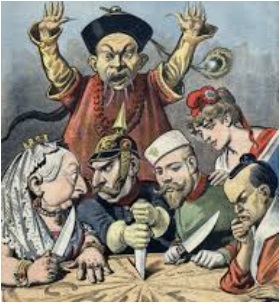 In the East, we value the Buddhist, Confucian, and Hindu ideas overlaid upon the more primitive
folk beliefs including Astrological, and
Sacrifice of various kinds to unseen entities
such as the spirits of dead ancestors. The
colonialists - British, Dutch, French, Germans and
Russians - who had overpowered the natives
with superior arms thought that their beliefs
- Religions (in particular Christianity), Capitalism and
Communism - are superior than those of the Buddha and
Confucius, and tried to impose their institutions
backed by their armed forces.
In the East, we value the Buddhist, Confucian, and Hindu ideas overlaid upon the more primitive
folk beliefs including Astrological, and
Sacrifice of various kinds to unseen entities
such as the spirits of dead ancestors. The
colonialists - British, Dutch, French, Germans and
Russians - who had overpowered the natives
with superior arms thought that their beliefs
- Religions (in particular Christianity), Capitalism and
Communism - are superior than those of the Buddha and
Confucius, and tried to impose their institutions
backed by their armed forces.
By the East, I mean the subcontinent of India aka South Asia,
Southeast Asia - with Myanmarpré, my particular interest - Far East
comprising China, Korea and Japan.
Pix on right: Colonialists curving out China, whilst a new one is
thinking how he would joined them, and then kick them out keeping the
spoils for himself.
What most authors of the subject failed to realize is that "It is Man with
inborn Greed trying to get the better of others". Greed is the
cause of conflicts culminating in World Wars.
During the colonial period, all of the countries
of Asia were subject to the impact of Western law.
Not only did the Asian peoples come to know of the
workings of Western law through study at home and
abroad, but also the Western-dominated governments
of Asia established courts and promulgated codes
and statutes that were based upon Western law -
and in fact were often duplicates of such laws.
Despite the enactment of these law codes, the
traditional customary law of the Asia societies
was, and generally is, the primary legal force for
dispute resolution in most Asian countries.
[UKT ¶]
UKT 190315: Western Law : What do we mean
by it? As a Canadian citizen of Bur-Myan descent,
I must point out that there is no such thing as
a unified Western Law. There are two variants,
that of the English speakers, and that of the French
speakers, and you need a team of lawyers half of
which speak having Canadian-English as the
mother-tongue, and the other half with Canadian-French
to officially adopt a piece of legislation in both
English and French. Now, with the Natives (who were
derogatorily called Red Indians and Eskimos and who
had welcomed the Europeans - the English and French
- in the past centuries), and immigrants (like me)
speaking either English or French as the home
language, the term Western Law is ambiguous.
As a working term for this paper written in English,
we must understand by Western Law, is the
English-variant.
Contents of this page
Westernization and Western law only affected a
relatively small group of people in most Asian
countries, to the extent that they found the
Western style law courts and codes a congenial
arena for settling legal disputes. This is not to
suggest that traditional customary law remained
static. It too was undergoing change, particularly
as the result of modernization and the Western
intrusion into Asia - but the change was and is
not so extensive that the "Western" law
codes have come to fill the hiatus between law and
society comfortably. This particular problem, i.e.,
the hiatus that exists
(p.roman15end-p.roman16begin) between Asian society, and the family law and legal
institutions promulgated by the government, is one
that was made obvious and elucidated by the conferees.
The conference focussed particularly on the manner in which the legal
institutions have addressed themselves to this question.
The conference was concerned initially with the nature of
customary law, thereafter dealt with the interaction and conflict between the
formal legal institutions and customary law, and finally dealt with some
specific problems of customary law and the family in a modernizing society.
Contents of this page
UKT 180505: How do you define "Societies",
on the basis of:
1. political boundary
2. geographical boundary
3. linguistic (both speech and script, or
just speech alone)
Unless the conferees can think in terms of culture,
reflected by language, for example, the inhabitants
of a Naga village becomes Indians, and their
relatives in the village on the next hill slope
becomes Myanmar, though none of the inhabitants
understand a single word of Hindi-Devanagari or
any of Burmese-Myanmar.
(p.roman16-1cont)
Eugene Ehrlich said: "At the present as well as at any other
time, the center of gravity of legal development lies not in legislation, nor in
juristic science, nor in judicial decision, but in society itself. "1
(fn-roman16-1)
[UKT ¶]
[Eugene] Ehrlich, however, recognized the element of command or "state norms" although
he did not foresee the extensive role this aspect of the law was to play in
industrialized society. Nevertheless he helped to show that the norms, or
"customary law," observed by the family, commercial institutions and religious
bodies are of substantial importance in determining people's behaviour, and in
fact in determining what he called law. [UKT ¶]
In pre-industrial society, where political power and
authority are generally relatively weak, [Henry] Maine has
shown that there was heavy reliance upon customary and
religious law and institutions.
2 (fn-roman16-2) (
p.roman16-1end)
UKT 180506, 190311: Henry Maine was writing
in 1888, when the Westerner's knowledge of the
East was minimal at its best. Most of the
Sanskrit (Hinduism), and Pali (Buddhism of Ceylon)
were still being studied by the Christian scholars
of the West. They knew next to nothing of Pali-Myan
(Buddhism of Myanmarpré).
They had thought Pali-Lanka was the only language
that mattered. And what they came up with - the
International Pali - was and is Pali-Lanka. The
Pali-Myan, both of Bur-Myan and Mon-Myan, is thought
to be just borrowings from Ceylon. In fact,
Pali-Lanka was derived from Old Magadhi, the
language in which the Buddha preached and which
was brought over to Lanka on the reign of King Asoka
who flourished some 250 years after the death of the
Buddha, and the indigenous Lanka language.
I contend that Pali-Myan was Old Magadhi brought over
to northern Myanmarpré by King Abiraza
 {a.Bi.ra-za mín:} (who flourished many centuries
before the Buddha), and by Buddha's own relatives
fleeing the wrath of Prince Widudaba
{a.Bi.ra-za mín:} (who flourished many centuries
before the Buddha), and by Buddha's own relatives
fleeing the wrath of Prince Widudaba
 {wi.ðu-ða.Ba. mín:þa:} in Buddha's life time.
Therefore, Pali-Myan preceded Pali-Lanka by many
centuries. Of course Pali-Myan became heavily tainted
during the time of King Anawrahta
{wi.ðu-ða.Ba. mín:þa:} in Buddha's life time.
Therefore, Pali-Myan preceded Pali-Lanka by many
centuries. Of course Pali-Myan became heavily tainted
during the time of King Anawrahta
 {a.nau-ra.hta mín:} of Pagan in the 11th century.
Pali-Lanka has no /θ/ sound which is present
in Pali-Myan. Moreover, it is not recognized that
Bur-Myan belongs to the Tib-Bur language group,
native Lanka to Aus-Asi group, and Eng-Lat &
Skt-Dev to IE group. I've come to conclude that
Old Magadhi, Néwari (spoken by remnants of the
relatives of Buddha), all belong to Tib-Bur group. And finally, I've concluded that
Pali-Myan is Tib-Bur.
In Myanmarpré, which may be classed as pre-industrial
society before the British incursion, political
power and authority of Theravada Buddhism are not weak. And
Henry Maine's observation is not applicable.
Contents of this page
Most Asian societies (with the possible exception of Japan),
3 (fn-roman16-3) although in stages of rapid social change, retain strong
characteristics of simpler technological societies, i.e. pre-literate
societies, and peasant societies* of the pre-modern tradition. A major
distinction between these preliterate societies and peasant societies is that
the latter have for centuries been in "constant contact with the centers
of intellectual thought (p.roman16end-p.roman17begin)
and development..." 1 (fn-roman17-1)
[UKT ¶]
*UKT 180506: The majority of Myanmar peasants (both sexes) were literate,
and the case of Myanmarpré before the British Annexation was exceptional. It
was because of the strong monastic education which the colonialists and
their erstwhile modern followers had and are still uprooting. They have no
idea that Myanmar script is phonetic (a major advantage over Eng-Latin), and
that Bur-Myan language uses a very simple grammar (a major advantage over
Skt-Dev and Hindi-Dev). See: Burmese
Grammar and Grammatical Analysis , by A. W. Lonsdale, Rangoon, 1899. -
BG1899-indx.htm (link chk 190311)
"The Burmese language is
constructed on scientific principles,
and there is no reason why its grammar
should not be dealt with also from a
scientific standpoint. But it may be safely
said that Burmese grammar as a science
has not received that attention it deserves."
Thus [Anthropologist Robert] Redfield noted that in peasant societies
two interdependent traditions, i.e., that of the reflective few and that of
the unreflective many, are constantly interacting. 2 (fn-roman17-2)
[UKT ¶]
UKT 190317: The two traditions of pre-literate and peasant societies:
before the European colonial incursion
1. Reflective few - the "great tradition": in Burma, it is Dhamathat
 {Dûm~ma.þût} "Codes"
2. Unreflective many - the "little tradition": the customary law of
common people
See also Folk Society, by Robert Redfield, in TIL HD-PDF and SD-PDF
libraries:
- RRedfiled-FolkSoc<Ô>
/ Bkp<Ô>
(link chk 190322)
Of course both preliterate
societies and peasant societies have some common characteristics, but this
general distinction is useful for our discussion. In the legal field we can, for
purpose of convenience, identify the "great tradition" with the august
religious-ethical codes and the secular legal codes often formed under the
influence of these religious-ethical codes and the secular legal codes often
formed under the influence of these religious ethical codes. The customary law
of the common people might properly be identified with the "little tradition."
Yet if must be borne in mind, as Redfield states, that there was continuous
contact between the "great" and " little" traditions, and thus mutual
influences; " The two traditions are interdependent."
Contents of this page
In the institutional field it is possible, although perhaps
less precise, to identify the formal law courts - at least at the highest levels
of traditional Asian peasant society - with the "great tradition"; while
identifying the social institutions such as lineages and clans, which also
administered the law, with the "little tradition." Perhaps the lowest courts
and/or the gentry ( who performed legal services such as conciliation), as
Redfield suggests, form the hinge between the local institutions of the people
and those of the state in the legal arena. Both these traditions are of course
presently in contact with Western technological society.
Customary law is of substantial importance in both
pre-literate and peasant societies, but it has certain differentiable
characteristics in each. 3
fn-roman17-3
Contents of this page
(p.roman17-2begin)
In the pre-literate societies, groups tend to be smaller,
there is generally less contact with wider groupings, and thus "... a
greater degree of conformity is psychologically necessary. " 4
fn-roman17-4 [UKT ¶]
Thus [with Sea-Dyaks]
in Sarawak, customary law is the basis for settling many disputes. 5
fn-roman17-5 [UKT ¶]
The headmen of (p.roman17end-p.roman18begin) (Introduction
XVIII)
the long-houses, farm-chiefs and other leaders settle disputes in accord with
animistic beliefs. [UKT ¶]
UKT 190315: The word animistic beliefs
need explaining. It simply means those beliefs
outside the beliefs of Judaism, Christianity,
and Islam, or collectively the Abrahamic
religions.
Theravada Buddhism, with at least the first three
sermons: the Four Noble Truths, the Anatta
Principle, and the Twenty-four Basics System, is compatible
with Modern Science. It is Science pure and simple.
Yet, it does not belong to the Abrahamic group.
The so-called animistic beliefs in Myanmarpré:
beliefs in Nats
 {nût}, Soans
 {soan:}, Nagas
 {na.ga:} and Belus
 {Bi-lu:}, for example, are condoned by Myanmar
Buddhism. I hesitate to call the Myanmar pre-Buddhistic
beliefs as animistic.
{Bi-lu:}, for example, are condoned by Myanmar
Buddhism. I hesitate to call the Myanmar pre-Buddhistic
beliefs as animistic.
The long-house is "... an independent unit relying for its continued existence
upon the creation and maintenance of a relationship with the 'unseen powers' ...
(p.roman18-1)
By the proper conduct of ritual, from the major and minor 'festivals' (gawai) to
the provision of offerings, the exercise of 'magic' and utterance of words of
power, the people and their possessions must be kept in a satisfactory state of
balance among themselves and in relation to the 'unseen powers". 1 (fn-roman18-1) [UKT ¶]
The farms, houses, property, and people in their families all have their
spiritual balance which must be maintained. "Any disturbance of the balance be
corrected without delay". 2 (fn-roman18-2) [UKT ¶]
"Restoration of the balance ..." is accomplished "... by furnishing a 'fine' ...
[i.e.] by making good the loss with something of equal ritual value". 3 (fn-roman18-3)
[UKT ¶]
These customary fines are generally enforced by "public opinion". 4 (fn-roman18-4)
Contents of this page
UKT 190316: Kadi-justice -
https://en.wikipedia.org/wiki/Qadi 190316
"A
qadi also cadi, kadi or kazi is the
magistrate or judge of a Shariʿa court, who also exercises extrajudicial
functions, such as mediation, guardianship over orphans and minors, and
supervision and auditing of public works. ¹."
Thus in the pre-literate societies the institutions for
administering law are generally less formal and less "rationalized" or
"rational." Perhaps R. Schmidt's and [Max] Weber's terminology is useful here in that
we can associate "Kadi-justice" predominantly with pre-literate society; while
"empirical" and even perhaps on occasion "rational" justice may be more readily
associated with certain aspects of peasant society. 5
(fn-roman18-5)
[UKT ¶]
UKT 190318: See From Max Weber: Essays in Sociology
-
https://books.google.com.mm/books?... R.+Schmidt's+and+Weber's+terminology
... =R.-Schmidt's-and-Weber's-terminology ... 190318
On p216, we find "The 'rational' interpretation of law on the basis of
strictly formal conceptions stands opposite the kind of adjudication that is
primarily bound to sacred traditions. The single case that cannot be
unambiguously decided by tradition is either settled by concrete 'relation'
(oracle, prophetic dicta, or ordeal -- that is, by 'charismatic' justice) or
-- and only these cases interest us here -- by informal judgements rendered
in terms of concrete ethical or other practical valuation. This is 'Kadi-justice',
as R. Schmidt has fittingly called it. Or, formal judgment are rendered,
though not by subsumption under rational concepts, by by drawing on
'analogies' and by depending upon and interpreting concrete 'precedents'.
This is 'empirical justice'. "
Note: the downloaded page is in ~~CUTS/LAW
"Kadi-justice" is "
primarily bound by sacred traditions," or "revelation" in its system for
settling cases. It employs techniques such as divination, ordeal, prophetic
dicta and other religious, magical crafts as adjudicatory techniques. Weber also
suggests that in "Kadi-justice" there may also be " ... informal judgments
rendered in terms of concrete ethical or other practical valuations." However, I
would suggest that this latter aspect of justice can be more properly associated
with "empirical" justice. At any rate, "Kadi-justice" tends to be predominant in
the legal systems of pre- literate society, which may also have aspects of
"empirical" and perhaps even a little "rational " justice.
In peasant society, "empirical" justice, i.e., "... formal
judgments... rendered, though not by subsumption under rational concepts,
but by drawing on 'analogies' and by depending upon and interpreting concrete
'precedents' '' is of substantial significance especially in the
(p.roman19) (Introduction XIX)

"great tradition." As [Max] Weber notes, this "empirical" jistice is not unknown in
industrial societies. 1 (fn-roman19-1) [UKT ¶]
[Max]
Weber attempts to separate "empirical"
justice from "rational" justice. He associates the latter with the feature that
" ... in principle a system of rationally debatable 'reasons' stands behind
every act of bureaucratic administration, that is, either subsumption under
norms or a weighing of ends and means." He associates rational administration in
law and government with bureaucratization, experts and scientific
administration. 2 (fn-roman19-2) [UKT ¶]
Conceptually systematized rational law is
associated with bureaucracy and modern society. While [Max] Weber's knowledge, and
thus understanding, of certain aspects of traditional Asian law was seriously
incomplete, 3
(fn-roman19-3) [UKT ¶]
and his categories not always as relevant as one might
wish, they are nevertheless of substantial use for our purposes, for they help
us classify certain aspects of law in different types of society.
In summary, "Kadi-justice" especially as being bound by
sacred tradition is particularly characteristic of adjudication in pre-literate
society. The second feature of "Kadi-justice, " i.e., informal judgments
rendered in terms of concrete ethical or practical values, is quite
characteristic of the conciliation so predominant in the "little tradition" of
peasant societies as well as in pre-literate societies. 4 (fn-roman19-4)
[UKT ¶]
The "great
tradition" is characterized by "empirical justice, " i.e., formal judgments
rendered by drawing on analogies and interpreting concrete precedents. "Rational
justice" can be primarily associated with contemporary Westernized legal
institutions and some aspects of the legal institutions of the "great tradition:
of peasant society.
Not only is the nature of legal administration different, but
explicit in the above classifications of law are certain institutional
characteristics for administering law. Thus "empirical" or "rational" justice
would generally require formal legal machinery of a complicated nature to
administer the law.
1 fn-roman19-1 - Essays in Sociology, op. cit., p. 217.
fn-roman19-1b
2 fn-roman19-2 - For example, one of the qualities which he rightfully attributes to
the bureaucracy is: " The management of the office follows general rules, which
are more or less stable, more or less exhaustive, and which can be learned.
Knowledge of these rules represents a special technical learning which the
officials possess. It involves jurisprudence, or administrative or business
management." Ibid., p. 198. fn-roman19-2b
3 fn-roman19-3 - For example he states re: traditional Chinese law, " ... in spite
of the traditionalism, there was no official collection of precedents because
legal formalism was rejected and, above all, because there was no central count
as in England," -which are two largely erroneous assumptions. Max Weber, The
Religion of China, Confucianism and Taoism; Hans H. Gerth, translator and editor
(New York, 1951) at P. 102.
- fn-roman19-3b
4 fn-roman19-4 - Conciliation of a sort is also an important legal procedure in
pre-literate society. See for example Lucy Mair, Primitive Government (Maryland,
1962) at p.41, where she describes a "professional mediator" with special ritual
powers "who can perform the" rite of reconciliation in Nuer society. [See:
https://en.wikipedia.org/wiki/Nuer_people 190317] -
fn-roman19-4b
Contents of this page
See: For background info on p.roman 20, read:
Wikipedia;
https://en.wikipedia.org/wiki/Qing_dynasty 190312
"The Qing dynasty, officially the Great Qing
()
 {hkín} [Manchu dynasty*], was the last imperial dynasty of China. It was established in 1636,
and ruled China proper from 1644 to 1912. It was preceded by the Ming
dynasty and succeeded by the Republic of China."
{hkín} [Manchu dynasty*], was the last imperial dynasty of China. It was established in 1636,
and ruled China proper from 1644 to 1912. It was preceded by the Ming
dynasty and succeeded by the Republic of China."
* Manchu dynasty: -
https://www.britannica.com/topic/Qing-dynasty 190318
"The Qing dynasty was first established in 1636 by the
Manchus to designate their regime in Manchuria (now the Northeast
region of China). In 1644 the Chinese capital at Beijing was captured by the
rebel leader Li Zicheng, and desperate Ming dynasty officials called on the
Manchus for aid."
UKT 190312: Be careful of Chinese words which have undergone English
spelling change in recent years. The word "Ch'ing" Is now spelled "Qing" (no
u after Q). I became interested in this dynasty after reading
The Imperial Woman by Pearl S. Buck, an historical novel on the life
of Empress Dowager Shu'shu. See downloaded book in TIL HD-PDF & SD-PDF
libraries
-
PSBuck-ImpWoman<Ô> /
Bkp<Ô>
(link chk 190312)
Introduction
XX
In Ch'ing China (1644-1911) for example, local customary law
( which we may associate primarily with the "little tradition") operated within
an idealized framework of rites (li) and under a code that was national in
scope. The li and code, along with the collection of cases and the hierarchy of
official courts - all of which were part of the "greater tradition"-
administered what we may primarily designate 'empirical" and in part "rational"
justice. The lineages, clans, elders, gentry, pao-chia and li-chia leaders may
be said to have generally administered " Kadi-justice." [UKT ¶]
In Sarawak [Borneo-Dayaks] on the other
hand, it was predominantly "Kadi-justice" administered by the heads of the long
house that prevailed. Leaders of lineages and clans, tribal chieftains, family
elders, etc., are generally the administrators of "Kadi-justice" in
peasant or pre-literate society.
Watch a video on Dayaks filmed in 1958 in TIL libraries:
- SeaDayaks<Ô>
/ Bkp<Ô>
(link chk 190319)
The legal machinery in Ch'ing times was extensive, the
bureaucracy complicated and elaborate, and the body of precedents, statutory
material, ehtical codes, collected cases, handbooks, etc., were imposing.
Traditional Chinese peasant society, with its elaborate bureaucracy, may
represent one extreme of peasant society, while Sarawak is a more typical
pre-literate society. Malay society and the society of the Dyaks of Sarawak
insofar as legal institutions are concerned.
Contents of this page
The traditional society of the Malays was composed of the
"...individual, the family, then the tribes, who constitute the components of
the State. "1
- (fn-roman20-1)
In the perpateh tradition of Negri Sembilan, there
are twelve tribes presided over by various chieftains. [UKT ¶]
See: -
https://en.wikipedia.org/wiki/Negeri_Sembilan 190319
The adat perpatch,
following matrilineal tribal forms except when electing a king, is usually
interpreted by village elders and clan chieftains.2
- (fn-roman20-2)
The pithy sayings
handed down from generation to generation and known to all provided the basis
for customary law. Thus the basis of rules of exogamy are contained in such
sayings as, "Our boys are wed to other clans,"; and , "A stranger weds into
our clan. For every stranger that weds into our clan, a share is set with just
consent."3 (fn-roman20-3)
Conciliation was a primary means of settling disputes.
Thus, aside from "Kadi-justic" which would predominate, there might be some
"empirical justice" but little "rational justice."
In separating justice into "Kadi," "empirical" and "rational"
justice, we are primarily describing the system of administering justice, (p.roman20end)
1. fn-roman20-1 - Inche Ahmad Mohamed Ibrahim, "Islam and Customary Law in the
Malaysian Legal Context," see. infra .
fn-roman20-1b
2. fn-roman20-2 - Joseph Minattur, "The Nature of Malay Customary Law," see infra .
fn-roman20-2b
3. fn-roman20-3 - Ibid .
fn-roman20-3b
Contents of this page
Introduction XXI

and by implication the institutions which administer the law,
rather than characterizing the substantive law itself. Thus, while we talk of "Kadi-justice"
as being bound by sacred tradition or revelation, we are referring primarily to
the means of settling disputes. As Weber describes "Kadi-justice": " The single
case that cannot be unambiguously decided by tradition is ... settled by
concrete 'revelation' (oracle, prophetic dicta, or ordeal - that is, by
'charismatic' justice) .... " While in part we are reflecting upon the nature of
the substantive law itself, we are substantially concerned with the system of
administration.
How can we characterize the substantive customary law which
emanates from the varied pre-literate and peasant societies of Asia? What are
its common attributes?
In the first place this traditional customary law has been
subject to a multitude of influences. The great religions and cultures of Asia -
in particular Islam, Buddhism, and Hinduism, as well as what we many loosely
characterize as Confucianism in its religious and ethical connotation ___
have had substantial impact upon, and have in turn been influenced by, customary
law.
UKT 190319: When mentioning the names of religions, countries, and
people, TIL editorial policy is to use the alphabetical order: thus,
in the above, it should be Buddhism, Hinduism, and Islam.
Buddhist [Theravada] ethics have had an influence upon Burmese customary
law, as have Confucian ethics upon Chinese customary law. Thus, for example, the
Six Rites necessary to validate a marriage according to traditional Chinese
customary law were based upon the rules of propriety (li) of the Chou dynasty,
i.e., were a part of the Confucian ethic.1 (fn-roman21-1)
While customary law determined the
method by which these rites would be performed, and indeed there was substantial
variance in methods in different parts of China, nevertheless, there was mutual
influence between custom and the rites.2 (fn-roman21-2)
Not only has the adat temenggong of Malay society received
Hindu influence, but a Joseph Minattur has shown, the adat perpatch was
also subject to Indian influence. 3 (fn-roman21-3)
The matriliny practiced by the
Nyars of Kerala and other South Indian areas probably influenced the Malay
institutions of Mingangkabau, and thus of Negri Sembilan.4 (fn-roman21-4)
As has been noted, despite the fact that the essence of
Muslim marriage is the " contract effected by akad nikah, .... [t]he most
outstanding feature of a Malay marriage is the bersanding or the sitting
in state of (p.roman21end-p.roman22begin)
1. fn-roman21-1 - Vermier Yamatak Chiu, "Some Notes on Chinese Customary Marriage," infra
- fn-roman21-1b
2. fn-roman21-2 - The Six Rites also received recognition by the law code.
fn-roman21-2b
3. fn-roman21-3 - Joseph Minattur, "Some Notes on Indian Influence on Malay Customary Law," see
infra. fn-roman21-3b
4. fn-roman21-4 - Ibid. Even the Mapillas, Muslims of the Sunni sect, were held to be
governed by principles of matrilineal descent by the Madras High Court,
indicating the strength of this customary institution.
fn-roman21-4b
Contents of this page
Introduction XXII 
the bride and bridegroom on the bridal throne, the 'Rajas for a day'. This
ceremony, which is Hindu in origin, holds a greater significance to the ordinary
Malay than the proceedings of the akad nikah. "1
(fn-roman22-1) [UKT ¶]
This aspect
of the marriage is so important that it " in effect reduces the Muslim marriage
ceremony to the status of an engagement. "2 (fn-roman22-2)
As a result of one of the
rulers of old Malacca taking a Chinese bridge sent by the Emperor of China, "[a]mong the Malays of Malacca, Johore, Negri Sembilan and Selangor it is also
customary of dress the bride in ancient Chinese costumes on a night of the
berhinai ceremonies..... Through the centuries what began as a fashion become an
integral part of Malay wedding customs. "3 -
(fn-roman22-3)
Similarly: " The Malay
customary rules regarding themaskahwin represent a compromise between Muslim law
and the ancient Malay custom."4
- (fn-roman22-4)
Traditional Hindu law was derived in part from ancient
customary rules, and details of caste and customs collected in the nineteenth
century have formed a source for contemporary Hindu law.5
(fn-roman22-5)
The
influence of Hindu ethics and religion upon the law of Burma, Thailand, Cambodia
and Loas is well known, as is the influence of Confucian Chinese ethics upon the
customary and formallaw of Korea, Vietnam, Japan and regions on the periphery of
China. Muslim influence on customary law is extensive and exists throughout Asia
including China, the Philippines, Indonesia, Malays, Borneo, Thailand, etc.
Buddhist influence on Chinese customary and formal law, as well as the customary
law of Burma, Vietnam, Loas, Cambodia, India, Mongolia, Tibet and other regions
is also quite obvious.
Thus there are major religions and ethical systems as well as
cultures that have influenced customary law and formal legal developments
throughout Asia, 6
- (fn-roman22-6)
in particular the Muslim,7 (fn-roman22-7)
Buddhist [UKT: most likely the Mahayana - not applicable of Theravada of
Myanmarpré],
Hindu and Confucianist schools. While in fact these religious-ethical systems
and their "codes" have become intertwined with customary law, it is worthwhile
differentiating these ethical legal principles from customary law. It is (p.roman22end)
1. fn-roman22-1 - Inche Ahmed bin Mohamed Ibrahim, "Islam and Customary Law in the
Malaysian Legal Context", see infra .
fn-roman22-1b
2. fn-roman22-2 - Ibid.
fn-roman22-2b
3. fn-roman22-3 - Ibid.
fn-roman22-3b
4. fn-roman22-4 - Ibid. Unlike Muslim law which recognize the groom's gift to the bride,
mahr, while Malay custom demands "... a whole series of conventional
presents..." Malay custom also fixes the amount of maskahwin.
fn-roman22-4b
5. fn-roman22-5 - S.P. Khetarpal, "Codification of Hindu Law," see infra.
fn-roman22-5b
6. fn-roman22-6 -The peculiar influence of Christianity on the formal law of the Philippines
is also to be noted. Of course Christianity has also influenced legal
developments in Madras and other parts of India for a very long time.
fn-roman22-6b
7. fn-roman22-7 - Of course one of the sources of Muslim law was custom, urf, and usage,
adat. fn-roman22-7b
Contents of this page
(Introduction XXIII)

also necessary to differentiate customary law from the secular codes and binding
cases of the "greater tradition" of traditional peasant society. The great
ethical, religious and secular codes and binding cases of Asia tend to be in
written form, and thus of a more permanent and rigid nature. Customary law is
generally unwritten ,1 (fn-roman
23-1)
and thus more flexible.
Van Vollenhoven found common elements in customary law in Indonesia that are
also of use in characterizing customary law; i.e., "(1) a preponderance of
communal over individual interests, ...(3) and all pervasive
'magical' and religious pattern of thought,
(4) a strong family oriented
atmosphere..."2 (fn-roman
23-2)
While(3), the "all-pervasive 'magical' and religious
pattern of thought" may be more significant in pre-literate and certain peasant
societies than it would be in others, a modified version might more
appropriately characterize traditional customary law, i.e., a pervasive ( rather
than "all-pervasive") magical and religious pattern of thought which was
reflected in the law. The strong family law atmosphere which was reflected in
the law. The strong family law atmosphere which van Vollenhoven describes
relates to both the administration of justice (in that family related
institutions such as the lineages and clans helped to administer the law), as
well as to the fact that the law was pervaded by family status relationships and
analogies thereto. Status is generally quite important in customary law and the
hierarchical nature of the family, for example, was reflected in the law as was
the status of chieftains, gentry, royalty and other principal groups. Status,
however, is also important in common law, as Pound has so clearly shoen.3
(fn-roman 23-3)
The common-law lawyer... thinks of the relation of principal and
agent and of powers, rights, duties and liabilities, not as willed by the
parties but as incident to and involved in the relation."4 (fn-roman
23-4)
While the "original type which provided the analogy" is the relationship of landlord-tenant
at common law, 5 (fn-roman
23-5)
the father-son relationship generally provides the
analogy for many customary law relationships in Asia. Thus duties and
liabilities arise form the nature of the relationships in both the common law
and customary law of Asia. 6 (fn-roman
23-6) (p.roman23end)
1. fn-roman 23-1- In recent years customary law in such places as Sarawak has been incorporated
into written form, generally at the instance of the government in order to make
the principles known to officials who are ignorant of the tradition as well as
for the benefit of the younger generation, similarly ignorant.
fn-roman 23-1b
2. fn-roman 23-2 - S. Takdir Alisjahbana, "Customary Law and Modernization in Indonesia," see
infra. Number (2) and the latter half of (4) of van Vollenhoven's
classifications seem less related to substantive law, and have thus been
omitted. fn-roman 23-2b
3. fn-roman 23-3 - Roscoe Pound, The Spirit of the Common Law (Boston, 1949) (Beacon ed.)
pp. 14-31, see particularly p.21. fn-roman 23-3b
4. fn-roman 23-4 - Ibid., p.21.
fn-roman 23-4b
5. fn-roman 23-5 - Ibid., pp. 22. 23.
fn-roman 23-5b
6. fn-roman 23-6 - It should be noted that Pound says "In the industrial and urban society of
today classes (to be continued in the following page footnotes)
fn-roman 23-6b
Contents of this page
Introduction XXIV

In summary, customary law in Asia is generally unwritten; it
tends to reflect group or communal rather than individual interests; it often
becomes intertwined with and permeated by "magical" and /or religious patterns;
family law relations are of much significance and analogies thereto are of
substantial significance in the law; and the law is concerned with details as
well as broad principles and has substantial local variants. The system of a
administering customary law is generally either "Kadijustice" which prevails
particularly in pre-literate societies and in the "little tradition" of peasant
societies or " empirical justice" which is prevalent in the "greater tradition"
of peasant society. "Rational justice" may also be administered in the "greater
tradition."
Contents of this page
How can customary law be differentiated from custom? The
answer to this turns on the age old question of how we define law. While this is
not the place to undertake a re-examination of this problem, Hoebel's definition
(while not without difficulties) is a useful one, i.e.: "A social norm is legal
if its neglect or infraction is regularly met, in threat or in fact, by the
application of physical force by an individual or group possessing the socially
recognized privilege of so acting. "1 (fn-roman
24-1)
Thus customary law would be that aspect of the law which manifested the
attributes described above. 2(fn-roman
24-2)
See: E. Adamson Hoebel (1906–1993)
-
https://en.wikipedia.org/wiki/E._Adamson_Hoebel 190319
Contents of this page
In the nineteenth century the religious, family-oriented,
rural Asian culture came into contact with the secularized, rational and
industrialized West. The Western powers soon assumed the role of the former
rulers of Asian society.3 (fn-roman
24-3)
The law and social institutions of traditional Asia
felt the impact of contemporary technology. 4 (fn-roman
24-4)
Customary law, related religious-thical
law and the secular positive law of tra-(p.roman24end)
(continuation for previous page footnote)
and groups and relations must be taken account of no less than individuals."
1.fn-roman 24-1- E. Adamson Hoebel, The Law of Primitive Man (Harvard University Press,
1954) p. 28. Force is defined by Hoebel, who refers to MacIever, as: "Force,
unqualified, means coercion -- the condition that exists whenever men act, or
refrain from acting, in a manner different from that which they themselves would
have chosen in a given situation, because others deliberately limit the range of
their choice either directly, through present control over it, or indirectly,
through the threat of consequences... The essentials of legal cocrcion are
general social acceptance of the application of physical power, in threat or in
fact, by a privileged party, for a legitimate cause, in a legitimate way, and at
a legitimate time. This distinguishes the sanction of law from that of other
social rules." at p.27. fn-roman 24-1b
2. fn-roman 24-2 - This of course is just a working and tentative definition which can only be
refined after continual criticism and examination by scholars and legal
practitioners. fn-roman 24-2b
3. fn-roman 24-3 - S.Takdir Alijahbana, "Customary Law and Modernization in Indonesia," see
infra. fn-roman 24-3b
4. fn-roman 24-4 - See for example Max Rheinstein, "The Law of Family and Succession, " Civil
Law in the Modern World (La. 1965) A. N. Yiannopoulos, editor, p.27 ff.
fn-roman 24-4b
Contents of this page
Introduction
XXV

traditional Asian society came into contact with Western legal institutions and
were often administered by Western or Western-trained personnel. The results
varied, however one can discern certain patterns. The former secular codes, such
as the Chinese Ta-Ch'ing Lü-Li, were often replaced by Western codes that
had little significance for Asian society. The religious institutions were to
some extent undermined by rational Western techniques. Customary law - although
similarly affected, particularly by the breakdown of pre-literate and peasant
institutions-remained very significant in most societies. Without the
traditional codes and traditional formal machinery for dispute resolution,
customary law was indeed important. While the "greater tradition" was seriously
weakened and in part displaced, the "little tradition" remained___
although of course not unchanged. On the other hand in some societies the
positive ethical- religious codes came to be interpreted by the Western style
courts as if they were Western codes and thus were regarded as fixed postulates
which were used as a basic for deciding individual cases ___ a
characteristic they often did not possess in their natural habitat.
In the family law field there are two contrasting policies
that can be distinguished regarding the administration of traditional Asian
family law by the Western powers or Western influenced judicial personnel. In
the English colonies, customary law was generally discouraged and English law
was utilized except in the family law area where room was left for the "
traditional customary law" of the people of the colony. Aside from outlawing
certain facets of family law which the English found abhorrent, the overt policy
of the English government was to recognize the traditional, religious and
customary family law of the natives in the courts. In fact as we shall see, the
enforcement of this overt policy encountered many complications.
Dutch colonial policy, however, differed somewhat. Whereas
the English generally imposed their laws on the native population in many areas
and merely excepted family law from this imposition, the Dutch, under the
influence of C. van Vollenhoven, came to exalt customary law. It was regarded as
a satisfactory basis for building a national legal system. Though customary law
"... was adulated for its 'wholeness' and its subtle refinement in satisfying
the community's sense of justice and feeling of mutual responsibility..."
attempts to put this theory into practice also met with several difficulties.
Western legal institutions are primarily rational in nature
and thus are in contrast to the predominantly "Kadi" or "empirical" justice of
Asian institutions. Legal institutions in the West tend to be relatively
important
[UKT: No footnotes on p-roman25]
Contents of this page
Introduction
XXVI

arenas for the peaceful resolution of domestic relations disputes. Social
institutions such as lineages and clans are not major institutions of social
legal control. The reverse situation existed and in fact still exists through
out much of Asia. In traditional Asian society the formal law courts were often
considered a last resort, and in fact certain opprobrium and shame were attached
to their use. Ideological support was often given for this attitude by the
government. Such feelings continue to exist in Asia with regard to the new
"Western" courts, although at times briefs are filed the the Western courts as a
means of pressing people to negotiate.1(fn-roman
26-1)
Conciliation was and remains a most significant aspect of
legal procedure in Asia. The procedures for conciliation-which was often carried
out by certain prestigious local leaders, gentry, tribal chieftains, clan or
lineage heads, etc.___ were and are delicate. Open conflict was to be avoided
and the pride of each party to be maintained. Even the lower level formal courts
in China promoted and continue to promote conciliation in what we may loosely
term civil cases. Where Western courts are established, however, there is
generally little room for such activity unless one can regard some of the
pre-trial2 (fn-roman
26-2)
conferences and family court proceedings, out of court
settlements, etc., as a form of conciliation. The adversary proceedings of the
common law courts are particularly ill-suited for conciliation procedures in
view of the pressure on each party to overstate his case and become identified
with a particular point of view pending a relatively clear cut victory. Further
more, as Maine has shown, legislation is most appropriate in the nation state
which has effective central political organs; nevertheless it was used
extensively by colonial legislatures which really did not have political
institutions that deeply affected the customary family law of the villages of
Asia. Thus various incompatibilities were inherent in the establishment of
Western courts in Asia.
Nevertheless as a result primarily of colonial pressures,
most Asian societies have "received" in smaller or larger part civil and common
law institutions. While European law was, at least in the family law area, not
generally imposed directly upon the populace, the results of various methods
were often the same. Where European institutions were not directly adopted,
traditional Asian institutions were interpreted by common or civil law methods,
thus either rigidifying the
1. fn-roman 26-1- See K. Ishwaran, "Customary Law in Village India," infra.
fn-roman 26-1b
2. fn-roman 26-2- But see Maurice Rosen berg. The Pre-trial Conference and Effective Justice
___ A Controlled Test in Personal Injury Litigation (New York,
1964), where pre-trail conferences (at least in personal injury litigation on
New Jersey) seem neither to refine nor shorten trails nor increase settlements.
fn-roman 26-2b
Contents of this page
Introduction
XXVII

institution of turning it into some hybrid legal form more closely resembling
its European parent.
Even in Indonesia where, "Although it was repeatedly stressed
that for the Indonesians law was to be a natural outgrowth of their own society,
it was yet inconceivable that in a dualistic society where one group dominated
another, the concrete task of giving form and content to this customary law
would be performed by the native people living in rural village communities."1
(fn-roman 27-1)
As a result, "... customary law could only be applied where it did not conflict
with the interests and policies of the colonial system."2 (fn-roman
27-2)
Thus the
customary law, administered only when convenient to the colonial government,
without real recognition of social change, and which continued to emphasize
local variations, became in fact in impediment to national unity.
In Burma, as in many of the English colonies, it was noted by
the early representative of the crown that justice in family matters would be
administered according to the established laws of Burma. However, despite
several English language publications on the subject, one of the earliest
representatives of the crown was under the mistaken impression that Burmese
courts had no law code to guide them, and that "all their decisions were
arbitrary."3 (fn-roman
27-3)
Though he lacked knowledge of the Burmese language, Mr.
Maingy was reluctant to employ native officials to administer the law directly.
As a compromise, after dismissing Burmese law as "very complicated, " he
prepared his own "Code of Regulations," but at the same time he made allowance
for local custom by providing that one learned in Burmese law would be present
at the judicial proceedings to advise the Commissioner. A jury was also
impanelled. "The result was that [these]... judicial proceedings assumed a
remarkably Anglo-Burmese character."4 (fn-roman
27-4)
But even this was more than the
British authorities in India, who directed the administration of justice in
Burma, could tolerate. Thus the "codes, statutes and regulations passed by the
British Governor-General of India and meant for the Indians came to be extended
to Burma..."5 (fn-roman 27-5)
However, as was the case in most British colonies, family law was
exempt from the direct imposition of Indian, i.e., English, law.
The Burma Laws Act, 1898, provided in Section 13 that in
family
1. fn-roman 27-1 - S. Takdir Alisjaabana, infra.
fn-roman 27-1b
2. fn-roman 27-2 - Ibid. In Indonesia customary law was applied to larger areas of the
law and not restricted to family law, as it generally was in English was in
English colonies, as noted supra. fn-roman
27-2b
3. fn-roman 27-3 - U Hla Aung, "The Effect of Anglo-Indian Legislation on Burmese Customary
Law," see infra. fn-roman 27-3b
4. fn-roman 27-4 - Ibid.
fn-roman 27-4b
5. fn-roman 27-5 - Ibid.
fn-roman 27-5b
Contents of this page
Introduction
XXVIII

law matters the courts shall apply "the Buddhist law in cases where the parties
are Buddhists..." The problems caused by this provision have been manifold.
On the basis of their knowledge about Hindu... and Muslim
law, the English took for granted, in their ignorance of Buddhism and Burmese
customary law, that the relationship between law and Buddhism with regard to
marriage, divorce and inheritance must be the same. In fact, in the strict sense
of the term, there is no such thing as Buddhist law; there is only influence
exercised by Buddhist ethics on change that have taken place in sutoms.1(fn-roman
28-1)
Furthermore the British took the Dhammathats and applied them
with the rigidity of a statute, something they never possessed in Burmese law.
The result was many peculiar decisions.
Similarly in Malaya and Singapore the English judiciary
generally relied upon a questionable and partial translation of the code of the Ch'ing dynasty as a basis for administering "customary" Chinese law. The
importance of the cases, rites (li), and real customary law was generally
unknown. "Expert" evidence upon which the court relied for definition of
customary law as frequently inaccurate. The role of stare decisis in this
English model judiciary, whereby the higher courts are generally bound by their
own decisions, tended to rigidify customary law. At odd instances English law
was applied to the Chinese. For example, the English Statutes of Distribution
were applied to the primary and secondary wives of the Chinese, contrary to
traditional Chinese customary law. The result in part was to put a premium upon
the acquisition of the status of secondary wife, for women were in effect
offered a substantial financial reward for entering such a relationship. Wives
of long standing could be made to share equally with these claimants.2
(fn-roman 28-2)
Adoption ordinances modeled on English law were passed, making it time-consuming
and expensive to adopt children, and causing antipathy in the Chinese community
which had long practised adoption, as Maurice Freedman has shown. Anachronisms
of the common law that were being whittled away by the courts of the
Commonwealth and England were enacted into law as late as 1961 in Singapore,
when a statutory enactment of Hyde v. Hyde was imposed upon the
people of Singapore. Thus in a community long practiced in polygamy and which
indeed had received sanction under the English model legal system for this
practice, the jurisdiction.
1. fn-roman 28-1 - Ibid. Emphasis supplied.
fn-roman 28-1b
2. fn-roman 28-2 - Buxtaum, David C., " Chinese Family Law in a Common Law Setting..., " see
infra. fn-roman 28-2b
Contents of this page
Introduction XXIX

of the court for purposes of divorce, etc., was determined in part by an English
definition of marriage that refused to acknowledge even potentially polygamous
unions as having the status of marriage.1 (fn-roman
29-1)
Finally the Privy Council, sitting in
far off England____ whose decisions were influenced in part by
colonial policy, and which lacked any real knowledge of local social
circumstances and customary law despite the ostensible assistance of experts___
was and is the highest court in Malaysia and Singapore.
Under such circumstances, how could the courts (despite the
weakening of the social institutions, e.g., lineages and clans) become a major
arena for the peaceful settlement of disputes? How indeed could a "common law"
be built?
In the Borneo states, Sabah and Sarawak the courts, in part
because of political-legal realities and in part as a result of a liberal
Charter granted by the Gladstone government, had evolved a somewhat more
rational method of determining Chinese customary law. The court apparently
looked to the customary law of the group to which the people before the court
belonged at the time of the decision. While there were dangers and difficulties
in this approach, e.g., the problem of ascertaining contemporary customary law,
and thus the need for careful social investigation as well as the potential
danger of sanctioning social trends antithetical to national goals, nevertheless
there is also substantial potential benefit to be derived from attempting to
make the judiciary meaningful to the people of the region. The courts at times
also seem to give judicial recognition to conciliation by social institutions,
thus utilizing this important institution.
Even Thailand, although not under direct colonial tutelage,
never the less felt various pressures to Westernize family law. "It was felt
that the Western powers, still enjoying the privilege of consular jurisdiction,
would be more inclined to admit the competence of the local courts if they found
that the law applied by these courts was nearer to their own."2
(fn-roman 29-2)
Thus it was
felt, as it was China due to the hope held out by the colonial powers,3
(fn-roman 29-3)
that
Westernization of the law would " facilitate future negotiations for abolition
of extraterritoriality which a number
1. fn-roman 29-1- Ibid.
fn-roman 29-1b
2. fn-roman 29-2 - Adul Wichienchroen and Luang Chamroon Netisastra, "Some Main Features of
Modernization of Ancient Family Law in Thailand," See infra.
fn-roman 29-2b
3. fn-roman 29-3 - Although in fact, despite substantial Westernization of Chinese laws, aside
from the Soviet Union and one other exception, most colonial powers retained
extraterritoriality until the latter part of World War II, when they had little
choice and it was to their political advantage to rid themselves of this jurisdiction.
fn-roman 29-3b
Contents of this page
Introduction XXX

of Western powers enjoyed in Thailand at that time."1 (fn-roman
30-1)
Certain Thai institutions
were also deemed old fashioned, and fear that they would subject the Thais to
Western criticism was voiced. Thereby certain Western legal institutions were
adopted, causing (as shall be discussed infra) certain social problems.
Thus Western legal institutions have come to affect legal
developments in Asia. The formal judiciary in its Western garb was and is
generally remote in thought and form from the society wherein it administers
law. Usually managed by Westerners or Western trained legal personnel, any
deviation from Western law is viewed by some as a threat to their special
position. At times these people are unacquainted with the society and customary
law of the nation in which they work, and are thus incapable of analyzing
indigenous legal institutions. Furthermore, attempts to use Western courts
of law which operate on the basis of Western procedural rules to administer
traditional customary law does not often stimulate beneficial results. Thus
while social institutions are losing their legal viability, if the courts of law
are not amenable to reasonable dispute resolution, added social pressures and
problems will result -- something modernizing societies need not encourage.
Contents of this page
Family law, which is closed related to " Kadi-justice" and very important in the
"little tradition," differs in many societies. Even within societies such as
Malay and Indian society there are many variations in this field of law, which
is particularly subject to religious, historical and customary influences.
English family law for example, prior to the Norman conquest, was administered
by the bishop of the diocese and the alderman, who sat together deciding
both civil and ecclesiastical matters.2 (fn-roman
30-2)
After the Norman conquest, the
ecclesiastical courts were separated from the civil courts at the instance of
the Roman court. The ecclesiastical courts asserted jurisdiction over marriage
and related matters, since marriage was a sacrament of the Church. The
ecclesiastical courts applied the common law of marriage which was based in part
upon Jewish law, Roman law, the Scriptures, writings of the Church Fathers and
periodic regulations of the Popes
1. fn-roman 30-1- Adul Wichiencharoen and Luang Chamroon Nitisastra, see infra.
fn-roman 30-1b
2. fn-roman 30-2- William Blackstone, Commentaries on the Law of England (Oxford, 1768)
Vol.3, p.61. fn-roman 30-2b
Contents of this page
 Introduction XXXI
and Council.1 (fn-roman-31-1)
It was not until the time of Henry VIII that appeals
from the English ecclesiastical courts to the Papal Curia were ended, 2
(fn-roman-31-2)
and it was only in the Matrimonial Causes Act, 1857, that the ecclesiastical
courts were deprived of their jurisdiction. Thereafter ecclesiastical law and
common law were gradually harmonized. English family law was also influenced by
the doctrine of the Church of England. Thus for example it was not until the
Marriage Act, 1836, that English law " ... permitted marriages to be solemnized
on the authority of a certificate in other ways than according to the rites of
the Church of England, thus for the first time recognizing the validity of a
purely civil marriage."3 (fn-roman-31-3)
And even today under the most recent
Marriage Act, 1949, and recent amendments4 (fn-roman-31-4)
publishing of the banns in the
parish church can be an essential part of a marriage solemnized by the Church of
England5 (fn-roman-31-5)
although marriages may now also be solemnized by other rites.
English marriage was defined by Lord Penzance in the famous
case of Hyde. v. Hyde6 (fn-roman-31-6):
" I conceive that marriage, as understood in
Christendom, may for this purpose be defined as the voluntary union for life of
one man and one woman, to the exclusion of all others. He further noted, "But
marriage is one and the same thing substantially all the Christian world over."
And we " ... regard it as a wholly different thing, a different status from
Turkish or other marriages among infidel nations, because we clearly should
never recognize the plurality of wives... This cannot be put on any rational
ground, except our holding the infidel marriage to be something different from
the Christian and our also holding the Christian marriage to be the same
everywhere, " Thus the court held that it could have no jurisdiction over a
Mormon "marriage," which apparently was in fact monogamous but was potentially
polygamous. This decision of course has been subject to much criticism and some
1.fn-roman-31-1- E. L. Johnson, Family Law (London, 1958) at p. I. See also F. Pollock and F.
W. Maitland, History of English Law ( Cambridge, 1952) II, pp. 364 et seq. The
common law courts were able to affect family law and marriage indirectly; for
example, by refusing dower to windows not married in facie ecclesiae and
refusing to recognize legitimization for purposes of inheritance of children
whose parents married after their birth, contrary to ecclesiastical practice.
fn-roman-31-1b
2.fn-roman-31-2 - W. Blackstone, at p.67.fn-roman-31-2b
3.fn-roman-31-3 - P. M. Bromley, Family Law (London, 1962) at p.38.
fn-roman-31-3b
4.fn-roman-31-4 - Marriage Act, 1949 (Amendment) Act, 1954; Marriage Acts Amendment Act, 1958;
Marriage (Enabling) Act, 1960. fn-roman-31-4b
5. fn-roman-31-5 - Although the marriage could also be solemnized on authority of a common
license granted by a parish church, special license granted by the Archbishop of
Canterbury, or superintendent registrar's certificate in any church or chapel
where the banns may be published. fn-roman-31-5b
6.fn-roman-31-6 -(1886), L. R. I. P and D. 130, at p.133.
fn-roman-31-6b
Contents of this page
Introduction XXXII
recent modification in England and the Commonwealth, and is only presented here
to indicate particular religious influences upon the development of English
family law. Similarly the civil law countries perhaps differ among the
themselves more in family law than in any other aspects of the law. It is not
unnatural that family law will be heavily dependent upon religious, customary
and historical influences. Thus the adoption of the substantive family law of
the West by Asian countries were entirely different religious, customary and
historical influences prevail, seems particularly inappropriate. It is for this
reason that the courts in Asia have had much trouble with family law,
particularly where unmodified Western legal institutions were adopted.
Polygyny, which was often sanctioned by both the traditional
customary religious-ethical and secular codes and cases in Asia, has been a
major source of legal friction. In Thailand for example it was felt by some that
polygyny "... was old fashioned and inappropriate for the modern days..."1 (fn-roman-32-1)
and
might be the cause for Western criticism of Thai morality. For these reasons,
and in the hope of eliminating extraterritoriality, polygyny was abolished and
the old Thai codes, which embodied customary law and were broadly drawn to allow
for change, were replaced by more detailed Western codes.
However, the Thai experience since the promulgation of the
new family law in 1935 indicates that the law has not succeeded in eradicating
polygamy, which it has attempted to do. Statistics are not available, but the
general impression is that, in spite of the law, the practice of polygamy seems
to continue undiminished. Such a departure of law from custom has created added
social problems of unmarried mothers and consequently of illegitimate children
to a degree unknown under the ancient polygamous law. However, in so far as
illegitimacy is concerned, a counteracting measure is found in the provision for
affiliation procedure whereby a child born out of wedlock may be legitimized
upon consent or request of the father. But in practice, there are not many cases
of legitimization. Regarding the unmarried mother, the law turns its back on her
and her problems, and the term "unmarried mother" becomes more and more of a
stigma.2 (fn-roman-32-2)
Similarly in Singapore where polygyny was sanctioned by traditional Chinese
customary law and formal law, as well as by Confucian ethics, and also
recognized and perhaps indirectly encouraged for a long time by the English
courts of Singapore, it was prohibited in 1961, criminal sanctions being
provided for enforcement. Singapore adopted by statute the Hyde v.
Hyde definition of marriage. Thus, while obviously not putting an immediate
brake upon polygyny, the practice of which may be fairly widespread3
(fn-roman-32-3)
in Singapore, children of these secondary
1.fn-roman-32-1- Adul Wichiencharoen and Luang Chamroon Netisastra, see infra.
fn-roman-32-1b
2.fn-roman-32-2- Ibid.
fn-roman-32-2b
3. fn-roman-32-3- Buxbaum, David fC., see infra.
fn-roman-32-3b
Contents of this page
Introduction XXXIII
unions will be stigmatized as illegitimate and secondary wives will be deprived
of their status.1 (fn-roman-33-1)
The potentiality of criminal prosecution on the
other hand seems somewhat remote, and in any case would indeed be harsh, There
is no necessary connection between polygyny, and modernization, nor with
polygyny and a harmonious family situation. "That it can be made to work
smoothly is perfectly clear from the evidence of ethnography."2
(fn-roman-33-2)
Whether polygyny conforms to contemporary notions of social justice is another
question, but it would seem that gradual, realistic and less harsh methods of
attempted elimination could be utilized with better results.3 (fn-roman-33-3)
Burma
for example has not prohibited polygamy, but has provided that the husband must
have the consent of the first wife before taking an additional spouse. Adultery
on the other hand is grounds for divorce. Parenthetically, from the point of
view of children, in a society where it is acceptable polygyny may be
psychologically and emotionally preferable to the successive marriage patterns
of some Western societies.
Divorce (while handled more rationally than polygyny by most
Asian jurisdictions) has caused conflict between Western substantive law and
traditional customary Asian law in the few jurisdictions which have adopted
strict nineteenth century Western law. Several Western jurisdictions are moving
towards allowing divorce by mutual consent in fact, or at least a more moderate
position on divorce. The Catholic Church is reexamining its position on this
matter and in fact in New York State ___ where adultery has for a long time been
the sole grounds for divorce, the Church did not stand in the way of legislative
change. The old New York law interestingly enough was known to have encouraged
perjury, as well as make divorce primarily available to the wealthy, who could
afford to leave the jurisdiction and establish residence elsewhere.4
(fn-roman-33-4)
Adversary divorce proceedings have been criticized in
1.fn-roman-33-1- "The unfortunate, and often tragic, status of the illegitimate
child in the great majority of modern Western family laws is an outcome of the
Christian conception of the monogamous marriage." W. Friedmann, Law in
Changing Society (Penguin cd.,1964) at p.209.
fn-roman-33-1b
2.fn-roman-33-2- G.P. Murdock, Social Structure (New York,1960) at p.30. Of the
societies sampled in this book, 193 were characterized by polygyny, only 43 by
monogamy and 2 by polyandry. Polygyny was defined as existing only where plural
marriages are contemporaneous and where the marriages involved "residential
cohabitation and economic cooperation as well as sexual association."
fn-roman-33-2b
3.fn-roman-33-3- See Buxbaum, David, infra.
fn-roman-33-3b
4.fn-roman-33-4- W. Friedmann, op. cit., p. 182 in discussing the techniques that
have permitted an expansion of divorce in the West notes: " The second, probalby
the most important and certainly the most ominous, technique is acceptance of
the practice of faked evidence. The result, that parties sufficiently wealthy to
afford the cost of litigation, and of the various agreements outside and inside
the court, which are necessary for the procedure to be brought to a successful
conclusion, can, in effect, obtain divorce by consent, discredits the law. It is
reached by fraud, and not infrequently perjury, no less objectionable for having
become fn-roman-33-4b
Contents of this page
Introduction XXXIV
many Western jurisdictions, and special family courts, domestic relations
courts, mandatory reconciliation services, conciliation services, etc., have
been established in an attempt to avoid the need to become involved in mutual
invective which thus exacerbates feelings and ends the possibility of
reconciliation. However in a jurisdiction that ling sanctioned divorce by mutual
consent, an adversary proceeding for divorce was instituted for the Chinese of
Singapore in1961.1 (fn-roman-34-1)
Thus another product of Western family law under
its own particular religious influence was instituted at this late date in
Singapore; whereas traditional Chinese customary law was in some respects more
in keeping with contemporary Western trends.
Generally speaking, however, each Asian jurisdiction's
attitude toward divorce ( in contrast to attitudes towards polygyny) depends in
part upon religious and customary law influences. Very often divorce by mutual
consent in accordance with traditional customary law is sanctioned. For example
traditional Chjinese law (although having as a result of Confucian ethics
incorporated seven provisions when divorce was expected and three when divorce
could not be granted) nevertheless in customary law and positive law permitted
divorce by mutual consent.2 (fn-roman-34-2)
In fact one suspects that this was probably the most
frequent means of divorce in Ch'ing times.3 (fn-roman-34-3)
Contemporarily Title IV of the Civil
Code permits divorce by mutual consent or judicial determination in Taiwan. In
mainland China, Article 17 of the Marriage Law, 1950, permits divorce by mutual
consent with the sanction of the court. There is also provision for divorce by
judicial determination. These statutes directly and by inference elevate the
power of the wife to initiate divorce proceedings in comparison to traditional
customary law. Thailand, under Civil and Commercial Code, Book V, permits
divorce by mutual consent as well as by judicial determination.
settled practice. It is hypocrisy, inertia, and the interest of some in the
maintenance of the existing state of affairs, which stand in the way of a reform
of the law that the most serious commentators have long recommended. The facade
of a semi-puritan ethics is preserved at the cost of sacrificing the integrity
of the law and often creating one law for the rich, another for the poor."
1.fn-roman-34-1- There has been discussion recently of changing this regulation in
Singapore. fn-roman-34-1b
2.fn-roman-34-2- See Tai Yen-hui, Chang-kuo Shen-fen Fa-shih (Taipei, 1959)
at p.69.fn-roman-34-2b
3. fn-roman-34-3- It should be recognized that much of the power of divorce rested
in the hands of the husband and the husband's family. However the wife and the
wife's family were not always powerless. The wife's family could attempt to
redeem their daughter, for example, as was done. The wife's family in the
situation where the husband married into the wife's family was of course in the
dominant position. The provisions of the marriage contract would also in part
determine the power of the parties to instigate divorce proceedings.
fn-roman-34-3b
Contents of this page
Introduction
XXXV

Traditional Hindu law influenced by Hindu religion generally only permitted
divorce via customary law among lower castes. Contemporary legislation permits
divorce upon certain specific grounds, e.g., adultery, insanity, virulent
leprosy, venereal disease, etc.,1(fn-roman-35-1)
for all castes; while retaining customary
divorce for lower castes.
While at Muslim law the "... husband had unlimited power to
terminate the marriage by the process called talāg, the wife had no means
of relieving herself form a yoke that had become almost unbearable."2(fn-roman-35-2)
Thus the
Dissolution of Marrages Act, 1939, in India, provided that the wife could obtain
divorce upon such conditions as desertion (for four years), failure to maintain
(for two years), failure to perform marital obligations, insanity,etc.3(fn-roman-35-3)
Malay custom was more lenient with regard to divorce than
Muslim law. An attempted reconciliation, bersuarang, was a necessary
precondition for a husband contemplating divorce. He would not a feast and
invite his wife's relatives to air his grievances.4 (fn-roman-35-4)
Nevertheless divorce could
be granted and generally a wife could herself return her dower use (or another
method of payment) and obtain a divorce if she were refused one by a blameless
husband.5 (fn-roman-35-5)
Now in Malaysia, where Malay customary law is mixed with Muslim law,
it is common " ... to require the husband to make a condition or ta'alik
to enable the wife to obtain a divorce if the husband should abandon her, fail
to maintain her for a stated period or assault her."6 (fn-roman-35-6)
Some states in fact
require this ta'alik . The wife also has power in Malaysia to apply to
the Kathi for divorce.7 (fn-roman-35-7)
Thus much of the divorce legislation discussed above reflects
the customary and religious practices of the communities in the light of certain
contemporary trends. Principal exceptions are Singapore, where English law
predominates, the Philippines and Vietnam. Law which has grown out of
traditional customary and religious law as modified by certain contemporary
pressures is generally more meaningful to the population. The law of divorce
with some noticeable exceptions stands in contrast to the laws on polygyny which
have often evolved less rationally.
1.fn-roman-35-1 S.P. Khetarpal, "Codification of Hindu Law, " see infra.
fn-roman-35-1b
2.fn-roman-35-2- Asaf A. A. Fyzee, "Recent Developments in Muhammadan Law in India,
1900-1960,"
International and Comparative Law Quarterly, no. 8 (1964) 46 at p.48.
fn-roman-35-2b
3.fn-roman-35-3- Ibid.
fn-roman-35-3b
4.fn-roman-35-4- Haji Mohamed Din bin Ali, "Malay Customary Law and the Family,"
see infra. fn-roman-35-4b
5.fn-roman-35-5- Inche Ahmad bin Mohamed Ibrahim, see infra. Although
according to the Ninety-nine Laws of Perak no divorce was permitted if the
husband was blameless, nevertheless in most jurisdictions in Malaysia it was so
permitted. fn-roman-35-5b
6.fn-roman-35-6- Ibid.
fn-roman-35-6b
7.fn-roman-35-7- Ibid
fn-roman-35-7b
Introduction
XXXVI 
Generally customary law is more flexible than religious law
and more easily subject to social change. Religious law having certain idealized
written codes is less amenable to modification. It is also more easily subject
to strong emotional ties and thus less likely to be a potential basis for
unifying legislation in communities where there is religious diversity, as there
is in most Asian societies. While undoubtedly there is an interrelationship
between customary law and religious-ethical law, it would seem to be
advantageous where feasible to build new legal institutions on the basis of
customary law. Van Vollenhoven was not entirely wrong in seeing certain unifying
elements in customary law, and as we have tried to show, there are others that
can provide a basis for the development of truly national legal systems, i.e., a
"common" law. Techniques that were and are meaningful in traditional customary
law.(e.g., the use of status and conciliation ) could be used to develop
contemporary institutions.
Conclusion
Customary law is important particularly in the family law
field in much of the world today. In Asia, revolutionary governments such as
that on mainland China have recognized the importance of customary law. Thus it
has been noted that in attempting to establish their legal program: " The
policies of the [Chinese] Government find obstacles in their way, to which the
authorities are inclined to make concessions. By and large they show
consideration for the customs of the masses..."1 (fn-roman-36-1)
Various legal
provisions such as the right of descendents to inherit property to provide for
the ancestral cult have been upheld, at least until recently, as a concession to
customary law.2 (fn-roman-36-2)
In Pakistan it has been suggested that the Criminal
Law Amendment Act, 1963, is really a return to the traditional Jirga system
and thus in parts to customary law.
It of course is not only in Asia, or even in pre-literate,
tribal or peasant societies that customary law is of importance. Thus for
example in France, custom is more important than in common law jurisdictions.
There are numerous references to custom and usages as a source of decision
regarding consensual transactions in the Civil Code. Thus under the category of
seundum legem or those lingustic or additive
1.fn-roman-36-1- M.H. van der Valk, " The Law of Succession in China, " V Law in
Eastern Europe 297 at p.319. fn-roman-36-1b
2.fn-roman-36-2- Ibid., at p. 320. At p. 326 it is noted that the chui-fu
situation is governed in part by customary law.
fn-roman-36-2b
Introduction
XXXVII 
usages, primarily statutory and also contractual duties are interpreted within
the statutory framework. Ambiguous language is interpreted according to usages.
Custom is probably a more important linguistic guide to interpreting statutes
than at common law.1 (fn-roman-37-1)
However there is a second category of custom, praeter
legem, which is custom that develops into new rules of law independently but
not in derogation of statutory law; for example, the series of rules governing
the disposition of family heirlooms or burial places. The codes make no
reference to these matters of inheritance or community property, thus the courts
apply customary law indirectly.2 (fn-roman-37-2)
There is a third category known as customs adversus legem,
or those that derogate from the statutory text. While there is much disagreement
here and the courts are not likely to admit this usage in the droit civil,
nevertheless recognition of such a custom may occur indirectly via interpreting
the intention of the parties in a particular transaction as derogating from the
droit supletif. On the other hand if there is a mandatory provision
in the statute, it may be interpreted in a manner not in conflict with custom.3 (fn-roman-37-3)
Thus in a civil law jurisdiction which prides itself for
reliance upon a code, custom plays a role in contemporary decision making. The
role of customary law in contemporary common law is perhaps somewhat more
restrictive, although a through examination of this question has yet to be made.
For example, it has been suggested by Max Gluckman that the concept of a
"reasonably prudent man" is really a customary law standard. Also commercial
institutions and others social institutions have certain customary rules that
may in fact even receive judicial recognition. We also must recognize on the
other hand that customary law in contemporary Western society has certain
characteristics which may differentiate it from peasant, tribal or pre-literate
societies, where it often is more embracing and more powerful, and not as
readily subject to change in fact by statute.
The reception of Western substantive law, particularly in the
family law area has generally meant that the law of the formal judiciary is not
1.fn-roman-37-1- Rene David and Henry P. de Vries, The French Legal System
(New York, 1958), see section on Custom.
fn-roman-37-1b
2. fn-roman-37-2- Ibid. The courts have also created certain remedies via
customary law. Generally the term usages rather than custom is used.
fn-roman-37-2b
3. fn-roman-37-3- Ibid. For example, where the civil code had a fixed rule
contrary to commercial custom regarding the payment of interest on current
accounts of reciprocal debits and credits, the courts held the code inapplicable
to current accounts, in accordance with commercial custom.
fn-roman-37-3b
Introduction
XXXVIII 
that of the people.1 (fn-roman-38-1)
Similarly the legal institutions have not
suitable places to administer customary law. The rules of procedure, form of
trail and method of inquisition were generally hostile to the development of
customary law or to the conciliatory procedures commonly associated with
traditional litigation. The desirability of insisting upon adversary procedures
seems limited. The role of stare decisis in an English model judiciary
where the courts, and especially the highest court, are bound by their own
decisions is peculiarly inappropriate to societies in a state of rapid social
change. The tradition of codification of the civil law countries, while useful
perhaps in the commercial law field, is again inappropriate for family law,
where provision should be made for change more readily than by resort to
legislation. The need for certainty in the family law field is less pressing
than in the areas relating to modern commerce. The desirability of reflecting
changing social patterns is substantial.
The result of the intrusion of Western law is that courts are
generally not arenas for the peaceful settlement of disputes and places to seek
justice, but become instead arenas for attacking a hostile situation that has
become so out of balance that normal methods of resolution according to
recognizable norms have no chance of redressing a balance.2 (fn-roman-38-2)
On the
other hand they have become in some societies places to threaten an adversary in
order to force him to come to some agreement. They become in a sense traditional
governmental institutions, except their redeeming features are minimal. They do
not stress conciliation of disputes, they are very expensive, and their law is
neither just nor intelligible to the common people. Of course this description
is perhaps the worst side of the picture, and does not fit every
jurisdiction in Asia and a small minority of Western educated people might find
the courts amenable. Nevertheless in the family law field this picture is
appropriate for a number of Asian societies.
Solutions to this problem are not easy. They depend in large
part upon local circumstances, the amenability of the courts to change, the
legislative interest in reform, etc. It would seem that ___ as a
necessary minimum ___ the judicial and other relevant personnel
should become acquainted with the traditional methods of settling disputes and
substantive law. Thereafter they should acquaint themselves with the relevance
and viability of traditional forms in relation on their con-
1.fn-roman-38-1- E.g., see E. Adamson Hoebel, "Fundamental Cultural Postulates and
Judical Law-making in Pakistan," 67 American Anthropologist, Special
Publication, No.6, Part 2 (December, 1965) 43 at p.45.
fn-roman-38-1b
2.fn-roman-38-2- Ibid.
fn-roman-38-2b
Introduction XXXIX

temporary society. They should then be prepared to make the legal institutions
relevant to the solution of family law problems by ridding them of those aspects
of Western substantive law and institutional procedure which are inappropriate
to the customary and religious law of their society. Finally, they should
___ armed with their constitutions or other idealized national goals
___ attempt to implement such changes as are efficacious to circumstances
and justice.
It should be remembered that the law of England was long
referred to as "the customs of the realm" or leges et consuetudines
angliae. Even in Blackstone's time, the area of Kent retained the custom of
gavelkind.1 (fn-roman-39-1)
In fact English common law grew from the collections of
tribal customs made by Alfred, Edger, and Edward the Confessor.2 (fn-roman-39-2)
The
royal courts, once they had obtained national jurisdiction, welded these local
customs into a "common law" for all the nation. This technique may be of use in
Asia.
It is interesting to note that the courts in Pakistan are
"ostensibly seeking to identify the basic postulates of Islam as set forth in
the Quran and to relate them to contemporary needs through the 'Formal
National Law."3 (fn-roman-39-3)
Thus the text of the Quran has been the basis
for reform which allows divorce to the wife in order to prevent her from going
astray. Without evaluating the efficacy of this particular decision, the
technique used is of substantial interest. If this can be accomplished with
religious law, then certainly customary law could be a basis for similar
approaches. The organic growth of law out of traditional persisting custom is
generally preferable in the family law area to the wholesale importation of
foreign law.
Some sanction also can be given to village leaders, as
perhaps has been done in Borneo. There, headmen were made elective officials
__ a modern concept which undoubtedly works imperfectly, but their
decisions as to conciliation or "arbitration" of family disputes were recognized
by the courts. At the same time marriages were to be registered, which was proof
of marriage, although one could still prove the existence of a marriage if no
registration had taken place. Customary law is recognized, but it is the
customary law of the parties at the time of the decision. Gradually local
leaders, the traditional legal institutions, and the law are being incorporated
into a modern legal framework. While there are substantial problems with
approach, and in particular
1. fn-roman-39-1- Charles Summer Labinger, "Customary Law" III Encyclopedia of
the Social Sciences (New York, 11 th printing, 1954) 662 at 665 f.
fn-roman-39-1b
2.fn-roman-39-2- Ibid., at p. 665
fn-roman-39-2b
3.fn-roman-39-3- E. Adamson Hoebel, " Fundamental Cultural Postulates..." op. cit.,
at p.53.fn-roman-39-3b
Introduction XXXX
the question as to whether the courts can feasibly determine changing customary
law ___ something which they seem to be ineffective at accomplishing most
recently; nevertheless such methodology has potential.
There is a need t ascertain what local customary practice is,
not merely as the Historical School might suggest to thereafter posit it in
legislation, but rather to see how it may be reflected in the formal law so that
the courts may become more responsive to the people's needs and at the same time
to see how local customary law may be realistically modified so as to make
progress towards the specific or general goals of each Asian nation. "Customary
law... is both a rule of conduct and a norm for decision..."1 (fn-roman-40-1)
and
thus can be given cognizance by the courts without the need for intervening
legislation. This both permits flexibility in approach and prevents the
development of a large hiatus between law and society. On the other hand,
legislation can on occasion be used to realistically modify customary law where
it is in conflict with national goals. Such legislation will only have real
effect where the courts are actually resolving the disputes of society and
reflecting and affecting the custom of the realm. If the courts are ignored by
the people, then the effect of legislation__ especially outside the
criminal sphere__ becomes minimal. Of course law cannot generally be an
instrument for social change without education and social understanding. While
the need to establish courts which administer "rational justice" is an important
part of building a modern technological society, the field of family law, even
in the West, is pervaded with religious and customary law and administered in
part by "Kadi" and "empirical" justice. Family law in different societies has
reflected local religious, ethical and customary divergences, that it may
continue to do so for some time should not seriously impede modernization.
Organic growth from traditional institutions to modern
institutions as rapidly as is feasible and just is preferable to the useless
establishment of meaningless or unjust institutions. From traditional
institutions of conciliation, modern institutions can gradually be constructed.
The flexible customary law can be incorporated into responsive legal
institutions; local customary variations can be welded together on the basis of
unifying elements and techniques, such as status relationships, to build a law
common to an entire society. The common law case method can provide a useful
technique for such unification provided that the courts retain flexibility and
do not interpret the role of stare decisis too strictly.
1.fn-roman-40-1- Eugene Ehrlich, Fundamental Principles..., at p.449.
fn-roman-40-1b
Introduction XXXXI
The following papers are divided into three parts for the
sake of convenience, although there is much overlapping between parts. The
Material for the Introduction was drawn in part from these articles, though, as
will be obvious, not all participants were in agreement on each and every point
discussed at the Conference. There was however much general agreement.
Nevertheless the Introduction naturally reflects my own conceptualization of the
problems and conclusions.
DAVID C. BUXBAUM
Contents of this page
UKT 180506: Footnotes in the middle of a seamless narrative are
a source of confusion. In TIL format, they are given only at the end of the HTML
page.
Footnotes on p.roman15 - NIL
Contents of this page
Footnotes on p.roman16
1 fn-roman16-1 Ehrlich, Eugene, Fundamental Principles of the Sociology of Law (
Cambridge, 1936), Walter Moll, translator, Foreword. -
fn-roman16-1b
2 fn-roman16-2 H [Henry
Summer] Maine, Early History of institutions (1888) 26, 38-40. See also
Julius Stone, The Province and Function of Law (Cambridge, 1961) P. 457 ff.
fn-roman16-2b
3 fn-roman16-3 But see von Mehren, A. T., "The Legal Order in Japan's Changing
Society: Some Observations, " 76 Harvard Law Review 1170 (1963) at p. 1193-4,
and related literature which indicates that despite the fact that " ... postwar
Japanese family law destroys much of the legal structure that supported the
hierarchical and collectivist concept of the family..." nevertheless, "[t]he
collectivist tendency - the emphasis on the group's good - still remains
strong..." fn-roman16-3b
Contents of this page
Footnotes on p.roman17

1 fn-roman17-1 Robert Redfield,
Peasant Society and Culture: An Anthropological
Approach to Civilization (Chicago, 1956) at p.69, where he quotes George M.
Foster, above, with approval. Redfield tentatively defined peasant society as
characterized by: "an intense attachment to native soil, a reverent disposition toward
habitual and ancestral ways, a restraint on individual self-seeking in favour of
family and community, a certain suspiciousness, mixed with appreciation of town life,
a sober and earthy ethic." at p. 140.
fn-roman17-1b
UKT 190319: In the above work of Robert Redfield, we find mention of the
Great tradition and Little tradition on p071.
2 fn-roman17-2 Ibid., at p. 70-72.
fn-roman17-2b
3 fn-roman17-3 This is not to discount its importance in modern legal systems
where as H. S. Morris noted, in a personal correspondence, modern factories are
small social systems having a whole array of norms or customs, some of which may
become incorporated into rules and regulations and others of which are examined
by the courts. fn-roman17-3b
4 fn-roman17-4 Edward Sapir, "Custom," III Encyclopedia of the Social Sciences (
New York, 11 th printing, 1954)E. R. A. Seligman, editor; p.658, at p. 661.
fn-roman17-4b
5 fn-roman17-5 Benedict Sandin, "Some Iban (Sea Dyak) Customary Law in Sarawak, "
infra. fn-roman17-5b
Contents of this page
Footnotes on p.roman18
1
fn-roman18-1 A. J. N. Richards, Dyak Adat Law in the Second Division (Sarawak,
1963) at p. 1. fn-roman18-1b
2 fn-roman18-2 Ibid., at p.2.
fn-roman18-2b
3 fn-roman18-3 Ibid.
fn-roman18-3b
4 fn-roman18-4 These customary fines must be distinguished from laws imposed by
authorities outside the longhouse. fn-roman18-4b
5 fn-roman18-5 See From Max Weber: Essays in Sociology (ed. and trans. by H. H. Gerth and C.
Wright Mills) (New York, 1958) at p.216. See also Max Weber on Law in Economy
and Society, ed. by Max Rheinstein, trans. by M. Rheinstein and E. Shils
(Cambridge, 1954) fn-roman18-5b
Contents of this page
End of TIL file