Update:
2020-12-07 04:57 AM -0500
TIL
Burmese Grammar 1899
The sounds of letters
ch03.htm
- Burmese Grammar and Grammatical
Analysis by A. W. Lonsdale, Education Department, Burma, British Burma
Press, Rangoon, 1899. A photocopy of the ink-on-paper book , and downloaded PDF
copies are available in the TIL Research Station, in Yangon.
Copied and edited by UKT
and staff of TIL . Not for sale. No copyright. Free
for everyone. Prepared for students and staff of
TIL Research Station, Yangon, MYANMAR :
http://www.tuninst.net ,
www.romabama.blogspot.com
index.htm |
Top
BG1899-1-indx
Foreword - by UKT
The sounds of letters in 2 files:
a. Vowels
Match-Pairs :
 {þa.wûN}
Mismatch-Pairs :
 {a.þa.wûN}
s019.
b. Consonants
s020.
s021.
Velar : row#1
s021-p.012.
Palatal : row#2
s021-p.013.
Retroflex : row#3
s021-p.014.
Dental : row#4
Labial : row#5
s021-p.015
Approximant-m : row#6 - Medial formers
Fricative : row#6 - Thibilant /θ/ (in International Pali Sibilant /s/)
Author's footnotes
UKT notes
Contents of this page
p010
(p010)
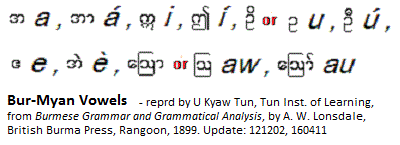 UKT 201126: What Lonsdale is describing below
are the Vowel-Letters, which have only
2 pitch registers, marked by vowel-duration
of 1 and 2 eye-blinks. What we generally use
are the Vowel-Signs modified by
UKT 201126: What Lonsdale is describing below
are the Vowel-Letters, which have only
2 pitch registers, marked by vowel-duration
of 1 and 2 eye-blinks. What we generally use
are the Vowel-Signs modified by
 {a.}: e.g.
{a.} (1 blnk),
{a.}: e.g.
{a.} (1 blnk),
 {a} (2 blnk),
 {a:} (emphatic 2 blnk), which were also described
as "creak", "modal", and "long" .
{a:} (emphatic 2 blnk), which were also described
as "creak", "modal", and "long" .
What Lonsdale is giving below are the "free" vowels. Read also
Wikipedia on Checked and Free vowels:
https://en.wikipedia.org/wiki/Checked_and_free_vowels 201126
"In phonetics and phonology, checked vowels are those that commonly
stand in a stressed closed syllable; and free vowels are those that
can stand in either a stressed closed syllable or a stressed open syllable."
Contents of this page
UKT 201201: The above caption is mine, to make navigation easier.
{a.}
[1 blnk] - This has the sound of the short open < a > as heard in
the first syllable of <papa> ; also in < adore>. It is represented
by a in this work.
{a}
[2 blnk] - This is long and open, and is pronounced like < a > in <ah>.
It is It is represented by á. [Lonsdale has presented this as
{a:} - it was probably a mistake.]
 { I. } [1 blnk] - is pronounced like the regular short sound of < i > as
heard in <pig>, and is represented by i . [This letter is quite
common in Pal-Myan, but rarely used in every-day Burmese even in "official"
communication. It has become so rarely used that many failed to recognize it as
a vowel, and is generally described as "ka-over-ku". What a shame!]
{ I. } [1 blnk] - is pronounced like the regular short sound of < i > as
heard in <pig>, and is represented by i . [This letter is quite
common in Pal-Myan, but rarely used in every-day Burmese even in "official"
communication. It has become so rarely used that many failed to recognize it as
a vowel, and is generally described as "ka-over-ku". What a shame!]
 { I } [2 blnk} - This is the long sound of
{I.} and may be transliterated by í as heard in <pier>, <machine>;
also in <bee>. [This letter is commonly used in official communication
and is more widely known than
{I.}.
{ I } [2 blnk} - This is the long sound of
{I.} and may be transliterated by í as heard in <pier>, <machine>;
also in <bee>. [This letter is commonly used in official communication
and is more widely known than
{I.}.
 {U.} [1 blnk] - This has the sound of <u> when pronounced like that of short <oo>
, as in <push>. It is represented by u . [The letter
{U.} is commonly used in everyday language for <egg> as in duck-egg
{U.} [1 blnk] - This has the sound of <u> when pronounced like that of short <oo>
, as in <push>. It is represented by u . [The letter
{U.} is commonly used in everyday language for <egg> as in duck-egg
 {Bè:U.} and chicken-egg
 {krak-U.}. ]
UKT 201126: The English <u> when used
as a free vowel presents no problem, however
when it is checked by a coda-consonant in a
syllable, there is confusion. The English
<u> is one of most troublesome vowels
for Burmese speakers learning ESL (English as
a Second Language). As a child I have wondered
why is <put> pronounced one way as
/pʊt/ and <but> another as /bʌt/.
Though we may not know the reason why, at least
we should be able to represent the pronunciations
unequivocally? In Burmese-Myanmar the spellings
are different and there is no confusion. Yet
when we write Romabama, the problem from English
resurfaced, which necessitates us to adopt {û}
for /ʌ/ : thus we can write {pwat} for
<put> and {bût} for <but>.
 {U} [2 blnk] - This has the long sound of
{U.}, being pronounced like < u > as heard in <Lu >, <rue>;
also in <pooh>. It is represented by ú . [This letter is
well-known. What is more commonly known is
{U} [2 blnk] - This has the long sound of
{U.}, being pronounced like < u > as heard in <Lu >, <rue>;
also in <pooh>. It is represented by ú . [This letter is
well-known. What is more commonly known is
 {U:} - the prefix of the names of grown-up men. It is an insult when a Westerner
drops it from a man's name.]
{U:} - the prefix of the names of grown-up men. It is an insult when a Westerner
drops it from a man's name.]
Contents of this page
 {É:} [emphatic 2 blnk] - has the power of < e > in < eh >, <Bey>
( = < a > in <mate>, <paper>. ). It is represented by e
.
{É:} [emphatic 2 blnk] - has the power of < e > in < eh >, <Bey>
( = < a > in <mate>, <paper>. ). It is represented by e
.
 {è:} [emphatic 2 blnk] - The sound of this equivalent to that of < e > as
pronounced in <there> or <held>. It is also heard in <air>,
<bear>, <care>. It is represented by è . [Note
that this phoneme has a diacritic over
{a.}. The diacritic is called
{è:} [emphatic 2 blnk] - The sound of this equivalent to that of < e > as
pronounced in <there> or <held>. It is also heard in <air>,
<bear>, <care>. It is represented by è . [Note
that this phoneme has a diacritic over
{a.}. The diacritic is called
 {nauk-píc}. A special method of representing the 3 registers is used:
 (1/2 blnk or 1 blnk),
 {èý} (2 blnk),
{è:} (emphatic 2 blnk)]
{èý} (2 blnk),
{è:} (emphatic 2 blnk)]
 {AU:} [emphatic 2 blnk] - This has the sound of < aw
> in <awful> . [When this phoneme is
sculpted as
{AU:} [emphatic 2 blnk] - This has the sound of < aw
> in <awful> . [When this phoneme is
sculpted as
 , some thought it is
 -
- {þa.ra.ric}. To prevent it, I've sculpted more rounded as
 .]
.]
 {AU} [2 blnk] - This is pronounced, like <au> in <audicity> with a
rising inflexion of the voice.
{AU} [2 blnk] - This is pronounced, like <au> in <audicity> with a
rising inflexion of the voice.

UKT 201201: Bur-Myan "mismatch-pair"
-
looks like matched, because
(emphatic 2 eye-blinks) and
(2 blnk). For BEPS, I've adopted Mon-Myan
- {AU:}-{ou}
Contents of this page
(s019-p011)
s019. There are two other letters which may be placed
with the vowels, viz.
 {o} (2 blnk), and
 {oän}. [Both are monophthongal vowels, but are thought to be diphthongs.] [UKT
¶]
{oän}. [Both are monophthongal vowels, but are thought to be diphthongs.] [UKT
¶]
{o} is a combination of the vowels
{a.},
{I.} and
{U.}, and has the sound
of the long < ô > as heard in <oh>, <Leo>, <opaque>. The
circle above [called {loän:kri:tín}, and the [vertical] line below
{a.} stand for
{I.}, and
{U.} respectively.
UKT 201127: How the
{o} comes about is said to be:
- {a.loän:tín}
/æ/ "put the circle above {a.}" -->
{a.loän:tín}
/æ/ "put the circle above {a.}" -->
 {i.} /i/
 {tíc.hkaún:gning} "draw up from
{i.} a line" -->
{o} /ɔ/.
{tíc.hkaún:gning} "draw up from
{i.} a line" -->
{o} /ɔ/.
It is not a glide from /i/ to /ɔ/: it is a monophthong - not a diphthong.
The student will learn more about them further on.
{oän} is a combination of the nasal
 {än} and the vowel
{U.}, and has the sound
of <ôn> as heard in <only> with the accent removed to the second
syllable.
{o} is a triphthong
{än} and the vowel
{U.}, and has the sound
of <ôn> as heard in <only> with the accent removed to the second
syllable.
{o} is a triphthong

 {ti.þa.ra.}, being a blend of three vowel sounds, and
{oän} may be considered a diphthong
{ti.þa.ra.}, being a blend of three vowel sounds, and
{oän} may be considered a diphthong
 {dwi.þa.ra.}.
Contents of this page
(s020-p011)
s020. Every Consonant in Bur-Myan has the sound of the
vowel
{a.} inherent in it [
 {mwé-hkän þa.ra.}], so that in its natural state, that is, when not blended or
combined with any other letter, it is fully articulated with its sound always
ending in that vowel; thus
{mwé-hkän þa.ra.}], so that in its natural state, that is, when not blended or
combined with any other letter, it is fully articulated with its sound always
ending in that vowel; thus
 {ka.},
 {sa.},
etc. When it occurs as the initial or the first letter of a word [onset
of syllable] it drops this vowel sound. When it occurs as a final [coda
of the syllable], it undergoes a certain modification. These points will be
discussed later on.
{sa.},
etc. When it occurs as the initial or the first letter of a word [onset
of syllable] it drops this vowel sound. When it occurs as a final [coda
of the syllable], it undergoes a certain modification. These points will be
discussed later on.
(s021-p011)
s021. The akshara
alphabetical names of the
consonants and their powers are given below: -
UKT 201128: Lonsdale's akshara-names such as
Ga'nge and Ga'gyi: contradicts
the one-to-one speech-to-script aspiration of
the Akshara-Syllable (or Abugida) recording
system. Because of this defect Lonsdale's names
are not given my work, and based on the meanings
of ngai = "little", and
gyi: = "great", is using
Ga-minor and Ga-major respectively.
Secondly, remember that English speakers could
not understand about the Tenuis-voiceless (vl)
(c1 aksharas) and ordinary-voiceless (c2 aksharas).
They do know the voiced (vd) (c3 aksharas), but
not the deep-H (c4 aksharas). Since c4 in Mon-Myan
is not deep-H, it must have contributed more to
the misunderstanding. If only the English speakers
could comprehend the Tenuis, the term
"aspirate" could be avoided altogether.
Thirdly, Lonsdale realizes that at least one c4 akshara is not an aspirate
of c3 : "the Burmese do not, however, aspirate it [i.e.
 {Da.}], but pronounce it like
 {da.}".
Velar : row#1 -
{ka.}-row
{ka.} [Tenuis-vl] - This is called Ka-major
 {ka.kri:} 'great ka' , and the power of
k as in kaleidoscope. [It is tenuis-voiceless
or simply tenuis. My question here is: Where is
Ka-minor ?]
{ka.kri:} 'great ka' , and the power of
k as in kaleidoscope. [It is tenuis-voiceless
or simply tenuis. My question here is: Where is
Ka-minor ?]
UKT 201128: In names below, Lonsdale uses the
word "aspirate".
Westerners, including IPA, to this day would not
recognize the existence of c2 and c4 as separate
phonemes and continue to call them aspirates of
c1 and c3. They have also failed to recognize the
existence of Tenuis-voiceless (or Tenuis) and
ordinary-voiceless. I've made corrections accordingly.
I urge the reader to look into the accompany PDF
copy.
Eng-Lat can only realize Tenuis when preceded by
 {Sa.}/
 {S} as in
 {Spa.},
e.g. English words <skin>
 {Skín:} and <spin>
 {Spín:}.
 {hka.} - [Though Lonsdale writes "This is the aspirate of
{ka.}", it is not so.] - This is the [tenuis] voiceless or
{ka.}-row, and is called
{hka.} - [Though Lonsdale writes "This is the aspirate of
{ka.}", it is not so.] - This is the [tenuis] voiceless or
{ka.}-row, and is called
 {hka.hkwé} 'curled up hka'
. Its power is that of k * but more tenuis = hk .
{hka.hkwé} 'curled up hka'
. Its power is that of k * but more tenuis = hk .
This consonant is usually represented by kh when it occurs in
International Pali words written in Roman [Latin] character.
* UKT 201201: What Lonsdale has said: "Its power is that of k " is
not correct. Without the Tenuis /k/ in English, English words such as <cat>
are pronounced with /kʰ/.
UKT 201128: Though Skt-Dev has the equivalent of
{hka.} as ख «kh», Sanskrit speakers prefer to
use a special conjunct क्ष «ks»
= क ् ष . The akshara ष «ṣ» /s/, is a Sibilant phoneme present
both in Sanskrit and English (IE languages), but absent in Bur-Myan (Tib-Bur).
What is present in Bur-Myan is the Thibilant phoneme
{þa.} /θ/. Romabama has to invent an akshara for ष «ṣ» /s/ as
{Sa.}/
{S} for use in BEPS.
(p011end-p012begin)
p.012.
 {ga.} - is called Ga-minor
 {ga.gnèý} 'little ga', and has the power
of g as in gasp .
{ga.gnèý} 'little ga', and has the power
of g as in gasp .
 {Ga.} - is called Ga-major
 {Ga.kri:}
'great ga', and according to the Páli pronunciation [International
Pali?], is an aspirate of
=
gh, but according to the Burmese, it has the same power as
,
i.e. g . The letter is used only in writing Páli words or words of Páli
origin.
{Ga.kri:}
'great ga', and according to the Páli pronunciation [International
Pali?], is an aspirate of
=
gh, but according to the Burmese, it has the same power as
,
i.e. g . The letter is used only in writing Páli words or words of Páli
origin.
 {gna.}/
 {ng} - This is a Semi-nasal
 nasal, and corresponds in sound to
the English ng as heard in hang . Its akshara-name
alphabetical-name is nga , pronounced without allowing the
tongue to touch the palate.
UKT 201128: English, Pali and Sanskrit do
not have words beginning with
{gna.} which has no nasal sound. It has only
words ending in killed akshara
{ng} as in hang , when the nasality
appears. The g In English words such
as gnome , the g is said to be
silent.
It is also noteworthy that there probably was no equivalent phoneme
of
{gna.} in Skt-Dev because it seems to be made up of: ड + dot --> ङ «nga»
Contents of this page
Palatal : row# 2
{sa.}-row
{sa.}/
 {c} [Tenuis-vl] - This is called
 {sa.loän:} 'round sa ', and the power of s in salute .
In International Pali Páli this is equivalent to
c , pronounced like the English ch , in church .
UKT 201128:
{sa.},
r1c1, is the first akshara of the
{sa.}-row
and is a Tenuis which is deaf to the English
ears. What the English has is the r1c2
 {hsa.}. The more significant problem for row#2,
the Palatals, is the presence of two types of
pronunciations - the stops, and the affricates.
What Bur-Myan and Pal-Myan have are the stops,
and what the English, International Pali and
Sanskrit have are the affricates. Romabama
for BEPS has to invent a set of aksharas
{hsa.}. The more significant problem for row#2,
the Palatals, is the presence of two types of
pronunciations - the stops, and the affricates.
What Bur-Myan and Pal-Myan have are the stops,
and what the English, International Pali and
Sanskrit have are the affricates. Romabama
for BEPS has to invent a set of aksharas
 {ca.},
 {cha.},
 {ja.}, using which we get <church>
 {chaach}.
{hsa.} - is voiceless aspirate of
{sa.}-row,
and is called
 {hsa.laim} 'twisted hsa ' . Its power = hs . The letter h
representing the c2
{hsa.laim} 'twisted hsa ' . Its power = hs . The letter h
representing the c2 aspirate is here placed first so as to
avoid giving the combination the power of sh as heard in sham .
In International Pali,
is equivalent to ch aspirated = ch'h.
UKT 201128: Here I must note about placing h : before or after
s . Lonsdale mentions that h-after-s would make it sh .
The h-after-akshara amounts to placing an
 {ha.hto:}. It is not a problem in Bur-Myan because
{sa.}
is a palatal-stop. But with fricative, or with palatal-fricative, it
is a problem: it gives sh as in sham .
{ha.hto:}. It is not a problem in Bur-Myan because
{sa.}
is a palatal-stop. But with fricative, or with palatal-fricative, it
is a problem: it gives sh as in sham .
 {za.} - This is named
 {za.hkwè:} 'split za ' . It has the
power of z .
{za.hkwè:} 'split za ' . It has the
power of z .
In International Pali [and Skt-Dev]
it is pronounced like j in jar .
[This shows English, International Pali, and Skt-Dev,
the r2-row is Palatal-affricate.]
 {Za.} - is called
-
{Za.} - is called
- {Za.myæÑ:hswè:} 'line-drawn za '. [Lonsdale's spelling {myæÑ:hswè:} is
not correct.]
{Za.myæÑ:hswè:} 'line-drawn za '. [Lonsdale's spelling {myæÑ:hswè:} is
not correct.]
In International Pali,
is the aspirate of
=
jh .
This consonant is chiefly used in Páli words or words derived from
the Páli
(p012end-p013begin)
p.013. [Lonsdale continues]
The consonants [of Palatal-stops]
{sa.},
{hsa.},
{za.},
and
{Za.}, as pronounced in Bur-Myan, are Stops Sibilants , that is, hissing
sounds . [Eng-Lat has only two Affricates: /ʧ/ (Tesh-digraph) and
/ʤ/ (Dezh-digraph). The English Affricates are dentals. Bur-Myan do not have basic aksharas
similar to English Affricates. What the Burmese has are
 {hkya.} and
 {gya.}: they break down under Virama. They are Palatal-medials.]
UKT 201129: I must contradict what Lonsdale had said about Sibilants,
i.e. hissing sounds. Eng-Lat being a Alphabet-Letter system, uses CVC
canonical structure for syllables, whereas Bur-Myan uses CVÇ where Ç is a
killed-consonant being under a Viram as
{c}. Thus,
{síc} does not end with a hissing sound:
{sa.}/
{c} is a stop. However,
{síS} and
{SíS}, end with a hissing sound:
{Sa.}/
{S} is a fricative - not known in Bur-Myan.
For the difference between Affricatives and Fricatives, see D Recasens and A
Espinosa's paper published in 2007 in TIL HD-PDF and SD-PDF libraries:
DRecasensAEspinosa-Affricate-Fricative<Ô> /
Bkp<Ô> (link chk 201129}
The r2c4
{Za.} is a lost phoneme of Bur-Myan, but still found in Pal-Myan. It is found in a very common Bur-Myan
word
 {Zé:} 'market', and its derivatives such as
 {Ze:þæÑ} 'market-seller' and
 {Zé:wèý}. The next r2c5 Nya-major
 {Ña.}/
 {Ñ} is completely lost: not even found in Pal-Myan. Its place is taken up by
Nya-minor
{Ñ} is completely lost: not even found in Pal-Myan. Its place is taken up by
Nya-minor
 {ña.}/
 {ñ}.
{ñ}.
Lonsdale does not include Nya-major
{Ña.}/
{Ñ} in the Sibilants , because it has no hissing sound. It is
not even a True-nasal: I call it a Semi-nasal like r1c5
{gna.}/
{ng}.
{Ña.}/
{Ñ} - This is called
nya , and has the power of ny as heard in banyan, or the
Spanish ñ .
UKT 201129: Lonsdale is not correct when he
states that "
nya ... has the power of ny
as heard in banyan ". The
True-nasal r4c5,
 {na.} being made a medial with
 {ya.pín.}
 becomes
 {nya.}. If it had remained a conjunct
 {n~ya.} it would be mute. Being a
medial
{nya.} it is pronounceable: yet there
is a slight pause after /n/ showing the presence
of a schwa. Because of this, it is proper to write
{n·ya.} and write Nya-major with
capital Spanish Ñ , and
Nya-minor with small Spanish
ñ .
{n~ya.} it would be mute. Being a
medial
{nya.} it is pronounceable: yet there
is a slight pause after /n/ showing the presence
of a schwa. Because of this, it is proper to write
{n·ya.} and write Nya-major with
capital Spanish Ñ , and
Nya-minor with small Spanish
ñ .
Contents of this page
 {Ta.} [Tenuis-vl] - This letter which is called

 {Ta.þän-lyín:hkyait} 'iron-hook ta ', is a retroflex
 lingual
(cerebral), and is sounded in International Pali as the English t
would be pronounced by placing the tip of the tongue far back against the
palate. The Bur-Myan, however, pronounce it as we pronounce t , thereby
giving it the same power as the dental
 {ta.}.
{Ta.} ट «ṭa» occurs only in Páli words or words derived from Páli.
{ta.}.
{Ta.} ट «ṭa» occurs only in Páli words or words derived from Páli.
In the writing of International Pali in Latin Roman
characters, the consonant [
{Ta.}] is transliterated by ṭ [note the dot-under-t ]
 {HTa.} - is also a retroflex
 lingual,
and is the ordinary-vl aspirate of the
{Ta.} [the tenuis-vl]. It is called
- {HTa.wûm:Bè:} 'duck hta '. It may be
transliterated by ht . It occurs chiefly in
Pal-Myan words.
{HTa.wûm:Bè:} 'duck hta '. It may be
transliterated by ht . It occurs chiefly in
Pal-Myan words.
In the writing of International Pali
in Latin Roman characters, this letter is represented
by ṭh . [notice the dot-under-t ]
 {ða.} - is the retroflex
 lingual d . The remarks on
{Ta.} [the first member of the retroflex row] as to its pronunciation are
applicable here. It may be transliterated by d . It is called
- {ða.rín-kauk} 'crooked breasted da ', and is initial only in Páli words.
In International Pali words written in the Roman character this
letter is represented by ḍ . [note the dot-under-d ]
 {Ða.} - is the Deep-H counterpart
 aspirate of
{ða.}, but the Burmese do not pronounce it as such ; it may therefore, be
transliterated by d . Its akshara alphabetical name is
- {Ða.ré-mhoat} 'water-dipper da '.
In the writing of International Pali in Latin Roman characters,
this consonant is transliterated by ḍh . [note the dot-under-d ]
(p013end-p014begin)
p.014.
 {Na.}/
 {N} - [Na-major] is a nasal as well as a retroflex
 lingual . It
is pronounced by the Burmese like n in [English] not ,
without bringing the point of the tongue upward nearly to the middle of the
palate. It is call Na-major
 {Na.kri:} 'great na ', and used only in Páli.
In International Pali written in the Latin Roman character this
letter is represented by ṇ . [notice dot-below-n ]
In UHS Pal-Myan dictionary, p.0426, there are nine Na-major, r3c5, words
with it as onset. They are related to the name of the akshara, and to any
other word showing that there are no regular Pali-Myan. Of course there are
many words through out the dictionary which end with
{N} as the coda. It is the same as in r1c5
{gna.}/
{ng}, which makes Na-major a Semi-nasal.
Contents of this page
Dental : row#4 -
{ta.}-row
{ta.} [Tenuis] - This is called
 {ta.wûm:pu} 'pot-bellied ta ', and is the dental
t in ton .
{ta.wûm:pu} 'pot-bellied ta ', and is the dental
t in ton .
 {hta.} - is the ordinary-vl counterpart
 aspirate of
{ta.}, and is equivalent to ht . Its akshara alphabetical
name is
{hta.hsín-htu:} 'elephant-fetter hta '.
This letter is usually represented by th in International
Pali words written in the Latin Roman character. The digraph [
t-and-h ] combination is not, however, adopted here, as it is
liable to be confounded with the [thibilant /θ/] sound of
{þa.} which, in
Bur-Myan, is pronounced like [English] thin [vl] or thee .
UKT 201201: It is because of this possibility,
Romabama has to adopt the Old-English
thorn-character þ .
{da.}
- is called
 {da.htwé:} 'youngest da ', and has the power of d in darn .
{Da.} - is the deep-H counterpart aspirate of
{da.}
in International Pali, and is represented in Latin Roman
characters by dh ; the Burmese do not, however, aspirate it [i.e.
{Da.}], but pronounce it like
{da.};
it may therefore be transliterated by d . It is called
 {Da.auk-hkreik} ' concave-bottom da '.
 is the old form from which it got its akshara
 alphabetical
name.
{na.}
/  {n} - is called Na-minor
 {na.gnèý} 'small na ', and is equivalent in power to the English n
.
{na.gnèý} 'small na ', and is equivalent in power to the English n
.
UKT 201201: Na-minor
{na.gnèý} having the akshara-forms
{na.} /
{n}, is the first True-nasal of Eng-Lat and Skt-Dev. It has another
form without leg,
 {na.}, which is used when it has to be modified, e.g.
 {nu.} .
Contents of this page
Labial : row#5 -
 {pa.}-row
{pa.} [Tenuis] - is called
 {pa.sauk} 'steep pa ', and has the power of p in pan .
 {hpa.} - is the ordinary-vl counterpart
 aspirate of
{pa.}, and may be transliterated by [digraph] hp . Its name is
 {hpa.U:htoap} 'capped hpa '.
p.015
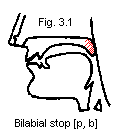
[The digraph] Ph is commonly used to represent this akshara
letter, but as it usually has the power of f , it is not
adopted.
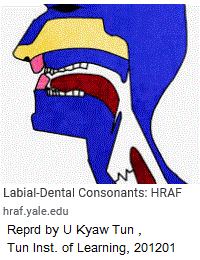
UKT 201201: Lonsdale should have differentiated Bilabial
{pa.} from Labial-Dental (upper front-teeth touching lower lip)
 {fa.} /f/. The problem is twofold: Bur-Myan does not have
Labial-Dentals, and Eng-Latin does not have Tenuis. Eng-Lat can
only realize Tenuis when preceded by
{Sa.}/
{S} as in
{Spa.},
{fa.} /f/. The problem is twofold: Bur-Myan does not have
Labial-Dentals, and Eng-Latin does not have Tenuis. Eng-Lat can
only realize Tenuis when preceded by
{Sa.}/
{S} as in
{Spa.},
e.g. English words <spin>
{Spín:} and <skin>
{Skín:}.
 {ba.} - is called
 {ba.htak-hkreik} 'concave-top ba '. In power it is equivalent to the
English b in barn.
{ba.htak-hkreik} 'concave-top ba '. In power it is equivalent to the
English b in barn.
UKT 201201: It is noteworthy that Skt-Dev did not originally have this
phoneme, because it had to borrow from:
व «va» + diagonal --> ब «ba».
The effect is a mix-up in transliteration from Pali.
 {Ba.} - is the deep-H counterpart
 aspirate of
{ba.}
in International Pali, and is represented in Latin Roman
character by [digraph] bh , but in Burmese it is the same as
{ba.}
b . It sometimes has the sound of
{hpa.} [especially under Mon-Myan influence], and is interchangeably written for
it, as, {Bau} for {hpau} "to produce, bring into view". Its akshara
alphabetical name is
 {Ba.koan:} 'hunchback ba '.
 {ma.} /
 {m} - named
{ma.} ma is the equivalent to the English m in manna.
{m} - named
{ma.} ma is the equivalent to the English m in manna.
Contents of this page
Akshara: -----
 {ya.}, ----
 {ra.}, ----
 {la.}, ----
 {wa.}
{wa.}
Medial-form: Ya-pin
, Ra-ric

 , La-swè
 , Wa-swè


{ya.} - named
 {ya.pak-lak} 'supine ya ', or simply
{ya.} ya , is like y in yam .
{ya.pak-lak} 'supine ya ', or simply
{ya.} ya , is like y in yam .
{ra.} - named
 {ra.kauk} [pronounced as {ya.kauk}] 'crooked
ra or ya ', is commonly pronounced like y ,
but in a few words especially those derived
from Pali-Myan, and in Rakhine dialect
{ra.kauk} [pronounced as {ya.kauk}] 'crooked
ra or ya ', is commonly pronounced like y ,
but in a few words especially those derived
from Pali-Myan, and in Rakhine dialect
Arakan it is sounded like
r .
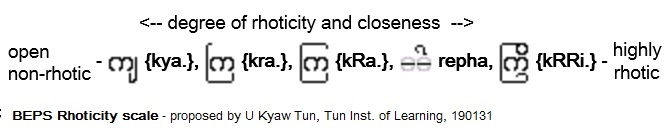
UKT 201201: BEPS needs to differentiate the
differing rhoticity in Bur-Myan, Pali-Myan,
and Skt-Dev for which I've to define a non-rhotic
to rhotic scale.
{la.} - named
{la.} la , is equivalent to l in English.
UKT 201201: English speakers cannot pronounce
the Welsh names which begin with L, correctly.
They have to make use of LL digraphs. So when
Lonsdale said: "is equivalent to
l in English", I'm taking it
with a grain of salt!
{wa.} - named
{wa.} wa, is like w in ward . Its International Pali equivalent
is va . [But not so in Pali-Myan:
{wa.} is pronounced with fully rounded lips.]
Contents of this page
Fricative : row#6
- Thibilant /θ/
In Bur-Myan, and Pali-Myan,
{þa.} is Thibilant with no trace of hissing
or hushing sounds. However, in International
Pali, Mon-Myan, Intha-Myan, etc.,
{þa.} is Sibilant /s/.
{þa.} - named
Contents of this page
Contents of this page
From: Wikipedia
http://en.wikipedia.org/wiki/Diphthong#English 081008
 In
phonetics, a diphthong (also gliding vowel) (from Greek
δίφθογγος, "diphthongos", literally "with
two sounds" or "with two tones") is a contour vowel — that is, a unitary vowel
that changes quality during its pronunciation, or "glides", with a smooth
movement of the tongue from one articulation to another, as in the English words
eye, boy, and cow. This contrasts with "pure" vowels, or
monophthongs, where the tongue is held still, as in the English word
papa.[1]
In
phonetics, a diphthong (also gliding vowel) (from Greek
δίφθογγος, "diphthongos", literally "with
two sounds" or "with two tones") is a contour vowel — that is, a unitary vowel
that changes quality during its pronunciation, or "glides", with a smooth
movement of the tongue from one articulation to another, as in the English words
eye, boy, and cow. This contrasts with "pure" vowels, or
monophthongs, where the tongue is held still, as in the English word
papa.[1]

UKT: Myanmars (myself included before I learned Phonetics) cannot pronounce
the English word <cow> correctly. Most of us do not realized
that it is a diphthong.
Diphthongs often form when separate vowels are run together in rapid speech.
However, there are also unitary diphthongs, as in the English examples above,
which are heard by listeners as single vowel sounds (phonemes).
[2]
In the IPA (International Phonetic Alphabet), pure vowels are transcribed with
one letter, as in English "sum" [sʌm]. Diphthongs are transcribed
with two letters, as in English "eye" [aɪ̯] or "same"
[seɪ̯m]. The two vowel symbols are chosen to represent the beginning and
ending positions of the tongue, though this can be only approximate.
The diacritic < ̯> is placed under
the less prominent component to show that it is part of a diphthong
rather than a separate vowel, though it is sometimes left off
in languages such as English, where there is not likely to be any confusion.
(That is, in precise transcription,
[ai] represents two vowels in
hiatus, as found for example in Hawaiian and Japanese, or in the English
word "naïve", not a diphthong as in English "knives").
UKT: I have been looking for a name of this diacritic which shows that it
is a part of the diphthong. The only one I can find so far (as of today
081020) is from MS Windows Character Map: Combining Inverted Breve Below
with the Unicode U032F. Here I am placing it under Schwa: [ ə̯ ].
It has been the common experience of Burmese speaking Myanmars in the
United States (I was included way back in the late 1950s) to find that no
one understands them when they say "Please check the oil" to the service
station attendant. Little do we realized that when we pronounce "oil", it
sounded "wine" to them. In fact the best we can articulate is
 {weing} (pronounced as monophthong with the coda as [ŋ] and not [n]) which
sounded very similar to "wine". Based on our common experience, I maintain
that there are no diphthongs or gliding vowels in Burmese. What Lonsdale and
most of the phoneticians about the so-called diphthongs and triphthongs are
from the way the graphemes are written and not how the phonemes are pronounced.
{weing} (pronounced as monophthong with the coda as [ŋ] and not [n]) which
sounded very similar to "wine". Based on our common experience, I maintain
that there are no diphthongs or gliding vowels in Burmese. What Lonsdale and
most of the phoneticians about the so-called diphthongs and triphthongs are
from the way the graphemes are written and not how the phonemes are pronounced.
Go back diphthong-note-b
Contents of this page
From Wikipedia
http://en.wikipedia.org/wiki/Grapheme 081020
In typography, a grapheme is the fundamental unit in written language.
Graphemes include alphabetic letters, Chinese characters, numerals, punctuation
marks, and all the individual symbols of any of the world's writing systems.
In a phonemic orthography, a grapheme corresponds to one phoneme.
In spelling systems that are non-phonemic – such as the spellings used most widely
for written English – multiple graphemes may represent a single phoneme.
These are called digraphs (two graphemes for a single phoneme) and
trigraphs (three graphemes). For example, the word ship contains four
graphemes (s, h, i, and p) but only three phonemes,
because sh is a digraph.
UKT: Sanskrit or Devanagari (in which Sanskrit is written) is described
as an abugida. Similarly, the Asoka script now dubbed Brahmi, the parent of
Devanagari, is an abugida. Therefore, Pali-Myanmar and Burmese-Myanmar must
be described as abugidas. The Wikipedia article on phonemic orthography
http://en.wikipedia.org/wiki/Phonemic_orthography 081020 gives:
"Scripts with a good grapheme-to-phoneme correspondence include
those of ... Sanskrit, ... and Spanish. Most constructed languages such as
Esperanto and Lojban have phonemic orthographies.
"As dialects of the English language vary significantly, it would
be difficult to create a phonemic orthography that encompassed all of them.
However, it is fairly easy to create one based on a standard accent such as
Received Pronunciation. ... In order to maintain a phonemic orthography such
a system would need periodic updating, ... "
Though I have come across the above Wikipedia article only lately, I have
been using the idea expressed in it in creating Romabama since the closing
years of the last century.
Different glyphs
can represent the same grapheme, meaning they are
allographs.
For example, the minuscule [lower case]
letter a can be
seen in two variants, with a hook at the top <a>, and without <ɑ>. Not all
glyphs are graphemes in the phonological sense; for example the
logogram
ampersand (&) represents the Latin word et (English ‘and’), which
contains two phonemes.
Go back grapheme-note-b
Contents of this page
Excerpt from
http://en.wikipedia.org/wiki/Phoneme 081020
In human language, a phoneme is the smallest posited structural unit
that distinguishes meaning. Phonemes are not the physical segments themselves,
but, in theoretical terms, cognitive abstractions or categorizations of them.
An example of a phoneme is the /t/ sound in the words tip, stand, water,
and cat. (In transcription, phonemes are placed between slashes,
as here.) These instances of /t/ are considered to fall under the same sound
category despite the fact that in each word they are pronounced somewhat
differently. The difference may not even be audible to native speakers, or the
audible differences not perceived. That is, a phoneme may encompass several
recognizably different speech sounds, called phones. In our
example, the /t/ in tip is aspirated, [tʰ] [UKT: equivalent to
 {hta.}],
while the /t/ in stand is not, [t] [UKT: equivalent to
{hta.}],
while the /t/ in stand is not, [t] [UKT: equivalent to
 {ta.}].
(In transcription, speech sounds that are not phonemes are placed in brackets,
as here.) In many languages, such as Korean and Spanish, these phones are
different phonemes: For example, /tol/ is "stone" in Korean, whereas
/tʰol/ is "grain of rice". In Spanish, there is no aspirated
[tʰ], but the phone in American English writer is similar
to the Spanish r /ɾ/ and contrasts with Spanish /t/.
{ta.}].
(In transcription, speech sounds that are not phonemes are placed in brackets,
as here.) In many languages, such as Korean and Spanish, these phones are
different phonemes: For example, /tol/ is "stone" in Korean, whereas
/tʰol/ is "grain of rice". In Spanish, there is no aspirated
[tʰ], but the phone in American English writer is similar
to the Spanish r /ɾ/ and contrasts with Spanish /t/.
Phones that belong to the same phoneme, such as [t] and [tʰ] for English
/t/, are called allophones. A common test to determine whether two phones are allophones or
separate phonemes relies on finding minimal pairs: words that differ by only the phones in question.
For example, the words tip and dip illustrate that
[t] and [d] are separate phonemes,
/t/ and /d/, in English, whereas the lack of such a contrast in Korean
( /tʰata/ is pronounced
[tʰada], for example) indicates that in this language they are allophones
of a phoneme /t/.
In sign languages, the basic elements of gesture and location were formerly
called cheremes (or cheiremes), but general usage changed to
phoneme.
Tonic phonemes are sometimes called tonemes, and timing phonemes
chronemes.
Some linguists (such as
Roman Jakobson,
Morris
Halle, and
Noam
Chomsky) consider phonemes to be further decomposable into
features, such features being the true minimal constituents of language.
Features overlap each other in time, as do
suprasegmental phonemes in oral language and many phonemes in sign
languages. Features could be designated as
acoustic (Jakobson) or
articulatory (Halle & Chomsky) in nature.
UKT: More in the original article.
Go back phoneme-note-b
Contents of this page
From:
http://en.wikipedia.org/wiki/Sapir-Whorf_Hypothesis 081009
In linguistics, the Sapir–Whorf hypothesis (SWH) (also known as
the "linguistic relativity hypothesis") postulates a systematic relationship
between the grammatical categories of the language a person speaks and how that
person both understands the world and behaves in it. Although known as the Sapir–Whorf
hypothesis, it was an underlying axiom of linguist and anthropologist
Edward Sapir and his colleague and student Benjamin Whorf.
The hypothesis postulates that a particular language's nature influences the
habitual thought of its speakers: that different language patterns yield
different patterns of thought. This idea challenges the possibility of perfectly
representing the world with language, because it implies that the mechanisms of
any language condition the thoughts of its speaker community. The
hypothesis emerges in strong and weak formulations.
(UKT: Whorf was a chemical engineer by training.)
Go back SWH-note-b
Contents of this page
End of TIL file

