Uns2005.htm
Larry D. Unsworth, Zin Tun, Heather Sheardown, John L. Brash
Journal of Colloid and Interface Science 281 (2005) 112-121
home-ZinTun.htm |
Top
indx-zin-publ.htm
Journal
Abstract
Introduction
Notes by Dr. Zin Tun
Physical property studies of surfaces formed by
chemisorption of polyethyleneoxide
(PEO) onto gold are reported. Such surfaces have
potential as model materials for elucidation of the mechanism of resistance to
protein adsorption by PEO surfaces.
Thiolated monomethoxy poly(ethylene oxide) (PEO)
was chemisorbed onto gold-coated silicon wafers under various conditions such
that different surfacechaindensities were achieved.
Chaindensity was varied by controlling PEO solubility
(proximity to cloud-point conditions) as well as chemisorption
time. Films prepared with PEO of molecular weight 750, 2000, and 5000 g/mol were
studied. Chaindensities determined in the dry state by
ellipsometry were found to be in the range of 0.4–0.7,
0.33–0.58, and 0.12–0.30 chains/nm2 for MW
750, 2000, and 5000 PEO, respectively. Chaindensity was
found to decrease with increasing molecular weight and to increase as
cloud-point conditions were approached. PEO-layer mass
densities and chaindensities were determined
independently by neutronreflectometry. Under
low-solubility conditions and for a 4-h chemisorption
time, film mass and chaindensity values of
1.0±0.3 g cm−3
and
 were found for MW 750 PEO, and
0.82±0.02 g cm−3
and
were found for MW 750 PEO, and
0.82±0.02 g cm−3
and
 for MW 5000 PEO. Ellipsometry data for these systems
yielded graft densities of
0.63±0.13
and
for MW 5000 PEO. Ellipsometry data for these systems
yielded graft densities of
0.63±0.13
and
 ,
respectively. Using the mass densities obtained from
the neutron data in the ellipsometry
calculations, chaindensities of
0.6±0.3
and
,
respectively. Using the mass densities obtained from
the neutron data in the ellipsometry
calculations, chaindensities of
0.6±0.3
and
 ,
respectively, were obtained for the MW 750 and 5000 films. The
ellipsometry and neutron data for the MW 5000
system are thus in agreement within experimental error. In general, the
chain-density values are much
higher than those corresponding to layers of unperturbed random coil PEO
(“mushrooms”), suggesting that the PEO layers are in the brush regime with the
chains in an extended conformation.
,
respectively, were obtained for the MW 750 and 5000 films. The
ellipsometry and neutron data for the MW 5000
system are thus in agreement within experimental error. In general, the
chain-density values are much
higher than those corresponding to layers of unperturbed random coil PEO
(“mushrooms”), suggesting that the PEO layers are in the brush regime with the
chains in an extended conformation.
 Introduction
Poly (ethylene oxide) (PEO)-modified surfaces have attracted much attention due to their excellent anti-biofouling properties [1-4]. In particular they have been shown to be resistant to nonspecific protein adsorption. An important class of such materials are formed by grafting, i.e., attachment of PEO to the surface via the polymer chain ends. Although the mechanism of protein resistance on these surfaces is not entirely clear, it is believed that the PEO chain length, surface chain density, and chain conformation are important factors [3,5]. -- (Uns2005intro01.gif)
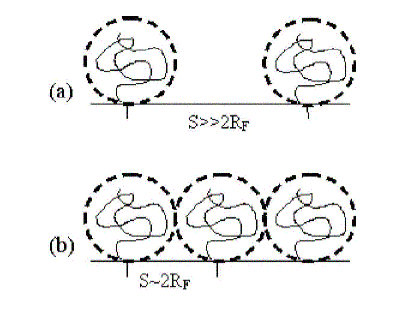
Alexander [6] has pointed out that the conformation of end-tethered
chains on a surface depends on the chain density (Fig. 1). A random coil
conformation (mushroom regime) occurs when the graft spacing (S) is
greater than 2 RF (RF is the Flory radius),
and a more extended conformation (brush regime) occurs when S < 2 RF
. It is also well understood that stretching-entropy and excluded-volume
interactions influence the chain density in the brush regime, in both cases as a
result of lateral confinement. Thus by varying chain density,
 chain conformation ranging from unperturbed random coil
to fully extended can, in principle, be
obtained. -- (Uns2005intro02.gif)
chain conformation ranging from unperturbed random coil
to fully extended can, in principle, be
obtained. -- (Uns2005intro02.gif)
The focus of the present work is to produce well-characterized PEO-grafted surfaces of variable chain density and chain length to allow a detailed study of the influence of these parameters on protein resistance. In this article the preparation and characterization of a series of surfaces prepared by chemisorption of chain-end thiolated PEO (molecular weight range 750-5000) to gold is reported . Such a system should in principle allow variation of chain density up to high values, with an absolute upper limit corresponding to the density of thiol binding sites on gold. (Uns2005intro03.gif)
The coupling of polymers and other molecules to gold by reaction
with thiol groups has been widely reported [7-10]. A system that has been
investigated extensively consists of intermediate-length alkanes (e.g., C-11),
thiol-terminated at one end and "tipped" or not with an oligoethylene oxide (OEO)
moiety at the other end. In these systems the ratio of OEO-terminated to
End of TIL file