 {aa-ya.} आय
  {aa-ya} आया
  {aa-yu.} आयु
  {aa-yau:} आयो
 a2ya1-030top-2.htm
from: Online Sanskrit Dictionary, February 12, 2003 . http://sanskritdocuments.org/dict/dictall.pdf 090907
Downloaded, set in HTML, and edited by U Kyaw Tun, M.S. (I.P.S.T., U.S.A.), and staff of TIL Computing and Language Centre, Yangon, Myanmar. Not for sale. No copyright. Free for everyone.
index.htm | Top
SED-vow-a2-indx.htm
{aa-ya.} आय
{aa-ya} आया
{aa-yu.} आयु
{aa-yau:} आयो
UKT notes
• Polestar : past , present and future
• Precession
of Equinoxes: Axial precession
{aa-ya.} आय
•
आयतम् (aayatam.h)
Skt:
आयतम् (aayatam.h) - (n) rectangle - OnlineSktDict
•
आयनांश
(aayanaa.nsha)
Skt:
आयनांश
(aayanaa.nsha) - Precession of Equinoxes. Used to convert Tropical positions to
Sidereal - OnlineSktDict
See my notes on Precession of Equinoxes and Polestar .
{aa-ya}
आया
•
आयातः (aayaataH)
Skt:
आयातः (aayaataH) - (m) import - OnlineSktDict
•
आयातन (aayaatana)
Skt:
आयातन (aayaatana) - abode, resting place - OnlineSktDict
{aa-yu.}
आयु
•
आयुः (aayuH)
Skt:
आयुः (aayuH) - (long) life - OnlineSktDict
•
आयुधं (aayudhaM)
Skt:
आयुधं (aayudhaM) - weapons - OnlineSktDict
•
आयुधानां
(aayudhaanaaM)
Skt:
आयुधानां
(aayudhaanaaM) - of all weapons - OnlineSktDict
•
आयुष्कारक
(aayushhkaaraka)
Skt:
आयुष्कारक
(aayushhkaaraka) - Significator of Longevity which is Saturn - OnlineSktDict
¤ आयुक्त āyukta
ppp. full of - SpkSkt
¤ आयुक्त āyukta
ppp. adj. joined with; burdened with;
charged with; appointed; applied to; united - SpkSkt
{aa-yau:}
आयो
•
आयोगः
(aayogaH)
Skt:
आयोगः
(aayogaH) - (m) commision - OnlineSktDict
Excerpts from: http://en.wikipedia.org/wiki/Precession 100416
Precession is a change in the orientation of the rotation axis of a rotating body. It can be defined as a change in direction of the rotation axis in which the second Euler angle (nutation) is constant. In physics, there are two types of precession: torque-free and torque-induced.
In astronomy, "precession" refers to any of several slow changes in an astronomical body's rotational or orbital parameters, and especially to the Earth's precession of the equinoxes. See Precession (astronomy).
UKT: Because of precession, the Earth's axis has been pointing at various stars over time. At the present, it is pointing approximately to Polaris (α Ursae), however, during the past a succession of stars has thus passed near enough to the north celestial pole to serve as the polestar.
UKT: Each of a succession of stars has thus passed near enough to the north celestial pole to serve as the polestar. At present the polestar is ... Pole star - Wikipedia, the free encyclopedia
 Axial
precession is the movement of the rotational axis of an astronomical body,
whereby the axis slowly traces out a cone. In the case of the Earth, this type
of precession is also known as the precession of the equinoxes or
precession of the equator. The Earth goes through one such complete
precessional cycle in a period of approximately 26,000 years, during which the
positions of [fixed] stars
as measured in the
equatorial coordinate system will slowly change; the change is actually due
to the change of the coordinates. Over this cycle the Earth's north axial pole
moves from where it is now, within 1° of
Polaris, in a
circle around the
ecliptic pole, with an angular radius of about 23.5 degrees (or
approximately 23 degrees 27 arcminutes
[2]). The shift is 1 degree in 72 years, where
the angle is taken from the observer, not from the center of the circle.
Axial
precession is the movement of the rotational axis of an astronomical body,
whereby the axis slowly traces out a cone. In the case of the Earth, this type
of precession is also known as the precession of the equinoxes or
precession of the equator. The Earth goes through one such complete
precessional cycle in a period of approximately 26,000 years, during which the
positions of [fixed] stars
as measured in the
equatorial coordinate system will slowly change; the change is actually due
to the change of the coordinates. Over this cycle the Earth's north axial pole
moves from where it is now, within 1° of
Polaris, in a
circle around the
ecliptic pole, with an angular radius of about 23.5 degrees (or
approximately 23 degrees 27 arcminutes
[2]). The shift is 1 degree in 72 years, where
the angle is taken from the observer, not from the center of the circle.
Discovery of the precession of the equinoxes is generally attributed to the ancient Greek astronomer Hipparchus (ca. 150 B.C.). The Precession (axial rotation) was later explained by Newtonian physics. Being an oblate spheroid, the Earth has a nonspherical shape, bulging outward at the equator. The gravitational tidal forces of the Moon and Sun apply torque as they attempt to pull the equatorial bulge into the plane of the ecliptic. The portion of the precession due to the combined action of the Sun and the Moon is called lunisolar precession.
UKT addition from: The Fall of Star Vega (Abhijit), by Dr. P. V. Vartak (Truth of 12,000 years B.C. recorded in Mahabharat) http://www.hindunet.org/hindu_history/ancient/mahabharat/mahab_abhijit.html 100221
"Krittikas were at the Summer Solstice between 21,800 and 20,840 years B.C. At this time Dhansishta was at the vernal equinox and hence was given the first place in the Nakshatras. From this period, the sages noticed the gradual fall of Abhijit. Falling steadily, it is assumed the position of the Celestial Pole at 12,000 B.C., when Indra met Skanda to think on the problem of time-reckoning. The story shows that the Indian sages were observing the stars and constellations at least from 23,000 years B.C."
See my note on a1bba1-015top-2.htm in this collection.
 The
inclination of Earth's orbit drifts up and down. Relative to its present
orbit this drift has a period of about 70,000 years. Relative to the
invariable plane it has a 100,000 year period. The invariable plane
represents the
angular momentum of the solar system, and is approximately the orbital plane
of Jupiter.
The
inclination of Earth's orbit drifts up and down. Relative to its present
orbit this drift has a period of about 70,000 years. Relative to the
invariable plane it has a 100,000 year period. The invariable plane
represents the
angular momentum of the solar system, and is approximately the orbital plane
of Jupiter.
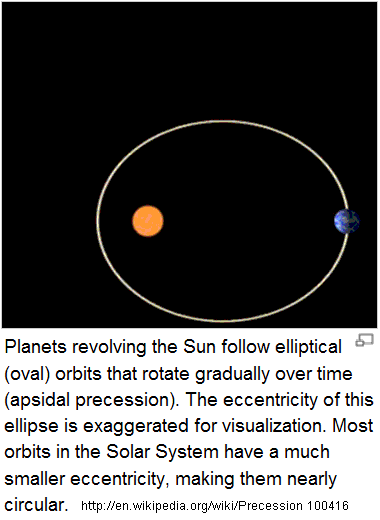
The orbit of a planet around the Sun is not really an ellipse but a flower-petal shape because the major axis of each planet's elliptical orbit also precesses within its orbital plane, partly in response to perturbations in the form of the changing gravitational forces exerted by other planets. This is called perihelion precession or apsidal precession.
Discrepancies between the observed perihelion precession rate of the planet Mercury and that predicted by classical mechanics were prominent among the forms of experimental evidence leading to the acceptance of Einstein's Theory of Relativity (in particular, his General Theory of Relativity), which accurately predicted the anomalies.[3][4]
These periodic changes of Earth's orbital parameters, combined with the precession of the equinoxes and of the inclination of the Earth's axis on its orbit, are an important part of the astronomical theory of ice ages. See also nodal precession. For precession of the lunar orbit see lunar precession.
Go back precession-note-b
From Wikipedia: http://en.wikipedia.org/wiki/Pole_star 100518
A pole star is a visible star, especially a prominent one, that is approximately aligned with the Earth's axis of rotation; that is, a star whose apparent position is close to one of the celestial poles, and which lies approximately directly overhead when viewed from the Earth's North Pole or South Pole. (A similar concept also applies to other planets.)
The term "the Pole Star" usually refers to
Polaris
 {Du-wun krèý} [MED218],
which is the current northern pole star, also known as the North Star.
The south celestial pole currently lacks a bright star like Polaris to mark its
position. At present, the
naked-eye star nearest to this imaginary point is the faint
Sigma Octantis, which is sometimes known as the South Star.
{Du-wun krèý} [MED218],
which is the current northern pole star, also known as the North Star.
The south celestial pole currently lacks a bright star like Polaris to mark its
position. At present, the
naked-eye star nearest to this imaginary point is the faint
Sigma Octantis, which is sometimes known as the South Star.
While other stars' apparent positions in the sky change throughout the night, as they appear to rotate around the celestial poles, pole stars' apparent positions remain essentially fixed. This makes them especially useful in celestial navigation: they are a dependable indicator of the direction toward the respective geographic pole, and their angle of elevation can also be used to determine latitude.
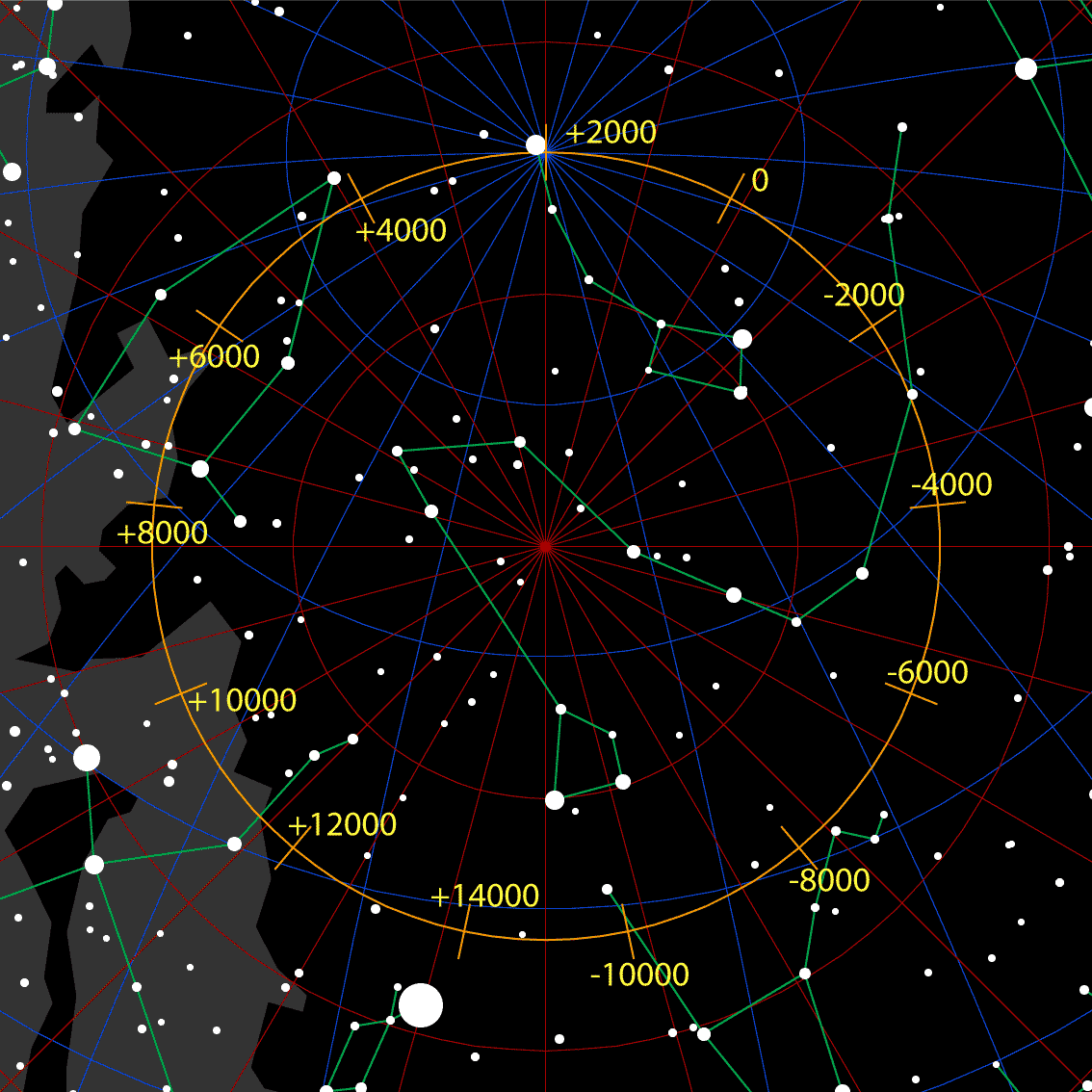 The
identity of the pole stars gradually changes over time because the celestial
poles exhibit a slow continuous drift through the star field. The primary reason
for this is the
precession of the Earth's rotational axis, which causes its orientation to
change over time. If the stars were fixed in space, precession would cause the
celestial poles to trace out imaginary circles on the
celestial sphere approximately once every 26,000 years, passing close to
different stars at different times. However, the stars themselves exhibit motion
relative to each other, and this so-called
proper motion is another cause of the apparent drift of pole stars.
The
identity of the pole stars gradually changes over time because the celestial
poles exhibit a slow continuous drift through the star field. The primary reason
for this is the
precession of the Earth's rotational axis, which causes its orientation to
change over time. If the stars were fixed in space, precession would cause the
celestial poles to trace out imaginary circles on the
celestial sphere approximately once every 26,000 years, passing close to
different stars at different times. However, the stars themselves exhibit motion
relative to each other, and this so-called
proper motion is another cause of the apparent drift of pole stars.
UKT: I've edited this section mostly by rearranging the paragraphs and supplying suitable subheadings. - 100519
At the present time, the northern pole star aka North Star, is Polaris, which lies about three-quarters of a degree from the north celestial pole, at the end of the "bob" of the Little Dipper asterism in the constellation Ursa Minor. A common method of locating Polaris in the sky is to follow along the line of the so-called "pointer" stars, the two stars farthest from the "handle" of the Big Dipper.
Polaris is a moderately bright star with an apparent magnitude of 1.97 (variable) making it the brightest star in the Little Dipper. Its current declination is +89°15'50.8".
Polaris' mean position (taking account of precession and proper motion) will reach a maximum declination of +89°32'23", so 1657" or 0.4603° from the celestial north pole, in February 2102. Its maximum apparent declination (taking account of nutation and aberration) will be +89°32'50.62", so 1629" or 0.4526° from the celestial north pole, on 24 March 2100.[1]
The North Star has historically been used for navigation, both to find the direction of north and to determine latitude. It always appears due north in the sky, and the angle it makes with respect to the horizon is equal to the latitude of the observer. The North Star is visible only in northern hemisphere skies and so cannot be used for navigation south of the equator.
Due to the precession of the equinoxes (as well as the stars' proper motions), the role of North Star passes from one star to another. Since the precession of the equinoxes is so slow, taking about 26,000 years to complete a cycle, a single star typically holds that title for many centuries.
Gamma Cephei (also known as Alrai, situated 45 light-years away) will become closer to the northern celestial pole than Polaris around 3000 CE. Iota Cephei will become the pole star some time around 5200 CE.
The brilliant Vega in the constellation Lyra is often touted as the best North Star (it fulfilled that role around 12000 BCE and will do so again around the year 14000 CE). However, it never comes closer than 5° to the pole.
When Polaris becomes the North Star again around 27800 CE, due to its proper motion it then will be farther away from the pole than it is now, while in 23600 BCE it came closer to the pole.
In 3000 BCE the faint star Thuban in the constellation Draco was the North Star. At magnitude 3.67 (fourth magnitude) it is only one-fifth as bright as Polaris, and today it is invisible in light-polluted urban skies.
... ... ...
In Japan the Pole Star was represented by Myouken Bosatsu, ja:妙見菩薩.
In
Vedic Wisdom, the Pole star is called
Dhruva, an
ardent devotee of the god
Vishnu, who was
blessed to be in a high position in the sky.
[citation
needed] According to Vishnu Puran; Dhruva [Pole Star:
{Du-wun krèý} - MED218] situated in
the tail of a Porpoise shaped Galaxy and Center of our Universe. our Solar
system is tied up with it by Aerial cords.
vishnu puran
THE form of the mighty Hari which is present in heaven, consisting of the constellations, is that of a porpoise, with Dhruva situated in the tail. As Dhruva revolves, it causes the moon, sun, and stars to turn round also; and the lunar asterisms follow in its circular path; for all the celestial luminaries are in fact bound to the polar-star by aerial cords. The porpoise-like figure of the celestial sphere is upheld by Náráyańa, who himself, in planetary radiance, is seated in its heart; whilst the son of Uttanápáda, Dhruva, in consequence of his adoration of the lord of the world, shines in the tail of the stellar porpoise . The upholder of the porpoise-shaped sphere is the sovereign of all, Janárddana. This sphere is the supporter of Dhruva; and by Dhruva the sun is upstayed. Upon the sun depends this world, with its gods, demons, and men. In what manner the world depends upon the sun, be attentive, and you shall hear.
A number of ancient building point toward the pole star or have specially bored holes which let in light only from the pole star. Examples are the pyramids of 2000-2500 BC and Newgrange, 3000 BC.
UKT: End of Wikipedia article.
Go back polestar-note-b
End of TIL file
