Update:
2012-01-04 09:51 AM +0630
TIL
Sanskrit English Dictionary
ra-155top-4.htm
from: Online Sanskrit Dictionary, February 12, 2003 .
http://sanskritdocuments.org/dict/dictall.pdf 090907
Downloaded, set in HTML, and edited by U Kyaw Tun, M.S. (I.P.S.T., U.S.A.), and
staff of TIL Computing and Language Centre, Yangon, Myanmar. Not for sale. No
copyright. Free for everyone.
index.htm | Top
SED-semivow-r6-indx.htm
Contents of this page
 {ra.}
र
{ra.}
र
 {rak~} रक् - conjunct included
 {ric~} रच्
 {riñ~} रञ् = र ञ ्
 {ra.ta.} रत
 {rût~}
रत्
{rût~}
रत्
 {ra.þa.} रस
 {rûþ~} रस् : when this is spelled with English digraph <th>,
it would appear as {rûth~} which could be confused with <Ruth>.
{rûþ~} रस् : when this is spelled with English digraph <th>,
it would appear as {rûth~} which could be confused with <Ruth>.
 {ra.ha.}
रह
{ra.ha.}
रह
 {rak~Sa}
र क ् ष ा -->
{rak~Sa}
र क ् ष ा -->
 {rak~hka}
?
{rak~hka}
?
UKT notes
• Bilu
• Ragu
• rangoli - Indian decorative folk art
¤ रोमाञ्च
= र ो म ा ञ ् च
Skt: रोमाञ्च
= र ो म ा ञ ् च
romaaJca - m. goose bumps - SpkSkt
Contents of this page
{ra.} र
p155top-4
• रंगावलू (ra.ngaavalii)
Skt: रंगावलू
(ra.ngaavalii) - (f) spectrum, colored design - OnlineSktDict
• रंज् (ra.nj..hh)
Skt: रंज्
(ra.nj..hh) - to entertain - OnlineSktDict
Contents of this page
UKT: I was looking at the problem of "killed k" followed by the sibilant
 {Sa.}
which would generate {kSa.} . I am now convinced that Pal-Myan {hka.} can be
either Sanskrit {kSa.} or {kha.}. However, this question will be settled
only after integrating Pal-Myan and Skt-Dev. -- UKT120104
{Sa.}
which would generate {kSa.} . I am now convinced that Pal-Myan {hka.} can be
either Sanskrit {kSa.} or {kha.}. However, this question will be settled
only after integrating Pal-Myan and Skt-Dev. -- UKT120104
p155top-5
• रक्त (rakta)
= रक् त
Skt: रक्त (rakta) - red
- OnlineSktDict
Contents of this page
p155b1
• रक्तं (raktaM)
Skt:
रक्तं
(raktaM) - the red one (raktaM may mean blood also)
- OnlineSktDict
• रक्तः (raktaH)
Skt: रक्तः
(raktaH) - attached - OnlineSktDict
Contents of this page
p155b1-2
• रक्तगंध
(raktaga.ndha)
Skt: रक्तगंध
(raktaga.ndha) - red scent - OnlineSktDict
• रक्तपुस्ष्पैः
(raktapusshhpaiH)
Skt:
रक्तपुस्ष्पैः
(raktapusshhpaiH) - with red flowers - OnlineSktDict
Contents of this page
p155b1-3
• रक्तरज्न्जित
(raktara.JNjita)
Skt:
रक्तरज्न्जित
(raktara.JNjita) - bloody - OnlineSktDict
• रक्तवाससम्
(raktavaasasam.h)
Skt:
रक्तवाससम्
(raktavaasasam.h) - having red dress - OnlineSktDict
• रक्तहीन
(raktahiina)
Skt: रक्तहीन
(raktahiina) - bloodless - OnlineSktDict
Contents of this page
p155b1-4
• रघुकुलतिलकं
(raghukulatilakaM).
Skt:
रघुकुलतिलकं
(raghukulatilakaM) - the mark (e.g one on the
forehead) of the Raghu family - OnlineSktDict
See my notes on Raghu .
• रघुत्तमः
(raghuttamaH)
Skt: रघुत्तमः
(raghuttamaH) - best of the Raghu race - OnlineSktDict
• रघुनंदन
(raghuna.ndana)
Skt:
रघुनंदन
(raghuna.ndana) - the delighter of the Raghus - OnlineSktDict
Contents of this page
p155b2
• रघुनन्दन
(raghunandana)
Skt:
रघुनन्दन
(raghunandana) - Rama - OnlineSktDict
• रघुनाथस्य
(raghunaathasya)
Skt:
रघुनाथस्य
(raghunaathasya) - lord of the Raghu's (rAma descended
from the famous - OnlineSktDict
• रघुनाथाय
(raghunaathaaya)
Skt:
रघुनाथाय
(raghunaathaaya) - to the lord of Raghus - OnlineSktDict
Contents of this page
p155b2-2
• रघुवंशनाथम्
(raghuva.nshanaatham.h)
Skt:
रघुवंशनाथम्
(raghuva.nshanaatham.h) - the lord of the
Raghu family - OnlineSktDict
• रघुवरं
(raghuvaraM)
Skt: रघुवरं
(raghuvaraM) - the chosen Raghu - OnlineSktDict
Contents of this page
p155b2-3
• रघूत्तमः
(raghuuttamaH)
Skt:
रघूत्तमः
(raghuuttamaH) - the best of the ragus (raghu-desendants) - OnlineSktDict
• रघूत्तमौ
(raghuuttamau)
Skt:
रघूत्तमौ
(raghuuttamau) - the best two of the Raghu race - OnlineSktDict
• रङ्गवल्लि
(ra.ngavalli)
Skt:
रङ्गवल्लि
(ra.ngavalli) - (f) rangoli - OnlineSktDict
See my note on rangoli
- Indian decorative folk art
Contents of this page
{ric~} रच्
p155b2-4
• रच् (rach.h)
Skt: रच्
(rach.h) - to form - OnlineSktDict
• रचना (rachanaa)
Skt: रचना
(rachanaa) - structure, construction - OnlineSktDict
Contents of this page
p155b3
• रचना (rachanaa)
Skt: रचना
(rachanaa) - construction, arrangement - OnlineSktDict
• रचना (rachanaa)
Skt: रचना (rachanaa)
- construction, arrangement - OnlineSktDict
• रचनात्मक
(rachanaatmaka)
Skt:
रचनात्मक
(rachanaatmaka) - constructional, polyschematic - OnlineSktDict
Contents of this page
p155b3-2
• रचयति (rachayati)
Skt: रचयति
(rachayati) - (10 up ) to arrange - OnlineSktDict
Contents of this page
{ra.za.} or {ra.gya.}?
p155b3-3
• रजः (rajaH)
Skt: रजः
(rajaH) - the mode of passion - OnlineSktDict
• रजकः (rajakaH)
Skt: रजकः
(rajakaH) - (m) washerman, dhobi - OnlineSktDict
Contents of this page
p155b3-4
• रजनि (rajani)
Skt: रजनि
(rajani) - night - OnlineSktDict
• रजनी (rajanii)
Skt: रजनी
(rajanii) - night - OnlineSktDict
• रजनीचर
(rajaniichara)
Skt: रजनीचर
(rajaniichara) - moon, demon - OnlineSktDict
Contents of this page
p155b4
• रजस (rajasa)
Skt: रजस (rajasa) - mobility - OnlineSktDict
• रजसः (rajasaH)
Skt: रजसः
(rajasaH) - from the mode of passion - OnlineSktDict
• रजसि (rajasi)
Skt: रजसि (rajasi) - of the mode of passion -
OnlineSktDict
Contents of this page
p156top
• रजोगुण (rajoguNa)
Skt: रजोगुण
(rajoguNa) - the mode of passion - OnlineSktDict
Contents of this page
p156top-2
• रज्जु (rajju)
Skt: रज्जु
(rajju) - f. rope, straight line - OnlineSktDict
• रज्जुः (rajjuH)
Skt: रज्जुः
(rajjuH) - m. rope - OnlineSktDict
Contents of this page
{riñ~}
रञ् = र ञ ्
p156top-3
•
रञ्जन
(raJNjana)
रञ्जन
= र ञ ् ज न
Skt: रज्न्जन
(raJNjana) - entertainment, delight - OnlineSktDict
•
रञ्जना
(raJNjanaa) रञ्जना
= र ञ ् ज न ा
Skt: रज्न्जना
(raJNjanaa) - (f) a giver of delight - OnlineSktDict
Contents of this page
p156top-4
• रण (raNa)
Skt: रण (raNa) - battle - OnlineSktDict
• रणकर्कश
(raNakarkasha)
Skt: रणकर्कश
(raNakarkasha) - the vanquishing one in the war - OnlineSktDict
• रणरंगधीरम्
(raNara.ngadhiiram.h)
Skt:
रणरंगधीरम्
(raNara.ngadhiiram.h) - the brave in the stage of war - OnlineSktDict
Contents of this page
p156top-5
• रणात् (raNaat.h)
Skt: रणात्
(raNaat.h) - from the battlefield - OnlineSktDict
• रणे (raNe)
Skt: रणे (raNe) - on the battlefield
- OnlineSktDict
Contents of this page
• रत (rata)
Skt: रत (rata) - engaged in - OnlineSktDict
• रताः (rataaH)
Skt: रताः (rataaH)
- engaged - OnlineSktDict
Contents of this page
p156b1-2
• रतिओ (ratio)
: Note: Do not pronounce as <ratio>
= र त ि ओ . It is <ra'ti'o>
Skt: रतिओ
(ratio) - guNottara - OnlineSktDict
Contents of this page
{rût~}
रत्
p156b1-3
• रत्न (ratna)
= र त ् न
Skt: रत्न
(ratna) - precious stones - OnlineSktDict
Contents of this page
p156b1-4
• रथ (ratha)
= र थ
Skt: रथ (ratha) - chariot - OnlineSktDict
Pal: ratha - m. a car, carriage, chariot - UPMT-PED179
• रथं (rathaM)
Skt: रथं
(rathaM) - the chariot - OnlineSktDict
Contents of this page
p156b1-5
• रथोत्तमं
(rathottamaM)
Skt:
रथोत्तमं
(rathottamaM) - the finest chariot - OnlineSktDict
• रथ्या (rathyaa)
Skt: रथ्या
(rathyaa) - ? - OnlineSktDict
• रदं (radaM)
Skt: रदं (radaM) - ? - OnlineSktDict
• रन्ध्रिका
(randhrikaa)
Skt:
रन्ध्रिका
(randhrikaa) - (f) punching machine - OnlineSktDict
Contents of this page
p156b2
• रभते (rabhate)
Skt: रभते
(rabhate) - ( 1 ap ) to begin, start - OnlineSktDict
Contents of this page
p156b2-2
• रमंते (rama.nte)
Skt: रमंते
(rama.nte) - revel; enjoy (Vr. Pr. III P PI.AP)
- OnlineSktDict
• रमते (ramate)
Skt: रमते
(ramate) - delights - OnlineSktDict
• रमन्ति (ramanti)
Skt: रमन्ति
(ramanti) - enjoy transcendental bliss - OnlineSktDict
• रमावास
(ramaavaasa)
Skt: रमावास
(ramaavaasa) - the abode of rama (lakshmi) - OnlineSktDict
Contents of this page
p156b2-3
• रमे (rame)
Skt: रमे
(rame) - Oh! ramA (Shiva tells this shloka to his consort PArvati -
OnlineSktDict
• रमेशं (rameshaM)
Skt: रमेशं
(rameshaM) - the lord of ramA (sItA) - OnlineSktDict
•
रम्भाफल
(rambhaaphala)
Skt:
रम्भाफल
(rambhaaphala) - plantain - OnlineSktDict
Contents of this page
p156b2-4
•
ररिजन
(rarijana)
Skt:
ररिजन
(rarijana) - Entourage - OnlineSktDict
•
रवि
(ravi)
Skt:
रवि
(ravi) - a name of Sun - OnlineSktDict
Contents of this page
p156b3
• रविः (raviH)
Skt: रविः
(raviH) - the sun - OnlineSktDict
• रविवार (ravivaara)
Skt: रविवार
(ravivaara) - Sunday - OnlineSktDict
Contents of this page
{ra.þa.} रस
p156b3-2
• रस (rasa)
Skt: रस (rasa) - enjoyment, interest
- OnlineSktDict
Pal: rasa - m. sap, juice, essence, taste - UPMT-PED179
• रसः (rasaH)
Skt: रसः (rasaH) - sense of enjoyment
- OnlineSktDict
• रसनं (rasanaM)
Skt: रसनं (rasanaM)
- tongue - OnlineSktDict
• रसवर्जं
(rasavarjaM)
Skt: रसवर्जं
(rasavarjaM) - giving up the taste - OnlineSktDict
Contents of this page
p156b3-3
• रसात्मकः
(rasaatmakaH)
Skt: रसात्मकः
(rasaatmakaH) - supplying the juice - OnlineSktDict
• रसायनं (rasaayanaM)
Skt: रसायनं
(rasaayanaM) - (n) chemical - OnlineSktDict
Contents of this page
p156b3-4
• रसायनशास्त्र
(rasaayanashaastra)
Skt:
रसायनशास्त्र
(rasaayanashaastra) - chemistry - OnlineSktDict
• रसायनशास्त्रम्
(rasaayanashaastram.h)
Skt: रसायनशास्त्रम्
(rasaayanashaastram.h) - chemistry - OnlineSktDict
¤ रसायनिक शामयिता
rasāyanika
śāmayitā
Skt: रसायनिक शामयिता
rasāyanika
śāmayitā m.
fire extinguisher - SpkSkt
Contents of this page
p156b4
• रसाल (rasaala)
Skt: रसाल (rasaala) - mango
- OnlineSktDict
*Pal: rasāla - m. sugar-cane - UPMT-PED179
Contents of this page
{rûþ~}
र स ्
p156b4-2
• रस्याः (rasyaaH)
= र स ् य ा ः
Skt: रस्याः
(rasyaaH) - juicy - OnlineSktDict
Contents of this page
{ra.ha.}
रह
p156b4-3
• रहसि (rahasi)
Skt: रहसि
(rahasi) - in a secluded place - OnlineSktDict
Contents of this page
p157top
• रहस्यं (rahasyaM)
Skt: रहस्यं
(rahasyaM) - mystery - OnlineSktDict
Contents of this page
p157top-2
• रक्ष् (rakSh.h)
= र क ् ष ्
Skt: रक्ष्
(rakSh.h) - to protect - OnlineSktDict
• रक्षः (rakShaH)
Skt: रक्षः
(rakShaH) - the rAkshasaas - OnlineSktDict
¤ रक्षस् rakṣas
= र क ् ष स ्
Skt: रक्षस् rakṣas -
n. harm, evil being - SpkSkt
¤ राक्षस
rākṣasa
= र ा क ् ष स
Skt: राक्षस
rākṣasa - adj. demonical. m. demon
- SpkSkt
Contents of this page
p157top-3
• रक्षकः
(rakShakaH)
Skt: रक्षकः
(rakShakaH) - (m) guard, protector - OnlineSktDict
Contents of this page
p157top-4
• रक्षण (rakShaNa)
Skt: रक्षण
(rakShaNa) - protection - OnlineSktDict
• रक्षणाय
(rakShaNaaya)
Skt:
रक्षणाय
(rakShaNaaya) - for protection - OnlineSktDict
Contents of this page
p157top-5
• रक्षति (rakShati)
Skt:
रक्षति
(rakShati) - (1 pp) to protect - OnlineSktDict
Pal: rakkhati - v. to protect, ward off, guard - UPMT-PED177
• रक्षस (rakShasa)
Skt: रक्षस
(rakShasa) - adj. devil - OnlineSktDict
Contents of this page
र क ् ष ा
{rak~Sa} -->
{rak~hka}
p157top-6
• रक्षा (rakShaa)
= र क ् ष ा
Skt: रक्षा
(rakShaa) protection - OnlineSktDict
*Pal: rakkhati - v. to protect, ward off, guard - UPMT-PED177
Pal:
{rak~hka} -
 -
UHS-PMD0804
-
UHS-PMD0804
• रक्षां (rakShaaM)
Skt: रक्षां
(rakShaaM) - protecting armour - OnlineSktDict
UKT: In the example below, notice the रा = र ा .
So the analysis could be राक्ष rākṣa
= र ा क ् ष :
• No splitting of क्ष : राक्ष
--> र ा क ् ष -->
रा क्ष
(giving rise to Romabama
 {raa-kSa.} with a
 {sa.hswè:}).
• Splitting of क्ष : राक्ष
--> र ा क ् ष -->
राक् ष
(giving rise to Romabama {raak-Sa.}
¤ राक्ष rākṣa
= र ा क ् ष
Skt: राक्ष rākṣa
m. demon - SpkSkt
Pal: rakkhasa - m. a demon, ogre - UPMT-PED177
Pal:
 {rak~hka.þa.} -
 - UHS-PMD0804
See my note on Bilu
Contents of this page
p157b1
• रक्षांसि
(rakShaa.nsi)
Skt: रक्षांसि
(rakShaa.nsi) - the demons - OnlineSktDict
Contents of this page
p157b1-2
• रक्षितं
(rakShitaM)
Skt: रक्षितं
(rakShitaM) - the person who has been protected (by)
- OnlineSktDict
• रक्षितः
(rakShitaH)
Skt:
रक्षितः
(rakShitaH) - (past part.masc.nom.S) the protected one
- OnlineSktDict
Contents of this page
p157b1-3
• रक्ष्य (rakShya)
Skt: रक्ष्य
(rakShya) - protection - OnlineSktDict
Contents of this page
UKT- 110916
Since, it is human to demonize their enemies, I am re-interpreting the word
<demon> as nothing but a derogatory term by the 'victors' to describe their
enemies. In Bur-Myan iconography there are two types of
 {Bi-lu:} :
¤
 {nût-Bi-lu} 'deva-demon' whose weapon is the double-edged sword.
They wear a pointed helmet-crown similar to those worn by Deva
{nût-Bi-lu} 'deva-demon' whose weapon is the double-edged sword.
They wear a pointed helmet-crown similar to those worn by Deva
 {dé-wa.} '
 {nût}'.
They do not eat human flesh, and some are very advanced spiritually. It is quite
common for an adapt of the Right-Hand-school aka
{nût}'.
They do not eat human flesh, and some are very advanced spiritually. It is quite
common for an adapt of the Right-Hand-school aka
 {a.htak-lûm:} to control a
{nût-Bi-lu}
through the agency of a
{a.htak-lûm:} to control a
{nût-Bi-lu}
through the agency of a
 {Bo:tau} 'grand-sire', to counter the influence of
the other type of
{Bi-lu:}
described below.
{Bo:tau} 'grand-sire', to counter the influence of
the other type of
{Bi-lu:}
described below.
¤
 {ka.toän: Bi-lu:} 'bald-head ogre' whose main weapon is the
cudgel and who are flesh-eaters. They eat humans. They can be made to work
for the human adapt (man or woman) of the Left-Hand-school aka
{ka.toän: Bi-lu:} 'bald-head ogre' whose main weapon is the
cudgel and who are flesh-eaters. They eat humans. They can be made to work
for the human adapt (man or woman) of the Left-Hand-school aka
 {auk-lûm:}.
It is very simple to 'rear' them: by planting a suitable ground orchid or
common lemon grass over an
{auk-lûm:}.
It is very simple to 'rear' them: by planting a suitable ground orchid or
common lemon grass over an
 {ing:} representing the
{Bi-lu:}. The human-adapt
has to 'feed' them by pouring fresh blood on the plant every appointed day.
However, if the human-adapt were to forget to supply his servant with blood,
he or she would be 'eaten' (killed) by the servant. The disadvantage to own
a {ka.toän: Bi-lu:} is unless the master is well protected, the servant
would come and get you to join their ranks the moment you die. I have the chance to witness such
a practice the first hand when I was young.
{ing:} representing the
{Bi-lu:}. The human-adapt
has to 'feed' them by pouring fresh blood on the plant every appointed day.
However, if the human-adapt were to forget to supply his servant with blood,
he or she would be 'eaten' (killed) by the servant. The disadvantage to own
a {ka.toän: Bi-lu:} is unless the master is well protected, the servant
would come and get you to join their ranks the moment you die. I have the chance to witness such
a practice the first hand when I was young.
It was rather common for farmers to keep a Bilu guarding their fields. Even shop
owners can keep Bilus to bring in customers. The
 {auk-lûm: hsa.ra} who I came to
know died a long time ago, and my search for another to observe him/her first
hand is still without success, simply because such a person would never admit
that he is a
{auk-lûm: hsa.ra}.
He would always claim that he is an astrologer of the
{a.htak-lûm:}. You have to watch him closely to follow his steps. But once
he detects that you are watching his steps and not afraid of
{auk-lûm:}
he would find a polite way to show you the door. I must warn the adventurous not
to get involved with such persons - not because they are cheats (they are
genuine adapts), but you can easily become controlled by them and if you were to
rebel you could not be saved by modern western medicine. If you would like to
pursue more, please read Maurice Collis Trials in Burma, or, Dr. Htin
Aung (former rector of Rangoon University) Folk Elements in Burmese Buddhism
. No wonder the ancients Indians (of Mahabharata) or the ancient Chinese
(including those of Kublai Khan) were afraid to stay in Burma for long
particularly in the Yaw area or Shan plateau if you had evil intentions towards
the locals.
{auk-lûm: hsa.ra} who I came to
know died a long time ago, and my search for another to observe him/her first
hand is still without success, simply because such a person would never admit
that he is a
{auk-lûm: hsa.ra}.
He would always claim that he is an astrologer of the
{a.htak-lûm:}. You have to watch him closely to follow his steps. But once
he detects that you are watching his steps and not afraid of
{auk-lûm:}
he would find a polite way to show you the door. I must warn the adventurous not
to get involved with such persons - not because they are cheats (they are
genuine adapts), but you can easily become controlled by them and if you were to
rebel you could not be saved by modern western medicine. If you would like to
pursue more, please read Maurice Collis Trials in Burma, or, Dr. Htin
Aung (former rector of Rangoon University) Folk Elements in Burmese Buddhism
. No wonder the ancients Indians (of Mahabharata) or the ancient Chinese
(including those of Kublai Khan) were afraid to stay in Burma for long
particularly in the Yaw area or Shan plateau if you had evil intentions towards
the locals.
Go back Bilu-note-b
Contents of this page
From Wikipedia:
http://en.wikipedia.org/wiki/Raghu 100127
Emperor Raghu was a valorous king of the
Ikshvaku dynasty. The name in Sanskrit translates to the fast one,
deriving from Raghu's chariot driving abilities. So celebrated were the exploits
of Raghu, that his dynasty itself came to be known as the Raghuvamsha or
the Raghukula after him. The history of his dynasty is elaborated upon by
Kalidasa in his
Raghuvamsha. The lineage described in the Raghuvamsha goes thus
Dilipa was the
father of Raghu, who was the father of
Aja, who was the father of
Dasaratha, who was the father of
Rama.
The warrior Raghu leads a military expedition to Transoxiana. He defeats and
subjugates local peoples along the way (presumably on his march through Central
Asia) until he reaches the Vankshu or Caksu, the Vedic/Puranic names of the Oxus
River. There, Raghu's army battles the Hepthalites, or White Huns, whom the
Indians called Hunas and Mlecchas (barbarians). The Hepthalites are defeated,
and the Raghuvamsha boasts of "The exploits of Raghu, whose valor expressed
itself amongst the husbands of the Huna women, became manifest in the scarlet
color of their cheeks."
Raghu was a great donor. It is said that no one returns from his palace
empty-handed.
After crossing the Oxus, Raghu and his army encountered the Kambojas, an
ancient Iranian people often mentioned in Indian texts. The Kambojas submitted
to Raghu and offered him gifts and treasures. Evidently, the Kambojas dwelt in
the vicinity of the Pamirs. Kalidasa describes the preponderance of walnut trees
in the Oxus country and indeed, this particular region is still known for the
cultivation of walnuts.
Raghu's father
Dilip was a very pious king, and performed as many as 100 yagnas or
sacrificial rituals. Until he did so, only
Indra, king of
the Gods, had earned that distinction. In a bid to prevent Dileepa from equaling
his record, Indra placed many hurdles in the path of the successful completion
of the 100th sacrifice, but Raghu was able to prevail over the forces of Indra
himself, and the sacrifice was completed successfully.
Raghu is best known today as the great-grandfather of
Rama. There are
indications that in the classical period, Raghu was a heroic personality of far
greater importance that what one would imagine today. The epic composed by the
classical poet Kalidasa on the lives of the ancestors of Rama is entitled
Raghuvamsha or the "Dynasty of Raghu". Indeed, Rama himself is known by many
appellations (such as Raghava, Raghunandan and Raghukula Nayaka),
indicative of his belonging to the family of Raghu, which again serves to
underscore the great prestige enjoyed by Raghu in the puranic era.
Go back Raghu-note-b
Contents of this page
rangoli - Indian decorative folk art
From Wikipedia:
http://en.wikipedia.org/wiki/Rangoli 110324


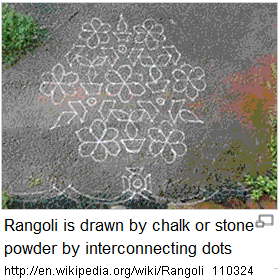
 Rangoli
is a traditional decorative folk art of India. They are decorative designs on
floors of living rooms and courtyards during
Hindu festivals and are meant as sacred welcoming area for the
deities.[1]
The ancient symbols have been passed on through the ages, from each generation
to the one that followed, thus keeping both the art form and the tradition
alive. Rangoli and similar practices are followed in different Indian states; in
Tamil Nadu, one has Kolam
[2], Madanae in Rajasthan, Chowkpurna in
Northern India, Alpana in Bengal, in Bihar it is called Aripana, and so on. The
purpose of Rangoli is decoration and it is thought to bring good luck.
Design-depictions may also vary as they reflect traditions, folklore and
practices that are unique to each area. It is traditionally done by women. Over
the years, tradition has even made room for modern additions, that add some
flair to this beautiful art. Generally, this practice is showcased during
occasions such as festivals, auspicious observances, celebrations of marriages
and other similar milestones and gatherings. Rangoli designs can be as simple as
geometric shapes, deity impressions, flower and petal shapes that are
appropriate to the given celebrations, but can become very elaborate with many
people coming together to work on the designs. The base material is usually dry
or wet granulated rice or dry flour, to which
Sindoor (vermillion),
Haldi (tumeric)
and other natural colours can be added. Chemical colours are a modern variation.
Other materials that are now used are coloured sand and even flowers and petals
as in the case of Flower Rangolis.
Rangoli
is a traditional decorative folk art of India. They are decorative designs on
floors of living rooms and courtyards during
Hindu festivals and are meant as sacred welcoming area for the
deities.[1]
The ancient symbols have been passed on through the ages, from each generation
to the one that followed, thus keeping both the art form and the tradition
alive. Rangoli and similar practices are followed in different Indian states; in
Tamil Nadu, one has Kolam
[2], Madanae in Rajasthan, Chowkpurna in
Northern India, Alpana in Bengal, in Bihar it is called Aripana, and so on. The
purpose of Rangoli is decoration and it is thought to bring good luck.
Design-depictions may also vary as they reflect traditions, folklore and
practices that are unique to each area. It is traditionally done by women. Over
the years, tradition has even made room for modern additions, that add some
flair to this beautiful art. Generally, this practice is showcased during
occasions such as festivals, auspicious observances, celebrations of marriages
and other similar milestones and gatherings. Rangoli designs can be as simple as
geometric shapes, deity impressions, flower and petal shapes that are
appropriate to the given celebrations, but can become very elaborate with many
people coming together to work on the designs. The base material is usually dry
or wet granulated rice or dry flour, to which
Sindoor (vermillion),
Haldi (tumeric)
and other natural colours can be added. Chemical colours are a modern variation.
Other materials that are now used are coloured sand and even flowers and petals
as in the case of Flower Rangolis.
UKT: Were the Buddha footprints a form of rangoli to mark the place where
the Gautama Buddha had visited? - UKT110324
History
Alpana is one name of rangoli. Mohen-jo-daro and Harappa also had Alpana.
Vatsyayan Alpana's work - the formula is described in Chausst arts (The most
ancient folk art). The word 'Alpana' is derived from the Sanskrit 'Oalanpeen' ;
Oalanpeen means to plaster. In ancient times people believed that these funds
artistic painting the town and villages - are able to contain cereal is full of
magical effects and reserve assets. This approach was Alpana art practiced on
religious and social occasions. Many fast or worship, which is given the Alpana,
Aryan is the era before. Swami Anand Kumar, who are called scholars of Indian
art, modern folk art of Bengal's view that the direct link is from 5000 years
ago the art of Mohen-jo-daro. Waratchari movement and Bangla folk art and
culture scholar Gurushay generator according to Dutt, the lotus flower Bengali
women make between their Alpanooan, at Mohenjo-daro of the lotus flower is a
replica. Some other scholars are of the opinion that Alpana Astrik people in our
culture, such as shaved species come from, which in this country many years
before the arrival of Aryans were living. According to the ancient and
traditional folk arts of Bangladesh's agricultural era standing. At that time
some people believe that gods and had some magical effects, which in practice
would have been a good harvest and Priatatmaaey had run away.[2] of Alpana
Inspired by these traditional Aleknoan Acharya Awneendranath Tagore Santiniketan
art building with other subjects of painting - this art also made a compulsory
subject. Today this art are known as Alpana of Santiniketan. The blonde goddess
in art will enjoy the memorable name of the mother are considered Alpana
Santiniketan
UKT: More in Wikipedia article.


Go back rangoli-note-b
Contents of this page
End of TIL file