p158.htm
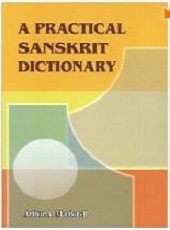
• A Practical Sanskrikt Dictionary,
by A. A. Macdonell, 1893,
http://www.sanskrit-lexicon.uni-koeln.de/scans/MDScan/index.php?sfx=jpg;
1929.
-
Nataraj ed., 1st in 2006, 2012.
-
https://dsal.uchicago.edu/dictionaries/macdonell/ 190516
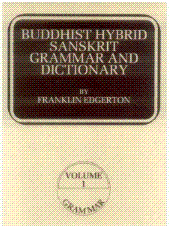
• The Buddhist Hybrid Sanskrit Grammar and
Dictionary, BHS, vol.2, by F. Edgerton,
pp. 627.
-
FEdgerton-BHSD<Ô> /
Bkp<Ô> (link chk 180627)
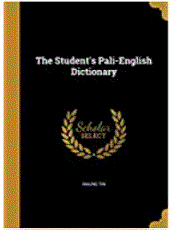
• The Student's Pali English dictionary ,
by U Pe Maung Tin, 1920.
- (ref: UPMT-PEDxxx).
Downloaded copies in TIL
HD-PDF and SD-PDF libraries:
-
UPMT-PaliDict1920<Ô> /
bkp<Ô> (link chk 190113)
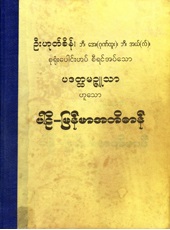
• Pali-Myanmar Dictionary
(in Pal-Myan), by U Hoke Sein,
- (ref: UHS-PMD). The dictionary in printed form is in TIL Research Library.
• Latin-English Vocabulary II, by Hans H Ørberg, 1998
-
HHOrberg-LinguaLatina<Ô> /
Bkp<Ô> (link
chk 190624)
Edited by U Kyaw Tun (UKT) (M.S., I.P.S.T., USA),
Daw Khin Wutyi, Daw Thuzar Myint, Daw Zinthiri Han
and staff of Tun Institute of Learning (TIL).
Not for sale. No copyright. Free for everyone.
Prepared for students and staff of TIL
Research Station, Yangon, MYANMAR
-
http://www.tuninst.net ,
www.romabama.blogspot.com
MC-indx.htm |
Top
MCpp-indx.htm
 {pa.la.}
p158-c1
 {pal}
{pal}
 {pa.wa.}
: How important is
{pa.wa.}
: How important is
 {pwa.}
in Skt-Dev?
{pwa.}
in Skt-Dev?
p158-c2
 {pa.sha.}
: in Pal-Myan, the
{pa.sha.}
(sibilant) are changed into
{pa.sha.}
: in Pal-Myan, the
{pa.sha.}
(sibilant) are changed into
 {pa.þa.}
(thibilant)
{pa.þa.}
(thibilant)
p158-c3
{pa.þa.}
 {pa}
{pa}
UKT notes :
• Vowels checked by killed approximants
 {pa.la.}
p158c1-b00/ p095
• पलिक्नी
palikni [ páliknî ]
= प ल ि क ् न ी
--> (प) (ल ि क ्) (न ी) -->
 {pa.laik-ni}
-- a. f. (of palitá) grey.
पलिक्नी páliknî
palitá) grey.
p158c1-b01/ p095
• पलित
palita [ palitá ]
-- a. grey, hoary; n. sg. & pl. grey hair:
-m-karana,
a. (î) making grey.
पलित palitá
grey, hoary; n. sg. & pl. grey hair: -m-karana, a. (î)
making grey.
{pal}
See my note on Vowels checked by killed approximants .
p158c1-b02/ p095
• पल्पूलन
palpulana [ pal-pûl-ana ]
= प ल ् प ू ल न -->
 {pal~pu.la.na.}
-- n. lye; alkaline water for washing.
पल्पूलन
pal-pûl-ana lye; alkaline water for washing.
p158c1-b03/ p095
• पल्पूलय
palpulaya [ palpûlá-ya ]
-- den. P. wash with alkaline water.
पल्पूलय
palpûlá-ya P. wash with alkaline water.
p158c1-b04/ p095
• पल्यङ्क
palyanka [ pali‿aṅka ]
-- m. couch; bedstead.
पल्यङ्क
pali̮aṅka couch; bedstead.
p158c1-b05/ p095
• पल्यङ्गय
palyangaya [ páli‿aṅgaya ]
-- cs. (√aṅg) Â. cause to go
round, stir; ps. revolve.
पल्यङ्गय
páli̮aṅgaya (√aṅg) Â. cause to go round, stir; ps. revolve.
p158c1-b06/ not online

• [pali‿aya]
-- Â. v. √i with pali
p158c1-b07/ p095
• पल्लव
pallava [ 1. pallava ]
= प ल ् ल व
-- den. P. put forth young shoots.
पल्लव 1. pallava
P. put forth young shoots.
p158c1-b08/ p095
• पल्लव pallava [ 2. pallava ]
-- m. n. sprout, shoot, twig (the term is
figuratively applied to fingers, toes, and
lips); strip of cloth, lappet: -ka,
m. libertine, i-kâ, f. N.; -grâhin,
a. over-spreading with shoots=diffuse, prolix;
-na, n. prolixity; -maya,
a. consisting of young shoots.
पल्लव 2. pallava
sprout, shoot, twig (the term is figuratively applied to
fingers, toes, and lips); strip of cloth, lappet: -ka, m.
libertine, i-kâ, f. N.; -grâhin, a. over-spreading with
shoots=diffuse, prolix; -na, n. prolixity; -maya, a.
consisting of young shoots.
p158c1-b09/ p095
• पल्लवय
pallavaya [ pallava-ya ]
-- den. P. put forth new shoots; extend, spread abroad:
vâkah --, talk diffusely: pp.
ita, furnished with shoots; far-spread; --°,
filled with, full of, abounding in.
पल्लवय
pallava-ya P. put forth new shoots; extend, spread abroad:
vâkah --, talk diffusely: pp. ita, furnished with shoots;
far-spread; --°, filled with, full of, abounding in.
p158c1-b10/ p095
• पल्लवापीडित
pallavapidita [ pallava‿âpîdita ]
-- pp. loaded with sprouts.
पल्लवापीडित
pallava̮âpîdita loaded with sprouts.
p158c1-b11/ p095
• पल्लविन्
pallavin [ pallav-in ]
-- a. having young shoots.
पल्लविन्
pallav-in having young shoots.
p158c1-b12/ not online
• [palli-kâ]
-- f. = pallî
p158c1-b13/ p095
• पल्ली
palli [ pallî ]
-- f. small village, esp. settlement of wild tribes:
-pati, m. headman of --.
पल्ली pallî
small village, esp. settlement of wild tribes: -pati, m.
headman of --.
p158c1-b14/ p095
• पल्वल
palvala [ pal-va-la ]
-- n. small tank, pond, pool.
पल्वल pal-va-la
small tank, pond, pool.
{pa.wa.}
UKT 120709: How important is
p158c1-b15/ p095
• पवन pavana [ páv-ana ]
-- m. (purifier), wind, breeze, air; god of wind;
vital air; breath; domestic (sacred) fire;
n. instrument for purifying, winnowing-fan;
whisk; sieve, strainer; potter's kiln;
-kshipta, pp. tempest-tossed;
-gava, m. (swift as the wind),
N. of a horse; -tanaya, m. son of the wind,
ep. of Hanumat and of Bhîmasena;
-‿âghâta, m. gust of wind;
-‿âtmaga, m. son of the wind,
fire; ep. of Bhîmasena.
पवन páv-ana
(purifier), wind, breeze, air; god of wind; vital air;
breath; domestic (sacred) fire; n. instrument for purifying,
winnowing-fan; whisk; sieve, strainer; potter's kiln;
-kshipta, pp. tempest-tossed; -gava, m. (swift as the wind),
N. of a horse; -tanaya, m. son of the wind, ep. of Hanumat
and of Bhîmasena; -̮âghâta, m. gust of wind; -̮âtmaga, m.
son of the wind, fire; ep. of Bhîmasena.
p158c1-b16/ p095
• पवमान
pavamana [ páv-amâna ]
-- pr. pt. √pû; m. wind; god of wind;
N. of a certain Agni or of a son of Agni;
N. of certain stotras sung by the Sâmagas
at the Gyotishtoma sacrifice: -vat,
a. accompanied by the Pavamâna stotra;
-sakha, m. (friend of the wind), fire;
-‿uktha, n. series of verses
in the midday Pavamâna.
पवमान páv-amâna
√pû; m. wind; god of wind; N. of a certain Agni or of a son
of Agni; N. of certain stotras sung by the Sâmagas at the
Gyotishtoma sacrifice: -vat, a. accompanied by the Pavamâna
stotra; -sakha, m. (friend of the wind), fire; -̮uktha, n.
series of verses in the midday Pavamâna.
p158c1-b17/ p095
• पवि pavi [ pav-í ]
-- m. tire of a wheel; metal tip of a spear
or arrow; iron band on Soma-stone; thunderbolt.
पवि pav-í tire
of a wheel; metal tip of a spear or arrow; iron band on
Soma-stone; thunderbolt.
p158c1-b18/ p095
• पवित्र
pavitra [ pav-í-tra ]
-- n. means of purifying; sieve, (Soma) strainer;
blade of sacrificial grass; purificatory text;
a. purifying, pure, beneficent; sanctified by (--°):
-ka, n. small sieve; (two) blades of
Kusa grass (--°, a.); vessel in which an honorific
gift is presented; -tarî kri,
purify or sanctify in a high degree; -tâ,
f., -tva, n. purity; -dhara, m. N.;
-pâni, a. holding blades of
Kusa grass in one's hand.
पवित्र pav-í-tra
means of purifying; sieve, (Soma) strainer; blade of
sacrificial grass; purificatory text; a. purifying, pure,
beneficent; sanctified by (--°): -ka, n. small sieve; (two)
blades of Kusa grass (--°, a.); vessel in which an honorific
gift is presented; -tarîkri, purify or sanctify in a high
degree; -tâ, f., -tva, n. purity; -dhara, m. N.; -pâni, a.
holding blades of Kusa grass in one's hand.
p158c1-b19/ p095
• पवित्रय
pavitraya [ pavitra-ya ]
-- den. P. purify, cleanse: pp. ita,
purified, sanctified, blessed.
पवित्रय
pavitra-ya P. purify, cleanse: pp. ita, purified,
sanctified, blessed.
p158c1-b20/ p095
• पवित्रवत्
pavitravat [ pavítra-vat ]
-- a. possessed of a means of purification,
a strainer or blades of Kusa grass;
purifying, cleansing.
पवित्रवत्
pavítra-vat possessed of a means of purification, a strainer
or blades of Kusa grass; purifying, cleansing.
p158c1-b21/ p095
• पवित्रारोपण
pavitraropana [ pavitra‿âropana ]
-- n. investiture of Krishna's effigy with
the sacred cord, a certain festival;
-‿ârohana, n. id.
पवित्रारोपण
pavitra̮âropana investiture of Krishna's effigy with
the sacred cord, a certain festival; -̮ârohana, n. id.
p158c1-b22/ p095
• पवित्रिन्
pavitrin [ pavitr-in ]
-- a. purifying; pure.
पवित्रिन्
pavitr-in purifying; pure.
p158c2-b00/ not online

• [pavitrî-kri]
-- purify; -bhû , become pure
{pa.sha.}
p158c2-b01/ not online

• [PAS]
-- only pr. st., pásya [पश्य
= प श ् य], see, possess vision;
behold, look at; observe, notice;
gaze, be a spectator, look on (tasya pasyatah ), g. abs.
before his eyes); see visit, present oneself to or receive (as a visitor); live
to see, experience, gain (fortune); find; look upon or regard as (2 ac; or 1
and ad. in -vat); consider, weigh; see with the spiritual eye (of seers and
poets), compose, invent (rites); foresee, with na, not see, be bind; ± sâdhu,
have discernment; payâmi, used parenthetically. I see I am convinced; paya, impv.
see , behold, used interjectionally at the beginning or in the middle of a
sentence to arouse attention; it is also employed in prase works to introduce a
verse. ati, survey. ann, look along; see, behold; apy out, discover; see again;
look back; regard as (2 ac.); consider. antar, look between or into. abhi, look
at observe, behold. ava, look upon, observe. a, behold. ud, see above; foresee,
expect; perceive. parâ, look away or into the distance. pari, survey, observe,
inspect; perceive; recognise as (2 ac). pra, see before one; foresee; look at,
observe, behold; distcern, judge; knoe; regard as (2ac.) prati, look at, behold;
perceive; know; live to see, experiecnce. vi, (see in detail), discern,
distinguish, see clearly, know; observe, perceive. sam, see at the same
time, survery; behold, perceive, recognise; inspect, review; regard, consider;
look upon as (2 ac.); count over or up, recapitulate; yasya sampasyatah,
before whose eyes.
p158c2-b02/ not online

• [PAS]
-- v. PÂSAYA , bind
p158c2-b03/ p095
• पशव्य
pasavya [ pasav-yã ]
-- a. relating to or fit for cattle.
पशव्य pasav-yã
relating to or fit for cattle.
p158c2-b04/ p095
• पशु pasu [ pás-u (or-ú) ]
-- m. [tethered beast], cattle (single head or herd); domestic animal
(including cows, horses, goats, sheep, asses, and dogs: opp.
mriga, wild beast); beast, brute; sacrificial animal, victim:
-kalpa, m. ritual of the animal sacrifice; (ú)-kâma,
a. desiring cattle; -ghna, a. killing animals; m.
cattle-slayer; -tâ, f., -tva, n. condition of being
a sacrificial animal; condition of cattle; bestiality;
-trip, a. cattle-stealing; -dharma, m.
manner of beasts or in which beasts are treated; -páti,
m. lord of beasts, ep. of Siva; -pâla, m. guardian
of flocks, herds man (also: -ka): -vat, ad. after the
manner of herdsmen; -pîdita, (pp.) n. damage
caused by cattle; -bandhá, m. (binding of victim to
sacrificial post), animal sacrifice; -mát, a. connected with
or abounding in cattle; containing the word
&open;pasu;&close; -rakshin, m. tender of cattle,
herdsman; -roman, n. hair of an animal; -vat, ad.
like the brutes; as with cattle; -vadha, m. slaughter of animals;
-sam âmnâya, m. enumeration of the sacrificial animals in the
Asvamedha: i-ka, a. mentioned in the Samâmnâya; -han,
a. (ghnî) killing beasts; -havya, n. animal
sacrifice.
पशु pás-u
(or-ú) [tethered beast], cattle (single head or
herd); domestic animal (including cows, horses, goats,
sheep, asses, and dogs: opp. mriga, wild beast); beast,
brute; sacrificial animal, victim: -kalpa, m. ritual of the
animal sacrifice; (ú)-kâma, a. desiring cattle; -ghna, a.
killing animals; m. cattle-slayer; -tâ, f., -tva, n.
condition of being a sacrificial animal; condition of
cattle; bestiality; -trip, a. cattle-stealing; -dharma, m.
manner of beasts or in which beasts are treated; -páti, m.
lord of beasts, ep. of Siva; -pâla, m. guardian of flocks,
herdsman (also: -ka): -vat, ad. after the manner of
herdsmen; -pîdita, (pp.) n. damage caused by cattle;
-bandhá, m. (binding of victim to sacrificial post), animal
sacrifice; -mát, a. connected with or abounding in cattle;
containing the word ʻpasu;ʼ -rakshin, m. tender of cattle,
herdsman; -roman, n. hair of an animal; -vat, ad. like the
brutes; as with cattle; -vadha, m. slaughter of animals;
-samâmnâya, m. enumeration of the sacrificial animals in the
Asvamedha: i-ka, a. mentioned in the Samâmnâya; -han, a.
(ghnî) killing beasts; -havya, n. animal sacrifice.
p158c2-b05/ not online

• [pasû-kri]
-- turn into an ox or a sacrificial beast
p158c2-b06/ not online

• पश्च pasca [ *pas-ká ] a. hinder; later.
p158c2-b07/ not online

• पश्चा
pasca [ pas-kấ ]
-- (in.) ad. (V.) behind, after; in the west; afterwards.
p158c2-b08/ not online

• पश्चात्
pascat [ paskất ]
-- (ab.) ad. behind, in the rear, after; backwards; from or in the west;
west wards; afterwards, hereafter, subsequently (sts. pleonastically with a
gd.); -kri, leave behind, surpass; place on the back or
despise; prp. with ab. and g. after; to the west of; tatah
paskât, after that, thereupon.
p158c2-b09/ not online

• पश्चात्ताप pascattapa [ paskât-tâpa ]
-- m. repentance, re- (p158c2end-p158c3begin)
morse; -tâpin, a. repenting; -puro-mâruta,
m. du. west and east wind; (d)-baddha-pu rusha, m. man
whose hands are tied behind his back; -bâhu-baddha, pp. id.;
(d)-bhâga, m. hind part.
p158c3-b01/ not online

• पश्चार्ध pascardha [
paska‿ardhá ]
-- m. hind portion; western side.
p158c3-b02/ not online

• पश्चिम
pascima [ pask-ima ]
-- a. hinder; western; last, latest, final:
-m darsanam drashtum,
see for the last time; â velâ,
f. evening time, close of day; â samdhyâ,
f. evening twilight; â, f. (sc. dis) west.
p158c3-b03/ not online

• पश्चिमाचल
pascimacala [ paskima‿akala ]
-- m. Western Mountain (a fabulous
mountain behind which the sun is supposed to set: cp.
asta‿akala); -‿ambu dhi, m. western
ocean; -‿itara, a. (opposite of west), eastern;
-‿uttara, a. north-western: -pûrva, a.
western, northern, or eastern.
p158c3-b04/ p095
• पस्त्य
pastya [ pastyã ]
-- n. stall; â, f. pl. homestead,
dwelling, household.
पस्त्य pastyã
stall; â, f. pl. homestead, dwelling, household.
p158c3-b05/ p095
• पल्हव
palhava [ pahlava ]
= प ल ् ह व
-- m. pl. the Parthians or Persians.
पल्हव pahlava
the Parthians or Persians.
{pa.þa.}
Though
{þa.} is an approximant it is not a medial former. It shares a property with plosive-stops in having a voiced form. The ordinary form is voiceless. -- UKT120709
We should expect to find
{pa.þa.}
entries. But we don't.
Referring to Monier-Williams brought up a few entries, the first under
[Page 612, Column 3] being:
¤ pas
pas cl. 1. P. Ā. pasati, ○te (vḷ. for
spaś Dhātup. xxi, 22)
• cl. 10. P. pāsayati, to bind (v. l. for paś, xxxiii,
45)
 {pa}
{pa}
{pa.} ,
{pa:}
p158c3-b06/ not online

• [1. PÂ], II. P.
-- p (V.), I. P. (Â.) piba , drink, quaff; imbibe (ac; V. also
g.); suck, sip; swallow; draw in; feast one's eyes or ears (in.) with
(ac. ), enjoy; drink up (life, blood, said of a sword or arrow);
exhaust (treasure); carry away, absorb: pp. pîtá, drank, quaffed,
sucked, absorbed: drawn in (smoke); absorbed (by the ears); exhausted,
aquandered; act. having drunk (generally -°); steeped in oil (weapon);
pita-vat, pp. act. having drunk cs. pâyáya, P. Â. cause to
drink; des. pipâsa, P. wish to drink, be thirsty: pp. pipâsita,
thirsty; intv. pepîya, Â. drink or be drunk eagerly or repeatedly.
ati, cs. cause to drink plenty of (2 ac.). anu, suck; imbibe with eyes or
ears (in.); absorb, cause to disappear. sam- â , imbibe. ni, imbibe, sip
in, suck. vi-ni, imbibe eagerly. nis, (nish), drink out of (ab);
drink or suck up. pari, drink before and after any one (ac.); drink or
suck up; smoke up; deprive of: pp. throughly studied. pra, begin to
drink; drink, imbibe. anu-pra, P. drink in turn; A drink after any one
(ac.). vi, drink copiously. sam, Â. . drink together. ...
p158c3-b07/ not online

• [2. PÂ] II. P.
-- pấ-ti , guard, preserve, protect,
from (ab.); govern, reign; observe, notice; regard, keep, follow. abhi,
guard, watch over; observe, ni, guard, watch over; protect from (ab.);
observe. pari, protect around, preserve; maintain, keep. ...
p158c3-b08/ not online

• [3. PÂ] III. Â.
-- pípîte , w. (?) ud ,
rise against, show hostility towards. ann⌣ud, fall or rush
upon(ac.). prati⌣ud, rise against (ac.)
p158c3-b09/ p095
• पा pa [ pâ ]
-- a. (only --°) 1. drinking; 2. guarding, protecting.
पा pâ --°) 1.
drinking; 2. guarding, protecting.
p158c3-b10/ p095
• पांशन
paṃsana [ pâms-ana ]
-- a. (î) defiling, disgracing (-°).
पांशन pâms-ana
(î) defiling, disgracing (-°).
p158c3-b11/ p095
• पांसु
paṃsu [ pâmsú ]
-- m. particle of dust, grain of sand:
gnly. pl. dust, sand.
पांसु pâmsú
particle of dust, grain of sand: gnly. pl. dust, sand.
p158c3-b12/ p095
• पांसुक
paṃsuka [ pâmsu-ka ]
-- m. pl. dust, sand; -lá,
a. dusty, dust-stained; sandy; defiled,
tainted; --°, disgracing: â,
f. dissolute woman, concubine.
पांसुक pâmsu-ka
dust, sand; -lá, a. dusty, dust-stained; sandy; defiled,
tainted; --°, disgracing: â, f. dissolute woman, concubine.
p158c3-b13/ p095
• पांसुक्रीडन
paṃsukridana [ pâmsu-krîdana ]
-- n. playing in the sand;
-krîdâ, f. id.; -gunthita,
pp. covered with dust; -dhvasta-siroruha, a.
whose hair is covered i. e. sullied with dust; -varsha, m.
n. shower of dust; -samkaya, m. heap of sand;
-samûhana, a. whirling up dust; -hara, a. id.
पांसुक्रीडन pâmsu-krîdana
playing in the sand; -krîdâ, f. id.; -gunthita, pp. covered
with dust; -dhvasta-siroruha, a. whose hair is covered i. e.
sullied with dust; -varsha, m. n. shower of dust; -samkaya,
m. heap of sand; -samûhana, a. whirling up dust; -hara, a.
id.
 {pa-ka.}
• पाक
paka [ 1. pấk-a ] ( p159c1-top )
-- ¹ a. [in process of ripening, immature:
√pak; or pâ-ka,
sucking], quite
( p158c3 end )
young; simple, ignorant, honest; m. young of
an animal.
पाक 1. paNk-a
[in process of ripening, immature: √pak; or pâ-ka, sucking],
quite young; simple, ignorant, honest; m. young of an
animal.
UKT:
p158c3-b14
moved to next file.
Below is the original navigation of Mac-Chicago, and will not work unless you are online.
If you are just a user, use Windows navigation.<Previous Page [157] <Page 158> Next Page [159]>
See this page in simple ASCII
Back to the Search Page | Back to the DDSA PageThe entries were given not only in HTML (which is very misleading) but also in simple ASCII which can be easily related to IAST . I am removing the so-called HTML which were in [...] and substituting simple ASCII.
-- UKT 120707
In Skt-Dev transcriptions derived from transliteration, it appears that the idea of checking the nuclear vowel with killed consonants is not prevalent. Thus,
• दत् dat [ dát ]
= द त ्
-- m. [(a)d-at, pr. pt. eater] tooth (nm. dan): --° a. f. -î.Note the virama (which I usually shorten to "viram") which shows that preceding consonant has it's intrinsic vowel killed. Of course, since the idea of an intrinsic vowel is absent in the alphabetic system of English, it is not taken into consideration in the transliteration which is used as a transcription. Here, द «da»/
{da.} still retains its intrinsic vowel form as «a».
In Romabama, which has become a transcription, if we were to allow the nuclear
vowel of the syllable
 {dût} to remain as it was as «a», the pronunciation sounded like
/
{dût} to remain as it was as «a», the pronunciation sounded like
/ {dakt}/, i.e.
 {dak} followed by a killed
 {t} as an afterthought.
I have noticed it for a long time trying to transcribe the common English
word C-A-T or <cat> /kæt/. (See DJPD16-086 for the transcription.). If we
transcribe it as
 {kût}
the pronunciation is actually /kʌt/ instead of /kæt/. Because of this I
have to change the Romabama transcription to {û} from {a}.
{kût}
the pronunciation is actually /kʌt/ instead of /kæt/. Because of this I
have to change the Romabama transcription to {û} from {a}.
When the checking killed consonant is actually a medial former which we
have described as an approximant, the problem becomes more complex. Firstly,
Skt-Dev does not seem to have the idea of medial formers as we do have in
Bur-Myan as evidenced from instances such as its preference to form repha
पर् «par»
 {par} instead of प्र «pra» {pra.} . The problem lies on
Skt-Dev र «ra» being a trill consonant /r/ which is different from Bur-Myan {ra.}
being an approximant /ɹ/. We find this difference in the two dialects of
English: the American English (General American - GA) with /r/ and the British
English (Received Pronunciation - RP) with /ɹ/.
{par} instead of प्र «pra» {pra.} . The problem lies on
Skt-Dev र «ra» being a trill consonant /r/ which is different from Bur-Myan {ra.}
being an approximant /ɹ/. We find this difference in the two dialects of
English: the American English (General American - GA) with /r/ and the British
English (Received Pronunciation - RP) with /ɹ/.
The four medial formers under consideration at present are: {ya.}, {ra.},
{la.}, {wa.} . When the intrinsic vowel of
{pa.} is
checked by these medial formers we get:
Skt-Myan:
{pèý} पय् ;
{pwa.} प्व (?)
In regular Bur-Myan,
{par} is unknown, and we get the medials
Bur-Myan:
{pya.} प्य ;
{pra.} प्र ;
{pla.} प्ल ;
To get a syllable similar to Bur-Myan
{pra.}, Skt-Dev uses a highly rhotic vowel
ऋ to give पृ which
is written in Romabama as
 {pRa.} .
Go back vow-check-approx-note-b
End of TIL file