p132.htm
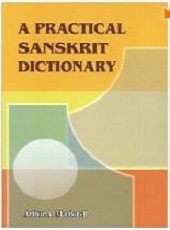
• A Practical Sanskrikt Dictionary,
by A. A. Macdonell, 1893,
http://www.sanskrit-lexicon.uni-koeln.de/scans/MDScan/index.php?sfx=jpg;
1929.
-
Nataraj ed., 1st in 2006, 2012.
-
https://dsal.uchicago.edu/dictionaries/macdonell/ 190516
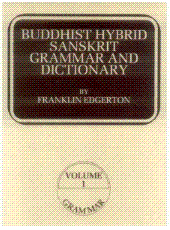
• The Buddhist Hybrid Sanskrit Grammar and
Dictionary, BHS, vol.2, by F. Edgerton,
pp. 627.
-
FEdgerton-BHSD<Ô> /
Bkp<Ô> (link chk 180627)
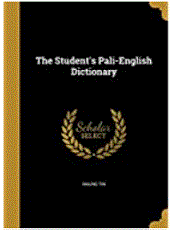
• The Student's Pali English dictionary ,
by U Pe Maung Tin, 1920.
- (ref: UPMT-PEDxxx).
Downloaded copies in TIL
HD-PDF and SD-PDF libraries:
-
UPMT-PaliDict1920<Ô> /
bkp<Ô> (link chk 190113)
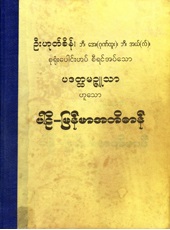
• Pali-Myanmar Dictionary
(in Pal-Myan), by U Hoke Sein,
- (ref: UHS-PMD). The dictionary in printed form is in TIL Research Library.
• Latin-English Vocabulary II, by Hans H Ørberg, 1998
-
HHOrberg-LinguaLatina<Ô> /
Bkp<Ô> (link
chk 190624)
Edited by U Kyaw Tun (UKT) (M.S., I.P.S.T., USA),
Daw Khin Wutyi, Daw Thuzar Myint, Daw Zinthiri Han
and staff of Tun Institute of Learning (TIL).
Not for sale. No copyright. Free for everyone.
Prepared for students and staff of TIL
Research Station, Yangon, MYANMAR
-
http://www.tuninst.net ,
www.romabama.blogspot.com
MC-indx.htm |
Top
MCpp-indx.htm
 {Da}
{Da}
p132-c1
 {Da-tu.}
 {Da-tRi.}
 {Da-na.}
: cf.
{Da-na.}
: cf.  {da-na.} दान
p132-c2
 {Da-ma.}
 {Da-ya.}
 {Da-ra.}
 {Da-ra}
p132-c3
 {Da-ri.}
 {Daar}
 {Da-wa.}
 {Di.}
{Di.}
Orphan: धार्ष्ट्य dhârsht-ya boldness, impudence.
UKT notes :
• Agnimitra
• Dhatri - the caregiver •
Dhavaka - the author •
Horse-gait • Nauclea cordifolia
 {Da}
{Da}
UKT: p132c1-top has been moved backward
to previous file - p131-2.htm
p132c1-b01/ p086
• धा dha [ 2. DHÂ ]
-- ² v.
धा 2. DHÂ DHE.
p132c1-b02/ not online
• धा dha [ 3. dhâ ]
-- ³ a. --° , placing
etc.; giving, granting (v. √1. dhâ).
p132c1-b03/ p086
• धाटी dhati [ dhâtî ]
-- f. sudden attack, surprise.
धाटी dhâtî
sudden attack, surprise.
{Da-tu.}
p132c1-b04/ p086
• धातु dhatu [ 1. dhâ-tu ]
-- ¹ m. layer; component part (--° a.); element
(five are assumed: ether, air, fire, earth, water);
elementary constituent of the body (seven are assumed:
alimentary juice, blood, flesh, fat, bone, marrow, semen;
or five: ear, nose, mouth, heart, abdomen; or three=dosha:
wind, gall, phlegm); elementary constituent of
the earth or of mountains: ore, mineral, metal,
esp. red chalk; verbal element, verbal root or base.
धातु 1. dhâ-tu
layer; component part (--° a.); element (five are assumed:
ether, air, fire, earth, water); elementary constituent of
the body (seven are assumed: alimentary juice, blood, flesh,
fat, bone, marrow, semen; or five: ear, nose, mouth, heart,
abdomen; or three=dosha: wind, gall, phlegm); elementary
constituent of the earth or of mountains: ore, mineral,
metal, esp. red chalk; verbal element, verbal root or base.
p132c1-b05/ p086
• धातु dhatu [ 2. dhấ-tu ]
-- ² a. suitable for sucking.
धातु 2. dhaN-tu
suitable for sucking.
p132c1-b06/ p086
• धातुकुशल
dhatukusala [ dhâtu-kusala ]
-- a. skilled in metallurgy; -kriyâ, f. metallurgy; -garbha-kum
bha, m. ash-pot; -ghoshâ, f. T. of a work on verbal
roots; -kûrna, n. mineral powder;
-pâtha, m. list of verbal roots (ascribed to
Pânini); -mat, a. containing elements; abounding in
minerals: -tâ, f. richness in minerals; -maya,
a. (î) consisting of or a bounding in metals or minerals;
-vâda, m. art of assaying, metallurgy; alchemy; -vâd in,
m. assayer; -visha, n. mineral poison;
-vritti, f. (Sâyana's) commentary on the
verbal roots.
धातुकुशल
dhâtu-kusala skilled in metallurgy; -kriyâ, f.
metallurgy; -garbha-kumbha, m. ash-pot; -ghoshâ, f. T. of a
work on verbal roots; -kûrna, n. mineral powder; -pâtha, m.
list of verbal roots (ascribed to Pânini); -mat, a.
containing elements; abounding in minerals: -tâ, f. richness
in minerals; -maya, a. (î) consisting of or abounding in
metals or minerals; -vâda, m. art of assaying, metallurgy;
alchemy; -vâdin, m. assayer; -visha, n. mineral poison;
-vritti, f. (Sâyana's) commentary on the verbal roots.
{Da-tRi.}
p132c1-b07/ not online

• धातृ [dhâ-tri]
{Da-tRi.}
-- m. supporter, establisher; preserver; originator, creator; C.; Creator of the
world (= Brahma); Fate; ...
p132c1-b08/ p086
•
धात्र
dhatra [ dhâ-trá ]
 {Da-tra.}
= ध ा त ् र
-- a. relating to Dhâtri.
धात्र dhâ-trá
relating to Dhâtri.
See my note on Dhatri - the caregiver
p132c1-b09/ p086
• धात्री
dhatri [ dhâ-trî ]
 {Da-tri}
= ध ा त ् र ी
-- f. nurse; midwife; waiting woman; mother; earth.
धात्री dhâ-trî
nurse; midwife; waitingwoman; mother; earth.
p132c1-b10/ p086
• धात्रेयिका
dhatreyika [ dhâtrey-ikâ ]
= (ध ा) (त ् र े) (य ि) (क ा)
 {Da-tré-yi.ka}
-- f. foster-sister; -î, f. id.
धात्रेयिका
dhâtrey-ikâ foster-sister; -î, f. id.
p132c1-b11/ p086
• धात्वाकर dhatvakara [ dhâtu‿âkara ]
-- m. mineral mine.
धात्वाकर
dhâtu̮âkara mineral mine.
{Da-na.}
Compare this word to
p132c1-b12/ p086
• धान dhana [ dhâ‿ana ]
-- a. --° , containing; n. receptacle; abode, seat; î, f. id.
धान dhâ̮ana --°,
containing; n. receptacle; abode, seat; î, f. id.
p132c1-b13/ p086
• धानक dhanaka [ dhâna-ka ]
-- m. a coin (=4 kârshâ panas); n. coriander.
धानक dhâna-ka
(=4 kârshâpanas); n. coriander.
p132c1-b14/ p086
• धाना dhana [ dhânấ ]
-- f. pl. grain.
धाना dhânaN
grain.
p132c1-b15/ p086
• धानुष्क
dhanuska [ dhânush-ka ]
-- a. armed with a bow; m. bowman.
धानुष्क dhânush-ka
armed with a bow; m. bowman.
p132c1-b16/ p086
• धान्य
dhanya [ dhânyã ]
= ध ा न ् य
-- a. cereal; n. (m.) sg. pl. corn, grain.
धान्य dhânyã
cereal; n. (m.) sg. pl. corn, grain.
p132c1-b17/ not online

• [dhânya-ka]
-- --° a. = dhânya ; m. N.; n. corinder; ...
p132c1-b18/ p086
• धान्यांश
dhanyaṃsa [ *dhânya‿amsa ]
-- m. grain of corn; -‿adá,
a. grain-eating; -‿amla, n. sour rice gruel;
-‿argha, m. price of corn.
धान्यांश
dhânya̮amsa grain of corn; -̮adá, a. grain-eating; -̮amla,
n. sour ricegruel; -̮argha, m. price of corn.
p132c1-b19/ p086
• धान्व dhanva [ dhânvá ]
-- m. pat. of Asita, chief of the Asuras.
धान्व dhânvá
Asita, chief of the Asuras.
p132c1-b20/ p086
• धान्वन
dhanvana [ dhânvan-a ]
-- a. situated in a desert.
धान्वन dhânvan-a
situated in a desert.
( end p132c1 )
{Da-ma.}
p132c2-b00/ not online

• धाम [dhâ-ma]
-- m. pl. kind of superhuman being
p132c2-b01/ p086
• धामच्छद् dhamacchad [ dhâma-kkhád ]
-- a. concealing his abode, ep. of an Agni and of a Vashatkâra.
धामच्छद् dhâma-kkhád
concealing his abode, ep. of an Agni and of a Vashatkâra.
p132c2-b02/ p086
• धामन् dhaman [ dhấ-man ]
-- n. fixed dwelling, abode, realm (of the gods);
esp. place of the sacred fire and of Soma; post
(also pl.); usage, law, order; power, majesty;
light, splendour (also pl.); priyam
dhấma, favourite abode, object; delight;
madhyamam dhâma vish- noh, middle
abode of Vishnu=sky.
धामन् dhaN-man
fixed dwelling, abode, realm (of the gods); esp. place of
the sacred fire and of Soma; post (also pl.); usage, law,
order; power, majesty; light, splendour (also pl.); priyam
dhaNma, favourite abode, object; delight; madhyamam dhâma
vish- noh, middle abode of Vishnu=sky.
p132c2-b03/ p086
• धामवत् dhamavat [ dhâma-vat ]
-- a. mighty, powerful.
धामवत् dhâma-vat
mighty, powerful.
p132c2-b04/ p086
• धामाधिप dhamadhipa [ dhâma‿adhipa ]
-- m. sun.
धामाधिप
dhâma̮adhipa sun.
{Da-ya.}
p132c2-b05/ p086
• धाय dhaya [ dhâya ]
-- m. layer.
धाय dhâya layer.
p132c2-b06/ p086
• धायस् dhayas [ dhấy-as ]
-- a. nourishing; n. only d. to sip or nourish.
धायस् dhaNy-as
nourishing; n. only d. to sip or nourish.
p132c2-b07/ p086
• धाय्या dhayya [ dhây-yâ ]
-- f. additional verse (in a litany).
धाय्या dhây-yâ
additional verse (in a litany).
{Da-ra.}
p132c2-b08/ p086
• धार dhara [ dhâr-a ]
-- a. holding, bearing, supporting (--° ): -ka, a. id. (--° ).
धार dhâr-a
holding, bearing, supporting (--°): -ka, a. id. (--°).
p132c2-b09/ p086
• धारण dharana [ dhâr-ana ]
-- a. (--° or g.) bearing, containing; possessing; preserving;
n. (dhấr-) bearing, holding; wearing; maintaining, preserving;
observance of (g.); mental retention; mental concentration, on
(lc.); possession; suppression; endurance: -ka, a.
containing (--° ); m. debtor.
धारण dhâr-ana
(--° or g.) bearing, containing; possessing; preserving; n.
(dhaNr-) bearing, holding; wearing; maintaining, preserving;
observance of (g.); mental retention; mental concentration,
on (lc.); possession; suppression; endurance: -ka, a.
containing (--°); m. debtor.
p132c2-b10/ p086
• धारणा
dharana [ dhâr-anâ ]
-- f. wearing (a dress); supporting, assistance; repression;
mental retention; memory; mental concentration,
suspension of the breath, immovable abstraction; settled rule; understanding.
धारणा dhâr-anâ
wearing (a dress); supporting, assistance; repression;
mental retention; memory; mental concentration, suspension
of the breath, immovable abstraction; settled rule;
understanding.
p132c2-b11/ p086
• धारणान्वित dharananvita [ dhârana‿anvita ]
-- pp. endowed with a good memory.
धारणान्वित dhârana̮anvita
endowed with a good memory.
p132c2-b12/ p086
• धारपूत dharaputa [ dhấra-pûta ]
-- pp. pure as a jet of water.
धारपूत
dhaNra-pûta pure as a jet of water.
p132c2-b13/ p086
• धारयत्
dharayat [ dhâr-ayat ]
-- pr. pt. cs. (√dhri) possessing; versed in; maintaining.
धारयत् dhâr-ayat
(√dhri) possessing; versed in; maintaining.
p132c2-b14/ p086
• धारयितव्य
dharayitavya [ dhâr-ay-i-tavya ]
-- fp. to be borne or held fast; to be regarded as
(in. of abst. N.).
धारयितव्य
dhâr-ay-i-tavya to be borne or held fast; to be regarded as
(in. of abst. n.).
p132c2-b15/ p086
• धारयिष्णुता
dharayisnuta [ dhâr-ay-ishnu-tâ ]
-- f. possession of a good memory.
धारयिष्णुता
dhâr-ay-ishnu-tâ possession of a good memory.
{Da-ra}
p132c2-b16/ p086
• धारा
dhara [ 1. dhấr-â ]
-- f. [√1. dhâv] torrent, stream; shower
(also of arrows, flowers); drop: pl. paces
of a horse (of which five kinds are assumed).
धारा 1. dhaNr-â
[√1. dhâv] torrent, stream; shower (also of arrows,
flowers); drop: pl. paces of a horse (of which five kinds
are assumed).
UKT 120428: I have never closely watched how a horse move. For those who are like me see my note on horse gait
p132c2-b17/ p086
• धारा dhara [ 2. dhấr-â ]
-- f. [√2. dhâv] edge, blade; circumference of a wheel.
धारा 2. dhaNr-â
[√2. dhâv] edge, blade; circumference of a wheel.
p132c2-b18/ p086
• धाराकदम्ब
dharakadamba [ dhârâ-kadamba ]
= (ध ा र ा क) (द म ् ब)

 {Da-ra-ka. dûm~ba.}
-- m. a plant ( Nauclea cordifolia );
-griha, n. shower-bath room;
-graha, m. cup filled from a stream of Soma.
धाराकदम्ब
dhârâ-kadamba shower-bath room; -graha, m. cup filled from a
stream of Soma.
UKT: I have 2 points to make in connection with this entry.
#1. The compound word is made up of 2 (or 3) words:
#2. Hinduism is strongly connected to Soma. What is this rejuvenating drink? Is it fermented juice from grapes, or toddy-palm? See my note on Nauclea cordifolia - a plant connected to Soma, or is it? Is the tree the same as Bur-Myan {ma.u ping}? If it is, it is probably the cup made of wood from this tree that is being referred to. I am waiting for input from my peers. -- UKT120428
p132c2-b19/ p086
• धाराराङ्कुर
dhararankura [ dhârâ‿aṅkura ]
-- m. hail.
धाराराङ्कुर
dhârâ̮aṅkura hail.
p132c2-b20/ p086
• धाराजल
dharajala [ dhârâ-gala ]
-- n. blood dripping from the blade
or edge (of a sword).
धाराजल dhârâ-gala
blood dripping from the blade or edge (of a sword).
p132c2-b21/ p086
• धाराञ्चल
dharancala [ dhârâ‿añkala ]
-- m. edge (of an instrument).
धाराञ्चल dhârâ̮añkala
edge (of an instrument).
p132c2-b22/ p086
• धाराधर
dharadhara [ dhârâ-dhara ]
-- m. cloud: -‿âgama, m. rainy season;
-‿atyaya, m. (departure of the clouds), autumn.
धाराधर
dhârâ-dhara cloud: -̮âgama, m. rainy season; -̮atyaya, m.
(departure of the clouds), autumn.
p132c2-b23/ p086
• धाराधिरूढ
dharadhirudha [ dhârâ‿adhirûdha ]
-- pp. standing on the very acme.
धाराधिरूढ
dhârâ̮adhirûdha standing on the very acme.
p132c2-b24/ p086
• धारानिपात
dharanipata [ dhârâ-nipâta ]
-- m. downpour of rain; -patha, m. range of a sword-blade:
-m prâpaya, put to the sword by any one (g.);
-pâta, m. pl. shower; -yantra, n. fountain:
-griha, n. shower-bath room; -vat, a.
edged; -varsha, m. n. pouring rain.
धारानिपात
dhârâ-nipâta downpour of rain; -patha, m. range of a
sword-blade: -m prâpaya, put to the sword by any one (g.); -pâta,
m. pl. shower; -yantra, n. fountain: -griha, n. shower-bath
room; -vat, a. edged; -varsha, m. n. pouring rain.
p132c2-b25/ p086
• धाराश्रु
dharasru [ dhârâ‿asru ]
-- n. flood of tears.
धाराश्रु dhârâ̮asru
flood of tears.
p132c2-b26/ p086
• धारासंपात
dharasampata [ dhârâ-sampâta ]
-- m. downpour of rain.
धारासंपात
dhârâ-sampâta downpour of rain.
( end p132c2 )
p132c3-b00/ p086
• धारासार
dharasara [ dhârâ‿âsâra ]
-- m. torrent of rain.
धारासार
dhârâ̮âsâra torrent of rain.
{Da-ri.}
p132c3-b01/ p086
• धारि dhari [ dhâr-i ]
-- a. bearing (--° ); m. cs. of √dhri (gr.).
धारि dhâr-i
bearing (--°); m. cs. of √dhri (gr.).
p132c3-b02/ p086
• धारिका
dharika [ dhâr-ikâ ]
-- f. support, pillar.
धारिका dhâr-ikâ
support, pillar.
p132c3-b03/ p086
• धारिन् dharin [ dhâr-in ]
-- a. (--° or g.) bearing; wearing; having, possessing;
keeping; maintaining; retaining, remembering; preserving, observing:
n-î, f. N. of Agnimitra's wife.
धारिन् dhâr-in
bearing; wearing; having, possessing; keeping; maintaining;
retaining, remembering; preserving, observing: n-î, f. N. of
Agnimitra's wife.
See my note on Agnimitra in Vishnu Purana, Bk 4, translated by H. H. Wilson , 1840. There are bound to be others by the name Agnimitra, but looking for a source before A. A. Macdonell's work, I found it in Vishnu Purana . -- UKT120428
{Daar}
p132c3-b04/ p086
• धार्तराष्ट्र
dhartarastra [ dhârta-râshtra ]
-- a. (î) belonging to Dhritarâshtra; m.
Dhritarâshtra's son, pat. of Duryodhana
(pl.=the Kurus); kind of goose.
धार्तराष्ट्र
dhârta-râshtra (î) belonging to Dhritarâshtra; m.
Dhritarâshtra's son, pat. of Duryodhana (pl.=the Kurus);
kind of goose.
p132c3-b05/ p086
• धार्मिक dharmika [ dhârm-ika ]
-- a. (î)
righteous, virtuous; set on or conformable to virtue; m.
devotionalist; magician (Pr.): -tâ, f., -tva,
n. justice, virtue.
धार्मिक
dhârm-ika (î) righteous, virtuous; set on or conformable to
virtue; m. devotionalist; magician (Pr.): -tâ, f., -tva, n.
justice, virtue.
p132c3-b06/ p086
• धार्य dharya [ dhâr-ya ]
-- fp. to be worn or borne; -kept, -retained;
-tolerated; -observed; inflicted (punishment); -directed
(mind) to (lc.); -kept in view; -checked.
धार्य dhâr-ya to
be worn or borne; -- kept, -- retained; -- tolerated; --
observed; inflicted (punishment); -- directed (mind) to (lc.);
-- kept in view; -- checked.
p132c3-b07/ p086
• धार्ष्ट्य dharstya [ dhârsht-ya ]
-- n. boldness, impudence.
{Da-wa.}
p132c3-b08/ not online
• [1. DHÂV] , I. P. (Â. rare)
-- ¹ dhấva , flow; run, -about, -up; -into, -after (ac.); -towards
(abhimukkam); rust at (ac.), ride at (prati); glide over (lc.); flee: pp. -ita
, running; frnite verb, began to run; es. dhâraya, P. cause to
run, urge on; drive (int.) with in, of vehicle and ac. of road; leap, dance,
anu, run after: pursue; stream through; spread over. upa, run away;
deviate from a previous statement, vary. abhi, flow -, hasten; towards;
rush at; run to help (ac.), give assistance. ava, drip down, a,
run or hasten to (ac.). upa, hasten to, take refuge with (ac.).
nis, rise from (ab.). pari, fow -, run about; run up; run round; - after
(ac.): mrigayâm -, pursue the chase, pra, flow forth: run away,
rush off, run; betake oneself to (ac.): pp. run away; cs. put to flight,
anu-pra, pursue. vi, disperse, sam, run together ; sush at; arrive
at a (ac).
p132c3-b09/ not online

• [2. DHÂV] , I.
-- ² dhấva , cleanse, rinse, wash, rub: pp. dhauta ,
cleansed, etc. : pure; washed away; polished, resplendent; cs. dhâvaya,
wash. nis. pp. nirdhauta, cleansed; washed away. pra, cs.
wash. vi, wash off: pp. cleansed. sam, Â. rub or
wash oneself.
p132c3-b10/ p086
• धावक dhavaka [ dhâv-aka ]
-- m. washerman; N. of an author.
धावक dhâv-aka
washerman; N. of an author.
See my note on Dhavaka, the author .
p132c3-b11/ p086
• धावन dhavana [ dhâv-ana ]
-- n. 1. running, galoping; attack; 2. washing; rubbing.
धावन dhâv-ana 1.
running, galoping; attack; 2. washing; rubbing.
p132c3-b12/ p086
• धावल्य dhavalya [ dhâval-ya ]
-- n. whiteness.
धावल्य dhâval-ya
whiteness.
p132c3-b13/ p086
• धाविन्
dhavin [ dhâv-in ]
-- a. 1. running (--° ); 2. washing (--° ).
धाविन् dhâv-in
1. running (--°); 2. washing (--°).
p132c3-b14/ not online
• [dhâ-sí] (V.)
-- 1. f. abode, home; 2. m. nourishment, comfort
{Di.}
p132c3-b15/ not online

• धि dhi [ 1. dhi ] V. P.
-- ¹ dhinoti , satisfy; gladden
p132c3-b16/ p086
• धि dhi [ 2. dhi ]
-- ² m. receptacle (only --° ).
धि 2. dhi
receptacle (only --°).
p132c3-b17/ p086
• धि dhi [ 3. dhi=adhi (in
dhi-shthita ]
-- ³ v. √sthâ).
धि 3. dhi=adhi (in
dhi-shthita √sthâ).
p132c3-b18/ p086
• धिक् dhik [ dhik ]
-- ij. of dissatisfaction, reproach, or lamentation; fie! woe!
with nm., vc., g., gnly. ac., sts. aho --, hâ
-(± kashtam), ha hâ dhik; dhig astu,
shame on --! fie on --! (ac. or g.); dhik kri,
reproach (ac.); ridicule, belittle.
धिक् dhik fie!
woe! with nm., vc., g., gnly. ac., sts. aho --, hâ -- (±
kashtam), hahâ dhik; dhig astu, shame on --! fie on --! (ac.
or g.); dhik kri, reproach (ac.); ridicule, belittle.
p132c3-b19p086
• धिक्कृत
dhikkrta [ dhik-krita ]
-- n. pl. disapprobation, reproaches.
धिक्कृत dhik-krita
disapprobation, reproaches.
p132c3-b20/ p086
• धिग्दण्ड
dhigdanda [ dhig-danda ]
-- m. reprimand.
धिग्दण्ड dhig-danda
reprimand.
p132c3-b21/ not online

• [dhig-vana]
-- m. a mixed caste
p132c3-b22/ p086
• धित dhita [ dhi-ta ]
-- pp. of √dhâ
and of √dhi.
धित dhi-ta √dhâ
and of √dhi.
From Sacred-texts.com : Vishnu Purana, Bk 4, translated by H. H. Wilson , 1840 :
http://merki.lv/vedas/Vishnu%20Purana%2004%20(eng).pdf - 120428
UKT: the following text contains words such as: • Magadha kingdom • Vidmisara • Ajatas'atru • Brahman Kautilya • Chandragupta • Vindusara • As'okavarddhana -- which are of interest to Buddhists.
Future kings of Magadha. Five princes of the line of Pradyota. Ten S'ais'unagas. Nine Nandas. Ten Mauryas. Ten S'ungas. Four Kanwas. Thirty Andhrabhrityas. Kings of various tribes and castes, and [ end p074. p075begin ] periods of their rule. Ascendancy of barbarians. Different races in different regions. Period of universal iniquity and decay. Coming of Vishnu as Kalki. Destruction of the wicked, and restoration of the practices of the Vedas. End of the Kali, and return of the Krita, age. Duration of the Kali. Verses chanted by Earth, and communicated by Asita to Janaka. End of the fourth book.
THE last of the Vrihadratha dynasty, Ripunjaya, will have a minister named Sunika [*1], who having killed his sovereign, will place his son Pradyota upon the throne [*2]: his son will be Palaka [*3]; his son will be Vis'akhayupa [*4]; his son will be Janaka [*5]; and his son will be Nandivarddhana [*6]. These five kings of the house of Pradyota will reign over the earth for a hundred and thirty-eight years [*7].
The next prince will be S'is'unaga [*8]; his son will be Kakavarna [*9]; his son will be Kshemadharman [*10]; his son will be Kshatraujas [*11]; his son will be Vidmisara [*12]; his son will be Ajatas'atru [*13]; his son will be Dharbaka [*14]; his son will be Udayas'wa [*15]; his son will also be Nandivarddhana; and his son will be Mahanandi [*16]. These ten S'ais'unagas will be kings of the earth for three hundred and sixty-two years [*17].
The son of Mahananda will be born of a woman of the S'udra or servile class; his name will be Nanda, called Mahapadma, for he will be exceedingly avaricious [*18]. Like another Paras'urama, he will be the annihilator of the Kshatriya race; for after him the kings of the earth will be S'udras. He will bring the whole earth under one umbrella: he will have eight sons, Sumalya and others, who will reign after Mahapadma; and he and his sons [*19] will govern for a hundred years. The Brahman Kautilya will root out the nine Nandas [*20]
Upon the cessation of the race of Nanda, the Mauryas will possess the earth, for Kantilya will place Chandragupta [*21] on the throne: his son will be Vindusara [*22]; his son will be As'okavarddhana [*23]; his son will be Suyas'as [*24]; his son will be Das'aratha; his son will be Sangata; his son will be S'alis'uka; his son will be Somas'armman; his son will be Sas'adharman [*25]; and his successor will be Vrihadratha. These are the ten Mauryas, who will reign over the earth for a hundred and thirty-seven years [*26].
The dynasty of the S'ungas will next become possessed of the sovereignty; for Pushpamitra, the general of the last Maurya prince, will put his master to death, and ascend the throne [*27]: his son will be Agnimitra [*28]; his son will be Sujyeshtha [*29]; his son will be Vasumitra [*30]; his son will be Ardraka [*31]; his son will be Pulindaka [*32]; his son will be Ghoshavasu [*33]; his son will be Vajramitra [*34]; his son will be Bhagavata [*35]; his son will be Devabhuti [*36]. These are the ten S'ungas, who will govern the kingdom for a hundred and twelve years [*37]. Devabhuti, the last S'unga prince, being addicted to, immoral indulgences, his minister, the Kanwa named Vasudeva will murder him, and usurp the kingdom: his son will be Bhumimitra; his son will be Narayana; his son will be Sus'arman. These four Kanwas will be kings of the earth for forty-five years [*38].
Sus'arman the Kanwa will be killed by a powerful servant named S'ipraka, of the Andhra tribe, who will become king, and found the Andhrabhritya dynasty [*39]: he will be succeeded by his brother Krishna [*40]; his son will be S'ri S'atakarni [*41]; his son will be Purnotsanga [*42]; his son will be S'atakarni (2nd) [*43]; his son will be Lambodara [*44]; his son will be Ivilaka [*45]; his son will be Meghaswati [*46]; his son will be Patumat [*47]; his son will be Arishtakarman [*48]; his son will be Hala [*49]; his son will be Talaka [*50]; his son will be Pravilasena [*51]; his son will be Sundara, named S'atakarni [*52]; his son will be Chakora S'atakarni [*53]; his son will be S'ivaswati [*54]; his son will be Gomatiputra [*55]; his son will be Pulimat [*56]; his son will be S'ivas'ri S'atakarni [*57]; his son will be S'ivaskandha [*58]; his son will be Yajnas'ri [*59]; his son will be Vijaya [*60]; his son will be Chandras'ri [*61]; his son will be Pulomarchish [*62]. These thirty Andhrabhritya kings will reign four hundred and fifty-six years [*63]. [ ]
Go back Agnimitra-note-b
by UKT - 120427
In the following entries we find a family of four sounds connected to the front close-vowels:
{Da-tré} धात्रे
This family of sounds can be viewed as a child's view of his world around
him. To him, the mother is the provider, the comforter, the beginning & end
of his world. This is denoted by the word
{Da-tRi.} धातृ .
[Notice the highly rhotic vowel.] Next in importance comes the nurse,
{Da-tri} धात्री , followed by
{Da-tré-yi.ka} the foster-sister. These three words are all connected
to the word
{Da-tra.} धात्र ,
the meaning of which is given as
"a. relating to Dhâtri". So what is "Dhâtri"?
We find it in "Devi Bhagavatam",
Chapter 5, "On the narrative of Hayagrîva" :
http://www.astrojyoti.com/devibhagavatam1-3.htm 120427
55. Thou art the vindu (m) over the Prânava (om) and thou art of the nature of semi-moon; Thou art Gâyattri, Thou art Vyârhiti; Thou art Jayâ, Vijayâ, Dhâtri (the supportress), Lajjâ (modesty), Kîrti (fame), Ichchâ (will) and Dayâ (mercy) in all beings.
56-57. O Mother! Thou art the merciful Mother of the three worlds; Thou art the adorable auspicious Vidyâ (knowledge) benefitting all the Lokas; Thou destroyest the Universe and Thou skilfully residest (hidden) in the Vîja mantras. Therefore we are praising Thee. O Mother! Brahmâ, Visnu, Mahes’vara, Indra, Sûrya, Fire, Sarasvatî and other Regents of the Universe are all Thy creation; so none of them is superior to Thee. Thou art the Mother of all the things, moving and non-moving.
58-61. O Mother ! When Thou dost will to create this visible Universe, Thou createst first Brahmâ, Visnu and Mahes’vara and makest them create, preserve and destroy this universe; but Thou remainest quite unattached to the world. Ever Thou remainest constant in Thy one form. No one in this Universe is able to know Thy nature; nor there is any body who can enumerate Thy names. How can he promise to jump across the illimitable ocean, who cannot jump across an ordinary well.
O Bhagavatî! No one amongst the Devas even knows particularly Thy endless power and glory. Thou art alone the Lady of the Universe and the Mother of the world.
We must also note that a young child has no idea of sex differentiation, nor gender in language. What are important to him is food and the food-provider especially the breast-feeder, and the comforter who gives him body-heat (or a cuddly teddy-bear for the Western child). The father is still a stranger to him. So the Datri is sexless, and could be a He, a She, or even It. I conjecture that this is the idea of a Universal Datri (neither a He, a She, nor It). If you look into the grammar of Bur-Myan, there is no gender. It is only to be found in English-Latin which was a real mental stumbling-block for me when I started to learn how to write (and speak) English correctly.
I wait for input from Sanskrit scholars, and others who know
more than me. -- UKT120427
Go back Datri-note-b
-- UKT 120428
Searching on the name "Dhavaka, the author" has brought up the name of a
king, Hasta, the patron of authors such as Dhavaka.
" A king of this name, [Hasta] , and a great patron of learned men,
reigned over Kashmir; he was the reputed author of several works, being,
however, only the patron, the compositions bearing his name being written by
Dhavaka and other authors. Raja Sekhar is the author of Prachanda Pandava,
Biddhasalvanjika, and Karpura Manjari. Murari composed Anargha Raghava." --
http://wordincontext.com/en/dhavaka 120428
Further search brought up:
"to earn fame like Kalidasa and money like Dhavaka" --
http://www.ebooksread.com/authors-eng/k-m-kavalam-madhava-panikkar/sri-harsha-of-kanauj-a-monograph-on-the-history-of-india-in-the-first-half-of-t-hci/page-5-sri-harsha-of-kanauj-a-monograph-on-the-history-of-india-in-the-first-half-of-t-hci.shtml
120428
One of the works attributed to him is Nagananda .
Go back Dhavaka-note-b

From Wikipedia: http://en.wikipedia.org/wiki/Horse_gait 120427
Horse gaits are the various ways in which a horse can move, either naturally or as a result of specialized training by humans.[1]
The animations below shows:
# walk - the 4 beat gait , # gallop , # pace - the 2 beat-gait


UKT: More in the Wikipedia article
Go back horse-gait-note-b
From: Flora of Thailand, Flora of Thailand, http://homepage.univie.ac.at/christian.puff/FTH-RUB/FTH-RUB-Haldina_compl_WEB.htm 120428
Haldina cordifolia (Roxb.) Ridsdale, Blumea 24: 361. 1978; Wong, Tree Fl. Mal. 4: 353. 1989.— Nauclea cordifolia Roxb., Pl. Corom. 11: 40 & t. 53. 1795; Kurz, For. Fl. Burm. 2: 66. 1877. — Adina cordifolia Hook. f. [in Benth. & Hook. f., Gen. Pl. 2: 31. 1873] ex Brandis, For. Fl. N.W. & C. India: 263 & t. 33. 1874; Hook. f., Fl. Br. Ind. 3: 24. 1880; Pitard, Fl. Gén. I.-C. 3(1): 38 & fig. 3:18-22. 1922; Craib, Fl. Siam. En. 2(1): 9. 1932.
From: Missouri Botanical Garden, http://www.theplantlist.org/tpl/record/kew-133153 120428
Nauclea cordifolia Roxb. is a synonym of Haldina cordifolia (Roxb.) Ridsdale .
The record derives from WCSP which reports it as a synonym (record 133153) with original publication details: Pl. Coromandel 1: 49 1796.
Full publication details for this name can be found in International Plant Names Index (IPNI): urn:lsid:ipni.org:names:757080-1.
From Wikipedia: http://en.wikipedia.org/wiki/Haldina 120428
Haldina cordifolia, syn. Adina cordifolia, also known as Kadam or Kadamba in Hindi, is a flowering plant in the family Rubiaceae, the sole species in the genus Haldina. It is native to southern Asia, from India and Sri Lanka east to southern China and Vietnam.
It is a deciduous tree that can grow well over 20 metres high. The flowers may be insignificant individually but can be seen as attractive when they bloom together in balls with a circumference of 2 to 3 cm. They are usually yellow in colour often tinged with a shade of pink. Kadam is at its blossoming best during winter. The bark of the tree acts as an antiseptic.
Go back N-cordifolia-note-b
End of TIL file