p105.htm
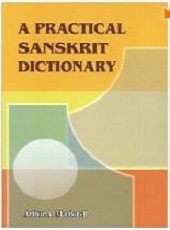
• A Practical Sanskrikt Dictionary,
by A. A. Macdonell, 1893,
http://www.sanskrit-lexicon.uni-koeln.de/scans/MDScan/index.php?sfx=jpg;
1929.
-
Nataraj ed., 1st in 2006, 2012.
-
https://dsal.uchicago.edu/dictionaries/macdonell/ 190516
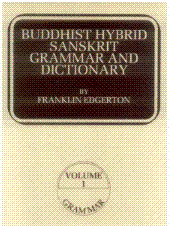
• The Buddhist Hybrid Sanskrit Grammar and
Dictionary, BHS, vol.2, by F. Edgerton,
pp. 627.
-
FEdgerton-BHSD<Ô> /
Bkp<Ô> (link chk 180627)
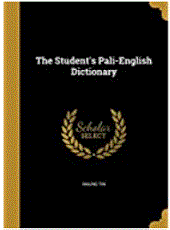
• The Student's Pali English dictionary ,
by U Pe Maung Tin, 1920.
- (ref: UPMT-PEDxxx).
Downloaded copies in TIL
HD-PDF and SD-PDF libraries:
-
UPMT-PaliDict1920<Ô> /
bkp<Ô> (link chk 190113)
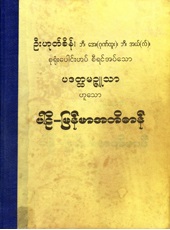
• Pali-Myanmar Dictionary
(in Pal-Myan), by U Hoke Sein,
- (ref: UHS-PMD). The dictionary in printed form is in TIL Research Library.
• Latin-English Vocabulary II, by Hans H Ørberg, 1998
-
HHOrberg-LinguaLatina<Ô> /
Bkp<Ô> (link
chk 190624)
Edited by U Kyaw Tun (UKT) (M.S., I.P.S.T., USA),
Daw Khin Wutyi, Daw Thuzar Myint, Daw Zinthiri Han
and staff of Tun Institute of Learning (TIL).
Not for sale. No copyright. Free for everyone.
Prepared for students and staff of TIL
Research Station, Yangon, MYANMAR
-
http://www.tuninst.net ,
www.romabama.blogspot.com
MC-indx.htm |
Top
MCpp-indx.htm
UKT 170815: This file was in progress when Ma Thuzar left. I had to pick up from where she left. It is now complete.
 {ta.}
{ta.}
p105c1
 {ta.ka.} /
 {tak}
{tak}
 {ta.kSa.}
: Pseudo-Kha
{ta.kSa.}
: Pseudo-Kha
UKT 180613: In transformation between BPal and Sanskrit, the Pseudo-Kha undergoes a special change when row#2 which is somewhat fricative, is involved:
{tic~hsa.} -->
This, I believe is due to Skt-Dev row#2 being Affricate, whereas Bur-Myan row#2 is Plosive-stop. I'll have to see if it is the case in Mon-Myan: bk-cndl-{sa.}-row<)) :
Mon pronounce{sa.}/
{c} as /{kya.}/ showing a need for dedicated glyphs for row#2:
{ca.},
(cha.),
{ja.}.
An added bonus is in transliteration of English <church>:{chaach} - avoiding the medial-conjunct {kya.} being under a viram.
 {ta.gna.} /
 {tín}
{tín}
 {ta.sa.} /
 {tic}
{tic}
 {ta.za.}
 {ta.ña.} /
 {tiñ}
{tiñ}
Case of missing Nya'gyi:
 {tæÑ}
{tæÑ}
 {ta.Ta.}
 {ta.ða.}
 {ta.Na.} /
 {tûN}
{tûN}
 {ta.ta.}
p105c2
 {tût} - for ref. see
 {ka.} -
p061.htm
{ka.} -
p061.htm
p105c3
 {ta.tra.}
 {ta.hta.} :
Indic speakers should note that IAST «tha» is
Bur-Myan {hta.}
{ta.hta.} :
Indic speakers should note that IAST «tha» is
Bur-Myan {hta.}
Important passage in this file:
#1. "The Burmese tradition that Buddhaghosa (fl. 5th century AD) was a native of Thaton ..." in Hinduism and Buddhism: an historical sketch (complete) by - Sir Charles Eliot (1862-1931). See Arahanta :{ra.hûn-ta}
See downloaded txt in TIL HD-PDF and SD-PDF libraries:
- CEliot-HinduismBuddhism01<Ô> / Bkp<Ô> (link chk 180620)
search: Hinduism and Buddhism volume 2 - Charles Eliot
search: Hinduism and Buddhism volume 3 - Charles EliotPersonal note: My wife Daw Than Than and I, have come across an heirloom, a beautifully carved side-table from Myanmarpré, from Sir Charles in the home of the widow of his grandson Mrs. Margaret Eliot in Deep River, Ont., CANADA. We were staying as house-guests with Margaret. - "for a scientist like me, it's hard to believe in Karmic connections"!
UKT notes :
• Arahanta :
{ra.hûn-ta}
•
Digital online dictionary from Univ.Chicago
- the 2016 version with its own
page number and entry number e.g.
my entry number of p105c1-b00 became online
p074-008. However, if the entry is not
listed in the online version, you'll see
only one number.
• Sarayu river
: mentioned in RigVeda and Ramayana
• Use of
familiar pairs to identify the
origin of the language.
 {ta.}
{ta.}
UKT 170810, 171109, 180614:
Writers of Macdonell's period used an older form of script for Devanagari which is entirely different the modern form. Moreover, they have used "vertical conjuncts" as in Pal-Myan. In the modern script, these have been turned into "horizontal conjuncts" which are more difficult to remember.
p105c1-b00 / p074-008
त [ tá ]
Skt:
- prn. of the 3rd prs.
(nm. sg. m. sa, f.
sâ) he, she, it, they; that, those
(a. or ɴ.); sts. attenuated
to an article in mg.; correl. to (preceding)
relative; with prns. of 1st & 2nd prs.,
e.g. soxham = I being such;
repeated: this and that, each, several,
various, respective; with relative (±vâ)
yah sa, whoever; yat tad, whatever, every,
any; yo yah -sa sa, who ever -he;
yad yad -tat tad,
whatever -that; tad yathâ, that is
as follows, that is to say.
8)
Nep:
त «ta»
- �Â�¹, a particle with a slight adversative or contrasting force:
then, now. -- ta ... ta either ... or. -- Emph. tai. [K. B.
ta, L. tā, S. ta, tã̄; -- < Sk. tāˊt: Aś.
ta, Pk. tā; -- or more prob. < Sk. tadāˊ: Pa. tadā; cf.
Sk. tadāˊnīm: Pk. &abrevemacr; (after taï after jaï < Sk.
yádi: otherwise Pischel Gr. Pk. § 113); Rom. te and; M. taĩ
then; -- or poss. < Sk. táthā: Pa. tathā, Pk. taha; Rom.
tha (?) and, K. ta. -- Pronom. stem ta-, v.s.v. tyo. --
Cf. tā.]
BPal:  {tän} - UHS-PMD0426
UKT frm UHS: ¹. n. that, that
article, that object. ni. therefore,
because of that. ². to you
p105c1-b01/ not online

• तंम्
[ tams ]
- pour out (desires); cs.
tamsaya, P. shake
{ta.ka.} /
{tak}
p105c1-b02 / not online

• तक् [ tak ]
= त क ् =
{tak}
- II. P. rush : pp. taktá ,
rushing along
p105c1-b03/ p074-007
• तक्मन्
[ tak-mán ]
- m. fever.
7)
p105c1-b04/ p074-006
• तक्र [ tak-ra ]
= त क ् र -->
 {ta.kra.}
Skt: तक्र [ tak-ra ]
- n. buttermilk mixed with an equal
amount of water. - Mac105c1
6)
BPal:  {tak~ka.} - UHS-PMD0426
- 
UKT from UHS: ¹. m.
speculation, thought. ². n.
buttermilk.
UKT170821: There are various kinds of buttermilk. What has been referred to above is the traditional buttermilk. See Wikipedia: https://en.wikipedia.org/wiki/Buttermilk 170821
p105c1-b05/ p074-005
• तक्राट
[ takra‿ata ]
- m. churning-stick.
5)
{ta.kSa.} :
Pseudo-Kha
p105c1-b06 / not online

• तक्ष्
[ taksh ]
- i. táksh , v. p.
takshno , hew, carve; split;
fashion (esp. of wood) ; ...
p105c1-b07 / p074-004
• तक्ष
[ taksh-a ]
-->  {tak~Sa.}
- m. carpenter (--°); N. of a son
of Bharata: -ká, m. cutter
(--°); N. of a serpent demon;
-ana, n. cutting,
carving; planing.
4)
© तक्ष
[ taksh-a ]
Skt: तक्ष
[ taksh-a ]
{tak~Sa.} - m. carpenter (--°);
N. of a son of Bharata: - Mac105
BPal:
{tic~hsa.}
- - UHS-PMD0427
UKT from UHS: ¹. m. carpenter,
planer . ². mfn. true. n.
accurate
p105c1-b08/ p074-003
• तक्षन्
[ táksh-an ]
- m. wood-cutter; carpenter.
3)
UKT 120306: there's a world of difference between the two English words 'wood-cutter' and 'carpenter'. A woodcutter is the one who goes into the forest to cut wood by lopping off large branches (wood) from trees, or cutting down the whole tree (timber). A carpenter is the one who works with timber: splitting them into planks, planing them and making them into furniture or building them into houses.
p105c1-b09/ p074-002
तक्षशिला
[ taksha-silâ ]
- f. N. of a city, the capital of
the Gandhâras: -tas,
ad. from Takshasilâ.
2)
BPal:  {tak~ka.þi.la} - UHS-PMD0427
UKT from UHS: f. Taxila
See Wikipedia: https://en.wikipedia.org/wiki/Taxila 171109
"तक्षशिला «takṣaśilā» "City of Cut Stone".
{ta.nga.} /
{ting}/{tín}:
 {ng}-coda as Kinsi
 {tïn~}
Kinsi
{tïn~} - for ref. see
{ka.} with Pseudo-Kha & Kinsi -
p061.htm :
p105c1-b10/ not online

• त्ङगन
[ taṅgana ]
- m. pl. N. of a people on the
upper Sarayû
See my note on Sarayu river सरयु «saráyu» :
- https://en.wikipedia.org/wiki/Sarayu 170810
{ta.sa.} /
{tic}
p105c1-b11 / p074-001
• तच्छील
[ tak-khîla ]
--> Skt:
 {tic~hsi-la.}
- a. having such a habit
[UKT: 'a distinctive dress or costume'];
similar.
1)
UKT note: The Skt words तक्षशिला «taksasila», तच्छील «tacchila», and तर्क «tarka» should be compared to Pal-Myan. Pal:
-
UKT from UHS: ¹. m. speculation, thought. ². n. buttermilk.
{ta.za.}
p105c1-b12/ p074-051
• तज्जीवन
[ tag-gîvana ]
- n. his livelihood; -gña,
a. knowing that; --°, familiar with,
versed in; m. connoisseur.
51)
{
ta.ña.}
UKT 170815: Case of missing Nya'gyi: If only the Nya'lé had been changed with the switch from Tib-Bur to IE, the following word would be non-nasal
p105c1-b13/ not online

• [ tañ ],
- VII. P. tanákti , contract
{ta.Ta.}
p105c1-b14/ not online

• तट् [ tat ]
- i. p. tatá , groan
p105c1-b15/ p074-050
• तट [ tat-a ]
- m. (n.), î,
f. slope, bank; often --° of
projecting parts of the body.
50)
BPal:
{ta.Ta.} - UHS-PMD0428c1
UKT from UHS: m. bank, cliff
p105c1-b16/ p074-023
• तटद्रुम
[ tata-druma ]
- m. tree on the bank; -bhû,
f. bank; -stha, a.
standing on the slope; indifferent; neutral
(as standing midway between summit and valley);
approximate (definition); -sthita,
pp. indifferent.
23)
p105c1-b17 / p074-022
• तटाक
[ tatâka ]
- n. pond, lake.
22)
p105c1-b18/ p074-021
• तटिनी
[ tat-inî ]
- f. (having banks), river:
-pati, m. ocean.
21)
{ta.ða.}
p105c1-b19/ not online

• तड् [ tad ]
- cs. tâdaya , p.
strike, beat ; chastise; wound. pari ,
cs. belabour with (in.),
pra , cs. strike down. vi
, cs. wound; strike against (lc.)
p105c1-b20/ p074-020
• तडाग
[ tadâga ]
- n. pond, lake: -bhedaka,
m. burster of tanks.
20)
p105c1-b21/ p074-019
• तडित्
[ tad-it ]
- f. lightning: -vat,
a. containing lightnings, flashing;
m. thunder-cloud.
19)
p105c1-b22/ p074-018
• तडिन्मय
[ tadin-maya ]
- a. resembling lightning; -mâlâ,
f. flash of lightning.
18)
p105c1-b23 / not online

• [ tadil-latâ ]
- f. id. ; -lakhâ ,
f. id.
{ta.Na.} /
{tûN}
UKT 170817: Pronunciations of
{taaN} (2 blnk ) are expected to be different.
p105c1-b24 / p074-017
• तण्डुल
[ tand-ulá ]
= त ण ् ड ु ल
--> {tûNð~la.} : notice the double coda
- m. grain, esp. of rice; grain
of rice as a weight: -kana,
m. grain of rice; -kandana,
n. bran.
17)
{ta.ta.}
p105c1-b25/ p074-016
• तत [ ¹. tatá ]
- m. father: vc. also my son.
16)
p105c2-b00/ p074-015
• तत [ ². ta-tá ]
- pp. of √1. tan.
15)
See my note on the Use of familiar-pairs, papa, mama, dada, as of linguistic origin.
p105c2-b01/ p074-014
• ततस् [ tá-tas ]
- ad. = ab. sg. du. pl. of prn.
ta, thence; there; thither; thereupon,
then; therefore; itas tatas, (from)
here and there, hither and thither;
tatah katham, how is it then that --?
tatah kim, what next? = pray go on;
what would be the use of it? what can be
the harm of it? does it not come to the same
thing? tatah kshanât,
-kshanam, immediately after;
tatah param, besides this, more over;
thereupon, afterwards; tatah paskât,
after that, then; tatah prabhriti,
thence forward; tatas tatah,
(from) here and there, hither and
thither, everywhere; what next? = pray go
on; tatoxnyatah, to some
other place; tatoxnyatra =
tasmâd anyasmin ; tatoxparam,
later, afterwards, another time;
yatas tatah, from whomsoever
= indiscriminately; (from) wherever;
yato yatah -
tatas tatah (from)
wherever - there (thence); whithersoever
- thither.
14)
p105c2-b02 / p074-013
• ततस्त्य
[ tatas-tya ]
- a. coming from thence.
13)
p105c2-b03/ p074-012
• ततामह्
[tatâ-mahá]
- m. grandfather
12)
p105c2-b04/ p074-011
• तति [ ¹. tá-ti ]
- a. pl. so many (nm., ac.
táti).
11)
p105c2-b05/ p074-010
• तति [ ². ta-ti ]
- f. multitude, troop.
10)
p105c2-b06/ p074-009
• ततिथ [ tati-thá ]
- a. ( î ) the so-manieth.
9)
/
 {tût}
{tût}
UKT 171030: You'll see on p106.htm that the prefix
/
{tûd} 'that' is an important pre-fix.
¤
UHS-PMD gives 4 meanings for a specific example:{tût~ta.} (gloss by UKT based on UHS)
- ¹. mfn. extremely hot (temperature), extremely bright (light energy) (as in gold smelting, when impurities are turned into slag and discarded)
- ². n. purity
- ³. n. (to become) (caused to become)?
- 4. mfn. state of becoming satisfied
p105c2-b07 / p074-031
• तत्कर्तव्य
[ tat-kartavya ]
= त त ् क र ् त व ् य
- fp. n. (necessity to do that),
appropriate course of action; -karma-kârin,
a. following the same occupations;
-kârin, a. doing the same thing;
-kâla, m. that time, that particular
time, previous time: -m, at that time,
at the same time; instantly, at once; a.
happening at the same time or at once,
-parikaryâ, f. immediate
hospitality; -kâlîna, a. being
at or belonging to that time; simultaneous;
-krita, pp. caused thereby;
-kshana, m. the same moment:
-m, ab., lc., °--,
straightway, instantly.
31)
p105c2-b08 / p074-030
• तत्तीर
[ tat-tîra ]
= त त ् त ी र
-- n. its bank.
30)
p105c2-b09 / p074-029
तत्त्व
[ tat-tva ]
- n. (that-ness), very essence,
true nature, truth, reality; principle
(esp. one of the 25 in the
Sâṅkhya philosophy); in the
Vedânta philosophy the word is artificially
analysed into "tat tvam", that
(art) thou, as expressing the identity of
the multiform phenomenal world (tvam) with
the one undifferentiated invisible Brahma
(tad): in., -tas, °--, in
reality; truly; exactly; thoroughly.
29)
p105c2-b10/ p074-028
तत्त्वज्ञ
[ tattva-gña ]
- a. knowing thoroughly (--°);
-gñâna, n. knowledge
of real essence, true knowledge;
-darsin, a. seeing or knowing
the truth; -dris, a. id.;
-bodha, m. knowledge of the
truth; title of two works; -bhâva,
m. true being or essence; -bhûta,
pp. true; -vid, a.
knowing thoroughly (--° or g.); -suddhi,
f. exact knowledge of the truth.
28)
p105c2-b11/ p074-027
• तत्त्वाख्यानोपमा
[ tattva‿âkhyâna‿upamâ ]
- f. simile implied in stating a truth
(e. g. "thy mouth is not a lotus"
implies "thy mouth is like a lotus");
-‿apahnava-rûpaka, n.
simile implied in denying the truth (e.g.
"thy eyes are not eyes but two bees"
implies "thy eyes are like two bees");
-‿abhiyoga, m. prosecution
based on facts; -‿artha, m.
matter of fact, truth; true sense of (--°):
-vid, a. knowing the true sense.
27)
p105c2-b12/ p074-041
तत्पद
[ tat-pada ]
- n. its place; the word tad;
-padavî, f. his path:
y-âm padam dhâ, set foot in
his path = imitate or vie with him;
-para, a. ¹. following
upon that; ². (having that as
the highest), occupied with that only;
exclusively devoted to, intent on,
(lc., --°): -tâ, f.
exclusive devotion, intentness;
-parâ yana, a. having that
as their final aim; -pârsva,
n. his side; -purusha,
m. his servant: the example used
to designate the class of determinative
compounds (i.e. those in which
the first part determines or limits the
second, specifically those in which the
first part has the sense of a case);
-pûrva, a. happening for the
first time; -pradhâna, a.
dependent on her; -prahrishta,
pp. pleased with that.
41)
{ta.tra.}
p105c3-b01/ p074-040
• तत्र [ tá-tra ]
- (V. also â)- ad. = lc.
of ta; there; thither; on this
occasion, on account of that, in that case,
then; tatra tatra, always in or on
that (those); here and there, hither and
thither; everywhere; yatra tatra,
wherever, anywhere; whithersoever; at every
opportunity: yatra tatra‿api,
whithersoever.
40)
© तत्र
[ tá-tra ]
Skt: तत्र
[ tá-tra ] - ... there; thither;
on this occasion, on account of that, in
that case, then; - Mac105c3
BPal:
{ta.tra.}
-  - UHS-PMD0430
UKT from UHS: there, in that case
p105c3-b02/ p074-039
• तत्रचक्षुर्मनस्
[ tatra-kakshur-manas ]
- a. directing eyes and thoughts thither.
39)
p105c3-b03/ p074-038
• तत्रत्य
[ tatra-tya ]
- a. being there.
38)
तत्रत्य
(p. 74) tatra-tya being there.
p105c3-b04/ p074-037
• तत्रभवत्
[ tatra-bhavat ]
- a. respected; m. the
gentleman there: -î, f. the
lady there (of persons absent from the stage).
37)
p105c3-b05 / p074-036
• तत्रस्थ
[ tatra-stha ]
- a. being or abiding there.
36)
p105c3-b06 / p074-035
• तत्रान्तरे
[ tatra‿antare ]
- lc. in the interval, meanwhile.
35)
p105c3-b07/ p074-034
• तत्संख्याक
[ tat-saṅkhyâ-ka ]
- a. the same in number; -sama,
a. equal to, synonymous with (--°);
-samaksham, ad. before his
eyes; -samîpe, lc. near him;
-sambandhin, a. connected
with that; -sprishtin, a.
touching that or those.
34)
तत्संख्याक
(p. 74) tat-saṅkhyâ-ka
{ta.hta.} : Indic
speakers should note that IAST «tha» is
Bur-Myan {hta.}
p105c3-b08/ p074-033
• तथा [ tá-thâ ]
- ad. so, thus (corr. to
yathâ, as, that; iva, as;
yena, that); that is so; so be it,
well, yes; so truly (in oaths);
in like manner, also, likewise; tathâ
ka, similarly, so also;
tathâ‿api, id.;
nevertheless, yet (gnly. with corr.
yadi‿api, api yadi,
kâmam, varam); tathâ hi,
for so (it is), so for instance, that is to
say, namely; tathâ‿eva, just so,
like wise, similarly (ka and
api sometimes added);
tathâ--yathâ, so-that; (so long) -till;
yathâ tathâ, in whatever way, in this
way or that, by all means; by commentators
used to indicate that a word is used
adverbially (in such a manner that it is --):
with na, by no means, practically not;
yathâ yathâ-tathâ tathâ, in whatever
way --so, the more --the more;
na tathâ, not so, untrue.
33)
p105c3-b09/ p074-049
• तथागत
[ tathâ-gata ]
- pp. faring or behaving thus,
so conditioned, such; m. a
Buddha; a Buddhist; -guna,
a. having such virtues: -tva,
n. the being such, true state,
real nature: -bhavitavya-tâ, f.
necessity of such a result: -bhâvin,
a. destined to become such;
-bhûta, pp. being such, -in
such a plight or condition: -mukha,
a. facing the same way.
49)
© तथागत
[ tathâ-gata ]
Skt: तथागत
[ tathâ-gata ] - pp. faring or
behaving thus, so conditioned, such;
m. a Buddha; a Buddhist;
- Mac105c3
BPal:  {ta.hta-ga.ta.} - UHS-PMD0430
-  -
UHS-PMD0430
-
UHS-PMD0430
UKT from UHS: m. Gautama Buddha behaving
exactly like the previous Buddhas, Arahanta, creature.
UKT 170812: See my note below on Arahanta , तथागत [ tathâ-gata ], UHS-PMD surface-meaning, and Shin Buddhaghosa's opinion. I opine that because Gautama Buddha referred to himself as Tathagata, the word was obviously being used as a personal pronoun in his time and in his homeland Magadha Mahajanapada.
p105c3-b10/ p074-048
• तथायतम्
[ tathâ‿âyatam ]
- ad. in the same direction.
48)
p105c3-b11/ p074-047
• तथारूप
[ tathâ-rûpa ]
- a. so formed, so shaped, of such
an appearance; -rûpin, a. id.;
-vidha, a. of such a kind,
being in such a condition or plight:
-m, ad. so, thus, in such wise;
-vidhâna, a. acting thus;
-vîrya, a. of such might;
-vrata, a. observing
such a course.
47)
p105c3-b12/ p074-046
• तथ्य
[ tath-ya ]
- a. true; n. truth: in.,
-tas, in accordance with truth;
-vakana, n. promise.
46)
तथ्य
(p.
74) tath-ya
p105c3-b13/ p074-045
• तद् [ tá-d ]
-- prn. nm., ac. n. of
ta: also base °--; ad.
there; thither; so, thus, then, in regard
to that (in the Brâhmanas);
then, in that case (corr. yadi,
ked); therefore, accordingly
(corr. yad, yatah,
yena); now (common in Brâhmanas
as a particle of transition);
tad api, even that, even then
(corr. ked); nevertheless
(corr. yadi‿api);
tad yathâ, this is as follows, thus
for instance.
45)
{ra.hûn-ta}- UKT 170812: We are here dealing with the word "Arahanta" given by UHS PMD surface meaning for the word "Tathagata".
UKT opinion: "Because Gautama Buddha referred to himself as Tathagata, the word was obviously being used as a personal pronoun. Since by the time of Buddhaghosa (fl. 5th century AD) who was claimed by Mon-Myan as a native of Thaton kingdom in southern Burma, but who was acclaimed by the Indians as an Indian from southern India, the personal pronouns used in Magadha Mahajanapada in Buddha's time would have been forgotten, hair-splitting interpretations would be just futile. Just as, the personal pronouns used in present-day Bur-Myan as "Khin'bya" (for "you") and "Kyun'daw" (for "I, me, myself") does not refer to "Master-Servant" relationship and the idea of "slavery",
{ta.ta.}-{ta.hta} तत-तथा (see : p105c1-b25/ p074-016 for तत ), did not involve the idea of Arahanta. The suffix
{ga.ta.} is added to emphasise the speaker. (see p081.htm for
The following is an excerpt from Google book-preview of Hinduism and Buddhism: an historical sketch (complete) by Sir Charles Eliot (1862-1931) (in 3 volumes), First publ. 1921
- https://books.google.ca/books?id... Buddhaghosa ...native...Thaton...Burma... Buddhaghosa-native-Thaton-southern-Burma... 170817
My next quest is to find in which particular volume is a similar reference to Buddhaghosa. I find it in volume 3, chapter xxxv, Ceylon:
"Even in its main outline the story is not very coherent for one would imagine that, if a Buddhist from Magadha went to Ceylon to translate the Sinhalese commentaries, his object must have been to introduce them among Indian Buddhists. But there is no evidence that Buddhaghosa did this and he is for us simply a great figure in the literary and religious history of Ceylon. Burmese tradition maintains that he was a native of Thaton and returned thither, when his labours in Ceylon were completed, to spread the scriptures in his native language. This version of his activity is intelligible, though the evidence for it is weak."
To get the deeper meaning you must
understand:
¤  {rhé: Bu.ra:} with the word {to.} - pl.
of previous Buddhas who are said to be as
many as the grains of sand of the Ganges
river.
{rhé: Bu.ra:} with the word {to.} - pl.
of previous Buddhas who are said to be as
many as the grains of sand of the Ganges
river.
¤  {mrût-swa-Bu.ra:} - (by common usage) the
Gautama Buddha
{mrût-swa-Bu.ra:} - (by common usage) the
Gautama Buddha
¤
{ra.hûn-ta} - Arahanta. By implication the
one who has attained nirvana just as the
Buddha. The only difference being, the
Buddha was the originator who discovered
the Four Noble Truths, etc., without a
teacher, and the Arahanta, is the latter
are those who followed Buddha's teachings.
¤  {þût~ta.wa} - creature, m. or
f. By implication anyone (devas,
humans, animals, inmates of hells, etc.)
who can become a Buddha eventually.
{þût~ta.wa} - creature, m. or
f. By implication anyone (devas,
humans, animals, inmates of hells, etc.)
who can become a Buddha eventually.
UKT 170812: तथागत
[ tathā-gata ] is used by Gautama
Buddha, and some of his disciples
as their personal pronoun. See Wikipedia:
https://en.wikipedia.org/wiki/Tath%C4%81gata
170812
"The word's original significance
is not known and there has been
speculation about it since at least the
time of Buddhaghosa, who gives
eight interpretations of the word, each
with different etymological support, in
his commentary on the Digha Nikaya,
the Sumangalailasini :
[1] "
From: Dhamma Wheel forum
http://www.dhammawheel.com/viewtopic.php?f=19&t=1417 120307
To the query: "Can laypersons become
arahata? posted 090517,
the best answers seems to be:
1. by Bhikkhu Pesala, 090517:
"Yes. There are a few
examples, such as
Uggasena. It is said that such Arahants
must ordain or they will die within seven
days."
2. by cooran , 090517 [UKT note:
the following is my excerpt]
"This was one of the
subjects of discussion between King Milinda
and the arahat Ngasena, as described in the
Questions of King Milinda. ... This issue
deals with the parinibbna of the arahat who
is a layman. There are two kinds of
parinibbna: the full extinction of defilements
(kilesa parinibbna) and the full extinction
of the khandhas (khanda parinibbna). In this
issue, parinibbna stands for the full
extinction of the khandhas, the final passing
away of the arahat. He will not be reborn." --
Milindas Questions, Seventh Division, no 2 .
3. to Jechbi: Ghatikara
 {Ga.ti.ka-ra.), this mikenz66 ,
090517 responded noting the difference
Arahanta and Non-returner.
{Ga.ti.ka-ra.), this mikenz66 ,
090517 responded noting the difference
Arahanta and Non-returner.
"As I understand it,
Ghatikara was a non-returner, not an
Arahant. There is a Samyutta Nikaya
conversation between him (as a Deva)
and the Buddha 1:50 {s i 35-36} (page
125 in Bhikkhu Bodhi's translation).
There's a nice talk about the MN Sutta
by Ajahn Brahm at
http://www.bswa.org/audio/podcast/SuttaStudy.rss.php "
See Wikipedia : https://en.wikipedia.org/wiki/Householder_(Buddhism) 171110
for householders Ghatikara in the time of Kassapa Buddha, and Citta in the time Gautama Buddha. The story of Ghatikara appears in MN 81 - Ghatikara Sutta - http://www.vipassana.info/081-ghatikara-e1.htm 171110
"Great king, the potter Ghatikara supports his blind decayed mother and father. Great king, the potter Ghatikara has destroyed the five lower bonds to the sensual world, is born spontaneously, will not proceed from that world and will extinguish in that same birth."
Go back Arahanta-note-b
- UKT 170810
At the beginning of my study of Sanskrit in Devanagari in 2012, I had used the
online version from University of Chicago.
Below is the original navigation of Mac-Chicago, and will not
work unless you are online.
If you are just a user, use Windows navigation.
<Previous Page [104] <Page 105> Next Page [106]>
See this page in simple ASCII
Back to the Search Page | Back to the DDSA PageThe entries were given not only in HTML (which is very misleading) but also in simple ASCII which can be easily related to IAST . I am removing the so-called HTML which were in [...] and substituting simple ASCII.
Unfortunately, the version I needed for my
work is presented in a form with missing and mixed-up pages. Still, it was a
great help to find a word, such as those which begins with
{ta.}.
It was a great help in spelling, and how it was rendered. I would not be able to
make any meaningful progress to go through all the 382 pages with more than
30,000 entries.
Now, after Daw Thuzar Myint has left me, and with Daw Khin Wutyi has taken up a
new job (doing whatever she could for me in her spare time), I have to continue
alone. I have to start with entries on
{ta.}. I
went online and search for digital version, and became shocked. It's format is
entirely different from the old jumbled-up version I was used to. See the new
version -
MC-indx.htm >
Digital-Chicago (link chk 170810)
Note from the present online version:
"NOTE: as of 5/11/2016, the Macdonell Sanskrit Dictionary is running under different software. You will notice slight differences in display, but the dictionary data is entirely the same."
The new version of 2016 has entries jumbled-up in a different way. It's
presentation, with its own page number and entry number is entirely different
from:
-
http://www.sanskrit-lexicon.uni-koeln.de/scans/MDScan/index.php?sfx=jpg
1929.
- ink-on-paper
Nataraj ed., 1st in 2006, 2012
- my TIL version ( aka SED online), because of which you will see two
sets of numbers.
The entries are on p.074, when they begin on p105 in both Univ. Cologne , Nataraj,
and my TIL version. Thus, for the very entry you'll see:
p105c1-b00
/ p074-008
Luckily, my assistants and I have already downloaded all pages from Univ. Cologne many years ago. It is also currently available on line.
Go back DigitalChicago-note-b
- UKT120306, 170810: Are the Vedas and Ramayana formerly Tib-Bur accounts which
are taken over of Hindu Poannars
 {poaN~Na:}, altered, and made into their own?
From Wikipedia:
- https://en.wikipedia.org/wiki/Sarayu 170810
- http://en.wikipedia.org/wiki/Sarayu 120306
The Sarayu (also Sarju; Dev. सरयु saráyu- f., later Dev. सरयू sarayū-) is a river that flows through the Indian state of Uttar Pradesh. This river is of ancient significance, finding mentions in the Vedas and the Ramayana. The Sarayu forms at the confluence of the Karnali (or Ghaghara) and Mahakali (or Sharda) in Bahraich District. The Mahakali or Sharda forms the Indian-Nepalese border. Ayodhya is situated on the banks of river Sarayu.
On Ram Navami, the festival that celebrates the birthday of Lord Rama [the god of Vaishnavite Hinduism], thousands of people take a dip in the Sarayu River at Ayodhya.[1]
UKT 170811: Based on Wikipedia: https://en.wikipedia.org/wiki/Rama_Navami 170811
We should compare this festival to our new-year "water festival" which is actually the transit of the Sun from the 12th Rasi to the First of the celestial equator marking the beginning of a new Luni-solar year, which usually occurs about the middle of March to middle of April. Since the weather is becoming hot, people would throw water on each other, and take dips in streams and rivers. The Sun being the source of all life on this Earth is worshipped in one form or another by all the peoples of the Earth. As such Rama maybe the anthropomorphized Solar disc.
The name is the feminine derivative of the Sanskrit root सर् sar "to flow"; as a masculine stem, saráyu- means "air, wind", i.e. "that which is streaming".
The river is mentioned three times in the Rigveda. The banks of the Sarayu are the location of the slaying of two Aryas at the hands of Indra in RV 4.30.18. It is listed together with western tributaries to the Indus: Rasā, Anitabha, Kubha, Krumu, and the Sindhu itself as obstacles crossed by the Maruts in RV 5.53.9. In this verse, Purisini appears as its epithet. At this stage of the earlier Rigveda, it apparently was a river west of the Indus system that corresponds to Iranian Harayu (Avestan acc. Harōiium, Old Persian Haraiva, modern Harē), the Herat river. It is invoked together with Sindhu and Sarasvati (two of the most prominent Rigvedic rivers) in the late hymn RV 10.64.
Later on, according to Ramayana 1.5.6, the Sarayu flowed beside the ancient city of Ayodhya, which is in the modern day Uttar Pradesh. It was a tributary of the Gogra. This Sarayu played a vital role for the city and life of Ayodhya, and according to the great Sanskrit epic Ramayana, is where Rama, the seventh Avatar of Vishnu immersed himself to return to his eternal, real Mahavishnu form, when he retired from the throne of Kosala. His brothers Bharata and Shatrughna also joined him, as did many devoted followers. The Sarayu is also the river upon whose banks King Rama was born.
According to a sub-story within the Ramayana, the banks of the River Sarayu is also the place where King Dashratha accidentally killed Shravan Kumar.
It is also called the only river flowing beneath the earth.
In ancient times Aciravati was one of the tributaries of the Sarayu.[2]
While the Sarayu river plays an important role in RigVeda and Atharva Veda along with Ramayana. Ayodhya, capital of King Rama is mentioned on the banks of Sarayu river. Sarayu river is mentioned in great details in Ramayana. In modern times there still exist Ayodhya on the banks of river Sarayu in Indian state of Uttar Pradesh. It is a tributary of the Ganges which meets two other rivers at the confluence (sangam) in U.P. See modern Sarayu picture
Go back Sarayu-note-b
-- UKT 120507
Note:
{ta.ta.} 'father' is from the familiar-pair for 'father-mother'. The
familiar for 'mother' is given on
p136.htm as: • नना
nana [ nanấ ] -- f. mother
(familiar like tata).
It reminds me of other pairs, {pa-pa} & {ma-ma}, and {hpé-hpé} & {mé-mé} of Bur-Myan. You'll note that {ta.ta}-{na.na} uses the dental plosive-stops whereas {pa-pa}-{ma-ma} and {hpé-hpé}-{mé-mé} use labial plosive-stops. I wonder whether this differentiation is an indicator of the linguistic origin of the speakers, because these father-mother familiar-pairs are the very ones a baby learning to speak would start to use. -- UKT120507
Go back familiar-pairs-note-b
End of TIL file

