p079-2.htm
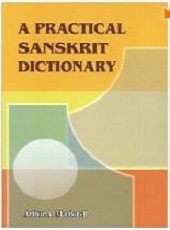
• A Practical Sanskrikt Dictionary,
by A. A. Macdonell, 1893,
http://www.sanskrit-lexicon.uni-koeln.de/scans/MDScan/index.php?sfx=jpg;
1929.
-
Nataraj ed., 1st in 2006, 2012.
-
https://dsal.uchicago.edu/dictionaries/macdonell/ 190516
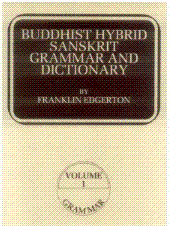
• The Buddhist Hybrid Sanskrit Grammar and
Dictionary, BHS, vol.2, by F. Edgerton,
pp. 627.
-
FEdgerton-BHSD<Ô> /
Bkp<Ô> (link chk 180627)
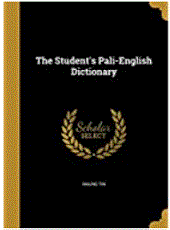
• The Student's Pali English dictionary ,
by U Pe Maung Tin, 1920.
- (ref: UPMT-PEDxxx).
Downloaded copies in TIL
HD-PDF and SD-PDF libraries:
-
UPMT-PaliDict1920<Ô> /
bkp<Ô> (link chk 190113)
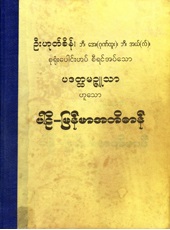
• Pali-Myanmar Dictionary
(in Pal-Myan), by U Hoke Sein,
- (ref: UHS-PMD). The dictionary in printed form is in TIL Research Library.
• Latin-English Vocabulary II, by Hans H Ørberg, 1998
-
HHOrberg-LinguaLatina<Ô> /
Bkp<Ô> (link
chk 190624)
Edited by U Kyaw Tun (UKT) (M.S., I.P.S.T., USA),
Daw Khin Wutyi, Daw Thuzar Myint, Daw Zinthiri Han
and staff of Tun Institute of Learning (TIL).
Not for sale. No copyright. Free for everyone.
Prepared for students and staff of TIL
Research Station, Yangon, MYANMAR
-
http://www.tuninst.net ,
www.romabama.blogspot.com
MC-indx.htm |
Top
MCpp-indx.htm
 {hka.} - True-Kha
p079-2c1
 {hka.ka.} : Though not listed in Sanskrit, it is listed in Népali
 {hka.ga.}
 {hka.gna.}
 {hka.sa.}
 {hka.za.}
 {hka.ña.} /
 {hka.Ña.} - I'll have to look into this possibility for Bur-Myan
 {hka.Ta.}
p079-2c2
 {hka.ða.}
p079-2c3
 {hka.Na.}
UKT 200115: For comparing two languages, such as Burmese (3 tones), and Népali (2 tones), I need info on Skt-Dev Visarga and Anusvāra, and on Bur-Myan Wic'sa
{wic~sa.} "double dot", Théthétin
{þé:þé:tín} "dot above", and Auk'mric
{auk-mric} "dot below".
I've found Visarga is equivalent to Wic'sa, the use is different even between Mon and Bur. Bur-Myan uses Visarga only after long (two-blnk) vowels, such as in
{na:},
{ni:}, and
{nu:}. So far, I haven't found any Skt-Dev equivalent for Auk'mric
Important: This note is to be appended to Two-Three Tone problem which I noticed as earl as 2009 in my work. See:
English Phonetics and Phonology for Burmese-Myanmar speakers
- https://www.tuninst.net/ENG-PHON/Eng-prod-snd/prod-snd.htm 200115
UKT notes :
• Khandava Forest खाण्डव वन «khāndəvə vənə»
• Missing Kha in IPA : Sanskrit vowels and
consonants
• Sapir-Whorf Hypothesis - a theoretical basis of BEPS
• Toddy Palm industry
 {hka.}
- True-Kha
{hka.}
- True-Kha
UKT 151206, 170417: Many words spelled with True-Kha
{K} in Pal-Myan are spelled with Pseudo-Kha
{kSa.}/
{kS~} in Skt-Dev. Being a basic consonant, can be under a viram, whereas
UKT 170416: See my note on the Missing Kha
p079-2c1-b00/ p060-061

• ख [khá]
Skt: ख [khá]
- n. cavity, hole, aperture (esp.
in the human body); wound; axle-hole (in the
nave of a wheel); ether; air; sky. - Mac079c1
61)
Skt: ख «kha» - sky, aakaasha -- Glos
IPal: {kha} - n. the air, sky, zero. -- UPMTPED080
Cavity of the loin:
Bur-Myan:{hka} (2 blnk):
{hka:} (2 blnk with emphasis)
• खं «khaM»
Skt:खं «khaM» - ether -- Glos
 {hka.ga.}
p079-2c1-b01/ p060-058
• खग [kha-ga]
Skt: खग [kha-ga] - a.
moving in the air, flying; m. bird;
-pati , lord of the birds, ep.
of Garuda - Mac079c1
58)
Skt: खग «khaga» = one
traversing in the sky, a name of Sun, also
birds - Glos
Skt: खगः «khagaH» = bird
(literally the sky-goer, 'khah' meaning sky
- Glos
IPal: {khaga} - m. a bird, arrow, sun, wind. - UPMTPED080
UKT 180222: I hate the idea of dubbing Garuda as the lord of birds, when the Garuda preys on smaller birds. The duty of a lord or king is to protect his subjects - not preying on them.
•
खगः (khagaH)
Skt: खगः (khagaH)
- bird (literally the sky-goer), 'khah' meaning sky - Glos
p079-2c1-b02/ p060-057

• खगम [ kha-gama ]
- m. bird; N. of a Brâhman.
57)
UKT 140706: Khagama is the Brahmin who cursed another Brahmin turning him into a snake. - Mahabharata Vol. 1, Book 1, The Book of the Beginning,
- https://books.google.ca/books?...Khagama+the+Brahmin... 170417
The downloade txt is in TIL HD-PDF and SD-PDF libraries:
- PCRoy-MahabharataVol01<Ô> / Bkp<Ô> (link chk 180222)
"The Dundubha then said, 'In former times I had a friend Khagama by name. He was impetuous in his speech and possessed of spiritual power by virtue of his austerities. And one day when he was engaged in the Agni-hotra (Fire-sacrifice), I made a mock snake of blades of grass, and in a frolic attempted to frighten him with it. And anon he fell into a swoon. On recovering his senses, that truth-telling and vow-observing ascetic, burning with wrath, exclaimed, 'Since thou hast made a powerless mock snake to frighten me, thou shalt be turned even into a venomless serpent thyself by my curse"
p079-2c1-b03/ not online
• [kha-galya]
- a certain part of a wheel
p079-2c1-b04/ p060-060
• खगाधिप [ khaga‿adhipa ]
- m. ep. of Garuda; -‿indra, m. id.
60)
•
खगोलशास्त्रम्
(khagolashaastram.h)
- astronomy - Glos
 {hka.gna.}
p079-2c1-b05/ not online

• खङ्ख [khaṅkha]
Skt: खङ्ख [khaṅkha]
- m. N. - Mac079c1
Skt: खङ्ख - m. Name of a
minister of king bālā
•
खङ्गः
(kha.ngaH)
Skt: खङ्गः
(kha.ngaH)
- m. sword - Glos
IPal: {khagga} - m. a sword, rhinoceros. - UPMTPED080
•
खङ्गमृगः
(kha.ngamRigaH)
- m. rhinoceros - Glos
 {hka.sa.}
p079-2c1-b06/ not online
• [khak ] i. p.
- khaka , shine; pp. khakita , sparkling;
brilliant or studded with (in., -°). ud, pp. interwoven with (in.,
-°)
p079-2c1-b07/ p060-045
• खचर [ kha-kara ]
- a. flying; m. bird; fairy; -kitra, n. picture in the air = chimera.
45)
 {hka.za.}
p079-2c1-b08/ p060-044
• खज [ khág-a ]
- m. stirring, churning; tumult of battle.
44)
p079-2c1-b09/ p060-043
• खजल [ kha-gala ]
- n. mist.
43)
p079-2c1-b10/ p060-042
• खजा [ khag-â ]
- f. churning-stick.
42)
 {hka.ña.} /
 {hka.Ña.}
UKT 180222: Don't get confused with Pseudo Za ज ् ञ = ज्ञ
UKT 190215: These entries could very well be
I'll have to look into this possibility when I start incorporating examples, such as{hkûn.Ña:} from Bur-Myan.
p079-2c1-b11/ not online
• [khañg ] i. p.
- khañga , limp
p079-2c1-b12/ p060-041
• खञ्ज [ khañg-a ]
Skt: खञ्ज [ khañg-a ]
- a. lame: -tâ, f., -tva, n. -ness.
41)
Skt:
खञ्जः (khaJNjaH) = m. a handicapped person, lame
- Glos
p079-2c1-b13/ p060-040
• खञ्जन [ khañg-ana ]
- m. wagtail: -‿akshî, f. girl with restless eyes.
40)
p079-2c1-b14/ p060-039
• खञ्जरीट [ khañga-rîta ]
- m. wagtail: -ka, m. id.
39)
 {hka.Ta.}
p079-2c1-b15/ not online
• [khata-khata-ya] â.
- crackle, hiss
p079-2c2-b00/ p060-038
• खटिका [khat-ikâ], खटिनी [ khat-inî ]
- f. chalk.
38)
p079-2c2-b01/ p060-037
• खट्वय [ khatva-ya ]
- den. P. turn into a bedstead.
37)
p079-2c2-b02/ p060-036
• खट्वा [ khatvâ ]
- f. bedstead; bed of sickness.
36)
p079-2c2-b03/ p060-035
• खट्वाङ्ग [ khatvâ‿aṅga ]
- m. n. club shaped like the foot of a bedstead (esp. as a weapon
of Siva): -dhara, -dhâra, -bhrit, a. bearing
a
khatvâṅga, ep. of Siva.
35)
p079-2c2-b04/ not online
• [khatvâṅg-in]
- a. id.
p079-2c2-b05/ p060-034
• खट्वातल [ khatvâ-tala ]
- n. space under a bed: lc. under the bed.
34)
p079-2c2-b06/ not online
• [khad ]
- [khand ] , break, cleave
 {hka.ða.}
p079-2c2-b07/ p060-033
• खड [ khad-a ]
- m. kind of sour drink made of buttermilk, etc.
33)
p079-2c2-b08/ p060-032
• खड्ग [ khad-gá ]
Skt: खड्ग [ khad-gá ]
- m. sword, dagger; rhinoceros; N. of a merchant's son.
32)
Skt:
खड्ग (khaDga) - sword - Glos
Pal:
 {hkag~ga.} - UHS PMD0341
UKT from UHS: double-edged dagger, rhinoceros
p079-2c2-b09/ p060-054
• खड्ग्राहिन् [ khadga-grâhin ]
- m. sword-bearer; -dhara, a. wearing a sword; m. N.;
-dhârâ, f.
sword-blade: -vrata, n. = asidhârâ-vrata; -dhenu, f. knife;
-pâni, a. having a
sword in one's hand; -pâta, m. sword-cut; -prahâra, m. sword-stroke;
-maya, a.
consisting of swords; -vat, a. armed with a sword; -vâri,
n. blood dripping from
a sword; -vidyâ, f. art of fencing; -sakha, a. armed with a sword;
-sena, m. N.;
-hasta, a. having a sword in the hand.
54)
p079-2c2-b10/ p060-053
• खङ्गामिष [ khadga‿amisha ]
- n. rhinoceros flesh.
53)
•
खड्गी (khaDgii)
- with sword - Glos
p079-2c3-b00/ p060-052
• खड्गिधेनुका [ khadgi-dhenukâ ]
- f. female rhinoceros.
52)
p079-2c3-b01/ p060-051
• खड्गिन्् [ khadg-in ]
- a. armed with a sword; m. rhinoceros.
51)
 {hka.Na.}
p079-2c3-b02/ p060-050
• खणखणाय [ khana-khanâ-ya ]
- den. Â. clatter, crack: pp. -yita, clashing, etc.
50)
p079-2c3-b03/ p060-049
• खण्ड [ khand-a ]
- a. incomplete, deficient, not full (moon); m. n. piece, part; section
(of a work); number, quantity, multitude, group; powdered sugar: -ka, m. part,
piece, section; kind of dance(?); -kâpâlika, m. a partial Kâpâlika (sectary);
-devakula,
n. ruined temple; -dhârâ, f. kind of musical performance or dance.
49)
© खण्ड [ khand-a ]
Skt: खण्ड [ khand-a ]
- a. incomplete, deficient, not full (moon); m. n. piece, part; section
(of a work); number, quantity, multitude, group; powdered sugar: - Mac079c3
Skt:
खण्ड (khaNDa) - m. n. piece
Pal:
 {hkûN~ða.}
-
 -- UHS-PMD0342
UKT from UHS: mfn. broken
[into pieces, sections, etc.].
m.n. a part, a section,
breaking up, torn pieces, sugar-block,
sugar-cane-jaggary
See my note on Toddy Palm jaggery and Toddy Palm industry
p079-2c3-b04/ p060-048
• खण्डन [ khand-ana ]
- a. breaking up, destroying, dispelling; n. crushing; hurting, wounding
(esp. with the teeth); curtailing, destroying; baffling; refuting; deceiving;
-anîya,
fp. to be broken or cut in pieces.
48)
© खण्डन [ khand-ana ]
Skt: खण्डन [ khand-ana ]
- a. breaking up, destroying, dispelling; n. crushing; hurting, wounding
(esp. with the teeth); curtailing, destroying; baffling; refuting; deceiving;
- Mac079c3
Skt:
खण्डन (khaNDana) - to pound, cut into pieces, injuring, hurting
- Glos
•
खण्डपिटासन (khaNDapiTaasana)
- the ankle-twist posture - Glos
UKT 170419: The ankle-twist posture is a Yoga Asana to cure a sprained ankle.
p079-2c3-b05/ p060-047
• खण्डमोदक [ khanda-modaka ]
- m. manna-sugar (Pr.).
47)
p079-2c3-b06/ p060-046
• खण्डय [ khanda-ya ]
- den. P. break or cut in pieces; injure; bite; interrupt, disturb;
destroy, dispel; cause to cease, satisfy; neglect; refute; deceive. ava, break
in pieces. ud, tear off. vi, cut in pieces, lacerate.
46)
•
खण्डयति (khaNDayati)
- to grate (as in grating a coconut) - Glos
p079-2c3-b07/ not online
• [khanda-vataka ]
- m. n. N. of village or town
• खाण्डव वन «khāṇḍva vana»
= ख ा ण ् ड व + व न
- n. N. ancient forest mentioned in the epic Mahabharata - Wikipedia.
UKT 170418: See my note on Khandava Forest
From Wikipedia: http://en.wikipedia.org/wiki/Khandava_Forest 120226, 170418
Khandava Forest (Skt: खाण्डव वन = ख ा ण ् ड व + व न , khāndəvə vənə) was an ancient forest mentioned in the epic Mahabharata. [1] It lay to the west of Yamuna river, in modern day Delhi territory. [UKT ¶]
 Pandavas cleared this forest to construct
their capital city called Indraprastha.
This forest was earlier inhabited by
Naga tribes led by a king named
Takshaka.
[2]
Arjuna and
Vasudeva Krishna [UKT: son of Yadava chief Vasudeva and his wife
Devaki and therefore a human just like Arjuna] cleared this forest
by setting up a fire. The inhabitants
of this forest were displaced. This was
the root cause of the enmity of the Naga
Takshaka towards the
Kuru kings who ruled from
Indraprastha and
Hastinapura.
[2]
Pandavas cleared this forest to construct
their capital city called Indraprastha.
This forest was earlier inhabited by
Naga tribes led by a king named
Takshaka.
[2]
Arjuna and
Vasudeva Krishna [UKT: son of Yadava chief Vasudeva and his wife
Devaki and therefore a human just like Arjuna] cleared this forest
by setting up a fire. The inhabitants
of this forest were displaced. This was
the root cause of the enmity of the Naga
Takshaka towards the
Kuru kings who ruled from
Indraprastha and
Hastinapura.
[2]
The Mahabharata states that Indra was
the protecting deity (Deva) of Khandava
forest, which is why the region was known
as Indraprastha.
[3]
When the forest was being burned, Indra
attacked Arjun with his bolt (vajra)
 {wa.ra.zain},
injuring him.
[4]
{wa.ra.zain},
injuring him.
[4]
UKT 120226, 190215: Indra is the god of thunder and thus of rain also. It is understandable that the Rain-god who has poured down his rain on a forest of trees would be protecting that forest. During a forest fire many animals including the snakes [Naga
{na.ga:}, and human-forest dwellers who worship
Do not think that Naga-worshippers were only forest-dwellers. Pre-Theravada Upper-Burmans, like Taung'thu'gyi Min
{taún-þu-kri: mín:}, who was deposed by Anawrahta's father, were Naga-worshippers. They were Tib-Bur speakers, whereas Arjun and Krishna were IE speakers.
A little known story is that at the time of the great war when Arjun and Karan come face to face with each other, the Naga King Aswasena desirous of avenging the death of his mother from Arjuna, in that battle quietly slips into the quiver of Karna in the guise of an Arrow. It is this Arrow that had almost killed Arjuna had it not been for Krishna who by pressing his feet on the chariot sank it one cubit deep into the earth hence the arrow missing its aim.
UKT: End of article
Go back Khandava-note-b
UKT 140415, 170416 :
When the Europeans arrived in India, they were baffled by
the sounds of c2 and c4 consonants such as
{hka.}
and
 {Ga.}. The early European Indologists were prisoners of their own
phonological restraints and were deaf to the sounds of our languages. I base
my statements on my understanding of
Sapir-Whorf
hypothesis - the most important theoretical background of my work on
BEPS languages. See the most recent update in Wikipedia:
{Ga.}. The early European Indologists were prisoners of their own
phonological restraints and were deaf to the sounds of our languages. I base
my statements on my understanding of
Sapir-Whorf
hypothesis - the most important theoretical background of my work on
BEPS languages. See the most recent update in Wikipedia:
-
http://en.wikipedia.org/wiki/Sapir-Whorf_hypothesis 140415
The r1c2
{hka.} ख
«kha» and r1c4
{Ga.}
are missing in the International Phonetic Alphabet (IPA) which was originally designed for
European languages of the Indo-European linguistic group. In fact all the c2
and c4 of all other Akshara rows are missing in the IPA. Romabama
 {ro:ma. ba.ma} based on Bur-Myan phonology, has been designed to remedy the
defects of IPA. Because of its late invention in the 20th century - after the
invention of the computers - I am able to make it ASCII-compatible. It can be
used to transcribe Bur-Myan into Eng-Lat with a one-to-one Speech to Script
mapping - a true phonetic language.
{ro:ma. ba.ma} based on Bur-Myan phonology, has been designed to remedy the
defects of IPA. Because of its late invention in the 20th century - after the
invention of the computers - I am able to make it ASCII-compatible. It can be
used to transcribe Bur-Myan into Eng-Lat with a one-to-one Speech to Script
mapping - a true phonetic language.


These innovations have resulted in what I am calling BEPS consonants and vowels:


Based on the Westerners' misunderstanding ख has been transliterated as «kha» in IAST,
which is not suitable in Bur-Myan. I have therefore put the "h" in front of
"k" as
{hka.},
and have taken it altogether out of घ «gha» writing
{Ga.}.
One hurdle I am facing is my ignorance of Skt-Dev pronunciations. I'm being
helped by an online website of spoken grammar lessons from: Shaale.com:
School of Traditional
Indian Arts and Literature
-
https://www.youtube.com/watch?v=mAbHLSL4kFs&list=PLZ83joYJYmWSFgcg-r0nOwnWPEqmvoaN4
151120
I've downloaded 11 videos, and they are
in TIL HD-VEDIO libraries:
Skt-Dev<Ô> / bkp<Ô> (link chk 171416)
Now listen to Sanskrit vowels and consonants:

04. Varieties of vowels in Sanskrit -
Lesson04<Ô>
06. Consonants in Sanskrit -
Lesson06<Ô>
In Lesson 04, you'll hear that there: three varieties of vowels differentiated
by Swara or 'accent' - the time taken to utter the vowel sound measure by
eye-blinks - important in Védic language: sounds similar to Bur-Myan?
"Short vowel /
ह्रस्व
«hrasva»
= ह ् र स ् व swara - needs 1 maatraakala to pronounce
"Long vowel /
दीर्घ
«deergha»
= द ी र ् घ swara - needs 2 maatrakalas to
pronounce
"Protracted vowel/
प्लुत «pluta»
= प ् ल ु त swara - needs 3 maatrakalas to
pronounce
" A मात्राकाल «Maatraakaala» is the time taken to wink once
"Not all vowels have all the three varieties"
After listening both to vowels and consonants, you will notice that because of one-to-one Speech to Script mapping, we can easily relate Skt-Dev to Bur-Myan, but not exactly to Mon-Myan.
UKT 140415, 140706, 170417 : My primary source of Skt-Dev spellings is from Univ. Chicago with many mixed-up pages. To remedy the situation, I am relying on:
¤ Spk-Skt online
¤ Sanskrit Documents downloaded html file in TIL library:
- MC-indx.htm > glossary.htm (link chk 170415)
Go back Missing-Kha-note-b
- UKT 140415, 170417
When the Europeans arrived in India, they
were baffled by the sounds of c2 and c4
consonants such as
 {hka.} and
 {Ga.}. The early European Indologists were
prisoners of their own phonological
restraints and were deaf to the sounds
of our languages.
{Ga.}. The early European Indologists were
prisoners of their own phonological
restraints and were deaf to the sounds
of our languages.
Our languages were considered to be
inferior to theirs because of our military
weakness. The conquerors could hear c2 &
c4 only as "aspirate" sounds. I
base my statements on my understanding of
Sapir-Whorf hypothesis - the most
important theoretical background of my work
on BEPS languages. See the recent update in Wikipedia:
http://en.wikipedia.org/wiki/Sapir-Whorf_hypothesis 140415

HUMAN VOICE
How it is produced and heard:
- indx-HV.htm (link chk 180223)
- snd-hear.htm (link chk 180223)
The Indologists could understand Sanskrit and other Indic sounds to some extent, because the commonality with Greek and Latin, and also with English, French and German. These languages all belong to the same linguistic group - the Indo-European. However, the Europeans were and still are baffled by the sounds of Burmese of the Tibeto-Burman linguistic group. Burmese is considered it to be just an adaptation of the Mon, which itself was derived from a south India script. The colonialist-historians simply looked down on our language and summarily wrote off our historical record of Tagaung (which had contacts with northern India many centuries before the birth of Gautama Buddha) as nothing but a fairy tale.
The eminent colonialist-jurist John Jardine,
wrote in 1893 in his Introduction , p.18, to Sangermano's
The Burmese Empire a Hundred Years Ago :
"Tagaung
 {ta.kaún:pæÑ} (possibly the Tugma metropoils
of Ptolemy), are to be treated as mere
fable". See Introduction , p.18
{ta.kaún:pæÑ} (possibly the Tugma metropoils
of Ptolemy), are to be treated as mere
fable". See Introduction , p.18
-
sang-j-indx.htm >
intro.htm
(link chk 190212)
The two sounds in Bur-Myan which they cannot understand
to this day are the sounds of
 {gna.}/
 {ng}
(with coloring of
{ng}
(with coloring of
 {ga.}
/g/), and
{ga.}
/g/), and
 {Ña.}/
 {Ñ}. These two phonemes are not
strictly nasals - the first is a plosive-stop, but
the second is an approximant similar to
{Ñ}. These two phonemes are not
strictly nasals - the first is a plosive-stop, but
the second is an approximant similar to
 {ya.}/
 {y} /j/.
Based on their misunderstand ख has
been transliterated as «kha» in IAST,
which is not suitable in Bur-Myan. I have
therefore put the "h" in front
of "k" as
{hka.},
and have taken out the h from
घ «gha» writing
{Ga.}.
The following is what I have written many years ago in Human Voice based on the then Wikipedia article. My understanding of the SWH remains the same. The following is from an old Wikipedia article.
From: http://en.wikipedia.org/wiki/Sapir-Whorf_hypothesis
In linguistics, the Sapir–Whorf hypothesis (SWH) states that there is a systematic relationship between the grammatical categories of the language a person speaks and how that person both understands the world and behaves in it. Although it has come to be known as the Sapir–Whorf hypothesis, it rather was an axiom underlying the work of linguist and anthropologist Edward Sapir and his colleague and student Benjamin Whorf. (UKT: Whorf was a chemical engineer by training.)
UKT: This is in accordance with the Buddhist
search for Truth and Final Liberation:
 {a.swè:a:loän: mha. kín:lwût hkyín:}.
Gautama Buddha, before he became a Buddha
(not "god", but an
"enlightened commoner"
{ma.ha þa-ma.na.þa.}), struggled for six
long years to find the "Truth",
by following the doctrines of various
faiths. Realizing the futility of the
tenets of all these doctrines, he set
them (such as the idea of a Creator or God)
aside, and started to find an unfailing
natural law. He discovered that
"no sentient being is free from
suffering" which became the
First Noble Truth of Buddhism. Starting
from that universal law, he arrived at
three more, and then at the Principle of Anatta
(or the futility of finding a permanent
unchanging entity commonly known as Atta.).
He then realized that he had become a Buddha --
{a.swè:a:loän: mha. kín:lwût hkyín:}.
Gautama Buddha, before he became a Buddha
(not "god", but an
"enlightened commoner"
{ma.ha þa-ma.na.þa.}), struggled for six
long years to find the "Truth",
by following the doctrines of various
faiths. Realizing the futility of the
tenets of all these doctrines, he set
them (such as the idea of a Creator or God)
aside, and started to find an unfailing
natural law. He discovered that
"no sentient being is free from
suffering" which became the
First Noble Truth of Buddhism. Starting
from that universal law, he arrived at
three more, and then at the Principle of Anatta
(or the futility of finding a permanent
unchanging entity commonly known as Atta.).
He then realized that he had become a Buddha --
 {zi.na.}. Any sane and logical human
being can be liberated from "Suffering"
if she or he could be free from all
"ideas" which could not be proven --
{a.swè:a:loän: mha. kín:lwût hkyín:}.
However, all those who has achieved that
goal following the teachings of the Buddha
are known as Arahant
{zi.na.}. Any sane and logical human
being can be liberated from "Suffering"
if she or he could be free from all
"ideas" which could not be proven --
{a.swè:a:loän: mha. kín:lwût hkyín:}.
However, all those who has achieved that
goal following the teachings of the Buddha
are known as Arahant
 {ra.hûn~ta} -- not
{zi.na.}
'originator'.
{ra.hûn~ta} -- not
{zi.na.}
'originator'.
Go back Whorf-note-b
UKT120130, 141117:

Inset shows making jaggery near Mount Popa in central Myanmar near the capital city NayPyitaw. The Popa area is where a lot of toddy palms are cultivated. The jaggery is palm-jaggery and NOT sugar-cane jaggery. Palm-jaggery is sweeter than cane-jaggery because of its high fructose content. It is considered to be a health product.
Toddy-palm industry is one of the most important industry of Myingyan-Magwé
area, the ancestral home of my great-grand father, U Yan Shin aka Bo Yan
Shin - an ancestral Burmese tribal chieftain, Kalan
 {ka.lûn}.

 According to my grandmother Daw Choak, U Yan Shin's eldest daughter, her
father had owned large tracks of toddy-palm plantations.
According to my grandmother Daw Choak, U Yan Shin's eldest daughter, her
father had owned large tracks of toddy-palm plantations.
According to my uncle, U Aung Myin, U Yan Shin's grandson, villagers armed with their long swords would heed the call of U Yan Shin who was also known in the area as Bo Yan Shin. Because of his followers he was reported by the Mayor of Salè to the King in Mandalay that Nga (derogatory suffix attached to a name of rebel) Yan Shin was preparing a rebellion. U Yan Shin had no recourse but to seek protection under the British in southern Myanmarpré. The Mayor of Salè had to pay with his life at the hands of U Yan Shin (my great grandfather) and his followers.
Go back Toddy-Palm-Industry-note-b
End of TIL file