p076C.htm
• A Practical Sanskrikt Dictionary,
by A. A. Macdonell, 1893,
http://www.sanskrit-lexicon.uni-koeln.de/scans/MDScan/index.php?sfx=jpg;
1929.
-
Nataraj ed., 1st in 2006, 2012.
-
https://dsal.uchicago.edu/dictionaries/macdonell/ 190516
• The Buddhist Hybrid Sanskrit Grammar and
Dictionary, BHS, vol.2, by F. Edgerton,
pp. 627.
-
FEdgerton-BHSD<Ô> /
Bkp<Ô> (link chk 180627)
• The Student's Pali English dictionary ,
by U Pe Maung Tin, 1920.
- (ref: UPMT-PEDxxx).
Downloaded copies in TIL
HD-PDF and SD-PDF libraries:
-
UPMT-PaliDict1920<Ô> /
bkp<Ô> (link chk 190113)
• Pali-Myanmar Dictionary
(in Pal-Myan), by U Hoke Sein,
- (ref: UHS-PMD). The dictionary in printed form is in TIL Research Library.
• Latin-English Vocabulary II, by Hans H Ørberg, 1998
-
HHOrberg-LinguaLatina<Ô> /
Bkp<Ô> (link
chk 190624)
Edited by U Kyaw Tun (UKT) (M.S., I.P.S.T., USA),
Daw Khin Wutyi, Daw Thuzar Myint, Daw Zinthiri Han
and staff of Tun Institute of Learning (TIL).
Not for sale. No copyright. Free for everyone.
Prepared for students and staff of TIL
Research Station, Yangon, MYANMAR
-
http://www.tuninst.net ,
www.romabama.blogspot.com
MC-indx.htm |
Top
MCpp-indx.htm

 {k~ta.} : Hswei'byi
 {hswè:byæÑ:} 'hanging consonant'
 {k~na.} /

UKT 171122, 190211: Hswei'byi
= Mon
and Hanging Ma : Bur
= Mon
. See and listen to hanging consonants on p087C.htm .
I'm also surprised to find 2 dialects in Sanskrit: the Southern dialect of Telugu & Tamil speakers, and the Northern dialect of Hindi speakers. Hanging consonants are generally disyllabic. They are comparable to Bur-Myan medials which are monosyllabic.
See my note on Slightly/Highly rhotic syllables
 {kya.}
- non-rhotic monosyllabic formed with Ya'pin
{kya.}
- non-rhotic monosyllabic formed with Ya'pin
 {ya.pín.} 'lifted by
 {ya.}'
vs.
{ya.}'
vs.
 {k~ya.}
(disyllabic) when
{ya.}
is a hanging consonant. Westerners and Indians always pronounce KYAW in my name
as
{k~ya.}.
{k~ya.}
(disyllabic) when
{ya.}
is a hanging consonant. Westerners and Indians always pronounce KYAW in my name
as
{k~ya.}.
It is worthwhile to note that Mon-Myan pronounces
{kya.} as a monosyllabic medial.
 {kRa.}
- rhotic disyllable:
{kRa.}
- rhotic disyllable:
 {kRa.ka.}
 {kRa.ta.}
 {kRa.pa.}
 {kRa.ma.}
 {kRa}
{kRa}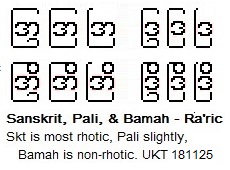
 {kRi.}
क्रि : don't
get mixed up with
{kRi.}
क्रि : don't
get mixed up with
 {kRRi.} कृ
 {kRi} क्री :
don't get mixed up with
{kRi} क्री :
don't get mixed up with
 {k-Ri}
कॄ
{k-Ri}
कॄ
 {kRu.}
UKT 180316: In next file, you'll come across
La'hswè and Wa'hswè
which are present in both Bur-Myan and Mon-Myan
UKT notes :
• Hanging consonants of Mon-Myan
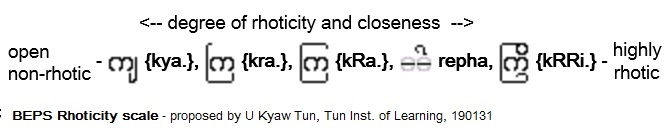
• Rhoticity Scale
Bur-Myan dialect of Irrawaddy valley is non-rhotic, whereas Pali-Myan and
Bur-Myan dialect of Rakhine State is slightly rhotic. Romabama has to satisfy
all their needs with slightly varying glyphs.
{k~ta.} : hanging-consonant present in Mon-Myan & Skt-Dev
See my note on Hanging consonants
p076c1-b05/ p058-012
• क्त [ k-ta ]
= क ् त -->
{k~ta.} pronounced as disyllable
- suffix ta of the pp.
(gr.).
12)
{k~na.} /

UKT 140412, 190211, 190324: Small Na as a hanging consonant is written 2 styles:
There are many English words with <kn> such as <knee> /niː/ & <know> /nəʊ/ (US) /noʊ/. And, you know what the modern English speakers had done. They "cheated" and simply dubbed <k> to be silent. And because of their cheating, the poor Celtic Gnome who is rich in gold has become a "Nome". I was really surprised to find many silent letters in English, which we will not allow in Bur-Myan. When the Western phoneticians insisted that we must not pronounce as it is spelled, it only shows their ignorance of the Akshara languages which are based on sound phonemic principles.
Now listen to Mon-Myan unusual conjuncts and medials in
Mon SpkAll lesson32-61txt<))
I've given in my notes 6 panels giving hanging consonants and medials /n/ {na.}, /m/ {ma.}, /j/ {ya.}, /r/ {ra.}, /l/ {la.}, /v/ {wa.}.See Mon-Myan 2-syllable words involving hanging consonants in p087C.htm .
p076c1-b06/ p058-011
• क्नथ [ knath-a ]
- the root knath (gr.).
11)
{kya.} (monosyllabic) vs.
{k~ya.} (disyllabic)
On transforming Bur-Myan (Tib-Bur, non-rhotic) to Skt-Dev (IE, highly rhotic), different degrees of rhoticity are met. Because of which I have to propose a rhoticity scale which also depends on the closeness of the vowel. See my note on Rhoticity Scale.
√knū, 'wet'. - Whit024
p076c1-b07/ p058-010
• क्नूय्् [ KNÛY ]
- only cs. knopaya, P. drench. abhi, wet, moisten.
10)
UKT 151201, 170623, 171121:
Bur-Myan has a set of syllables very close in pronunciation to{kyi.} (1 blnk) &
{kri.} (1 blnk). It is spelled with Nya-major aka Nya'gyi
{Ña.}/
{Ñ}, and is perfectly non-rhotic. Though traditionally assigned to r2c5 cell in Bur-Myan, because of its ability to be under the viram sign, it has been moved to the Palatal-approximant position, the neighbour of Velar-approximant
{ý}.
{kræÑ.} (1 blnk),
{kræÑ} (2 blnk),
{kræÑ:} (emphatic 2 blnk)
In Pali-Myan, Nya'gyi cannot be placed under virama
{a.þût}: it breaks up into two Nya'lé:
{ñ~ña.}
p076c1-b08/ p058-009
• क्याकु
[ kyâku ] -->
{k~ya-ku.} -->
 {kya-ku.}
- n. mushroom.
9)
{kRa.}
: rhotic disyllable
UKT 151201, 180114: The conjunct क्र = क ् र cannot be written with a hanging
{ra.}, because it would be confusing in Mon-Myan. It is written as
{kRa.ka.}
p076c1-b09/ p058-008
• क्रकच
[ krakaka ]
Skt: क्रकच
[ krakaka ]
- m.n. saw; m.
a plant. - Mac076c1
8)
Skt: क्रकच
- m.n. a saw. m. kind of
musical instrument, Ardea virgo, plant
Capparis aphylla , name of a hell
- MWilliams: SktDict
¤ The demoiselle crane (Grus virgo) [syn. Ardea virgo] is a species of crane found 28 central Eurasia, ranging from the Black Sea to Mongolia and North Eastern China. - https://en.wikipedia.org/wiki/Demoiselle_crane 171122
¤ Capparis decidua [syn. Capparis aphylla ] is commonly known as karira, [2] is a useful plant in its marginal habitat. Its spicy fruits are used for preparing vegetables, curry and fine pickles and can attract helpful insectivores; the plant also is used in folk medicine and herbalism." - https://en.wikipedia.org/wiki/Capparis_decidua 171122
√krakṣ, 'crash'. - Whit024
p076c1-b10/ p058-007
• क्रक्ष््
[ kraksh ]
= क ् र क ् ष ्
--> {krak~S}
- only pr. pt. krákshamâna,
(V.) raging, roaring.
7)
{kRa.ta.}
p076c1-b11/ p058-006
• क्रतु [ kr-á-tu ]
- m. power, might, efficacy; counsel, intelligence, wisdom; inspiration;
plan, purpose, wish, will; sacrifice (sts. personified); N. of the three
liturgies forming the prâtar anuvâka; N. of a son of Brahman (one of the
Pragâpatis and of the seven Rishis); a star in the Great Bear.
6)
p076c1-b12/ p058-005
• क्रतुदेव [ kratu-deva ]
- m. N.; -mat, a. resolute; intelligent, wise; -râg, m. chief sacrifice
(Asvamedha and Râgasûya); -vikrayin, a. selling the rewards for a sacrifice;
-víd,
a. powerful, inspiring.
5)
p076c1-b13/ p058-004
• क्रतूय [ kratû-yá ]
- den. P. will earnestly.
4)
√krath, 'be jubilant'. - Whit024
p076c1-b14/ p058-003
• क्रथ्् [ krath ]
- only cs. krâthaya, P. be extravagant or wild.
3)
p076c1-b15/ p058-002
• क्रथ [ krath-a ]
- the root krath (gr.).
2)
p076c1-b16/ p058-001
• क्रथकैशिक [ kratha-kaisika ]
- m. pl. N. of a people (descended from Kratha son of Vidarbha and from
Kaisika).
1)
Wikipedia: https://en.wikipedia.org/wiki/King_Romapada 171122
"Romapada or Chitraratha was the youngest son King Vidarbha of Yadava and an adopted son of King Dharmaratha of Anga."
p076c1-b17/ not online
• [krathana-ka]
- m. N. of a camel
p076c1-b18/ not online
• क्ननद् [ krand ] i.
- kránda , neigh, roar; wail; resound, rattle; implore piteously (ac.) ;
cs. krandaya, P. cause to neigh d. or = simple vb; intv.
kánikrant-ti, -te: pt. káni-krat, kánikradat,
kanikradyimâna, = simple vb. akkhâ, cs. cry to. abhi, roar
(at). â, call on, invoke; cry piteously; invoke the aid of (ac.); cs. cry
out to.
√krand, kland, 'cry out'. - Whit024
p076c1-b19/ p058-032
• क्रन्द [ kránd-a ]
- m. neigh; cry: -dhvani, m. cry of pain; -ana, n. crying aloud; lamentation;
-as, n.
battle-cry: du. the two contending hosts.
32)
{kRa.pa.}
p076c1-b20/ not online
• क्नप् [ krap ]
Skt: क्नप् [ krap ]
- v. krip - Mac076c1
Skt: क्रपते { क्रप् } «krapate» - v. compassionate, go - SpkSkt
{kRa.ma.}
√kram, 'stride'. - Whit025
p076c1-b21/ not online
•
क्नम् [ kram ]
 {kRûm},
i.
{kRûm},
i.
- krãma-ti ( -te ), krãma-te (-ti), stride, step ;
go to (ac. or lc.); take refuge with (lc.); pass through,
traverse; tower above; take possession of, occupy, fill; Â. succeed, take
effect: pp. krânta; cs. krâm-aya, cause to step;
iniv. kaṅkranate, kaṅkramyate, kaṅkramiti,
walk about. ati, pass by, go beyond, traverse, cross; overstep,
neglect; depart from (ab.); be deprived of (ab.); pass, elapse;
exceed, surpass; trespass, transgress; cs. allow to pass by; disregard.
abhi‿ati, overcome. vi‿ati, overstep; pass by (of
time), elapse; neglect. trespass; wrongly surrender oneself to (ac.)
sam-ati, vl. anu, follow, go through in order,
enumerate; particularize; state in an index. apa,
go away, depart, retreat from (ab). ava, depart, retreat from (ab.).
ava, depart, withdraw; escape. â, come up, approach, enter; step on
(ac., lc.); press upon (ac.); seize, attack; gain possession of;
ocupy, overspread; rise, ascend (Â.); begin (inf.); pp. see s. v.; cs.
cause to enter adhi‿â, fall upon; choose, occupy. nir-â, issue
forth (from, ab.). prati‿â, step back. sam-â, step upon
(ac.); assail, take possession of; occupy. ud, rise; go out; leave
(ab.); depart (life); avoid. prati‿ud, depart. vi‿ud,
overstep; pass over, neglect. upa, come up, approach (ac., lc.);
treat; physic; perform begin (ac., d., or inf.). sam-upa, A. begin
(inf.). nis, go out of, leave (ab.); depart; pp.
nish-krânta, = exit, exeunt; cs. cause to leave, let
out of (ab.); drive out. abhi-nis, go out of (ab.). vi-nis,
step out, emerge from (ab.). parâ, stride forth, be valorous,
put forth one's strength, do one's best. pari, walk about (esp. on the
stage); traverse, visit; surround; overtake. anu-pari, inspect in
turn. sam-pari, walk round (ac.); visit. pra, stride along;
go aside; traverse; rise to (ac.); assail courageously; be valorous;
fight with (ac.); pp. courageous, valorous, brave. sam, come
together, unite; go to; enter; pass from (ab.) to (lc.); pp.
transferred from (ab.) to (--°); cs. lead to (v ac.);
transfer to (lc.) upa-sam, approach.
• क्रमपद «kramapada» - n. conjunction of words in the krama reading - SpkSkt
p076c2-b01/ p058-031
• क्रम [ krám-a ]
- m. step; gait; course; posture for attack; regular order, succession,
gradation; inheritance; method, manner, way; usage, ritual; occasion, reason for
(--°,
g.); a way of reciting the Veda: in., ab., or -tas, in order, in turn; in.,
ab.,
°--, in due course, regularly, gradually; in. in the course of (--°).
31)
p076c2-b02/ p058-030
• क्रमगत [ krama-gata ]
- pp. coming in the way of (g.).
30)
p076c2-b03/ p058-029
• क्रमण [ krám-ana ]
- n. step, tread; walking; treading on (--°).
29)
p076c2-b04/ not online
• [kramad-îsvara]
- m. N. of a grammarian
p076c2-b05/ p058-028
• क्रमपाठ [ krama-pâtha ]
- m. krama method of reciting the Veda; -prâpta, pp. inherited;
-yoga, m.
regular order, succession; -râgya, n. N. of a locality; -varta, N. of a country;
-vriddhi, f.
gradual increase; -sas, ad. in order, in turn; gradually.
28)
p076c2-b06/ p058-027
• क्रमाक्रान्त [ krama‿âkrânta ]
- pp. seized at one bound; -‿âgata, pp. come by succession, inherited;
-‿âyâta, pp. id., hereditary.
27)
p076c2-b07/ p058-044
• क्रमिक [ kram-ika ]
- a. inherited, hereditary; successive.
44)
p076c2-b08/ p058-045
• क्रमुक [ kramu-ka ]
- m. betel-nut tree.
45)
p076c2-b09/ p058-046
• क्रमेलक [ kramela-ka ]
- m. camel.
46)
 {kRa.ya.}
p076c2-b10/ p058-026
• क्रय [ kray-á ]
- m. purchase; price: -krîta, pp. bought; -vikraya,
m. (sg. and du.)
purchase and
sale; trade; -vikrayin, a. buying and selling, bargaining.
26)
p076c2-b11/ p058-025
• क्रयण [ kray-ana ]
- n. purchase; -âna-ka, a. marketable; -ika,
-in, m. buyer.
25)
p076c2-b12/ p058-024
• क्रय्य [ kráy-ya ]
- fp. purchasable.
24)
 {kRa.wa.}
p076c2-b13/ p058-023
• क्रविष्णु [ kravish-nú ]
- a. eager for raw flesh.
23)
p076c2-b14/ p058-022
• क्रविस्् [ krav-ís ]
- n. raw flesh, carrion.
22)
p076c2-b15/ p058-021
• क्रव्य [ krav-yá ]
- n. id.: -bhakshin, -bhug, a. flesh-eating;
-mukha, m. N. of a wolf; -vãhana,
a. carrying away bodies (v. l. for kavya-).
21)
p076c2-b16/ p058-020
• क्रव्याद्् kravya◡́ad, ˚द [ -da ]
- a. flesh-eating, corpse-consuming; m. beast of prey.
20)
 {kRa.sha.}
p076c2-b17/ p058-019
• क्रशय [ krasa-ya ]
- den. P. emaciate.
19)
p073c3-b00/ not online
• क्रशिमन् [kras-i-man]
Skt: क्रशिमन् [kras-i-man]
- m. thinness, slenderness, shallowness. - Mac076c3
Skt: क्रशिमन् «kraśiman» -
m. shallowness, emaciation,
leanness - SpkSkt
 {kRra.Sa.}
p073c3-b01/ p058-018
• क्रष्टव्य [ krash-tavya ]
- fp. to be dragged; to be extracted.
18)
( end of old p076-1.htm )
{kRa}
p073c3-b02/ p058-043
• क्राणा [ kr-ânã ]
- ad. (pr. pt. √kri) willingly; straightway.
43)
p073c3-b03/ p058-043
• क्रान्त [ krân-tá ]
- pp. √kram; n. step; -ti, f. ecliptic.
42)
{kRi.}
क्रि: don't
get mixed up with
{kRRi.} कृ .
Wrapped around by the foot of
{ra.ric}
UKT 151201, 170411, 170623, 180114:
I was in a dilemma:In Bur-Myan the non-rhotic language (especially in the Irrawaddy valley dialect), we rarely spell non-rhotic syllables with
-{kri.ti.kraún-taún} - adv. 'in a daze' - MLC MED2006-037c2
However, in Pal-Myan the slightly-rhotic language, this orthography may be used, e.g.
-{kRi.ya} 'verb' - MLC MED2006-038c1
p073c3-b04/ p058-041
• क्रिमि
[ krími ]
- incorrect spelling of krimi.
41)
p073c3-b05/ p058-040
• क्रिया [ kri-yâ ]
- f. making, doing; performance; business, transaction; action, act;
work; trouble;
labour; notion of the verb, verb (gr.); literary work; rite, ceremony; medical
treatment, cure;
(legal) proof.
40)
p073c3-b06/ p058-039
• क्रियाकुल [ kriyâ‿âkula ]
- a. busy, overwhelmed with business; -‿âtmaka, a. whose nature is activity:
-tva, n. abst. ɴ.; -dveshin, a. evading the evidence;
-‿antara, n. interruption
of an action;
another action; -pada, n. verb; -prabandha, m. continuity of an action;
-‿abhyupagama, m.
express promise; -yoga, m. connexion with an action or verb; employment of
means; the
practical Yoga; -yogya, a. fitted for work; -‿artha,
a. having an action as an
object; -lopa,
m. failure of ceremonies; -vat, a. performing actions, active; performing sacred
rites; -vidhi, m.
specific rule of action; employment of a verb; -viseshana, n. adverb;
-sakti,
f. capacity of acting:
-mat, a. capable of acting.
39)
p073c3-b07/ p058-038
• क्रिवि [ krívi ]
- m. water-skin: pl. N. of a people (in C.= Pañkâla).
38)
{kRi}
:
UKT 190325: CAUTION : Don't get mixed up with
{kri}.
Yet, there probably was a mixed up between Light-rhotic Pali
Light-rhotic Pali : {kRi.},
Use or Not in Myan:{kri:} 'big'
Non-rhotic Myan:
√krī, 'buy'. - Whit025
p073c3-b08/ not online
• क्री [ krî ] ix. krî-nã , -ni
- n, buy from (ab., g.) for (in.: price): pp.
bought, purchased; captivated by (in.). â, upa, id. nis,
buy off, redeem (from, ab.). pari, buy, barter, for (in.);
hire (in. or a. of price). vi, barter or sell for
(in.); des. vi-kikri-sha, Â. wish to exchange for (in.);
intend to give up.
√kriḍ, 'play'. - Whit025
p073c3-b09/ not online
• क्रीड् [ krîd ] i
Skt: क्रीड् 1. P. (क्रीडति, क्रीडित) 1 To play, amuse oneself; ... - Apte:SktDic
p073c3-b10/ p058-037
• क्रीड [ krîd-á ]
- a. playing, dallying; -ana, n. playing, play: -ka,
m. plaything; -anîya,
n. id.
37)
p073c3-b11/ p058-036
• क्रीडा [ krîd-ã ]
- f. play, sport, jest, dalliance: -kapi-tva, n. jesting imitation of a
monkey; -kânana, n. pleasure-grove; -kâsâra, m. pleasure-pond;
-kopa, n. simulated
anger; -kautuka,
n. wanton curiosity; -kausala, n. art of jesting; -gríha,
m. n. pleasure-house;
-parvata, m.
(artificial) pleasure-hill: -ka, m. id.; -mayûra, m. pet peacock;
-markatapota,
m. pet young
monkey; -mahîdhra, m. pleasure-hill; -rasa, m. enjoyment of sport or fun:
-maya,
a. consisting in
the water of play; -vesman, n. pleasure-house; -sakunta, m. pet bird;
-saila,
m. pleasure-hill; -saras, n. pleasure-lake.
36)
p073c3-b12/ p058-035
• क्रीडि [ krîd-í ]
- a. playing, dallying; -ita, pp. one who has played; n. play;
-ín, a.
playing, dallying;
-ú: -mát, a. id.
35)
p073c3-b13/ p058-034
• क्रीत [ krî-ta ]
- pp. √krî; n. purchase: -ka, a. (son) acquired by purchase;
-‿anusaya, m.
repenting of a purchase.
34)
( end of old p076-2.htm )
{kRu.}
√kru, 'be rough or raw' - Whit026
p073c3-b14/ not online
• क्रु [kru]
- be rough or raw
p073c3-b15/ p058-033
• क्रुञ्च्् [krúñka] (nm. kruṅ), क्रुञ्च [ krúñka ] 
- m. curlew.
33)
cur·lew - n. ¹. Any of several brownish, long-legged shore birds of the genus Numenius, having long, slender, downward-curving bills. - AHTD
√krudh, 'be angry'. - Whit026
p073c3-b16/ not online
• क्रुध् [ krudh ] iv. p.
- (â.) krúdhya , be or grow angry (with, d., g.; at, lc.) :
pp. krud-dhá
, angry, enraged, with (d., g., lc., upari, or prati);
cs. krodháya ,
enrage, abhi , be angry with (ac.) : pp. enraged, prati , return any
one's (ac.) anger. sam , be angry: pp. angry.
• [krudh]
Skt: [krudh] - be angry, IV. P. krúdhyati; red. ao. inj. cukrudhāma, ii. 33, 4.
-- Mac:SktDict
Skt: krudh क्रुध् 4 P. (क्रुध्यति, क्रुद्ध) To be angry (with the dat. of the
person who is the object of anger); ... -- Apte:SktDict
(end of new p076c3)

- UKT: 140411, 170409, 170623, 180306, 190212
I'had only known the medial formers in Bur-Myan.
In modern Bur-Myan language there are 4 medial formers:
{ya.},
{ra.},
 {wa.},
and
{wa.},
and
 {ha.}. They are approximants, and all give monosyllabic medials, e.g. with
 {ka.}
giving
{kya.} and
{ka.}
giving
{kya.} and
 {kra.}. However, in the Old Pagan dialect and modern Dawei dialect there is an additional medial
former:
{kra.}. However, in the Old Pagan dialect and modern Dawei dialect there is an additional medial
former:
 {la.}. Altogether there are 5.
See ¤ Hanging consonants in Basic Mon-Myanmar Language by Nai Maung Toe, Rangoon, 2007, p047. See downloaded pages in TIL HD-PDF and SD-PDF libraries -
- NaiMgToe-MonMyan<Ô> / Bkp<Ô> (link chk 190211)
In Mon-Myan, there are 11 hanging consonants : hanging r1c5(pronounced as "Gné", hanging r2c5
Now, when I venture into Mon-Myan, I'm finding that these fall under the class
of hanging consonants
{hswè:byæÑ:}, with the exception of Ha'hto
 {ha.hto:}.
The Ra'ric medial
{kra.} - though it has the British English r with IPA transcription /ɹ/,
is non-rhotic. It is pronounced similar to
{kya.}
in Irrawaddy dialect (used in Yangon and Mandalay). It is however, slightly rhotic in Rakhine dialect
and probably more rhotic in Pal-Myan.
{ha.}
cannot be used with
{ka.}
because
{ha.}
is Glottal. However, it will form medials with all the five nasals,
 {gna.}/
 {ng},
{Ña.}*,
{ng},
{Ña.}*,
 {Na.},
 {na.} and
 {ma.}. For example, with True-nasals
{na.} and
{ma.} to give
{ma.}. For example, with True-nasals
{na.} and
{ma.} to give
 {nha.} and
 {mha.}.
* Note: Nya-major
You need to know how the Mon-Myan hanging consonants are pronounced. Refer to:
¤ Mon-Myan Language: Speech and Script
- spk-all-indx.htm (link chk 190325)
Formerly I had thought Skt-Dev, just like Bur-Myan
& Pal-Myan, would have monosyllabic medials. I
am now finding that Skt-Dev has only disyllabic
conjuncts, and so what I had thought to be
{kya.} should be written as
{k~ya.} with
{ya.} hanging below. Yet, because of non-existence
of KY sound in English, Hindi and Sanskrit, it is
immaterial whether you write it as
{kya.} or
{k~ya.}.
No wonder my Indian friends in Canada, and my class-mates in US, could not properly pronounce my Burmese name KYAW.
Now, after listening to Mon-Myan pronunciations,
I've concluded that Mon-Myan
{ra.ric.} is quite rhotic, and should, therefore
be written full-hooded as in Pal-Myan as
{kRa.}.

Compare
with Super-SS :
 {Ska.},
 {STa.},
 {Sta.},
 {SNa.},
 {Sna},
 {Spa.},
 {Sma.},
 {Sla.},
 {Swa.}, and a few more, with the hanging-consonants
of Mon-Myan.
{Swa.}, and a few more, with the hanging-consonants
of Mon-Myan.
According to Nai Mg Toe,
 {sa.}/
 {c})
च «ca» [NOT the hisser ष «ṣa»] will allow only the following as "hangers-on":
{c})
च «ca» [NOT the hisser ष «ṣa»] will allow only the following as "hangers-on":
 {ða.},
{na.},
{ma.},
{ya.},
{ra.},
{la.},
{wa.}. This indicates that Mon-Myan
hanging-consonants are not lisping-consonants.
{ða.},
{na.},
{ma.},
{ya.},
{ra.},
{la.},
{wa.}. This indicates that Mon-Myan
hanging-consonants are not lisping-consonants.
My comment on what Nai Maung Toe has said is, it is of the same genre as Weikcha and Maukcha arbitrary rule. Such rules need to be eliminated from Burmese and Mon speeches for new comers to learn the languages.
By "new comers", I mean not only the foreigners, but children born of full-blooded Mons living in Southern Burma. Though both parents speak Mon-Myan, many of their children refuse to learn their ancestral tongue. I first came to notice that among those in Yangon city. Mon is an endangered language.
Now listen to Mon-Myan unusual conjuncts and medials
Mon SpkAll
lesson32-61txt<))
The 6 panels giving hanging consonants and medials
/n/ {na.}, /m/ {ma.}, /j/ {ya.}, /r/ {ra.},
/l/ {la.}, /v/ {wa.} are given below:


Look for La'hswè
 {la.hswè:} 'hanging
{la.}': it can be pronounced either as:
{la.hswè:} 'hanging
{la.}': it can be pronounced either as:
 {kla.}
(monophthong) or
{kla.}
(monophthong) or
 {k~la.)(diphthong). But once you have been exposed
to English sounds such as <class> and
<slow>, you can pronounce it as monophthong.
{k~la.)(diphthong). But once you have been exposed
to English sounds such as <class> and
<slow>, you can pronounce it as monophthong.
Wa'hswè
 {wa.hswè:} 'hanging
{wa.}',
and Hisser-sa'hswè
{wa.hswè:} 'hanging
{wa.}',
and Hisser-sa'hswè
 {Sa.hswè:} 'hanging hisser
 {Sa.}' - on
p077.htm <
br>
Note: Palatal
{sa.}/
{Sa.}' - on
p077.htm <
br>
Note: Palatal
{sa.}/
 {c} and Dental
{Sa.}/
{c} and Dental
{Sa.}/
 {S} are clearly differentiated in Romabama.
Go back to hanging-conson-note-b
UKT 120127, 140412, 170410, 180113, 180316, 190211:
CAUTION: Bur-Myan and its counter-part Skt-Dev consonantal
pairs have looks-alike:
{hta.} थ (U0925) &
And also note that the transcription of थ (U0925)
is «THA» . This necessitates the use of Old English "thorn" for Bur-Myan
 {þa.}
{þa.}
Consider the case of
the highly rhotic Skt-Dev क्रि =
 {kRi.} vs. Skt-Dev कृ =
{kRRi.}. In Bur-Myan, in which there is no rhoticity, there is no of mix up between
{kra.} &
{kya.}, or
{kri.} &
{kyi.} even though both are pronounced the same in Irrawaddy dialect. This
dialect takes further precaution by using
{kræÑ.} instead of
{kri.}.
{kRi.} vs. Skt-Dev कृ =
{kRRi.}. In Bur-Myan, in which there is no rhoticity, there is no of mix up between
{kra.} &
{kya.}, or
{kri.} &
{kyi.} even though both are pronounced the same in Irrawaddy dialect. This
dialect takes further precaution by using
{kræÑ.} instead of
{kri.}.
However, they are pronounced differently in the
Ra'khine dialect of the western coast of Myanmarpré
which is just across the Bay of Bengal in the
southern part, and across the Kaladan River
 {ku.la:tûn mric}, and the Naf River
 {nût mric} in the northern part from India and Bangladesh. See Wikipedia:
-
https://en.wikipedia.org/wiki/Kaladan_River 190211
-
https://en.wikipedia.org/wiki/Naf_River 190211
I opine that the Ra'khine dialect has become somewhat rhotic due to the
geographical proximity between the rhotic languages of India and Bangladesh, and
non-rhotic Myanmar languages. When we learn Pal-Myan, we are advised to follow
the Rakhine dialect in pronouncing the Ra'ric
{ra.ric.}-sounds. This led me to conclude that Pal-Myan
{kRa.} is more rhotic than Bur-Myan
{kra.}.
Faced with the problem of pronunciation, I had to
split up the original
p076.htm to
concentrate on the difference in rhoticity
between Bur-Myan and Pali-Myan involving
the Ra'ric
{ra.ric} sound. I also have to take note of
the highly rhotic Skt-Dev ऋ (1 blnk)/
ॠ (2 blnk), and also the fact that the
International Pali does not have the
"emphatic 2 blnk" sound. The result is I've come
up with the scheme (using the length of the
hood to represent the degree of rhoticity:
Over years my position has changed, and please
note that as my understanding of BEPS languages
increased, my opinions will change further. For
the present, I hold that monosyllabic medials
such as
{kya.} &
{kra.} are not present in Sanskrit. They are
present only in Bur-Myan among the BEPS
languages. Pali-Myan, is presumed to be similar
to Bur-Myan in most cases. However, it is
slightly rhotic, and should be represented with
a different glyph as
 {kRa.} with the "roof" of
{ra.ric} extended. Sanskrit is the most rhotic
especially in close-vowel. The has led me to
define a rhoticity scale.
{kRa.} with the "roof" of
{ra.ric} extended. Sanskrit is the most rhotic
especially in close-vowel. The has led me to
define a rhoticity scale.
After listening repeatedly the Mon-Myan sounds,
I feel that it is similar to Sanskrit
because the medials,
{kya.} &
{kra.}, are pronounced as disyllabic. Moreover, of
the old Mon dialects, the only dialect remaining is
the Mataban dialect of present day Mon-state. Mon
dialect sounds different as one goes from west to
east into Thailand and Cambodia. The dialect of
Pegu-Mons - that of my great-grandmother Daw MèMa
- which had been adulterated by Telugu, has
completely disappeared.
Bur-Myan medials are from approximants
{ya.},
{ra.},
{la.} (in Dawè dialect),
{wa.} and
{ha.}. The processes of formation are known as
{ya.pín.},
{ra.ric},
{la.hswè:},
{wa.hswè:}, and
{ha.hto:}.
{la.hswè:},
{wa.hswè:} are "hanging-consonants" and
shapes of the hanging-on consonant
{la.} and
{wa.} remain unchanged: whereas there is change in
shape in
{ya.pín.},
{ra.ric} and
{ha.hto:}.
Go back Rhoticity-Scale-note-b
End of TIL file