
p065-2.htm
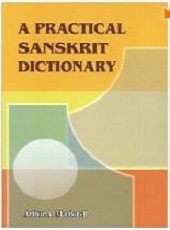
• A Practical Sanskrikt Dictionary,
by A. A. Macdonell, 1893,
http://www.sanskrit-lexicon.uni-koeln.de/scans/MDScan/index.php?sfx=jpg;
1929.
-
Nataraj ed., 1st in 2006, 2012.
-
https://dsal.uchicago.edu/dictionaries/macdonell/ 190516
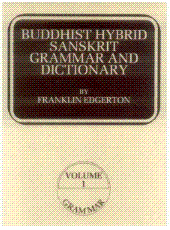
• The Buddhist Hybrid Sanskrit Grammar and
Dictionary, BHS, vol.2, by F. Edgerton,
pp. 627.
-
FEdgerton-BHSD<Ô> /
Bkp<Ô> (link chk 180627)
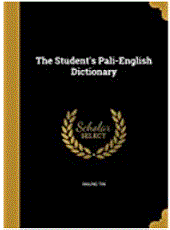
• The Student's Pali English dictionary ,
by U Pe Maung Tin, 1920.
- (ref: UPMT-PEDxxx).
Downloaded copies in TIL
HD-PDF and SD-PDF libraries:
-
UPMT-PaliDict1920<Ô> /
bkp<Ô> (link chk 190113)
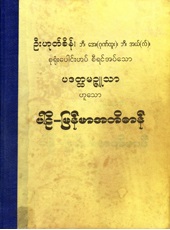
• Pali-Myanmar Dictionary
(in Pal-Myan), by U Hoke Sein,
- (ref: UHS-PMD). The dictionary in printed form is in TIL Research Library.
• Latin-English Vocabulary II, by Hans H Ørberg, 1998
-
HHOrberg-LinguaLatina<Ô> /
Bkp<Ô> (link
chk 190624)
Edited by U Kyaw Tun (UKT) (M.S., I.P.S.T., USA),
Daw Khin Wutyi, Daw Thuzar Myint, Daw Zinthiri Han
and staff of Tun Institute of Learning (TIL).
Not for sale. No copyright. Free for everyone.
Prepared for students and staff of TIL
Research Station, Yangon, MYANMAR
-
http://www.tuninst.net ,
www.romabama.blogspot.com
MC-indx.htm |
Top
MCpp-indx.htm
See my note on Checking Long Vowels - not allowed in Bur-Myan
Compare with checking{ka.} (1 blnk) in p060-3.htm
{kâ}/{kaa} का (long vowel: 2 eye-blinks)
 {kâ-ka.}/{kaa-ka.}
काक
{kâ-ka.}/{kaa-ka.}
काक
 {kaak}/{kâk}
UKT 190411, 200203: I've to use
{hka.mauk}-diacritic for front-vowel pairs: {ka.}-{kâ} (open-vowels) and {ki }-{kî } (close-vowels). However, I cannot do this for back vowel {ku.}-{kû } due to English using only one u for both /ʌ/ (as in but) and /ʊ/ (as in put). I have no option but to use: {ku.kuu}. From this it follows that
{käin} , and it has to be differentiated from the Kinsi
{kân~}/{kaïn} !
{kân~}/{kaïn} : Kinsi
 {kâ-sa.}/{kaa-sa.} काच
 {kâ-za.}/{kaa-za.} काज
 {kâ-ña.}/{kaa-ña.} काञ
 {kâ-Ta.}/{kaa-Ta.} काट
 {kâ-HTa.}/{kaa-HTa.} काठ
 {kâ-Na.}/{kaa-Na.} काण
 {kâ-ta.}/{kaa-ta.} कात
 {kâ-da.}/{kaa-da.}
Skt Roots: entered below:
Whit018:
√kā, see √kan;
√kāñks, 'desire';
√kaç,
'appear, make a show';
UKT 190411, 200203: Computers cannot differentiate ṣ (with a dot below) and s (without dot) in bookmarks. It is one of the reasons for me to invent ASCII-compatible Romabama
{ro:ma.ba.ma}. Also remember that Bur-Myan thibilant-phoneme
{þa.} /θ/ is not present in Skt-Dev. Its equivalents in Skt-Dev are all sibilants: the husher /ʃ/, the extreme hisser /s/, and a normal hisser /s/. They are dental, and are represented by [ś]-/ʃ/ , [ṣ]-/s/, and [s]-/s/.
To make the confusion worse, Bur-Myan pronounces r2 as palatal-stops, whereas Skt-Dev (and incidentally Mon-Myan, and Eng-Lat) as palatal-affricates. Romabama
{sa.}/
{c} for च ,
{sha.}/
{sh} for श ,
{Sa.}/
{S},
{þ}.
The result of my analysis is shown in the right.श ś [ɕ] /ʃ/ ; ष ṣ [ʂ] /s/; स s [s] /θ/
UKT notes
• Buddha Carita : person of miraculous birth
• Checking the Long Vowels
• Kanabhuti the Cyclop :
• Kanva Rishi : Origin of Tantra ?
• Kakshivat
- Buddha's miraculous birth (UKT should I combine it with Buddha Carita?)
• Katantra Vyakaranam :

 {ka-tûn~tra. bya-ka.ra.Na.} - teaching Sanskrit to a Telugu king
• Myanmar Monastic Education
• Two-three tone problem
{kâ} का Refer to p060-3.htm for comparison with
See my note on Two-three tone problem, and its resolution when Mon-Myan, which is similar to Skt-Dev, is taken into account.
√kā, see √kan - Whit018
√kāñkṣ, 'desire' - Whit018
- Verb, kasta v.b.s., kasita s.+
• p065c2-b12/ not online

का [kâ]
- °- = ka- , kad- , kava- ,
ku- , bad
UKT 170222: का [kâ] , the Skt-Dev interrogative, is also the name of God.
See ¤ Allah, The Unique Name of God, 'research into the names of God in over 150 languages of the world' by Maulana Abdul Haq Vidyarthi , 2007. The downloaded book is in the TIL HD-PDF and SD-PDF librairies
- AHVidyarthi-Allah<Ô> / Bkp<Ô> (link chk 200211)
Inset pix: p.092 of the above book:UKT 200204: Just because, a tribe calls their tribal god the "god of all gods" does not make him Allah. After all, "gods", and "god of all gods" are just Axiomatic beings, whom none has seen or talk to except in their "dreams" and "trances". I'm just content just to go by the First Four Laws, and Anatta Principle of our teacher, Siddhartha Gautama, who was a man of flesh and blood, who eventually died and was cremated. In reverence, I salute him: {na.mau:boad~Da-ya.þaid~Dän} in the language of my great grandmother: - Mon-Myanmar salutation<))
• p065c2-b13/uchg p053-
कांशि [ kâmsi ]
- m. goblet, cup.
• p065c2-b14/uchg p053-033
कांस्य [ kâmsya ]
- a. brazen; n. brass;
-kâra, m. bell-founder;
-tâla,
m. cymbal;
-pâtra,
n.,
î, f. brazen
vessel.
{ka-ka.} काक
• p065c2-b15/uchg p053-
काक [ kâka ]
- m. crow: î, f. female crow;
-tâ, f. state of a crow;
-tâlîya,
a.
accidental as the fall of the
fruit in the story concerning the crow and the date, i.e. as accidental as the
fall of the date at
the moment of the crow's alighting on the palm-tree = post hoc, non propter hoc:
-m or -vat, ad.
suddenly, unexpectedly;
-paksha, m. crow's wing; curl on the temples of boys or
youths:
-ka,
--°, a. id.;
-yava, m. pl. grainless barley;
-rava,
a. cawing like a crow,
cowardly;
-rûka, a.
cowardly.
From - https://en.wikipedia.org/wiki/Post_hoc_ergo_propter_hoc 200204
"Post hoc is a particularly tempting error because correlation appears to suggest causality. The fallacy lies in a conclusion based solely on the order of events, rather than taking into account other factors potentially responsible for the result that might rule out the connection. A simple example is 'the rooster crows immediately before sunrise; therefore the rooster causes the sun to rise.' "
UKT 200204: The Bur-Myan equivalent is{htûn: þi: krwé hkeik/ kyi: nín: hkeik// i.e. as accidental as the fall of the
datetoddy-fruit at the moment of the crow's alighting on the palm-tree .
• p065c2-b16/uchg p053-
काकलि [ kâkali ]
- f. low, sweet tone;
î, f. id.; musical instrument with a low note used
to test whether
one is asleep.
• p065c2-b17/uchg p053-
काकाक्षिन्याय [ kâk]
- m.: in., ab. after the manner of the crow's eye, i.e. in opposite
directions, with reference both to what precedes and what follows;
-‿akshi-golanyâya,
m. id.
•
p065c2-b18/uchg p053-
काकिणी kâkinî, ˚नी [ -nî ]
- f. cowrie, small coin = 1/4 pana.
•
p065c2-b19/uchg p053-
काकु [ kâku ]
- f. cry of grief, wail; change of voice, emphasis.
• p065c2-b20/uchg p053-
काकुत्स्थ [ kâkutstha ]
- m. descendant of Kakutstha (ep. of Aga, Dasaratha, Râma, Lakshmana).
UKT 170213: Kakutstha was a king of the Solar dynasty, the son of Bhageeratha, and an ancestor of Rama. His son is Raghu. - http://www.apamnapat.com/entities/Kakutstha.html 110903
See detail in Wikipedia: https://en.wikipedia.org/wiki/Suryavansha 170213
"Suryavansha{þu.ri.ya. wän-þa.} (Suryavam(n)sham aka Solar Dynasty) is a mythological dynasty of ancient India. The term Suryavanshi refers to a person belonging to Suryvansha dynasty. ... Ikshvaku: the first prominent monarch of this dynasty, ..." King Ikshvaku 'Sugar-cane' is known as "Okkaka" {auk~ka-ka. mín:} in Bur-Myan.
• p065c2-b21/uchg p053-
काकुद्् [ kâkud ]
- f. palate.
(p065c2-end)
• p065c3-b00/uchg p053-
काकोल [ kâkola ]
- m. raven; n. kind of poison; a certain hell.
• p065c3-b01/uchg p053-
• काकोलूकीय
[ kâka‿ulûk-îya ]
- n. story of the crows and the owls.
 {kâ-kSa.} : Pseudo Kha
• p065c3-b02/uchg p053-
काक्षीवती
[ kâkshîvatî ]
= (क ा) (क ् ष) ी व त ी
- f. daughter of Kakshîvat.
See my note on काक्षीवत : persons of miraculous birth - in The Buddha Carita - my first introduction (110904) to Mahayana Buddhist texts by E.B. Cowell, 1894. As a down-to-earth scientist, I am sceptical of miracles. My interest is only in their linguistic content.
My note on Buddha Carita is useful for me in learning to read Skt-Dev conjuncts,
See also • Kakshivat - Buddha's birth (UKT; to be combined with Buddha Carita)śriyaṁ parārdhyāṁ vidadhadvidhāt jit tamo nirasyannabhibhūtabhānubh t |
nudannidāghaṁ jitacārucaṁdramāḥ sa vaṁdyate 'rhanniha yasya nopamā || 1.1*1. That Arhat is here saluted, who has no counterpart, — who, as bestowing the supreme happiness, surpasses (Brahman) the Creator, — who, as driving away darkness, vanquishes the sun, — and, as dispelling all burning heat, surpasses the beautiful moon.
 {kâín}/
{kâïn~}
{kâín}/
{kâïn~}

UKT 190408: Remember, I've to use ín & ïn because I couldn't find a monograph for semi-nasal
{gna.}/
{ng} which is generally spelled with digraph ng . Remember, the English silent letters in English. The English word <king> is pronounced /kɪŋ/ (DJPD16-300) - without g sound.
• p065c3-b03/ not online
काङ्क्ष [kāṅkśa]
Skt: क2381;क्ष् [kāṅkśa]
- desire, long for, strive after; expect, wait for (ac.):
pp. -ita.
abhi, long for: pp. wished for, desired.
â, desire, want;
strive for; wait for (ac.), seek (g.), turn towards (ac.); require
as a complement (gr.) - Mac065
Skt: काङ्क्षा «kāṅkṣā» - f. wish, desire, hankering, inclination,
etc. - SpkSkt
• p065c3-b04/uchg p053-
काङ्क्षणीय
[ kâṅksh-anîya ]
- fp. desirable;
-â, f. desire for (--°);
-in, a. desirous of, longing for,
waiting for (ac. or --°).
√kāç,
'appear, make a show'. - Whit018
Verb. kāçita e. ;
-kāçya b.
{kâ-sa.} काच
• p065c3-b05/uchg p053-
काच [ kâká ]
- m. glass:
-mani, m. crystal;
-ra, a. made of glass.
{kâ-za.} काज
• p065c3-b06/uchg p053-
काज [ kâga ]
- n. mallet.
In connection with the mallet
{lak-hkût} and triangular brass gong
{kré:sæÑ},
see my note on Myanmar Monastic Education.
{kâ-ña.} काञ
• p065c3-b07/uchg p053-
काञ्चन
[ kâñkana ] = क ा ञ ् च न
- n. gold; money; a. (î) golden;
- giri,
m. gold mtn., ep. of Meru;
-prabha,
a. shining like gold;
-maya, a. (î) golden;
-mâlâ, f. N. of various women;
-varman,
m. N. of a king;
-‿akala, -‿adri,
m. ep. of Mount Meru.
© काञ्चन
[ kâñkana ]
= क ा ञ ् च न -->
 {kâiñ~sa.na.}
Skt: काञ्चन
[ kâñkana ]
- n. gold; money; a. (î) golden; - MC065c3
BPal:  {kiñ~sa.na.} - UHS PMD0277
UKT from UHS: n. gold
UKT 151031: Notice the vowel change in going from Pal-Myan:
• p065c3-b08/uchg p053-
काञ्चनीय
[ kâñkan-îya ]
- a. golden.
• p065c3-b09/uchg p053-
काञ्ची [ kâñkî ]
- f. small girdle generally adorned with bells;
-kalâpa, m. id.;
-guna,
m. girdle-band;
- sthâna, n. hips.
• p065c3-b10/uchg p053-
काञ्जिक [ kâñgika ]
- n. sour gruel.
{kâ-Ta.} काट
• p065c3-b11/uchg p053-
काट [ kâtá ]
- m. depth, bottom.
• p065c3-b12/ not online
[kâṭaya-vema]
- m. N. of a commentator
UKT 200207:Kâṭayavema was the commentator of Mâlavikâgnimitra written by Kalidas
- SPPandit-KalidasMalavikagnimitra<Ô> / Bkp<Ô> (link chk 200207)
• p065c3-b13/uchg p053-
काटव [ kâtava ]
- n. sharpness.
{kâ-HTa.} काठ
• p065c3-b14/uchg p053-
काठ [ kâtha ]
-->
{ka-HTa.}
- a. derived from Katha;
-ka,
a. (î) relating to Katha;
n. N. of a Veda:
-‿upanishad =
katha‿upanishad.
UKT 170214, 200208 : See also p061.htm > note: Katha Upanishad
- from Wikipedia: https://en.wikipedia.org/wiki/Katha_Upanishad 170214
"The Katha Upanishad कठोपनिषद् «kaṭhopaniṣad» aka Kāṭhaka Upanishad is one of the mukhya (primary) Upanishads, embedded in the last short eight sections of the Kaṭha school of the Yajurveda. [1] [2] ... The Upanishad is the legendary story of a little boy, Nachiketa – the son of Sage Vajasravasa, who meets Yama (the Indian deity of Death [and Justice]). [Yama in popular Myanmar Buddhism is King of the Hell.] Their conversation evolves to a discussion of the nature of man, knowledge, Atman (Soul, Self) and moksha (liberation). [2] "
Today, 200208, the Full Moon of Ta'baung, when I, by fullness of the Moon, can be considered to be my 85th birth-day. I am crossing a milestone in Life, and its time to consider Death from various angles.
Read Katha Upanishad, by Swami Sivananda, 2012
- Sivananda-KathaUpanishad<Ô> / Bkp<Ô> (link chk 200212)
Read The Magic and Occultism of India, by L. W. deLaurence, 1909
- LWdeLaurence-MagicOccultIndia<Ô> / Bkp<Ô> (link chk 200212)
"As you delve into Hindu, Egyptian ancient mysteries the Spirit world will open before you. The more you begin to understand the language of the Adepts the more grows your conception of that life and world called Spirit, not seen by the outward sight."
• p065c3-b15/uchg p053-
काठिन्य
[ kâthin-ya ]
- n. hardness, stiffness; firmness, austerity.
{kâ-Na.} काण
• p065c3-b16/uchg p053-
काण [ kâná ] :
- a. one-eyed; blind (eye);
perforated; one-handled; -tva,
n. one-eyedness;
-bhûti, m. N. of a Yaksha.
UKT 170214: Don't mix up with Karna
{kar~Na.} कर्ण, «karṇa» of Mahabharata.
© काण [ kâná ] -->
{ka-Na.}
Skt: काण [ kâná ] - a.
one-eyed; blind (eye); perforated; one-handled; - Mac65c3
BPal:
{ka-Na.} - UHS-PMD0306
- 
UKT from UHS: mfn. blinded in one eye
See my note on
Kanabhuti the Cyclops
UKT 171213: The story of
Also: The epic poem - https://en.wikipedia.org/wiki/Dionysiaca 171213, 200208
and on Greek god of wine and harvest: https://en.wikipedia.org/wiki/Dionysus 171213
See the epic poem in Greek by Nonnos with English translation by W H D Rouse, 1942
- WHDRouse-NonnosDionysiaca<Ô> / Bkp<Ô> (link chk 200208)
• p065c3-b17/ not online
[kânelî-mâtri ]
- m. bastard
Skt: काणेलीमातृ «kāṇelīmātṛ» - m. bastard - SpkSkt
• p065c3-b18/uchg p053-
काण्टक [ kântaka ]
- a. (î) consisting of thorns.
• p065c3-b19/uchg p053-
काण्ड [ kãnda (or á) ]
Skt: काण्ड [ kãnda (or á)]
- m. n. piece; section of a plant (from joint to joint);
slip; blade,
stalk; arrow; tube (of bone); section (in a book);
-pata: -ka,
m. curtain. - Mac065c3
© काण्ड [ kãnda (or á) ]
Skt: काण्ड [ kãnda (or á)]
- m. n. piece; section of a plant (from joint to joint); slip; blade,
stalk; arrow; tube (of bone); section (in a book) - Mac065c3
Skt: काण्ड
«kāṇḍa» - adj. part of
trunk of tree with branches, praise, opportunity,
quantity, separate department or subject, kind of
square measure, cluster, flattery - SpkSkt
BPal:  {kûN~ða.} - UHS PMD0281
UKT from UHS: mn. arrow, section
(in a book), division, part, trunk (bearing
branches of a tree)
• p065c3-b20/ not online
[kândâra]
- m. a certain mixed caste
• p065c3-b21/uchg p053-079
काण्डी [ kândî ]
- f. little blade.
• p065c3-b22/uchg p053-
काण्डीर [ kând-îra ]
- a. armed with arrows.
• p065c3-b23/uchg p053-
काण्व [ kânvá ]
- m. pat. descendant of Kanva: pl. the school of Kanva.
See my note on Kanva
Rishi
Kanva कण्व «káṇva» was an ancient Hindu rishi, to whom some of the hymns of the Rig Veda are ascribed. He was called a son of Ghora and one of the Angirasas. He is sometimes included in the list of the seven sages (the Saptarishis).
- http://en.wikipedia.org/wiki/Kanvas 110904
( end of old p065-3.htm )
{kâ-ta.} कात
p065c3-b24/ not online
• कातन्त्र
[kâ-tantra]
= क ा त न ् त ् र -->
{ka-tûn~tra.}
-- n. T. of a grammar; m. pl. its followers
UKT 140225, 170218, 200211: Grammar is
{þûd~da} 'sound' of the human voice. However
{ka-tûn~tra. bya-ka.ra.Nûm} कातन्त्र-व्याकरणम् is morphology. Note the visible virama which shows that
Katantra Vyakaranam
See my note on Katantra Vyakaranam.
• p065c3-b25/uchg p053-
कातर [ kâtara ]
- a. cowardly; timid, faint-hearted,
despondent; afraid of (lc., inf., --°):
-tâ, f., -tva,
n. fear.
© कातर [ kâtara ]
-->
 {kâ-ta.ra.}
Skt: कातर [ kâtara ]
- a. cowardly; timid, faint-hearted,
despondent; afraid of (lc., inf., --°):
- Mac065c3
BPal:
{kâ-ta.ra.} - UHS-PMD0306
-

UKT from UHS: m. a person unstable
in mind and character
• p065c3-b26/uchg p053-
कातर्य
[ kâtar-ya ]
- n. apprehension, faint-heartedness,
cowardice.
p065c3-b27/ not online
• [kât-kri ]
- mock, deride
• p065c3-b28/uchg p053-
कात्यायन
[ kâtya‿ayana ]
- m. pat. N. of a celebrated sage;
&isharp;,|
f. N. of Yâgñavalkya's
wife; a. (î) derived from Kâtyâyana;
î-ya,
m. pl. school of Kâtyâyana; n. T. of various
works.
See Wikipedia: https://en.wikipedia.org/wiki/K%C4%81ty%C4%81yana 200212
"Kātyāyana (कात्यायन) also spelled as Katyayana (c. 2nd century BC) [ citation needed] was a Sanskrit grammarian, mathematician and Vedic priest who lived in ancient India"
{kâ-da.}
काद


p065c3-b29/uchg p053-
कादम्ब
[ kâdamba ]
- m. kind of goose with dark-grey wings;
n. flower of the Kadamba tree.
• p065c3-b30/uchg p053-
कादम्बर [ kâdambara ]
- n. sour cream; î, f. kind of intoxicating liquor; T. of a romance & its heroine:
-lokana‿ânanda, m. ep. of the moon;
-sagdhikâ,
f. common
carouse.
UKT 200206: Without a human teacher to teach me Sanskrit, I've to rely on the Internet. And from online sources such as The Buddha Carita, I can learn Sanskrit on my own terms: no home work, no exam - nothing whatsoever. I've only one critic and a severe judge - myself! I've no one to give me a certificate and none to give me an award. My own satisfaction is all I need.
From: The Buddha-Carita, or The Life of Buddha by Aśvaghoṣa, edited and translated by Edward B. Cowell, 1892, 1894
Cowell has also done the Buddha-Carita in Skt-Dev. His works are in TIL HD-PDF and SD-PDF libraries; all links checked 200206
- EBCowell-BuddhaKaritaDev<Ô> / Bkp<Ô>
- EBCowell-BuddhaCaritaEng<Ô> / Bkp<Ô>
- EBCowell-BuddhaCaritaDoublePage<Ô> / Bkp<Ô>
UKT 200206: To transcribe Cowell's Sanskrit, you'll
need to remember mostly श ś , ष
ṣ , स s ; ā, ī , ū ;
ṁ . Cowell's Devanagari is of the old form, but
what you'll will transcribe would be in the new
Devanagari. Don't be intimidated by long words - they
can be separated : take cues from easily recognizable
diacritics such as
ं ा ि ी ु ू ृ े .
First you must learn to recognize short phrases, such as IAST
«śriyaṁ» --> श ् र ि य ं
= श्रियं
«tamo» --> तमो
«nudannidāghaṁ» --> ?
«vaṁdyate» --> व ं द ् य त े
= वंद्यते
«yasya» --> यस्य
�«nopamā» --> नोपमा

----- the following is from: https://www.ancient-buddhist-texts.net/Texts-and-Translations/Buddhacarita/01-Book-I.htm 200212
śriyaṁ parārdhyāṁ vidadhadvidhātṛjit tamo
nirasyannabhibhūtabhānubhṛt |
nudannidāghaṁ jitacārucaṁdramāḥ sa vaṁdyate 'rhanniha yasya nopamā || 1.1
*
Verses marked with an asterick are omitted from Johnson's edition as being
spurious..02
1. That Arhat is here saluted, who has no counterpart, — who, as
bestowing the supreme happiness, surpasses (Brahman) the Creator, — who, as
driving away darkness, vanquishes the sun, — and, as dispelling all burning
heat, surpasses the beautiful moon.
... ... ...
mayāpi taṁ kukṣigataṁ dadhānā vidyudvilāsaṁ
jaladāvalīva |
dānābhivarṣaiḥ parito janānāṁ dāridryatāpaṁ śamayāṁcakāra || 1.22*
22. Māyā also, holding him in her womb, like a line of clouds holding a
lightning-flash, relieved the people around her from the sufferings of poverty
by raining showers of gifts.
sātaḥ purajanā devī kadācidatha luṁbinīm |
jagāmānumate rājñaḥ saṁbhūtottamadohadā || 1.23*
23. Then one day by the king’s permission the queen, having a great longing in
her mind, went with the inmates of the gynaeceum into the garden Lumbinī.
śākhāmālaṁbamānāyāḥ puṣpabhārāvalaṁbinīm |
devyāḥ kukṣiṁ vibhidyāśu bodhisattvo viniryayau || 1.24*
24. As the queen supported herself by a bough which hung laden with a weight of
flowers, the Bodhisattva suddenly came forth, cleaving open her womb.
tataḥ prasannaśca babhūva puṣyastasyāśca devyā
vratasaṁskṛtāyāḥ |
pārśvātsuto lokahitāya jajñe nirvedanaṁ caiva nirāmayaṁ ca || 1.25 (1.9)
25.
15 At that time the constellation Puṣya was auspicious, and
from the side of the queen, who was purified by her vow, her son was born for
the welfare of the world, without pain and without illness.
prātaḥ payodādiva tigmabhānuḥ samudbhavanso 'pi ca
mātṛkukṣeḥ |
sphuranmayūkhairvihatāṁdhakāraiścakāra lokaṁ kanakāvadātam || 1.26*
26. Like the sun bursting from a cloud in the morning, — so he too, when he was
born from his mother's womb, made the world bright like gold, bursting forth
with his rays which dispelled the darkness.
taṁ jātamātramatha kāṁcanayūpagauraṁ
prītaḥ sahasranayaṇaḥ śanakairagṛhṇāt
maṁdārapuṣpanikaraiḥ saha tasya mūrdhni
khānnirmale ca vinipetaturaṁbudhāre || 1.27*
27. As soon as he was born the thousand-eyed (Indra) well-pleased took him
gently, bright like a golden pillar; and two pure streams of water fell down
from heaven upon his head with piles of Mandāra flowers.
surapradhānaiḥ paridhāryamāṇo
dehāṁśujālairanuraṁjayaṁstān |
saṁdhyābhrajāloparisaṁniviṣṭaṁ navoḍurājaṁ vijigāya lakṣmyā || 1.28*
28. Carried about by the chief suras, and delighting them with the rays that
streamed from his body, he surpassed in beauty the new moon as it rests on a
mass of evening clouds.
ūroryathaurvasya pṛthośca
hastānmāṁdhāturiṁdrapratimasya mūrdhnaḥ |
kakṣīvataścaiva bhujāṁsadeśāttathāvidhaṁ tasya babhūva janma || 1.29 (1.10)
29. As was Aurva's birth from the thigh,
Mahābh. I, 2610.16 and Pṛthu's from the hand,
17
and Māndhātṛ's, who was like Indra himself, from the forehead,
18 and Kakṣīvat's from the upper end of the arm,
19 — thus too was his birth (miraculous).
UKT 200206: Note the word «kakṣīvataścaiva» --> «kakṣīvata» = क क ् ष ी व त = कक्षीवत
krameṇa garbhādabhiniḥsṛtaḥ san babhau gataḥ khādiva
yonyajātaḥ |
kalpeṣvanekeṣviva bhāvitātmā yaḥ saṁprajānan suṣuve na mūḍhaḥ || 1.30 (1.11)
30. Having thus in due time issued from the womb, he shone as if he had come
down from heaven, he who had not been born in the natural way, — he who was born
full of wisdom, not foolish, as if his mind had been purified by countless aeons
of contemplation.
Go back Buddha-Carita-note-b
UKT 190408, 200204:
This page is on long vowel
{ka}/{kaa}/{kâ}* (2 blnks). The question here is:
what would happen, if the long vowel is
checked by various codas beginning with:
- codas of the wag-aksharas:
 {k},
{c},
{k},
{c},
 {T},
{T},
 {t},
{t},
 {p} ,
{p} ,
- codas of semi-nasals and true nasals:
{ng},
 {ñ},
{ñ},
 {N},
{N},
 {n},
{n},
 {m}
{m}
- codas of a-wag aksharas:
 {y},
{y},
 {r},
{r},
 {l},
{l},
 {w},
{þ}
{w},
{þ}
- and long-forgotten approximant
 {Ñ} which had been erroneously thought to
be nasal.
{Ñ} which had been erroneously thought to
be nasal.
See the beginning of this problem on
p060-3.htm
(link chk 200203)
>
 {kak} कक् for comparison to
{kaak} काक्
{kak} कक् for comparison to
{kaak} काक्
* An unexpected problem is how to represent
{ka}/{kaa}/{kâ}. It is a remnant from 20 years
ago when I had settled on representing the three
tones of Bur-Myan as:
 {a.},
{a.},
 {a},
{a},
 {a:}. As an alternative for long {a}, I've used
{aa}. Now, it's time to try {â} (Alt+0226)
- but only for checking of long vowel
{â}. But, don't you think writing {kaa} is more convenient than {kâ} ? And with
{kâ} there is always the likelihood of losing the diacritc.
{a:}. As an alternative for long {a}, I've used
{aa}. Now, it's time to try {â} (Alt+0226)
- but only for checking of long vowel
{â}. But, don't you think writing {kaa} is more convenient than {kâ} ? And with
{kâ} there is always the likelihood of losing the diacritc.
Go back CheckingLongVowels-note-b
"Cyclops" is singular, plural is "Cyclopes" -- AHTD
UKT 140225, ... , 181222, 200208:
Folklores and stories told as history about Greece and India can be all mixed up. We must remember Alexander the Great's military campaign to India, and the Buddhist cultural missions from India, probably with peoples from northern Myanmarpré, even to Rome itself and to the eastern parts of the Roman Empire.
Even if you doubt this,
remember that the Myanmar akshara
 {ta.} [თ Tan in Georgian] is still present in the name of the
country of Georgia, both as a glyph and
in pronunciation /t/. Now you will understand why I am mixing up Kanabhuti from
India and Cyclopes from Greece.
{ta.} [თ Tan in Georgian] is still present in the name of the
country of Georgia, both as a glyph and
in pronunciation /t/. Now you will understand why I am mixing up Kanabhuti from
India and Cyclopes from Greece.
Wikipedia: https://en.wikipedia.org/wiki/Cyclops 170214
Also: - https://en.wikipedia.org/wiki/Dionysiaca 170214
to the "the main subject of which is the life of Dionysus, his expedition to India, and his triumphant return to the west."
UKT 181222: I'd thought that Dionysus was a human, but it appears that he might be just the God of Wine, merriment and debauchery of the Greeks in particular or Indo-Aryan peoples wielding iron-weapons infiltrating into the area of Tib-Burmans in India who had only bronze-weapons to defend themselves. From the relief on the handle of a silver-plate, you can see Dionysus on the chariot drawn by lions, followed by the Greek-god Pan . See downloaded txt in TIL HD-PDF and SD-PDF libraries
- CAlexander-IndianDionysus<Ô> / Bkp<Ô> (link chk 200208)
"This silver crescent was the ear, or handle, of a shallow dish. Such another dish was once found in the harbor at Bizerta in Tunisia, during dredging operations; it is circular, with two crescent handles, weighs nearly ten pounds, and is about a yard across, over all."
The story of Kanabhuti - the Yaksha
 {yak-hka.} [taken by common Bur-Myan as
"giant" or "ogre"],
with one-eye appeared in a collection of
legends, fairy tales and folktales by
Somadeva (fl. 11 century A.D.) in
katha sarit sagara
कथासरित्सागर
or "Ocean of the Streams of Story".
The original work was translated by
C. H. Tawney (1837–1922) in 1880. The
story appeared in Book 1, Chapter 2, p6-7.
"How Kanabuti became a Pisacha". The story is told in the fashion of story within
another story, which in turn is within another story - resulting in utter
confusion.
{yak-hka.} [taken by common Bur-Myan as
"giant" or "ogre"],
with one-eye appeared in a collection of
legends, fairy tales and folktales by
Somadeva (fl. 11 century A.D.) in
katha sarit sagara
कथासरित्सागर
or "Ocean of the Streams of Story".
The original work was translated by
C. H. Tawney (1837–1922) in 1880. The
story appeared in Book 1, Chapter 2, p6-7.
"How Kanabuti became a Pisacha". The story is told in the fashion of story within
another story, which in turn is within another story - resulting in utter
confusion.
Because Kanabhuti has only one eye, I will
refer him as "Kana the Cyclops".
The downloaded pdf is in the TIL library.
- CHTawney-SomadevaKathaSaritSagar01<Ô>
/
bkp<Ô> (link chk
200208)
 The myths about a giant race or races of
humans, dubbed as
The myths about a giant race or races of
humans, dubbed as
 {Bi-lu:} or
{yak-hka.} in the East, or Cyclopes
in the West, are probably true if you take
into consideration the remains of gigantic
structures, known as Cyclopean stones of
Mycenaean culture (ca.1600- ca.1100 BCE).
{Bi-lu:} or
{yak-hka.} in the East, or Cyclopes
in the West, are probably true if you take
into consideration the remains of gigantic
structures, known as Cyclopean stones of
Mycenaean culture (ca.1600- ca.1100 BCE).
-
https://en.wikipedia.org/wiki/Mycenaean_Greece
170214
and lost civilizations which had built
structures with massive stones such as
- pyramids of Egypt:
-
https://en.wikipedia.org/wiki/Great_Pyramid_of_Giza
170214
- Stonehenge of Britain
-
https://en.wikipedia.org/wiki/Stonehenge
170214
- Incas and the ancient peoples of Americas
-
https://en.wikipedia.org/wiki/List_of_pre-Columbian_cultures
170214
- From Angkor Wat to Stonehenge: How Ancient People Moved Mountains, by Jane J.
Lee, Nov. 8, 2013:
-
https://news.nationalgeographic.com/news/2013/11/131106-how-ancient-people-moved-huge-structures-archaeology/
190409
The human-author of the story, Somadeva
(fl. 11 century A.D.), was a
Shaivite-Hindu

 {þi-wa. poaN~Na:}, one of those who supposes
that Siva-déva
{þi-wa. poaN~Na:}, one of those who supposes
that Siva-déva
 {þi-wa.nût-mín:} is the Supreme-God
'Creator-Destroyer-Everything' instead of
believing in Hindu-Trinity with Brahma [for clarity I will refer to the Hindu
Brahma as Mahabrahma
{þi-wa.nût-mín:} is the Supreme-God
'Creator-Destroyer-Everything' instead of
believing in Hindu-Trinity with Brahma [for clarity I will refer to the Hindu
Brahma as Mahabrahma

 {ma.ha brah~ma}]
being the Creator, Vishnu-deva
{ma.ha brah~ma}]
being the Creator, Vishnu-deva
 {baiþ~þa.no:nût-mín:} the Administrator,
and Siva
{þi-wa.nût-mín:} the Destroyer. Thus, Somadeva
calls Siva the MahaDeva.
{baiþ~þa.no:nût-mín:} the Administrator,
and Siva
{þi-wa.nût-mín:} the Destroyer. Thus, Somadeva
calls Siva the MahaDeva.
UKT 200208: A clear distinction must be made between the Hindu concept of the Brahma, and the concept of Theravada Buddhism. See Wikipedia: https://en.wikipedia.org/wiki/Buddhist_cosmology_of_the_Theravada_school 202008
Although, "Vishnu" is spelled{paiþ~þa.no:} in the same vein as
{paiþ~þa} 'a unit of weight'.
The Shaivites
believes all the Mother-goddesses
of the original inhabitants of the
Indian-subcontinent, the Tib-Bur speakers,
to be the wives of Siva, thereby making
him the most sex-hungry god always
engaging in sex with Parvati - the flax
plant representing the common peoples.
The Shaivites worship Siva just as a Linga
(Siva's penis) ever stuck in the Yoni
(Parvati's vagina).
See also Wikipedia:
http://en.wikipedia.org/wiki/Kathasaritsagara
140225
Go back Kanabhuti-Cyclop-note-b
-- UKT 140225, ... , 171214, 200208
Proper nouns, such as the names of places
and peoples, are a mine-field in any
language. For example, the word "Myanmar"
 {mrûn-ma} (or more properly {mɹûn-ma}
spelled with a non-rhotic /ɹ/ *), can be a
country, a script, or an ethnicity. Thus it is
imperative to include the suffix
{mrûn-ma} (or more properly {mɹûn-ma}
spelled with a non-rhotic /ɹ/ *), can be a
country, a script, or an ethnicity. Thus it is
imperative to include the suffix
 {præÑ} /pɹé/,
 {sa}, and
 {lu-myo:}.
* non-rhotic /ɹ/ as in British accent - not as in American which is more rhotic
Whenever you come across the name of a person or place, make sure who that person is or where the place is located.
From Wikipedia: https://en.wikipedia.org/wiki/Kanva 140225, 200208
Kanva (Karnesh) कण्व «káṇva» was an ancient Hindu Veda
rishi of the Treta yuga, to whom some of the hymns of the Rig Veda
are ascribed. He was called a son of Ghora and one of the
Angirasas. [UKT: whenever you see an "s" at the end of noun, make sure it is
the "killed-þa." and not the English plural <s>]. He is sometimes included in the list of the seven sages (the
Saptarishis).
UKT 200208: The time of Kanva rishi is given as Treta yuga त्रेता युग. We, Theravada Buddhists are more familiar with
{kûm~Ba}, and I was curious to know Treta yuga
{youg} in terms of
"Angira अङ्गिरा «áṅgira», pronounced [ɐ́ŋɡiɽɐ]) is a Vedic rishi (sage) of Hinduism. He is described in the Rigveda as a teacher of divine knowledge, a mediator between men and gods, as well as stated in other hymns to be the first of Agni-devas (fire gods). [1] [2] He is known by both names angiras and angira. In some texts he is called angiras and in some he is called angira. In some texts, he is considered to be one of the seven great sages or Saptarishis, but in others he is mentioned but not counted in the list of seven great sages. [3] In some manuscripts of Atharvaveda, the text is attributed to "Atharvangirasah", which is a compound of sage Atharvan and Angira. [4] [5] The student family of Angira are called "Angira", [1] [6] and they are credited to be the authors of some hymns in the first, second, fifth, eighth, ninth, and tenth books of the Rigveda. [7] "
UKT 170215, 200208: Because of the Hindu Poannars
Rig-Véda is a collection of Mantras
{mûn~tûn} the so-called hymns to various celestial beings, males & females, Déva
{dé-wa.}, Asura
{a.þu.ra}, even Aspira (the celestial dancers in the employ of Celestial King Indra: Skt-Dev: अप्सराः «apsarāḥ», Pali-IAST «accharā»,
{dé-wíc~hsa.ra} as the goddesses of gambling-luck or fortune), and lower beings right down to Man'es
{nût-saim:} and ghosts
{þa.rè:}
{tíc~hsé} all having "powers of various degree" due to their "births" without material bodies. These immaterial entities can affect the lives of humans of flesh and blood.
Inset pix: A Cambodian dancer dancing the Aspira dance.
To the Myanmar-Buddhists the Mantras
{ra.þé.} (to be recited meticulously without music) to make these celestial and earth-bound immaterial beings serve them. These human Rishis
{a.kyín. þi-la.} to empower the
{yûn~ta.ra:} known as Inn
{ ín:} in Bur-Myan and Yan in Cambodian and Thai languages .
Indra
{ain~dra.}, the king of the dévas is always afraid of these Mantra-wielding
An inferior novice
{zau-gyi} who not having a
{þu-yaún mèý}.
All these beliefs are of the Tib-Bur speakers - the Bronze Age indigenous peoples - under the rubric of Tantric practices, and I opine that the Hindu Poannars
For a glimpse of what Tib-Bur of the old had believed, see the modern Tij-Rishi Panchami - women's festival, by Lynn Bennett, in TIL HD-PDF and SD-PDF libraries:
- LBennett-03WivesOfRishis<Ô> / Bkp<Ô> (link chk 200212)
Now let's continue with Kanva कण्व «káṇva» the rishi:
• Kanva is also the name of a founder of a Vedic shakha [see below],
• Kanva is also the name of several princes and founders of dynasties and several authors.
• The Kanvas are the descendants of king Vasudeva Kanva (1st century BCE).
• The Kanvas are also a class of evil spirits, against whom hymn 2.25 of the Atharva Veda is used as a charm.
The kanva was a great rishi in Treta Yug. He was the founder of Mahrshi kanva ashrama.
Maharshi Kanva Ashram is located in a well-grown village called "Kanalda". KANALDA is 12 km north of Jalgaon district in Maharashtra, India. More details can be found on http://www.maharshikanvaashram.com/
From Wikipedia: http://en.wikipedia.org/wiki/Shakha 140225
A shakha «śākhā» "branch" or "limb", is a Hindu theological school that specializes in learning certain Vedic texts, or else the traditional texts followed by such a school. [3] [4] An individual follower of a particular school or recension is called a śākhin. [5] The term is also used in Hindu philosophy to refer to an adherent of a particular orthodox system. [6]
A related term caraṇa, ("conduct of life" or "behavior") is also used to refer to such a Vedic school: [7] "although the words caraṇa and śākhā are sometimes used synonymously, yet caraṇa properly applies to the sect or collection of persons united in one school, and śākhā to the traditional text followed, as in the phrase śākhām adhite, ("he recites a particular version of the Veda")". [4] The schools have different points of view, described as "difference of (Vedic) school" (śākhābhedaḥ). Each school would learn a specific Vedic Saṃhita (one of the "four Vedas" properly so-called), as well as its associated Brahmana, Aranyakas, Shrautasutras, Grhyasutras and Upanishads. [3] [4]
In traditional Hindu society affiliation with a
specific school is an important aspect of class
identity. By the end of the Rig Vedic period the
term Brāhmaṇa
{poaN~Na:} had come to be applied to all members
of the priestly class, but there were subdivisions
within this order based both on caste and on the
shakha (branch) with which they were affiliated.
[8]
A Brāhmaṇa who changed school
would be called "a traitor to his
śākhā"
(śākhāraṇḍaḥ).
[3]
Go back Kanva-rhisi-note-b
-- UKT 110904, 170213, 200210
Being by birth and practice a Theravada
Buddhist, particularly with a modern
material science background, I have never
delved into the Mahayana texts. Below is
an excerpt of the birth of Gautama Buddha
from the English translation of
The Buddha-karita of Asvaghosha
by E. B. Cowell.
- taken from
http://www.sacred-texts.com/bud/sbe49/
. See downloaded pdf in TIL HD-PDF and SD-PDF libraries. There are 3 versions:
in order to differentiate them I've renamed them. There is one more by E B
Cowell: it is under another name.
#1.
EBCowell-BuddhaCaritaDoublePage<Ô>
1. That Arhat is here saluted, who has no counterpart,—who, as bestowing the
supreme happiness, surpasses (Brahman) the Creator,—who, as driving away
darkness, vanquishes the sun,—and, as dispelling all burning heat, surpasses the
beautiful moon.
#2.
EBCowell-BuddhaCaritaEng<Ô>
«śriyaṁ pa  .. ...
nudannidāghaṁ jitacārucaṁdramāḥ sa vaṁdyate ’rhanniha yasya nopamā» || 1.1*2
1. That Arhat is here saluted, who has no counterpart, — who, as bestowing the
supreme happiness, surpasses (Brahman) the Creator, — who, as driving away
darkness, vanquishes the sun, — and, as dispelling all burning heat, surpasses
the beautiful moon.
#3. EBCowell-BuddhaKaritaDev<Ô>
UKT: I can now take #2 and #3 together and learn to read and write Skt-Dev.
4.
EBCowell-RigVedaFifthBk<Ô>
UKT: English translation only.

Book I: [Bhagavatprasūtiḥ] - [The Birth of the Holy One] ¹
śriyaṁ parārdhyāṁ ...
nudannidāghaṁ jitacārucaṁdramāḥ sa vaṁdyate ’rhanniha yasya nopamā ||
1.1* ²
1. That Arhat is here saluted, who has no counterpart, — who, as bestowing the supreme happiness, surpasses (Brahman) the Creator, — who, as driving away darkness, vanquishes the sun, — and, as dispelling all burning heat, surpasses the beautiful moon.
āsīdviśālonnatasānulakṣmyā payodapaṁktyeva parītapārśvam | udagradhiṣṇyaṁ gagaṇe ’vagāḍhaṁ puraṁ maharṣeḥ kapilasya vastu || 1.2*
2. There was a city, the dwelling-place ³ of the great saint Kapila, having its sides surrounded by the beauty of a lofty broad table-land as by a line of clouds, and itself, with its high-soaring palaces, 4 immersed in the sky.
Wikipedia: https://en.wikipedia.org/wiki/A%C5%9Bvagho%E1%B9%A3a 170213
" Aśvaghoṣa अश्वघोष) (c.80 - c.150 CE) was an Indian philosopher-poet, born in Saketa in northern India to a Brahmin family. [1] He is believed to have been the first Sanskrit dramatist, and is considered the greatest Indian poet prior to Kālidāsa [most probably Shaivite Hindu]. He was the most famous in a group of Buddhist court writers, whose epics rivalled the contemporary Ramayana [Hindu epic]. [2] Whereas much of Buddhist literature prior to the time of Aśvaghoṣa had been composed in Buddhist Hybrid Sanskrit, Aśvaghoṣa wrote in Classical Sanskrit. [3]From: http://www.ishwar.com/buddhism/holy_mahayana_texts/buddha_karita_of_asvaghosha/texts01.html 110904
Note: Website http://www.ishwar.com/buddhism/holy_mahayana_texts/ 171212 has other texts which can be downloaded:
• The Amitâyus Dhyâna Sûtra
• The Buddha-karita of Asvaghosha
• The Larger Pragñâ Pâramitâ Hridaya Sûtra
• The Smaller Pragñâ Pâramitâ Hridaya Sûtra
• The Larger Sukhâvatî Vyûha
• The Smaller Sukhâvatî Vyûha
• The Vagrakkhedikâ (Diamond-Cutter)
1. That Arhat is here saluted, who has no counterpart, -- who, as bestowing the supreme happiness, surpasses (Brahman) the Creator, -- who, as driving away darkness, vanquishes the sun, -- and, as dispelling all burning heat, surpasses the beautiful moon.
2. There was a city, the dwelling-place of the great saint Kapila, having its sides surrounded by the beauty of a lofty broad table-land as by a line of clouds, and itself, with its high-soaring palaces, immersed in the sky.
... ... ...
9. A king, by name Suddhodana, of the kindred of the Sun, anointed to stand at the head of earth's monarchs, -- ruling over the city, adorned it, as a bee-inmate a full-blown lotus.
--- --- ---
15. To him there was a queen, named Mâyâ, as if free from all deceit (mâyâ) -- an effulgence proceeding from his effulgence, like the splendour of the Sun when it is free from all the influence of darkness, -- a chief queen in the united assembly of all queens.
--- --- ---
19. Then falling from the host of beings in the Tushita heaven, and illumining the three worlds, the most excellent of Bodhisattvas suddenly entered at a thought into her womb, like the Nâga-king entering the cave of Nandâ.
--- --- ---
23. Then one day by the king's permission the queen, having a great longing in her mind, went with the inmates of the gynaeceum into the garden Lumbinî.
24. As the queen supported herself by a bough which hung laden with a weight of flowers, the Bodhisattva suddenly came forth, cleaving open her womb.
--- --- ---
27. As soon as he was born the thousand-eyed (Indra) well-pleased took him gently, bright like a golden pillar; and two pure streams of water fell down from heaven upon his head with piles of Mandâra flowers.
28. Carried about by the chief suras, and delighting them with the rays that streamed from his body, he surpassed in beauty the new moon as it rests on a mass of evening clouds.
29. As was Aurva's birth from the thigh, and Prithu's from the hand, and Mândhâtri's, who was like Indra himself, from the forehead, and Kakshîvat's from the upper end of the arm, -- thus too was his birth (miraculous).
--- --- ---
33. Unflurried, with the lotus-sign in high relief, far-striding, set down with a stamp, -- seven such firm footsteps did he then take, -- he who was like the constellation of the seven rishis.
34. 'I am born for supreme knowledge, for the welfare of the world, -- thus this is my last birth,' -- thus did he of lion gait, gazing at the four quarters, utter a voice full of auspicious meaning.
UKT: More in the article.
Go back Kakshivat-note-b
Kātantra Vyākaraṇa
-- UKT 140226, ... , 181222, 200211
The Sanskrit following the Panini's Aṣṭādhyāyī grammar is known as the the Classical Sanskrit. What goes before Panini is usually described as "Védic-Sanskrit" - a term which I dispute.
UKT 170220: Here's another question. We know that
{þûd~da} is 'sound'. It is translated as English word "grammar". Can it be right? A. W. Lonsdale in his ¤ Burmese Grammar and Grammatical Analysis 1899
- BG1899-indx.htm - update 160930
has described the Burmese Grammar in in two parts: Part 1. Orthoepy (pronunciation) and orthography (spelling); and Part 2. Accidence and syntax. Since, 'sound' is given asWhat we miss in teaching Grammar in Myanmarpré is teaching Accidence (another unfamiliar word), and Syntax (a word which has no clear-cut equivalent in Burmese: there are other similar cases which necessitates me - a half-baked "grammarian", to coin my own definitions for which I beg you to understand.). Describing Grammar as
Védic and its various dialects was the language of
the original inhabitants of the Bronze Age of the
Indian subcontinent: Magadhi being the most prominent.
Most of these dialects, in particular Néwari, the
extant language of the blood relatives of Gautama
Buddha. They are still living in the Kathmandu valley
of Népal. Néwari is Tib-Bur. There are many
similarities between Néwari and Bur-Myan, in particular
words beginning with the phoneme
{gna.} as onset and
{ng} as coda. It is absent in IE languages such as
Eng-Lat and Skt-Dev. Its IPA symbol is /ŋ/. Though
described as a nasal, I contend that it is not. It has
no nasal sound in onset, in both Bur-Myan and Mon-Myan
(Peguan dialect). I've described it as Semi-nasal
to different from  {na.}/
{n}, and,
{na.}/
{n}, and,
 {ma.}/
{m}.
{ma.}/
{m}.
Sanskrit, is the language of the intruders into India wielding iron weapons, and they conquered the Tib-Bur speakers. They brought in the Iron Age displacing the Bronze age in India in particular extending into Myanmarpré and South-east Asia.
 Panini

 {hsa.ra pa-Ni.ni.}, Vyasa
 {hsa.ra bya-þa.} व्यास
«vja:sə», and other ancient linguists of the time
adapted Védic into Sanskrit. I hold that the ancient
Védic was Tib-Bur, whereas Panini's Sanskrit is IE.
{hsa.ra bya-þa.} व्यास
«vja:sə», and other ancient linguists of the time
adapted Védic into Sanskrit. I hold that the ancient
Védic was Tib-Bur, whereas Panini's Sanskrit is IE.
He [व्यास «vja:sə»] is called Ved Vyasa because he had split the original version of Vedas into four parts; Ved Vyasa literally means 'the splitter of Vedas'. It was because Ved Vyasa had split the Vedas that it became easy for people to understand it. This is how the divine knowledge was made available to everyone. Jan 18, 2016 - Google search 200211
UKT 170220: Sanskrit is speech: I am not sure what script it went with. Certainly, it was not Devanagari, because it's older name was Nagari. Moreover, there have been changes in the shape of the aksharas as can be seen in the difference used by A. A. Macdonell, and the present. What then was the script of the intruders - those with their male gods of juvenile bed-time stories? Was it Cuniform, since they came through Persia? Or, did they even has a script?
Whatever the script was to write the Vedas, those who had studied the human language scientifically, based on Place of Articulation, and Mode of Articulation in the human vocal tract, would have used a scientifically derived script, such as one based on circles which has a bearing on pronunciation. Inset shows how a single circle may be used to convey meaning: such as differentiation between what is Perfect and what are Imperfections. To convey pronunciation both single circle and double circles would have to be used.
 I was, and is still, very weak in grammar, and do not
know the difference between
{þûd~da} and
{bya-ka.ra.Na.}. I search in the Dictionary of
Pali-derived Myanmar words (in Bur-Myan) -
UTM-PDMD by U Tun Myint, Univ. of Rangoon
Press, 1968, pp 627. For
{þûd~da}, on p352-353, and for
{bya-ka.ra.Na.} on p207.
I was, and is still, very weak in grammar, and do not
know the difference between
{þûd~da} and
{bya-ka.ra.Na.}. I search in the Dictionary of
Pali-derived Myanmar words (in Bur-Myan) -
UTM-PDMD by U Tun Myint, Univ. of Rangoon
Press, 1968, pp 627. For
{þûd~da}, on p352-353, and for
{bya-ka.ra.Na.} on p207.
At present my understanding (as of 170219)
is: Byakarana
{bya-ka.ra.Na.} is a Védinga
 {wé-dín~ga.} "a limb or branch"
of Véda, and is made up of two parts:
relation of
{þûd~da} 'sound or speech' to 'script',
and the how the words are built formed
in the script - by joining - resulting
in more "speech-words'. "How
words are built" can be glossed as
"morphology".
{wé-dín~ga.} "a limb or branch"
of Véda, and is made up of two parts:
relation of
{þûd~da} 'sound or speech' to 'script',
and the how the words are built formed
in the script - by joining - resulting
in more "speech-words'. "How
words are built" can be glossed as
"morphology".
UKT 170219: Véda is collective Knowledge and was in existence in Védic language long before the intruders with their male Hindu-gods Vishnu and Siva - minor gods in RigVéda - appeared on the scene. "The Vedanga वेदाङ्ग «vedāṅga» "limbs of the Veda", are six
auxiliarydisciplines of Knowledgein Hinduismthat developed in ancient times, and has been connected with the study of the Vedas. [1] [2] ..."
- https://en.wikipedia.org/wiki/Vedanga 170219
I still have to look into ¤ Burmese Grammar and Grammatical Analysis 1899 by A. W. Lonsdale, Rangoon: British Burma Press, 1899 xii, 461, in two parts. Part 1. Orthoepy (pronunciation) and Orthography (spelling); Part 2. Accidence and syntax - BG1899-indx.htm (link chk 181222) .
ac·ci·dence - n. Grammar ¹. The section of morphology that deals with the inflections of words. - AHTD
Now what is Morphology?
From Wikipedia:
- https://en.wikipedia.org/wiki/Morphology_linguistics 170218
"In linguistics, morphology is the study of words, how they are formed, and their relationship to other words in the same language. [2] [3]. It analyzes the structure of words and parts of words, such as stems, root words, prefixes, and suffixes. Morphology also looks at parts of speech, intonation and stress, and the ways context can change a word's pronunciation and meaning." Wikipedia on Panini:
- https://en.wikipedia.org/wiki/P%C4%81%E1%B9%87ini 170219 states:
"The Aṣṭādhyāyī [the monumental work of Panini] was not the first description of Sanskrit grammar, but it is the earliest that has survived in full. The Aṣṭādhyāyī became the foundation of Vyākaraṇa, a Vedanga. [46] "
Based on the above, I must conclude that
Vyākaraṇa is "Grammar"
- both the relation of sound to script, and how words
are formed based on script. The rules on how the
words are formed is Sandhi.
"Sandhi
 {þänDi.} संधिः «sandhí»
[1] "joining")] is a cover term for
a wide variety of phonological processes that occur
at morpheme or word boundaries (thus belonging to
morphophonology).
-
https://en.wikipedia.org/wiki/Sandhi 170218
{þänDi.} संधिः «sandhí»
[1] "joining")] is a cover term for
a wide variety of phonological processes that occur
at morpheme or word boundaries (thus belonging to
morphophonology).
-
https://en.wikipedia.org/wiki/Sandhi 170218
The story of Kātantra Vyākaraṇa
{ka-tûn~tra. bya-ka.ra.Na.} is about Sandhi - a
special system known as
{ka-tûn~tra.}. It belongs to a school of Grammar
known as the Aindra
{ain~dra.} school.
-
http://en.wikipedia.org/wiki/Aindra_School_of_Grammar
140225
UKT 170220: The Aindra school of Sanskrit grammar is one of the eleven schools of Sanskrit grammar mentioned in Pāṇini's Ashtadhyayi. Although it is named after the celestial king Aindra
Arthur Coke Burnell, author of On the Aindra school of Sanskrit grammars , 1875, points out that most non-Pāṇinian systems of Sanskrit grammar were traceable to this school of grammar. Since Aindra
See downloaded text in TIL HD-PDF and SD-PDF librariess
- ACBurnell-AindraGramm<Ô> / Bkp <Ô> (link chk 181222)
 The whole story of Kātantra
Vyākaraṇa
{ka-tûn~tra. bya-ka.ra.Na.}
{ka-tûn~tra. bya-ka.ra.Na.}, is about
teaching Skt-Dev to a Telugu king in as
little as 6 months, especially the Sanskrit
Sandhi. The king seems to have some
knowledge of Sanskrit. He would already have
knowledge of Telugu his mother-tongue, and
some knowledge of Magadhi, the dominant
Prakrit of his time.
The whole story of Kātantra
Vyākaraṇa
{ka-tûn~tra. bya-ka.ra.Na.}
{ka-tûn~tra. bya-ka.ra.Na.}, is about
teaching Skt-Dev to a Telugu king in as
little as 6 months, especially the Sanskrit
Sandhi. The king seems to have some
knowledge of Sanskrit. He would already have
knowledge of Telugu his mother-tongue, and
some knowledge of Magadhi, the dominant
Prakrit of his time.
We also note that since Telugu and Mon-Myan belong to Aus-Asi (Austro-Asiatic) languages, teaching the Telugu king would be comparable to teaching a Mon-Myan who already knows Pali which is derived from Magadhi speech the script of which is Asokan, found on many inscriptions of Buddhist king Asoka.
There is a fascinating story behind the writing of this great Sanskrit grammar...
Some 2200 years ago, the great King Sātavāhana ruled the Andhra Pradesh.
UKT 170217: I am not certain who King Sātavāhana was, because of which I am quoting Wikipedia on Satavahana dynasty (1st century BCE–2nd century CE):
- https://en.wikipedia.org/wiki/Satavahana_dynasty 170217
"... They formed a cultural bridge and played a vital role in trade and the transfer of ideas and culture to and from the Indo-Gangetic Plain [northern India] to the southern tip of India. They supported Brahmanism as well as Buddhism, and patronised Prakrit language* instead of Sanskrit."* Note: "Prakrit" of the Jains is known as Ardhamāgadhī 'Half-Magadhi'. It is written in Gujarati, whilst that of the Buddhists in Magadha is Magadhi written in Asokan script.
Composed by Sarvavarma in the second CE of the Common Era, the Kātantra Vyākaraṇa was a game changer as far Sanskrit grammars were concerned. Also known as the Kalāpa or the Kaumāra Vyākaraṇa, legend says that it was created in response to a very unique demand by a King to teach him Sanskrit in a very short time.
From: कातन्त्र-व्याकरणम् Katantra-Vyakaram, by Sarvavarma, edited by Dr RS Saini, 1987
- http://www.navelgazing.net/2013/12/kantantra-vyakaranam.html 170219 (not accessible)
and, https://groups.google.com/forum/#!topic/ROZ-EK-SHER/ikCdYQZtan4 140226
*modakaṃ dehī deva
= mā udakaṃ dehī deva
(Lord, please do not splash me with water)
Once, while he was relaxing in his water pond with his many queens; one of them, tiring of this sport, asked him in Sanskrit to stop splashing her with water by saying, "modakaṃ dehī deva". The brave King, unfamiliar with Sanskrit sandhis, incorrectly assumed that she wanted "modakas", a special kind of sweet, and asked his servants to fetch the vaunted sweet. The queen laughed at him and playfully rebuked him for his lack of proficiency at Sanskrit.
UKT 200212: Two separate words, one ending with a vowel, and the next beginning with a vowel - mā udakaṃ - when pronounced together becomes "modakam". The King's L1 is Telugu (a southern language), and of course he did not know the intricacies of Sanskrit. On the other hand the queen was probably a Sanskrit speaker from the north and was probably speaking with a Sanskrit accent. I imagine it would be like a Bur-Myan husband with an English wife. I personally know quite a few couple who got into such family squabbles.
A suitably chastised King asked two of his learned courtiers to instruct him in the intricacies of Sanskrit asap. He asked them how much time it would take to master Sanskrit. The first scholar, Guṇāḍhya [says 6 yr], explained that it normally took about 12 years to gain mastery of Sanskrit grammar, but boasted that he would teach the King in only 6 years. The second scholar, Sarvavarma [says 6 month], claimed that Sanskrit grammar could be taught in 6 months.
In the ensuing unscholarly debate between the two masters, Guṇāḍhya [6-yr] claimed that if Sarvavarma [6 month] could make the King an expert in Sanskrit in 6 months flat, he would never, ever write a book in Sanskrit or Prakrit [UKT: Maghadi?] ! To do one better, Sarvavarma proclaimed that if he could not make the King an expert in Sanskrit in 6 months, he would carry Guṇāḍhya’s footwear on his head for the next 12 years!
After the tall claim, Sarvavarma found it difficult to match it in deed, and hence sought the blessings, help and guidance of Svāmī Kārtikeya, the Jain monk. Under his tutelage, Sarvavarma learned and composed the Kātantra Vyākaraṇa in a very short period of time.
UKT 170215: Since Jain literature is in Ardhamāgadhī 'Half-Magadhi', I presume it was to Magadhi-Prakrit roots that Sarvavarma went.
Presumably, King Sātavāhana was blessed with peaceful neighbours and peace-loving countrymen, for within the stipulated time frame of 6 months, he devoted himself to studying and mastering Sanskrit grammar following the Kātantra Vyākaraṇa method.
UKT 170221: Since the following text contains many Sanskrit words, I must wait for another time to understand what it is really about!
UKT 200213: The following is from: http://www.navelgazing.net/2013/12/katantra-vyakaranam.html#!/2013/12/katantra-vyakaranam.html 200213.
I've tried to download and save in TIL libraries, but my attempt failed. The only alternative that I have is to copy the text line by line.
1. It is also known as Kātantra; Kalāpa; Kalāpaka; Kaumāra; Sarvavarmika; Daurgasiṃha, Durgasiṃhīya
2. Created to teach Sanskrit to King Sātavāhana in a very short period of time.
3. Kātantra uses the traditional sequence of words in a sentence placing subject in the first case object in the second case and instrumental cause in the seventh case.
4. Uses a simpler scheme of suffixes than Pāṇinian grammar.
5. Uses 14 svaras [vowels] to Pāṇini’s 9.
UKT 170220: See below Indic Models of Description in Tibetan Grammar, by P.C. Verhagen, J. Bronkhorst, 2001 for Katantra vowels.
6. Recognises 52 varṇas to Pāṇini's 42.
7. Kātantra samanvaya follows loka vyavahāra, as opposed to Pāṇini samanvaya, which does not follow loka vyavahāra but is designed to facilitate the pratyāhāras. Hence Kātantra is more practical as it covers classical as well as laukika (general) usage.
8. Since Kātantra does not use pratyāhāras, the brevity of sūtras is sometimes compromised. But the student is saved from the pains of mastering the pratyāhāra system!
9. Kātantra renders a very practical and realistic grammar and states that wherever there is no sutra in his vyākaraṇa, the user must follow the general spoken convention.
lokopacārād grahaṇasiddhiḥ'
Kātantra Vyākaraṇa 1.1.23
10. Brevity can be attained in two ways:
śabdakṛta lāghava : Using the barest minimum of words:
Plus point - very few words required, makes for elegant writing
Minus point - cryptic style; the meaning is not always quickly graspedarthakṛta lāghava : Explaining the concept in a clear and lucid style.
Plus point - is obvious
Minus point - more words are required, to illustrate the meaning clearly and to facilitate immediate comprehension.
Kātantra uses arthakṛta lāghava, while Pāṇini uses śabdakṛta lāghava. Hence Kātantra is more user-friendly!
11. Kātantra Vyākaraṇa was used widely in India from Bengal to Kashmir, and from Andhra to Orissa and Central India. It was also used in neighbouring Tibet, Nepal and Sri Lanka.
12. As proofs of Kātantra's enduring and widespread popularity, many grammatical works were written on the Kātantra system, in different scripts such as Śāradā, Vaṅga, Utkala, Grantha and Devanāgarī. There are more than 40 separate works on the Kātantra Rūpamālā. There exist more than 23 ṭīkās in Tibetan on the Kātantra Vyākaraṇa.
13. Both Jains and Buddhists claim authorship of Kātantra Vyākaraṇa - strong evidence of of its excellence, practicality and the fascination it commands.
UKT 170220: Indic Models of Description in Tibetan Grammar, by P.C. Verhagen, J. Bronkhorst, 2001 seems to be a good read on Katantra. I could only get a book-preview. On p.260 it is written:
Go back Katantra-note-b1
UKT 140225, 200206:

A Myanmar male child about to be novitiated into the Theravada Buddhist order
sometimes spends a few days in the monastery
learning the elements of Buddhist prayers. Known
as a Master Novice-to-be or Master Holiness
 {hpo:þu-tau}, he has his prayer beads around his
neck and in his hands he holds a brass triangular gong
{kré:sæÑ} by its single string, and in his right
hand he holds a wooden mallet
{lak-hkût} with which he is about to strike at a
corner of the triangular gong to make it spin while
producing a sweet note that goes up and down.
{hpo:þu-tau}, he has his prayer beads around his
neck and in his hands he holds a brass triangular gong
{kré:sæÑ} by its single string, and in his right
hand he holds a wooden mallet
{lak-hkût} with which he is about to strike at a
corner of the triangular gong to make it spin while
producing a sweet note that goes up and down.
The child, the Novice-to-be, is usually pleased with
his new role. He now has to sleep in the monastery
away from home in the care of young ordained monks
which is a new experience. He can still eat his
evening meals, and he plays with his little
{kré:sæÑ}. What he has to learn by heart is the Five
Precepts, Eight Precepts, and then the Ten. The
lessons are easy to remember, and he received lots
of encouragement. Then comes the novitiation ceremony
when he would be decked out as a prince.
See Wikipedia:
https://en.wikipedia.org/wiki/Shinbyu 200207
At the conclusion of the ceremony he would be a little novice-monk decked out in yellow-robes. No more evening meals, and every morning he has to beg for his alms, without a head-covering walking bare-foot at the end of long line of monks.
Then comes the real learning, and he has to learn
the Buddhist Eleven Holy Discourse - eleven suttas
- one by one. They become harder and harder to
remember. And the senior monk would punish him if
he could not pronounce the Pali words properly. He
has to recite stanza by stanza giving the the
meaning in Burmese. This is really a lesson in
Phonetics, memory training and discipline. If he
could not keep up with his lessons, he is usually
punished - usually with knocks on his bare head or
by caning. Then comes the reportedly hardest of all
- the Dhajagga Sutta

 {Da.zag~ga. þoat}. Most of the novice-monks doffed
the yellow robes and ran back home. We then have
the saying:
{Da.zag~ga. þoat}. Most of the novice-monks doffed
the yellow robes and ran back home. We then have
the saying:
 {shín ko hpak/ Da.zak//} "what destroys the
novice is the Da'zak".
{shín ko hpak/ Da.zak//} "what destroys the
novice is the Da'zak".
Listen to Dhajagga Sutta
{Da.zag~ga. þoat} recited by the famous Mingun Sayadaw, noted for his excellent
memory:
- Wikipedia:
https://en.wikipedia.org/wiki/Mingun_Sayadaw 200207
- Mingun Sayadaw <))
Go back Myan-Monastic-Ed-note-b
-- UKT 120202, 140207, 170212, 181220
Though English has short vowels and long
vowels it did not come to my notice until
I started to learn phonetics a couple
of decades ago. However, when I took
up Binpathak
 {bín~pa.þak} aka BEPS, it came to me
with a vengence.
{bín~pa.þak} aka BEPS, it came to me
with a vengence.
 The two-three tone problem is present between
Skt-Dev and Bur-Myan. Yet the Bur-Myan speakers
are so used to it that they do not even notice
its existence. The problem for the allophones
of /na./ is illustrated with
The two-three tone problem is present between
Skt-Dev and Bur-Myan. Yet the Bur-Myan speakers
are so used to it that they do not even notice
its existence. The problem for the allophones
of /na./ is illustrated with
--------- न --------- ना
{na} ---
{na:}
I wonder how the monks from Sri Lanka who were used to Sanskrit pronunciation had managed to solve this problem when religious interchange between Lanka and Pagan was almost routine in the Pagan era. -- UKT 120202
Then to improve my listening skill to Skt-Dev I started listening to Hindi speakers singing mantras and songs in Skt-Dev. I also listened to Tamil speakers, but I realized there is quite a difference between the two sets of speakers singing and speaking the same Sanskrit. The first noticeable opening was when I listened to Anuradha Paudwal singing the Gayatri Mantra - bk-cndl-gayatri<))
In the above illustration, she was singing the same verse twice. I looked into the lyrics and found she had emphasized /n/ of the 4th line:
om bhur bhuvah svaha
tat savitur varenyam
bhargo devasya dhimahi
dhiyo yo nah prachodayatnah when directly transliterated into Myanmar gives नः , which is found in Mon-Myan as
. It is not present in Bur-Myan. Now, I find myself in another problem: the visarga

{wic~sa.pauk} (which I shortened to
Captivated by her voice, and beginning
to understand the explanations, I
downloaded the lyrics and analysed the
words one by one. I then transcribed them
in Romabama, and then into Sanskrit
(Skt-Myan). I immediately noticed the word
{na:.} which is not present in Bur-Myan.
The syllable
{na:.} has a very short vowel -
only 1/2 eye-blink, compared to
{na.} with a vowel length of one full
eye-blink. From the meaning I understand
it to be equivalent to
{gna.} becoming
 {gnaa.}. When I looked into Mon-Myan I
find such words. Then I realized that
my two-three tone problem is resolved
when this very short vowel is introduced.
{gnaa.}. When I looked into Mon-Myan I
find such words. Then I realized that
my two-three tone problem is resolved
when this very short vowel is introduced.
Go back two-three-note-b
End of TIL file


