
p062-1.htm
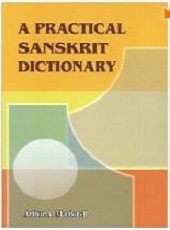
• A Practical Sanskrikt Dictionary, by A. A. Macdonell, 1893,
http://www.sanskrit-lexicon.uni-koeln.de/scans/MDScan/index.php?sfx=jpg;
1929.
- Nataraj ed., 1st in 2006, 2012.
-
https://dsal.uchicago.edu/dictionaries/macdonell/ 190516
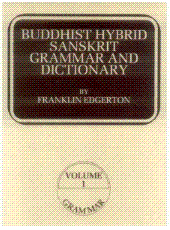
• The Buddhist Hybrid Sanskrit Grammar and Dictionary, BHS, vol.2, by F.
Edgerton, pp. 627.
-
FEdgerton-BHSD<Ô> /
Bkp<Ô> (link chk 180627)
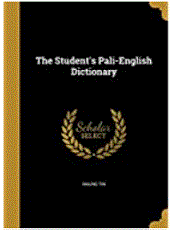
• The Student's Pali English dictionary , by U Pe Maung Tin, 1920.
- (ref: UPMT-PEDxxx). Downloaded copies in TIL HD-PDF and SD-PDF libraries:
-
UPMT-PaliDict1920<Ô> /
bkp<Ô> (link chk
190113)
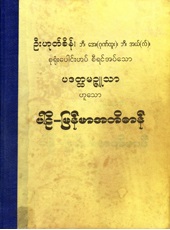
• Pali-Myanmar Dictionary
(in Pal-Myan), by U Hoke Sein,
- (ref: UHS-PMD). The dictionary in printed form is in TIL Research Library.
• Latin-English Vocabulary II, by Hans H Ørberg, 1998
-
HHOrberg-LinguaLatina<Ô> /
Bkp<Ô> (link
chk 190624)
Edited by U Kyaw Tun (UKT) (M.S., I.P.S.T., USA), Daw Khin Wutyi, Daw Thuzar
Myint, Daw Zinthiri Han and staff of Tun Institute of Learning (TIL).
Not for sale. No copyright. Free for everyone.
Prepared for students and staff of TIL Research Station, Yangon,
MYANMAR
-
http://www.tuninst.net ,
www.romabama.blogspot.com
MC-indx.htm |
Top
MCpp-indx.htm
 {ka.hta} कथा : contd
p062c1
 {ka.hti.} कथि
 {ka.da.} कद
 {ka.na.} कन
p062c2
 {kûn} कन्
 {ka.nya} - spelled with Na-minor conjunct
 {na.gnèý ya.pín.}
Skt Roots: entered below:
Whit016: √kad, 'destroy';
Whit017: √kan, kā, 'be pleased, enjoy';
UKT notes :
• Indo-Scythian and Thakya
• Problem of
Nya-major & Nya-minor
in Bur-Myan, Mon-Myan, and Pal-Myan
•
Stories of Somadeva - the human author
कथासरित्सागर
«kathasaritsagara» 'ocean of the streams of stories'
{ka.hta} कथा
• p062c1-b00/uchg p051-
कथान्तर
[ kathâ‿antara ]
Skt: कथान्तर
[ kathâ‿antara ]
- n. conversation, talk - Mac062c1
IPal: «katha» - f. speech, discourse, conversation, story, account -
UPMT-PED065
• p062c1-b01/uchg p051-009
• कथापीठ
[ kathâ-pîtha ]
- n. T. of the 1st book of the
Kathâsaritsâgara;
-prabandha, m. legend;
-prasaṅga, m. occasion
of conversation: in., ab. = in the
course of conversation, incidentally;
-prastâva, m. id.: -tas,
in the course of conversation;
-maya,
a. consisting of tales;
-mukha,
n. introduction to a story; T. of the
2nd book of the Kathâsaritsâgara;
-yoga, m. conversation.
• p062c1-b02/uchg p051-
कथालाप
[ kathâ‿âlâpa ]
- m. conversation; narration;
-‿âvalî, f. collection of
tales;
-‿ava-sesha, m.
survival in story only, i.e. death; a.
dead:
-tâ, f. abst. ɴ.;
-‿avaseshî-bhû, die.
© कथालाप
[kathâ‿âlâpa]
Skt: कथालाप
[kathâ‿âlâpa] - m.
conversation; narration -- Mac062c1
BPal:  {ka.hta-þal~la-pa.}
-  - UHS-PMD0288
UKT from UHS: m. speech, lecture
• p062c1-b03/uchg p051-
कथाशेष
[ kathâ-sesha ]
- a. dead:
-tâ, f. abst.
ɴ.;
-sandhi, m. junction
in the narrative where it is interrupted by
another;
-saritsâgara, m. ocean of
streams of stories, T. of a collection of
tales by Somadeva.
UKT171201: See my note on Stories of Somadeva or कथासरित्सागर «kathāsaritsāgara» 'Ocean of the Streams of Stories' - a collection of Indian legends, fairy tales, and folk tales by a Saivite Brahmin
{þi-wa. poaN~Na:} named Somadeva (11th century).
{ka.hti.} कथि
• कथिक «kathika»
Skt: कथिक «kathika»
- adj. a narrator, relater, story-teller
by profession -- SpkSkt
BPal:  {ka.hti.ka.}
-  -
UHS-PMD0288
-
UHS-PMD0288
UKT from UHS: mfn. one who lectures,
m. lecturer
UKT 140212: My position for many years at the Myanmar universities was "Lecturer" aka
• p062c1-b04/uchg p050-
कथित
[ kath-ita ]
Skt: कथित
[ kath-ita ] - (pp.) n.
conversation, narrative. - Mac062c1
BPal:  {ka.hti.ta.}
-  - UHS-PMD0288
UKT from UHS: mfn. having said,
lectured, stated. n. words that have
been spoken
• p062c1-b05/ not online

Skt: [kathî-kri ]
- turn into a narrative: pp. dead - Mac062c1
Skt: कथीकृत «kathīkṛta» - adj. reduced to a mere tale, i.e. deceased -
SpkSkt
• p062c1-b06/uchg p051-
कथोदय
[ kathâ‿udaya ]
- m. beginning of a story; statement;
-‿udghâta, m. beginning
of a narrative.
• p062c1-b07/ p051-
कथ्य
[ kath-ya ]
- fp. to be related; that may be
mentioned.
{ka.da.} कद
Skt: √kad,
'destroy'. - Whit0016
Only in the deriv. kadana e.+, and in cakāda kadanam r., where
cakāda is a misreading for cakāra.
• p062c1-b08/uchg p051-
कद्् [ kád ]
- V. n. nm., ac. sg.
of ka, what? = I hope? with neg.
= I hope not?
esp. with
kid (kákkid);
with kaná and neg.
in no way; °--, bad, wretched, insignificant.
• p062c1-b09/uchg p051-
कदन [ kad-ana ]
- n. slaughter, destruction;
torturing. - Mac062c1
Skt: कदन «kadana»
- n. destruction, killing, havoc,
slaughter - SpkSkt
• p062c1-b10/uchg p051-
कदन्न
[ kad-anna ]
= क द न ् न
- n. bad food:
-tâ,
f. abst. ɴ.
Pal:  {ka.dûn~na.} - UHS PMD0288
UKT from UHS: n. bad food
• p062c1-b11/ p051-
कदम्ब
kadamba, ˚क [ -ka ]
- m. a tree bearing orange-coloured
blossoms; n. multitude, plenty; swarm.
• p062c1-b12/ p051-
कदर्थ
[ kád-artha ]
- a. for what purpose?
• p062c1-b13/uchg p051-
कदर्थन
[ kad-arth-ana ]
- n., â, f. tormenting;
-anîya, fp. to be tormented;
-aya, den. P. despise; torture,
distress; surpass;
î-kri, disregard:
-ti, f. torment.
• p062c1-b14/uchg p051-
कदर्य
[ kad-arya ]
- a. avaricious, miserly:
-tâ,
f.,
-bhâva, m. avarice.
• p062c1-b15/uchg p051-
कदल [ ka-dala ]
- m. plantain babana tree (symbol of
frailty);
i-kâ, f. plantain babana
tree; flag, esp. on an elephant;
î, f. plantain babana tree:
-garbha, m. pith of the
plantain babana: â,
f. N.;
-griha, n.
plantain babana arbour;
-sukham, ad.
as easily as a plantain babana.
UKT151027, 170201: What is known as "plantain" is now called "banana". To the North Americans "plantain" is a weed. See Wikipedia: https://en.wikipedia.org/wiki/Plantago_major 151027
The leaves, stirred-fried, can be eaten. The fresh leaves contain an antiseptic which is specific for ingrown nails.
See: Section 9: Para-Medicine{pa.ra.hsé:} - MP-Para-indx.htm (link chk 181213)
and ¤ Botanical Names of Myanmar Plants of Importance
-- MP-LSR-indx.htm > Agri2000-indx.htm >{a.}
Entry no. 63-1681,{a.krau:tic-htaún pín},
{Ba:krau:},
{hpa:krau:},
{hsé:kyau-kri:} , Plantago major , fam. Plantaginaceae
• p062c1-b16/uchg p051-
कदा [ ka-dã ]
- inter. when?
-kana,
some time, ever;
-kid, some
time or other; once; some times; perhaps;
--‿api, at any time, always;
na -kana, kid,
or ‿api, never.
• p062c1-b17/ p051-017
कद्रु
[ kádru ]
= क द ् र ु :
2nd phoneme spelled with
 {ra.ric}
- a. reddish brown; &usharp;,
f. earth; N. of [Rishi] Kasyapa's
wife, mother of the serpents.
17)
See my note on Manasa (Bengali: মনসা, Manasha
{ma.na.þa dé-wi}) is a Hindu folk goddess of snakes and scorpions
{ka.na.} कन
√kan, kā,
'be pleased, enjoy'. - Whit0017
- Pres. [4.] kayamana ev'.
• p062c1-b18/ not online

कन् [kan ] -->
{kûn}
Skt: कन् [kan ] -
i. p. be satisfied; be pleased with
(ac.); shine - Mac062c1
Skt: चके
{ कन् } «cake { kan }»
- v. be liked or wished for, be satisfied
with, be satisfied or pleased - SpkSkt
UKT 171130, 200125: It is noteworthy that the Bur-Myan word
{ka.na:} means to "hold a feast" - with wild dancing by the mediums (men, women, and transvestites). The event is held for the Ma'nes
{nût} loosely translated into English as "spirits". The combined word is:
{nût ka.na:} - MLC MED2006-236
See: https://en.wikipedia.org/wiki/Nat_(spirit) 200125
• p062c1-b19/uchg p051-
कनक [ kán-aka ]
- n. gold; m. thorn apple;
N.;
-kadalî, f. species of
plantain;
-danda, m. royal
umbrella;
-pura, n., î,
f. N. of a city; -prabhâ,
f. N. of a princess;
-mañgarî,
f. N.; -maya, a.
(î) golden;
-rasa, m.
fluid gold; -rekhâ, <>. N.;
-latâ, f. golden creeper;
-lekhâ, f. N. of a princess;
-valaya, m. n. golden bracelet;
-vâhinî, f. N. of a river;
-sikharin, m. golden peaked,
ep. of Meru; -sûtra, n.
golden chain;
-‿adri,
m. ep. of Meru.
© कनक [ kán-aka ]
Skt: कनक [ kán-aka ]
- n. gold; m. thorn apple;
N.; - Mac062c1
BPal:  {ka.na.ka.} - UHS-PMD0289
- 
UKT from UHS: n. gold, gold ornament
• p062c1-b20/uchg p051-
कनकासन
[ kanaka‿âsana ]
- n. throne. [UKT: literally
'golden throne']
• p062c1-b21/ not online
[kana-khala]
- m. pl. N. of certain mountains
UKT 171129: You can trace the above word from [khala]
khalaḥ - खलः लम् [खल्-अच्] ¹. a threshing floor; खले न पर्षान् प्रति हन्मि भूरि Rv.1.48.7; Ms.11.17,115; Y.2.282. ...
- Apte:SktDict
khalatikaḥ - खलतिकः a mountain. - Apte:SktDic
• p062c1-b22/uchg p051-
कना [ kanã ] :
UKT: aks-to-aks transliteration, without
English-transcription, gives
 {ka.na}.
Skt: कना [ kanâ']
- f. girl. - Mac062c1
Skt: कना «kanā»
- f. maid - SpkSkt
BPal:  {kíñ~ña} - UHS PMD0278


UKT from UHS: f. bride, girl,
Kanya rasi (Virgo = August-Sept)
Bur:
 {ka.Ña} - n. young maiden -
MLC MED2006-002
{ka.Ña} - n. young maiden -
MLC MED2006-002
See my note on The problem of Nya-major & Nya-minor, and the absence of palatal nasal in English
• p062c2-b00/uchg p051-
कनिक्रदत््
[ kán-i-kradat ]
- nm. sg. m. pr. pt. intv.
of √krand.
• p062c2-b01/ not online
[kanísh-ka]
- m. N. of an Indo-Scythic king
(first century A.D.)
See my note on
Indo-Scythian and Thakya
• p062c2-b02/ not online
[kan-i-shkan]
-- 3 sg. intv. of √skand
• p062c2-b03/uchg p051-012
कनिष्ठ
[ kán-ishth-a (or -á) ]
= क न ि ष ् ठ
- spv. smallest; lowest; least;
youngest; younger; m. descending pail
of water-wheel;
â, f.
youngest wife; little finger;
a-ka,
a. (ikî) smallest;
-ikâ, f. little finger;
obedience.
• p062c2-b04/uchg p051-
कनी [ kanî ]
- f. girl (V. only g. pl.).
• p062c2-b05/uchg p051-
कनीन
[ kan-îna ]
- a. young, youthful:
-ká,
m. boy, youth: ã,
f. girl, virgin;
(&isharp;na)-ka, m.,
a-kâ, i-kâ, f.
pupil of the eye.
• p062c2-b06/uchg p051-
कनीयस््
[ kán-îyas ]
- cpv. smaller, less; very little;
younger; m. younger brother or son.
{kûn} कन्
√kan, kā, 'be pleased, enjoy'. - Whit0017
p062c2-b07/ p051-035
• कन्त्व
[ kan-tvá ]
- n. welfare.
35)
p062c2-b08/ p051-034
• कन्था [ kanthâ ]
= क न ् थ ा
Skt: कन्था
[ kanthâ ] - f. patched garment. - Mac062c2
34)
BPal:
 {kûn~hta} - UHS-PMD0290
- 
UKT from UHS: f. an old
cloth full of patches
p062c2-b09/ p051-033
• कन्द [ kanda ]
= क न ् द -->
 {kûn~da.}
Skt: कन्द [ kanda ]
- m. bulbous root. - Mac062c2
33)
BPal:
{kûn~da.} - UHS-PMD0290
- 
UKT from UHS: bulbs, tubers, name
of a plant
 {wa.U.}.
UKT 171130:
See Section 9, Para-Medicine{pa.ra.hsé:} -- MP-Para-indx.htm > Agri2000-indx.htm >
{wa.} (link chk 181214)
-entry 54-1447
p062c2-b10/ p051-032
• कन्दर
[ kan-dara ]
- n. cave; ravine; elephant goad.
32)
p062c2-b11/ p051-031
• कन्दर्प
[ kan-darpa ]
- m. Kâma; [carnal] love.
31)
p062c2-b12/ p051-030
• कन्दल
[ kan-dal-a ]
- n. flower of the plantain;
-î, f. plantain tree;
-ita, pp. produced in
profusion; -in, a. covered
with blossoms of the Kandalî; full of (--°).
30)
p062c2-b13/ not online
• कन्दु [kandu]
- frying-pan; -ka , m. id.; ball
(for playing with); pillow: -lilâ
, f. game of ball; -kâ-vati ,
f. N. of a princess
Skt: कन्दुः
«kanduḥ» - m., f. a boiler,
oven - Apte:SktDic
p062c2-b14/ p050-029
• कन्धर [ kan-dhara ]
- m. neck.
29)
p062c2-b15/ p050-028
• कन्य [ kan-ya ]
- a. smallest: -ka, a. id.,
â, f. = kan-yâ;
-kubga, n. N. of a town, Kanauj.
28)
{ka.nya} कन्या UKT 181213: - spelled with Na-minor conjunct
• p062c2-b16/uchg p050-
• कन्या [ kan-yâ ]
= क न ् य ा
- f. girl, virgin; daughter; Virgo (in the
Zodiac);
-‿âgâra, n. women's
apartments;
-griha, n. id.;
-tva, n. virginity;
-dâtri,
m. man who gives a daughter in marriage;
-dâna, n. bestowal of a daughter
in marriage; -dûshin, a.
deflowering a virgin;
-pura, n. women's apartments;
-bhâva,
m. virginity; -bhaiksha,
n. begging for a girl;
-maya, a. consisting of a maiden or daughter;
-vat, a.
having a daughter; m. father of a daughter; -vedin, m. son-in-law;
-vrata, n.
monthlies:
-sthâ, f. menstruating woman.
© कन्या [ kan-yâ ]
-->
{ka.n~ya}
Skt: कन्या [ kan-yâ ]
- f. girl, virgin; daughter; Virgo
(in the Zodiac); - Mac062c2
BPal:
{kíñ~ña} - UHS-PMD0278
-
UKT from UHS: f. virgin, young girl.
Astrology. Virgo or Kanya
Bur:
{ka.Ña} - n. young maiden - MED2010-002
(end of old p062-1.htm )
- UKT 200123
I am writing this note based on the following:
Wikipedia: https://en.wikipedia.org/wiki/Indo-Scythians 200125
"Indo-Scythians (also called Indo-Sakas) were a group of nomadic Iranian peoples of Saka and Scythian origin who migrated southward into western and northern South Asia (Sogdiana, Bactria, Arachosia, Gandhara, Sindh, Kashmir, Punjab, Haryana, Uttar Pradesh, Bihar, Rajasthan, Gujarat and Maharashtra) from the middle of the 2nd century BC to the 4th century AD. "
UKT 200125 - Since the time of Gautama Buddha (563?-483? B.C - AHTD) was earlier, he cannot be an Indo-Scythian. We might as well move to :
https://en.wikipedia.org/wiki/Saka 200125.
"The Saka, Śaka, Shaka or Sacae (Old Persian:
Sakā; Brahmi*:

 Śaka, Sk-Dev शक, Śaka;
Ancient Greek: Σάκαι, Sákai;
Latin: Sacae;
Chinese:
塞,
old *Sək,
mod. Sāi,
were a group of nomadic
Iranian peoples who historically inhabited the northern and eastern
Eurasian Steppe and the
Tarim
Basin.[2]
[3]"
Śaka, Sk-Dev शक, Śaka;
Ancient Greek: Σάκαι, Sákai;
Latin: Sacae;
Chinese:
塞,
old *Sək,
mod. Sāi,
were a group of nomadic
Iranian peoples who historically inhabited the northern and eastern
Eurasian Steppe and the
Tarim
Basin.[2]
[3]"
UKT 200125: *Brahmi - though given as Brahmi, it is Gupta script. Brahmi or Asokan is
. I base my observation based on the script given in - Francis Mason & Eisel Mazard (馬大影) version of Shin Kicsi Pali Grammar, 1st distribution in 2015,
- FMasonMazard-PalGramm<Ô> / Bkp<Ô> (link chk 200125)Let's move to another: https://en.wikipedia.org/wiki/Shakya
"The Shakya (Pali in the Brahmi script: 𑀲𑀓𑁆𑀬 Sakya, Sākiya, or Sakka,[1][2][3] Sanskrit: Śākya, Devanagari: शाक्य) were a clan of late Vedic India (c. 1000 – c. 500 BCE) and the later so-called second urbanisation period (c. 600 – c. 200 BCE) in the Indian subcontinent (i.e. the present-day nations of India and Nepal). The Shakyas formed an independent oligarchic[note 1] republican state known as Śākya Gaṇarājya.[4] Its capital was Kapilavastu, which may have been located either in present-day Tilaurakot, Nepal or present-day Piprahwa, India.[5][6][7]
Go back Indo-Scythian-Thakya
 UKT:
140213, 151028, 170201, 180411, 181214
UKT:
140213, 151028, 170201, 180411, 181214
I've been on this problem for many years. Not finding any satisfactory solution, I've no choice but to make a few bold assumptions. "... fools rush in where angels fear to tread ... was first written by Alexander Pope in his 1711 poem An Essay on Criticism. ... It has since entered the general English lexicon as an idiom." - https://en.../Fools_rush_in_where_angels_fear_to_tread (180411)
What follows is my analysis. It is not accepted by MLC (Myanmar Language Commission)
There is a possibility that the word
{ka.Ña.} is a pure Bur-Myan word of Tib-Bur origin.
We have to consider this possibility because
 {Ña.}/
 {Ñ} does not belong to Palatal plosive-stop r2c5 cell.
Based on its ability to stand undivided under Virama
{ Ñ}, and also on the presence of pure Bur-Myan words like
{Ña.} 'night', it could be very well be an Approximant
- a neighbour of
{Ñ} does not belong to Palatal plosive-stop r2c5 cell.
Based on its ability to stand undivided under Virama
{ Ñ}, and also on the presence of pure Bur-Myan words like
{Ña.} 'night', it could be very well be an Approximant
- a neighbour of
 {ya.}/
 {ý}. Nya-major
{Ña.}is like
{ya.} a basic akshara. We can explain why the word
for "maid" is pronounced differently in
Bur-Myan and Pali-Myan.
{ý}. Nya-major
{Ña.}is like
{ya.} a basic akshara. We can explain why the word
for "maid" is pronounced differently in
Bur-Myan and Pali-Myan.
In Pali-Myan, which had been adulterated by
Pali-Lanka which itself has been influenced by Sanskrit,
{Ña.}
is a conjunct which breaks up as soon as it is
placed under a viram, {ñ~ña.}.
If we accept that
{Ña.} is a basic akshara, we can easily transliterate
words, especially proper nouns, like
- Shin Kic'si
 {shín kic~sæÑ:} aka
 {rhín kic-sæÑ:}
- Nay'pyi'taw
 {né-præÑ-tau},
- U Khin Aung Kyi
 {U: hkín-aún-kræÑ},
- Daw AungSan SuKyi
 {dau aún-hsûn: su.kræÑ}, and
- Daw KyiKyi Ngè
 {dau kræÑ-kræÑ gnèý}.
Summing up I contend that:
The word
{a.þût} as
Nya-major aka Nya'gyi
{Ña.} is absent in all Indic languages. Skt-Dev
(IE) has only Nya-minor aka Nya'le as
Palatal affricate. On the other hand,
Nya-minor was introduced into Bur-Myan only when
Pali-Lanka which became Pali-Myan only when Theravada
Buddhism was introduced into Ceylon aka Lanka. Remember,
Pali was an artificial language, invented in Lanka from
Magadhi (Tib-Bur) and Lanka (Aus-Asi) under the
influence of Skt-Dev. (IE). The word
{ka.Ña} 'maiden' became corrupted further probably due
to Western influence and became कना
[ kanã ]
{ka.nya} which is actually tri-syllabic and should
be properly spelled as
{ka.n~ya}.
 To look into this problem further, see Mon-Myan -
MonMyan-indx.htm (link chk 200125)
To look into this problem further, see Mon-Myan -
MonMyan-indx.htm (link chk 200125)
and,
1. Grammatical notes and Vocabulary
of the Peguan Language, to which are added
a few pages of phrases, etc., by Haswell, J.M.,
ABM Press (American Baptist Mission Press),
Rangoon, 1874
-
JMHaswell-Peguan<Ô> /
Bkp<Ô> (link chk 200125)
2. A vocabulary of English and Peguan,
to which are added a few pages of geographical
names , by Stevens, E.O., ABM Press, Rangoon, 1896
- EOStevens-PeguanVocab<Ô> /
Bkp<Ô> (link chk
200125)
3. Notes on the transliteration of Burmese
alphabet into Roman characters, and vocal and
consonantal sounds of the Peguan or Talaing
language, by R. C. Temple, Rangoon 1876,
- RCTemple-TranslitBurPeguan<Ô> /
Bkp<Ô> (link chk
200125).
When I tried to include Mon language in Binpathak aka BEPS, I found that my dream of transcription is a failure because Mon-Myan has a different phonology from Bur-Myan. I've to accept differences in pronunciation of the same word in two Myanmar languages.
eye-blinks: (1/2 blk) -- (1 blk) -- (2 blk) -- (2 blk with emphasis)
Bur-Myan: ----------------{Ña.} --
{Ña:}
Mon-Myan:{Ña:.} --
Notice how I sculpt and differentiate the words using my Lakkwak and colour scheme.
I must now put in a word of thanks to prayers
like Gayatri Mantra - bk-cndl-gayatri<))
It was in the Mantra the presence of vowels with
1/2 eye-blinks:
 {na:.}
Go back Nyagyi-Nyale-note-b
UKT 170131, 171201: Be careful of Hindu
names. Here Somadeva is the name of a
human author
 {þi-wa. poaN~Na:} of 11th century AD.
See its connection to Panchatantra Tales
पञ्चतन्त्र
'Five Principles or Techniques'
{þi-wa. poaN~Na:} of 11th century AD.
See its connection to Panchatantra Tales
पञ्चतन्त्र
'Five Principles or Techniques'
Stories of Somadeva is a famous 11th-century
collection of Indian legends, fairy tales
and folk tales See: The translation by
C H Tawney, 1880, are in 10 vols. See
TIL PDF libraries: (link chk 171201)
- CHTawney-SomadevKathaSaritSagara01<Ô> /
Bkp<Ô>
- CHTawney-SomadevKathaSaritSagara07<Ô> /
Bkp<Ô>
-
CHTawney-SomazdevKathaSaritSagara10Indx<Ô> /
Bkp<Ô>
- Wikipedia:
https://en.wikipedia.org/wiki/Kathasaritsagara
151026
From Wikipedia: http://en.wikipedia.org/wiki/Kathasaritsagara 110901
Kathasaritsagara (Skt: कथासरित्सागर "ocean of the streams of stories") is a famous 11th-century collection of Indian legends, fairy tales and folk tales as retold by a Saivite Brahmin named Somadeva.
Nothing is known about the author other than that his father's name was Ramadevabatta. The work was compiled for the entertainment of the queen Suryamati, wife of king Anantadeva of Kashmir (r. 1063-81).
It consists of 18 books of 124 chapters and more than 21,000 verses in addition to prose sections. The principal tale is the narrative of the adventures of Naravahanadatta, son of the legendary king Udayana. A large number of tales are built around this central story, making it the largest existing collection of Indian tales. It notably also contains recensions of the Panchatantra in Book 10; and the Vetālapañcaviṃśati, or Baital Pachisi, in Book 12.
The Katha-sarit-sagara is generally believed to derive from Gunadhya's Brhat-katha, written in Paisachi dialect from the south of India. [UKT ¶ ]
UKT 170201: "Paiśācī is a largely unattested literary language of the middle kingdoms of India mentioned in Prakrit [ BHS ?] and Sanskrit grammars of antiquity. It is found grouped with the Prakrit languages, with which it shares some linguistic familiarities, but is not considered a spoken Prakrit by the grammarians because it was purely a literary language, but also due to its archaicism. [3] " -- https://en.wikipedia.org/wiki/Paisaci 170201
But the Kashmirian Brhat-katha from which Somadeva took inspiration may be quite different from the Paisachi one as there were two versions of the Brhat-katha extant in Kashmir, as well as the related Brhatkatha-sloka-samgraha of Buddhasvamin from Nepal. Like the Panchatantra, tales from this (or its main source book the Brhat-katha) travelled to many parts of the world.
The only complete translation into English [1] is by C. H. Tawney (1837–1922), published in two volumes (1300 pages in all) in 1880. This was greatly expanded, with additional notes and remarks comparing stories from different cultures, by N. M. Penzer, and published in ten volumes ("privately printed for subscribers only") in 1924.
Another translation was to be published in seven volumes by the Clay Sanskrit Library, translated by Sir James Mallinson, but it published only two volumes, reaching up to canto 6.8, before the publisher ended operations.
UKT: End of Wikipedia article.
Go back Somadeva-stories-note-b
End of TIL file
 {kûm}
{kûm}