p264.htm
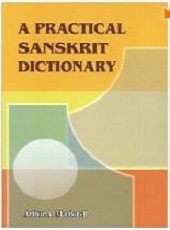
• A Practical Sanskrikt Dictionary,
by A. A. Macdonell, 1893,
http://www.sanskrit-lexicon.uni-koeln.de/scans/MDScan/index.php?sfx=jpg;
1929.
-
Nataraj ed., 1st in 2006, 2012.
-
https://dsal.uchicago.edu/dictionaries/macdonell/ 190516
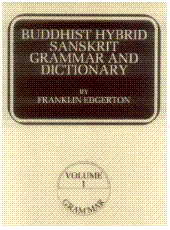
• The Buddhist Hybrid Sanskrit Grammar and
Dictionary, BHS, vol.2, by F. Edgerton,
pp. 627.
-
FEdgerton-BHSD<Ô> /
Bkp<Ô> (link chk 180627)
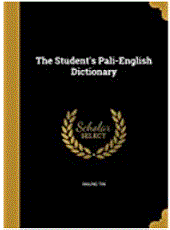
• The Student's Pali English dictionary ,
by U Pe Maung Tin, 1920.
- (ref: UPMT-PEDxxx).
Downloaded copies in TIL
HD-PDF and SD-PDF libraries:
-
UPMT-PaliDict1920<Ô> /
bkp<Ô> (link chk 190113)
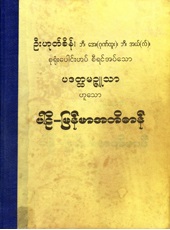
• Pali-Myanmar Dictionary
(in Pal-Myan), by U Hoke Sein,
- (ref: UHS-PMD). The dictionary in printed form is in TIL Research Library.
• Latin-English Vocabulary II, by Hans H Ørberg, 1998
-
HHOrberg-LinguaLatina<Ô> /
Bkp<Ô> (link
chk 190624)
Edited by U Kyaw Tun (UKT) (M.S., I.P.S.T., USA),
Daw Khin Wutyi, Daw Thuzar Myint, Daw Zinthiri Han
and staff of Tun Institute of Learning (TIL).
Not for sale. No copyright. Free for everyone.
Prepared for students and staff of TIL
Research Station, Yangon, MYANMAR
-
http://www.tuninst.net ,
www.romabama.blogspot.com
MC-indx.htm |
Top
MCpp-indx.htm
 {lu.}
{lu.}
p264c1
 {lu}
{lu}
 {lé}
{lé}
p264c2
 {lè:}
{lè:}
 {lau:} लो
p264c3
{lu.} : contd
p264c1-b01
• लुप्
[lup]
- N.
dropping, elision (of a letter etc.); a. dropped.
p264c1-b02
• लुप्तविसर्ग
[lupta-visarga]
- a. lacking Visarga: -tâ, f. absence of Visarga;
-̮upama, a. lacking the comparative particle (iva): â, f.
incomplete or elliptical simile; -̮upamâna, n. incomplete
comparison.
p264c1-b03
• लुब्ध
[lub-dha]
- pp. √lubh:
-ka, m. hunter; the star Sirius; -gana, a. having covetous
followers; -tâ, f. greed, covetousness; -tva, n. id.; eager
longing for (--°).
p264c1-b04
• [LUBH] IV. P. Iubhya (V., rare; C.),
- grow bewildered, go astray; desire, long for
(d., lc.; ord. mg.); entice, allure: pp. Inbdhs, beweildered, confused; desirous
or greedy of, craving after, longing for (lc., -°); greedy, covetous; cs. P.
lobhaya, derange; excite the desire of, entice, attract; intv. lolubhyate, have
a vehement desire for (lc.). a, become desordered; des. of cs. turb. upa, cs.
excite the desire of, entice, lead astray. pari (-lobha, metr. for lobhaya),
id.; cs. id. pra, go astray, have illicit desires (of women): excite the desire
of, allure, lead astray: pp. f. having conceived an illicit desire for (saha);
cs. excite the desire of, allure, seek to seduce; divert the atention of (ac.)
by (in.). prati, cs. infatuate (V.); attract, vi, cs. lead astray; excite the
desire of, allure, seek to seduce; beguile; enchant with (lc.). sam, become
deranged (Br.); cs. derange, disorder; efface (traces; V.); entice, seek of
seduce.
p264c1-b05
• [LUL] I. P. lola,
- move (int.) to and fro, roll about (only pr. pt. lolat and
lolamana); disappear: pp. lulita, moving to and fro, agitated, heaving, waving;
touched; crushed, injured, having suffered; cs. lolaya, abhi, pp. touched. a,
pp. gently stirred. vi, pp. moved to and fro; shed (tears, rain); deranged,
disordered, dishevelled; cs.pp. vilolits, moved to and fro; scattered in all
directions. sam, pp. come into contact with (-°); deranged.
p264c1-b06
• लुलाप
[lulâpa]
- m.
buffalo.
p264c1-b07
• लुलाय
[lulâya]
- m. ep. of
Yama.
p264c1-b08
• लुलित
[lul-ita]
- pp.; n. motion.
{lu}
p264c1-b09
• [LU] , V. P. lunoti (Br., very rare), IX. lunati, lunite,
- cut (grass), reap (corn),
pluck (flowers); cut off, clip, lop, cut down, sever, pierce; cut off, destroy,
annihilate: pp. luna, cut, -off, lopped, plucked; nibbled off; knocked out
(teeth); severed; stung; destroyed. ava, pp. cut off. a, A. tear off: pp.
plucked. nis, pp. niriuna, cut off: hewn in pieces. vi-pra, pp. cut or plucked
off. vi, cut off.
p264c1-b10
• लूता
[lûtâ]
- f.
spider; kind of skin disease.
p264c1-b11
• लून [lûna]
- pp. √lû; n.
tail (very rare): -visha, a. having poison in its tail.
p264c1-b12
• [Irit]
- (terminations) the s- future.
{lé}
p264c1-b13
• लेख [lekh-a]
- m. [√likh]
stroke, line; written document, letter (sg. & pl.); god,
deity (very rare): pl. a certain class of gods (E., rare):
-ka, m. writer, secretary, copyist; calculation: -m kri,
make a calculation, reckon.
p264c2-b00
• लेखन
[lekh-ana]
- a. (î)
scratching, scarifying, lacerating; exciting, stimulating;
attenuating; n. writing down, transcribing: î, f. writing
reed, reed-pen; -anîya, fp. to be drawn or painted; to be
written.
p264c2-b01
• लेखपत्त्र
[lekha-pattra]
- n. letter; -pattrikâ, f. id.; -sâlâ, f. writing
school; -samdesahârin, a. delivering a written message; -hâra:
-ka, m. letter-carrier; -hâr-in, a. delivering letters with
(--°): (-i)-tva, n. delivery of letters with (--°); -̮adhikârin,
m. secretary of a king.
p264c2-b02
• लेखा
[lékh-â]
- f. [√likh]
streak, line, stroke, stripe, furrow; digit or crescent (of
the moon); edge; delineation; figure, likeness; impression,
mark.
p264c2-b03
• लेखिका
[lekh-ikâ]
- f.
little streak; -in, a. touching (--°).
p264c2-b04
• लेख्य
[lekh-ya]
- fp. to
be scarified; -- written (down); -- painted; depicted,
painted; to be counted (--°); n. (art of) writing;
transcription; drawing, painting; written document, letter;
inscription; painted figure; --° (with gananâ-)=catalogue,
roll of (--°): -gata, pp. painted; -pattra, n. document,
letter; -maya, a. painted; -rûpa, a. id.
p264c2-b05
• [let]
- ( terminations of) the subjunctive.
p264c2-b06
• लेण्ड
[lenda]
- n.
excrement.
p264c2-b07
• [ledari]
- f. N. of a river.
p264c2-b08
• लेप [lep-a]
- m. [√lip]
smearing, anointing; ointment, unguent, plaster; spot,
stain, impurity, sp. grease adhering to dishes, hands, etc.;
moral taint, sin; food: -ka, m. plasterer, white-washer,
mason; -kara, m. id.
p264c2-b09
• लेपन
[lep-ana]
- n.
anointing, besmearing, plastering, with (in., --°);
ointment; plaster, mortar; --° a. besmeared, plastered with;
-in, a. (--°) besmearing, covering with; besmeared, covered
with; -ya, fp. moulded, modelled; to be defiled: -kâra, m.
moulder.
p264c2-b10
• लेलिहान
[le-lih-âna]
- pr. pt. intv.
√lih; m. serpent.
p264c2-b11
• लेवार [levâra]
- m. N. of an Agrahâra
p264c2-b12
• लेश [les-a]
- m.
[√lis=√ris] particle, atom, drop, little bit, small amount
of (g., --°; very common --°=very little or slight,
insignificant; °--, in., or -tas, very slightly or briefly);
a rhetorical figure in which a statement is made indirectly
(e. g. ʻthe boast of the Pândavas on slaying Bhîshma under
the leadership of Sikhandin will be oursʼ); a rhetorical
figure in which what is usually considered as an advantage
is represented as a disadvantage and vice versâ.
p264c2-b13
• लेशिक
[les-ika]
- m.
mower of grass; -in, a. having particles of (--°).
p264c2-b14
• लेश्य
[les-ya]
- m., a,
light.
p264c2-b15
• लेष्टु
[lesh-tu]
- m. [√lis] lump of earth, clod.
p264c2-b16
• लेह [leh-a]
- m. [√lih] licker, sipper; lambative, electuary; -ana, n. licking; -ya,
fp. to be licked or lapped up, to be eaten by licking.
{lè:}
p264c2-b17
• लैङ्ग
[laiṅga]
- a. relating to grammatical gender; i-ka, a. relating to or
resulting from a characteristic mark or evidence, inferred;
m. statuary.
p264c2-b18
• लैङगोद्भव
[laiṅga̮udbhava]
- n. history of the origin of the Liṅga.
{lau:} लो
p264c2-b19
• [LOK]
- I. A. loka [prob.= roka, ruk], see, perceive; cs. P. lokaya, regard, look at;
behold, perceive; recognise, know. abhi, cs. regard, view. ava, (be able to)
see; cs. look, -up; look at, behold, view, regard (ac.); review (an army); look
out for; watch; regard (of the aspect of planets in astrology); look at
graciously: perceive: pp. avalokita; gd. avalokya. sam-ava, look; look at,
regard, iuspect; perceive, behold; look; look at, view, regard; look upon
graciusly; consider, examine, study (dhiya, buddhya): perceive, recognise, find
out, know, to be (2 ac.): avapnam -, have a dream; hridi-, think of. praa, cs.
gd. pralokya, seeing in the distance (v.r. alokya). sam-a, cs. look at, regard;
consider; perceive, observe, recognise as (2. ac.). vi, look at; examine, study
(rare); cs. be able to see; look; look at, regard, view, inspectg; direct one's
attention to, examine, study (rare); have regard to (rare); perceive, observe;
look over (a hedge); ps. vilokyate, be visible. pra-vi, cs. look; look at,
regard; observe (astronomically); consider, ponder; perceive, see. sam, du, w,
ughayatah, look at each other.
p264c3-b01
• लोक
[lok-á]
- m. [orig. probably uloká,
which is almost invariably used in RV., and perh. =(a)
va-loká: √ruk] (free) space, room, place (V.); tract,
region, country; world, division of the universe (the two
worlds=heaven and earth; the three --, = the same and the
atmosphere or the lower regions; seven worlds are commonly
spoken of); heaven; earth; (sg. & pl.) mankind, folks,
people (sts. opp. king); men (pl.: opp. women); community,
company (often --° to form collectives); ordinary life,
common usage, worldly affairs (opp. Veda); sight (only --°
in kákshur-, seeing with the eye): (urúm) lokám kri, make
room for, grant freedom to (d.; V.); ayám lokáh, this world;
asaú or páro lokáh, that or the other world; loke, in place
of (g.; Br.); in ordinary life, in popular speech; in the
world, on earth; iha loke, here on earth; kritsne loke, in
the whole world.
p264c3-b02
• लोककण्टक
[loka-kantaka]
- m.
thorn = curse of mankind, pernicious man; -kartri, m. creator
of the world, ep. of Brahman, Vishnu, or Siva; -kânta, pp.
beloved of the world, dear to all mankind; -kâma, a.
desirous of a certain world; -kâra, m. creator of the world,
ep. of Siva; -krit, m. creator of the world; -kshit, a.
inhabiting heaven; -gâthâ, f. popular (traditional) verse;
-guru, m. teacher of the world or people; -kakshus, n. pl.
eyes of the people; -kâritra, n. ways of the world; -gít, a.
winning territory (Br.); gaining heaven; -gña, a. knowing
the world or men: -tâ, f. knowledge of the world; -tattva,
n. id.; -tantra, n. course of the world; -tas, ad. from
people, from popular talk; in accordance with usage; -traya,
n., î, f. the three worlds (heaven, earth, air or lower
regions); -dambhaka, a. cheating the people; -dvaya, n. the
two worlds (heaven and earth); -dvâra, n. gate of heaven; -nâtha,
m. lord of the worlds, ep. of Brahman, Vishnu, Siva, of the
gods, and of the sun; protector of the people, king; N. of
Avalokitesvara; a. protected by mankind; -nindita, pp.
blamed by every one; -pa, m. regent of a world;
world-guardian (of whom there are eight); -pati, m. lord of
the world, ep. of Brahman or Siva; lord of the people, king;
-patha, m. general or usual way; -paddhati, f. id.; -pâlá,
m. world-guardian (of whom from Manuonwards four or eight
are assumed according as four or eight quarters are counted;
exceptionally five); guardian of the people, king; -pitâmaha,
m. great forefather of mankind, ep. of Brahman; -punya, N.
of a locality; -pûgita, pp. universally honoured; -pravâda,
m. common report, popular or current saying; -prasiddha, pp.
generally known; -prasiddhi, f. general prevalence: in.
according to prevailing usage; -bhartri, m. supporter of the
people; -mahesvara, m. great lord of the world, ep. of
Krishna, -mâtri, f. mother of the world, ep. of Gaurî
End of TIL file