Update:
2006-03-18 06:31 PM +0700
TIL
Medicinal Plants of Myanmar
Oleaceae
by Kyaw Soe and Tin Myo Ngwè, Forest Resource Environment Development and
Conservation Association (FREDA), Series 1, 2004, ISBN 974-91986-0-3
Copied by U Kyaw Tun, and staff of TIL for staff and students of TIL. Not for sale.
Main Index of DB |
Top
Index ofCollected papers
Agri.Dept.2000:
Akshara
Science names
Family names
Contents of this page
UKT: Nagathein references are given to check the Burmese-Myanmar names. *
shows where there is no agreement in Burmese name but when the plant is
identifiable from botanical name.
{tau-san°-pèy}
Jasminum pubescens Willd.1-373
Main Index of DB |
Top
Contents of this page
KS-TMN 177
|
Botanical name: Jasminum pubescens Willd. Sp.Pl. 137. 1797.
Myanmar name: Taw-sabai; Sabai
English names: Common Jasmine; Downy Jasmine; Musk Jasmine
Family: Oleaceae
Burmese-Myanmar name in Nagathein :1-373
{tau-san°-pè~}
Photos:
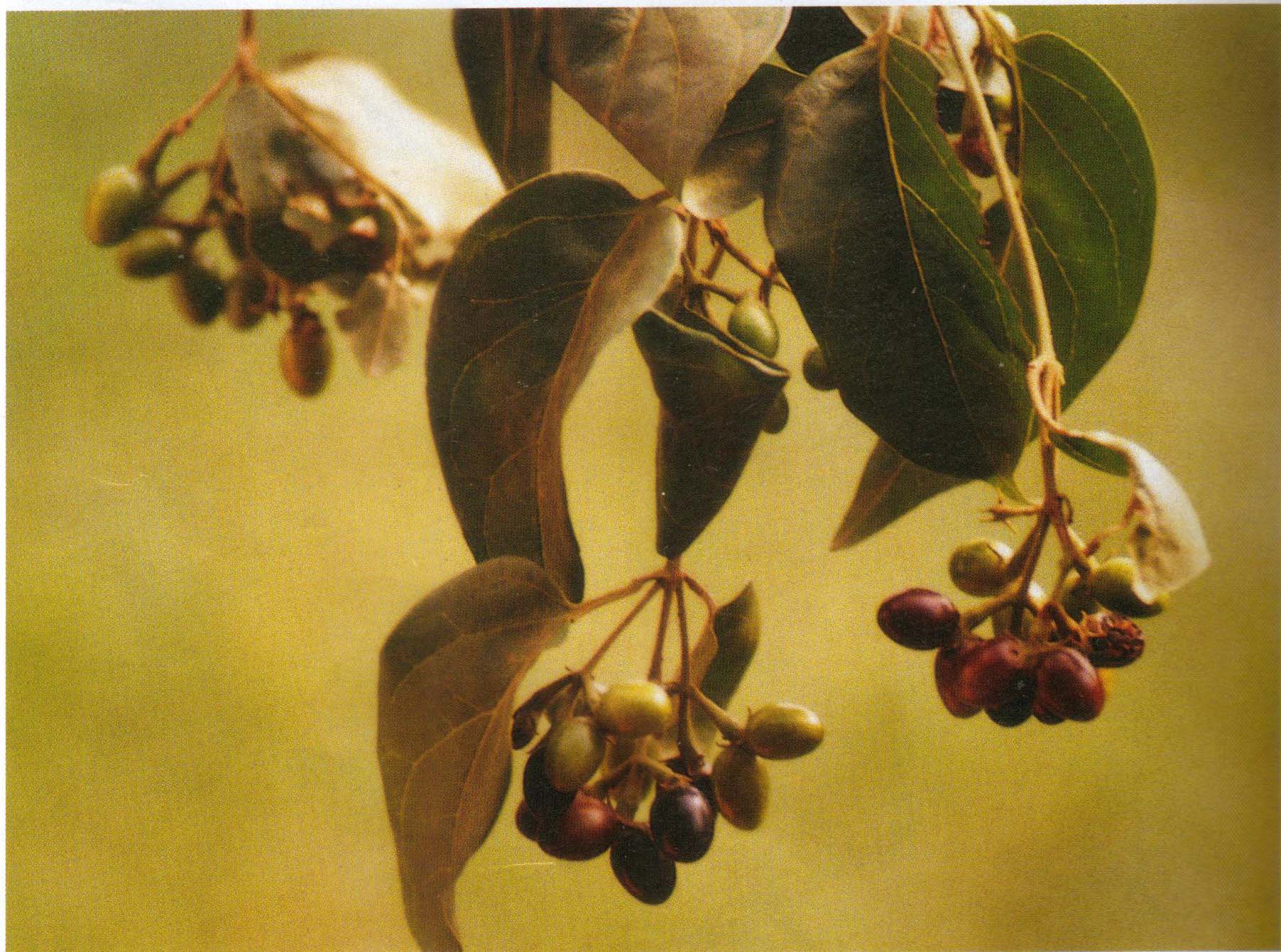
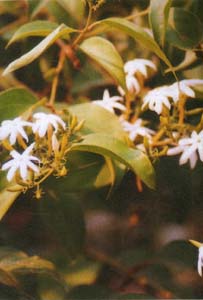
left -- habit with flowers
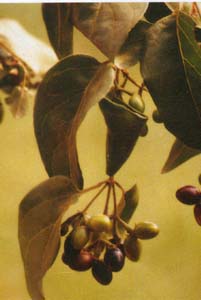
right -- habit with fruits
Click on the pictures to enlarge.
|
 |
 |
Identification characters:
A lianous shrub; younger stems villous with tawny tomentum. Leaves opposite and
decussate, simple; exstipulate; petioles densely villous; laminae ovate to
elliptic-ovate, the bases rounded or often cordate, the margins entire, the tips
acute, often mucronate, unicostate, reticulate, the upper surfaces glabrescent,
the lower pubescent. Inflorescences terminal dichasial cymes at the ends of
short axillary branches, densely flowered; bracts lanceolate, acute, large,
foliaceous. Flowers ebracteolate, pedicellate, bisexual, zygomorphic,
pentamerous, hypogynous. Calyx synsepalous, 5-lobed, campanulate, the lobes
subulate, densely villous. Corolla synpetalous, 5- to 7-lobed, salverform, the
lobes elliptic-oblong, acute, white, fragrant. Androecium polyandrous, stamens
2, epipetalous, the filaments short, inserted, the anthers dithecous, oblongoid,
dorsifixed, the cells back to back, apiculate due to connective extension,
introrse, dehiscence longitudinal. Pistil 1, ovary globose, 2-carpelled,
syncarpous, 2-loculed, the placentation axile, the ovule solitary in each locule,
the style cylindric, the stigma 2-fid. Fruit a berry, ellipsoid, black,
subtended by the suberect persistent calyx teeth; seeds 1-2 ellipsoid, erect,
non-endospermic.
Flowering period: November-January
Fruiting period: January-June
Distribution: Commonly grows
wild or planted throughout Myanmar.
Parts used and uses: Flower -- Intracranial disease; Metrorrhagia;
Oedema; Biliary infection; Cardiac tonic; Diarrhoea; Heartburn; Antidote for poisons.
Main Index of DB |
Top
Contents of this page
End of TIL file