Update:
2006-03-18 05:40 PM +0700
TIL
Medicinal Plants of Myanmar
Leguminosae - Caesalpinioideae
by Kyaw Soe and Tin Myo Ngwé, Forest Resource Environment Development and
Conservation Association (FREDA), Series 1, 2004, ISBN 974-91986-0-3
Copied by U Kyaw Tun, and staff of TIL
for staff and students of TIL. Not for sale.
Main Index of DB |
Top
Index of Collected papers
Agri.Dept.2000:
Akshara |
Science names |
Family names
Contents of this page
UKT: Nagathein references are given to check the Burmese-Myanmar names. *
shows where there is no agreement in Burmese name but when the plant is
identifiable from botanical name.
{hsu:kauk-nak} -- C. sepiaria
{hsu:hkauk} -- C. nuga{a.lo-lé:} -- ?
Caesalpinia nuga Ait. 1-4341-433?
{ngu.} ; {ngu.shwé-wa} ; {hpwa:hpak}
Cassia fistulaL. 1-349
{pri~-pan:ño} ; {pri~-pan:shwé}
Cassia glauca Lam.
{mè-za.li} ; {tau-mè-za.li}
Cassia siamea Lam. 2-436
{dan.hkywè:} Cassia tora L. 2-086
{man-kri:} Tamarindus indica L. 2-456
Main Index of DB |
Top
Index of Collected papers
Agri.Dept.2000:
Akshara |
Science names |
Family names
Contents of this page
KS-TMN 122
{hsu:kauk-nak} -- C. sepiaria
{hsu:hkauk} -- C. nuga{a.lo-lé:} -- ?
Caesalpinia nuga Ait. 1-4341-433?
|
Botanical name: Caesalpinia nuga Ait. Hort. Kew.ed.2.111, 32. 1811.
Myanmar names: Sugauk-net; Sugauk; Alolay
English name;
Family: Leguminosae - Caesalpiniodeae
Burmese-Myanmar name in Nagathein 1-4341-433:
{hsu:kauk-nak} -- C. sepiaria
{hsu:hkauk} -- C. nuga
{a.lo-lé:} -- ?
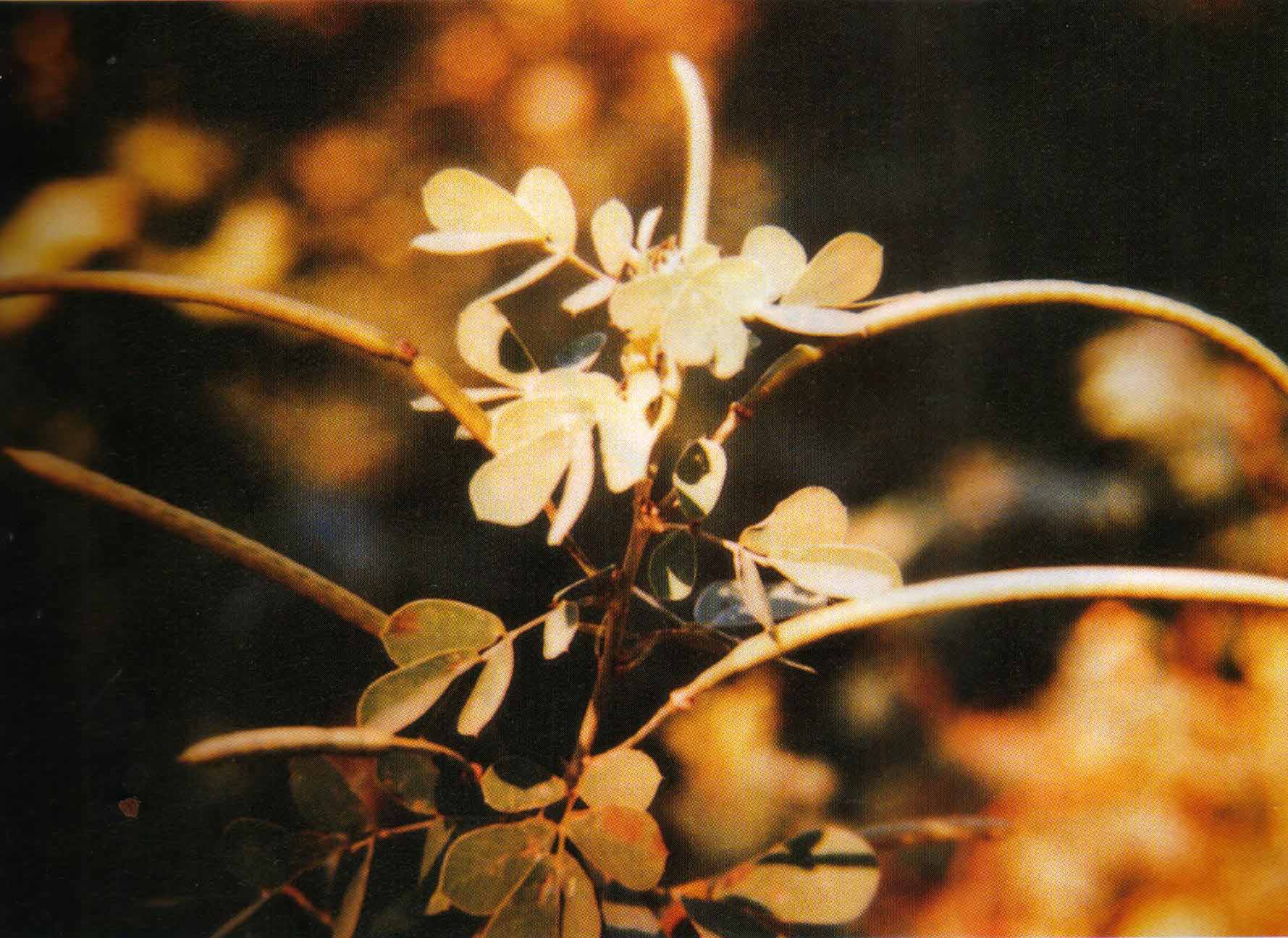
Photos:
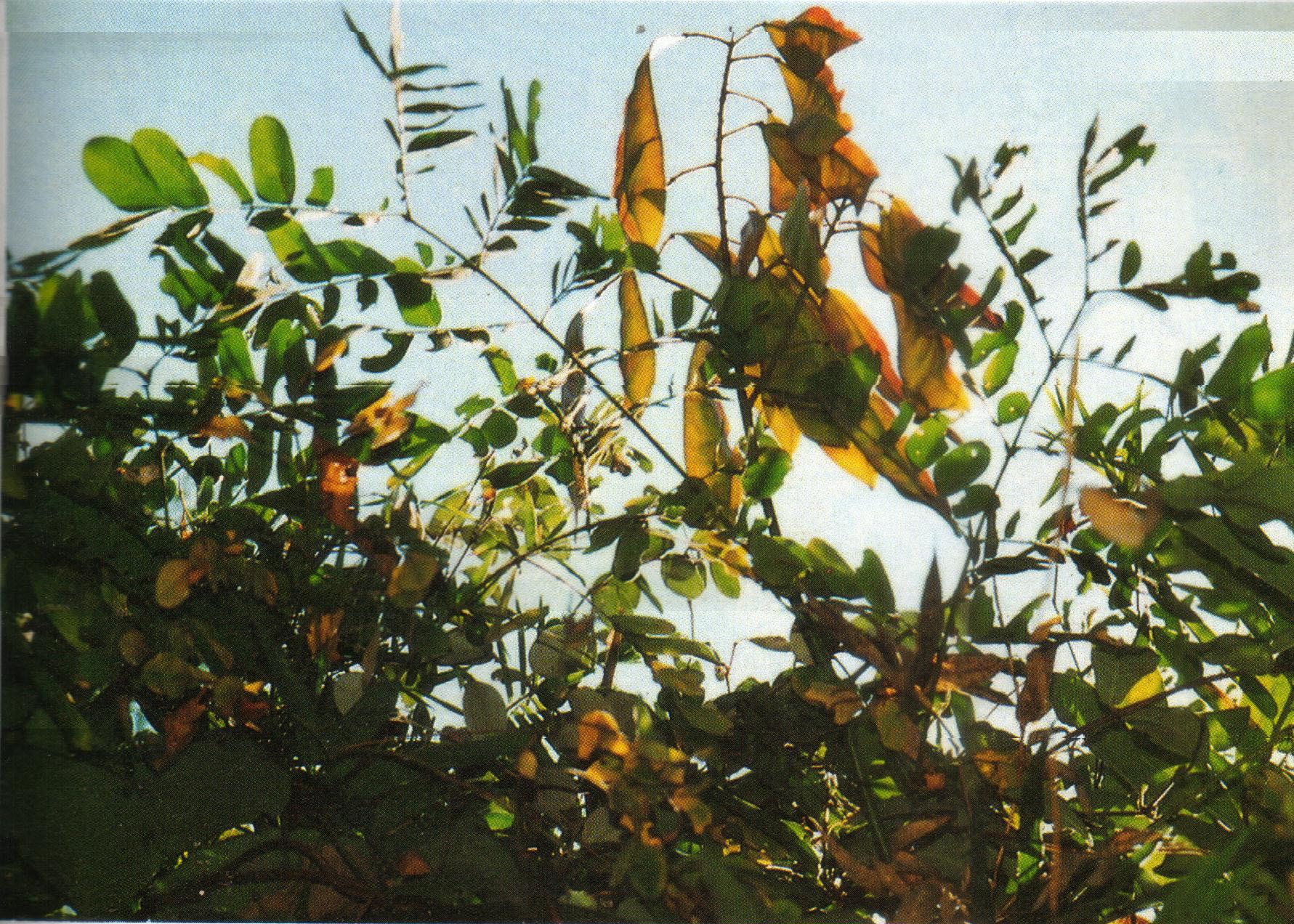
left -- habit with young flowers
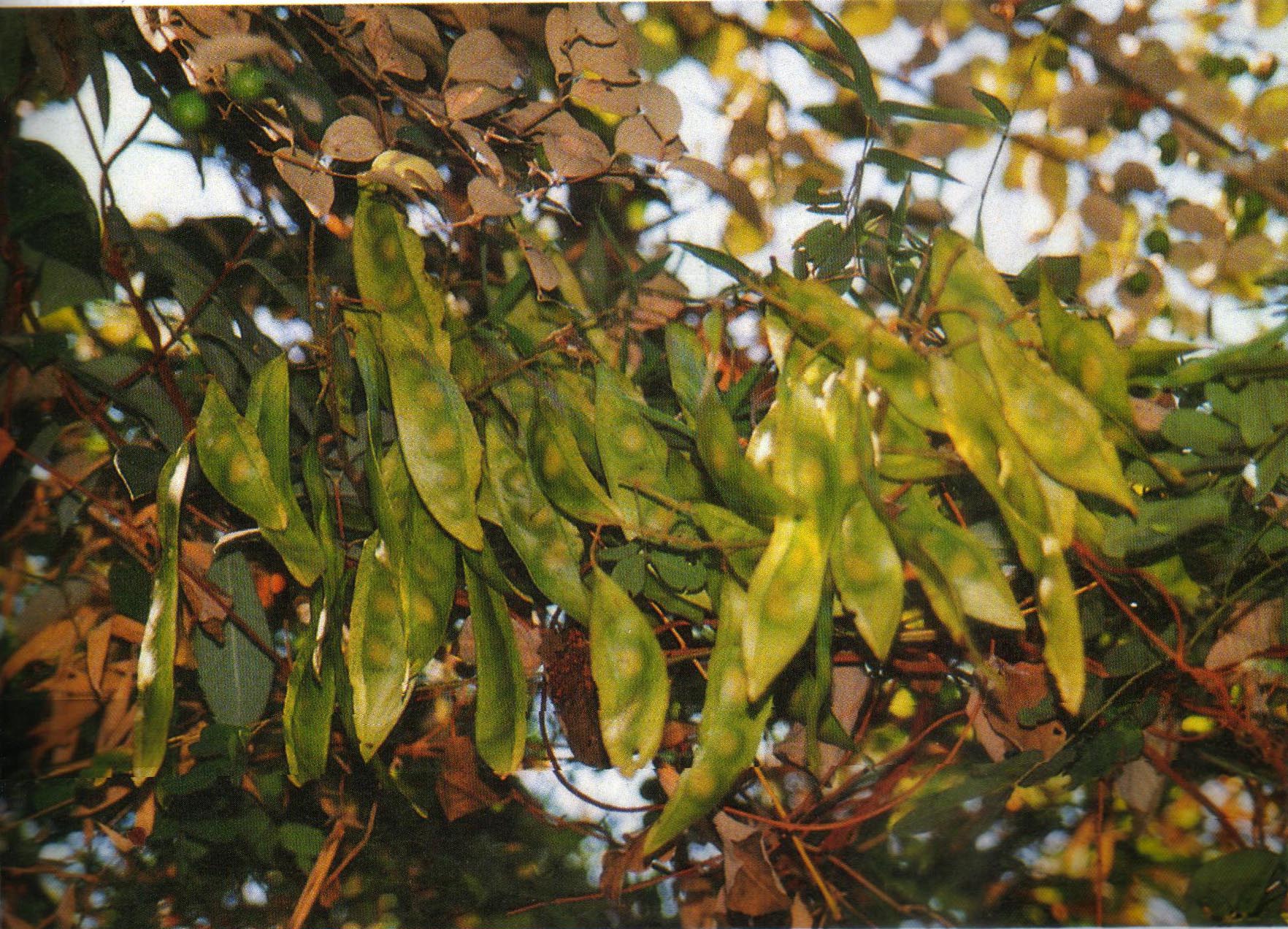
right -- habit with fruits
Click on the pictures to enlarge. |
 |
 |
Identification characters:
A large woody climber; stems stiff, wiry, armed with retrorse prickles,
glabrous, bark rough, fibrous, yellowish grey. Leaves alternate, bipinnately
compound, paripinnate; stipules spinous; petioles pulvinate, petioles and
racheae beset with retrorse prickles; secondary racheae 2-3 pairs; petiolules
short; leaflets 2-3 pairs, elliptic to elliptic-ovate, the bases rounded,
oblique, the margins entire, the tips acute, the surfaces glabrous, the upper
smooth and glaucous, coriaceous; stipels spinous. Inflorescences in terminal and
axillary panicles; bracts caducous. Flowers ebracteolate, pedicellate, bisexual,
zygomorphic, 5-merous, hypogynous. Calyx synsepalous, 5-sect, the lobes
dimorphic, the anterior lobe largest, concavely cymbiform, enclose other lobes
yellow or yellowish green, deciduous. Corolla apopetalous, the petals 5,
dimorphic, distinctly clawed, the posterior petal spathulate, the others
orbicular, yellow. Androecium polyandrous, stamens 10, the filaments densely
lanuginose from mid-length to base, the anthers dithecous, oblongoid, dorsifixed,
introrse, dehiscence longitudinal. Pistil 1, ovary ellipsoid, subsessile,
1-carpelled, 1-loculed, the placentation parietal along ventral suture, the
ovules few in the locule, the gynophore short, the style filiform, the stigma
simple. Fruit a pod, obliquely and broadly ellipsoid, flattened, sharply beaked,
coriaceous, black; seeds 1-2, discoid, compressed, smooth, non-endospermic.
Flowering period: October - November
Fruiting period: December - March
Distribution: Grows wild throughout Myanmar, particularly along the coastal areas.
Parts used and uses: Root -- Urolithiasis; Gives energy.
Juice of wood -- Opthalmia (for oral and external application).
Leaf -- For post-partum uterine contraction . Fruit -- Opthalmia
Main
Index of DB | Top
Contents of this page
KS-TMN 125
{ngu.} ; {ngu.shwé-wa} ; {hpwa:hpak}
Cassia fistula L. 1-349
|
Botanical name: Cassia fistula L. Sp. Pl. 377. 1753.
Myanmar names: Ngu; Ngu-shwe-wa; Hpwa-bet
English names: Cassia; Golden shower; Indian Laburnum; Purging Cassia
Family: Leguminosae-Caesalpinioideae
Burmese-Myanmar name in Nagathein 1-349:
{ngu.} ; {ngu.shwé-wa} ; {hpwa:hpak}
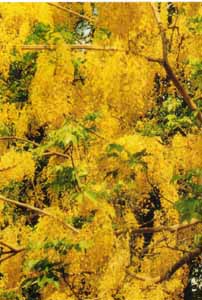
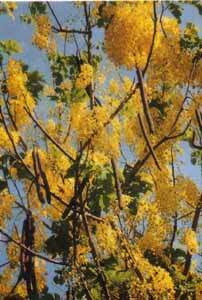
Photos:
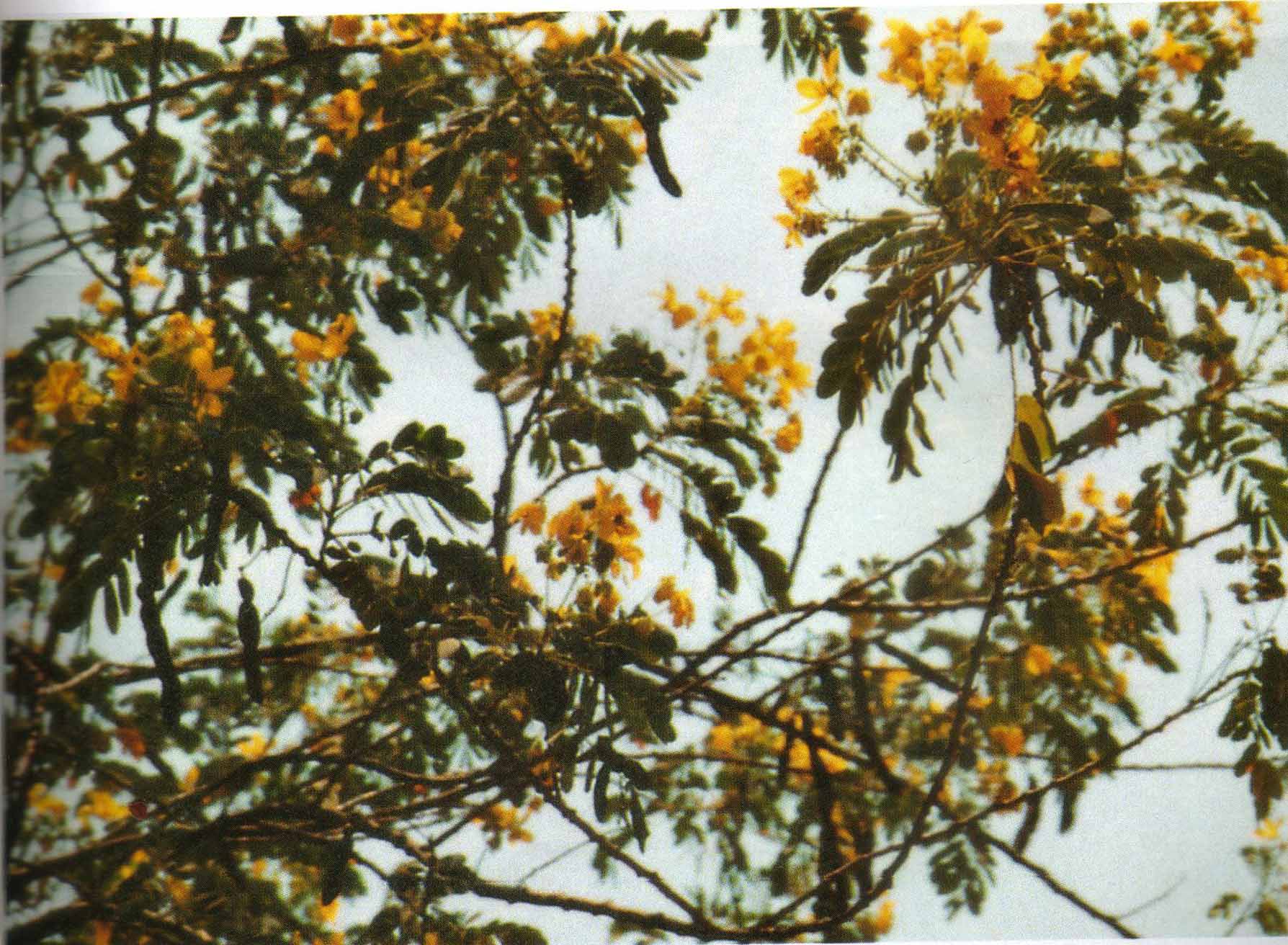
left -- habit with flowers
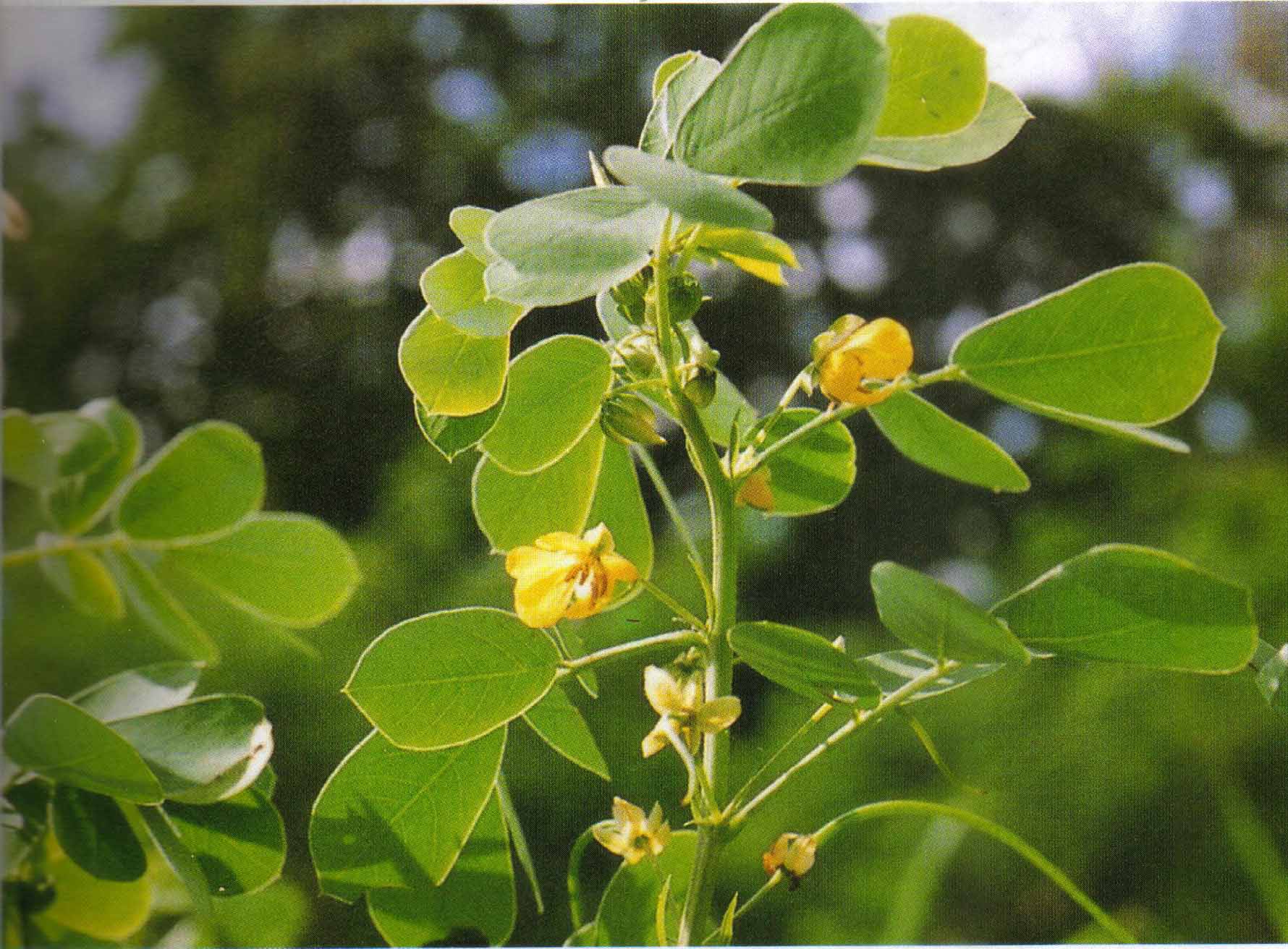
right -- habit with fruits
Click on the pictures to enlarge. |
 |
 |
Identification characters:
A tree; younger stems terete, pubescent, bark smoothe and pale grey when young,
rough and dark brown when old. Leaves opposite, unipinnately compound,
paripinnate; stipules minute, linear-oblong, persistent; petioles and racheae
obscurely canaliculate at the adaxial sides, glands absent; petiolules distinct;
leaflets 4-e pairs, ovate to ovate-oblong or elliptic-oblong, the bases cuneate,
the margins entire, the tips acute to acuminate, the upper surfaces
subcoriaceous, glaucous, puberulent, Inflorescences in axillary racemes, lax,
pendant, 10- to 23-flowered; peduncles puberulent; bracts lanceolate, caducous.
Flowers ebracteolate, pedicellate, bisexual, zugomorphic, pentamerous,
hypogynous. Calyx aposepalous, sepals 5, equal, oblong or obovate-oblong,
persistent. Corolla apopetalous, petals 1+4, bimorphic, shortly dawed, the
anterior petal largest, ovate to elliptic-ovate, the remaining 4 ovate, bright
yellow, deciduous. Androecium polyandrous, stamens 10, 7 fertile, 3 sterile, the
3 fertile stamens long and lowest, the other 4 short and lateral, the long
filaments curved with large anthers, the short ones straight with small anthers,
the anthers dithecous, oblongoid, the large anthers basifixed, dehisce by
longitudinal slits, the small ones versatile, dehisce by pores at the base, the
sterile anthers much smaller, erect, indehiscent. Pistil 1, ovary cylindrical,
curved, 1-carpelled, 1-loculed, the placentation parietal along ventral suture,
the ovules many in 2 alternating rows on a single placenta, the style 1, short,
the stigma capitate, the gynophore distinct. Fruit a pod, indehiscent,
cylindical, pendulous, not torulose, hard, dark brown or black, pulp sweetish,
dark coloured, seeds completely separated by transverse dissepiments; seeds
25-90, ovoid to broadly ovoid or obovoid, compressed, brown or reddish brown,
endospermic.
Flowering period: April-May
Fruiting period: June-August
Distribution : Common throughout the dry plains
Parts used and uses: Root, leaf, flower, fruit, seed
-- Root -- Flatulence; Haematological disorder.
Leaf -- Herpeszoster; Leprosy.
Fruit -- Dysuria; Oliguria; Haematuria; Orchitis; Bronchitis; Arthritis;
Constipation; Flatulence.
Main
Index of DB | Top
Contents of this page
KS-TMN 126
{priñ-pan:ño} ; {pri~-pan:shwé} Cassia glauca
Lam.
|
Botanical name: Cassia glauca Lam. Dc. Prodr. ii.495. 1830.
Myanmar names: Pyi-pan-nyo; Pyi-pan-shwe
Myanmar name in script:
 {priñ-pan:ño}
English name:
Family: Leguminosae-Caesalpinioideae
Burmese-Myanmar name in Nagathein
{priñ-pan:ño} ; {pri~-pan:shwé}
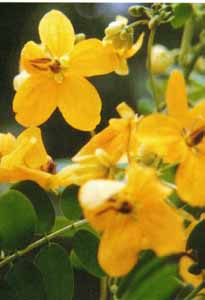
Photos:
left -- habit with flowers
right -- habit with fruits
Click on the pictures to enlarge. |
 |
 |
Identification characters:
A small tree; younger stems terete, glabrous. Leaves opposite to subopposite,
alternate near the inflorescence axis, unipinnately compound, paripinnate;
stipules linear, falcately curved, caducous; petioles and racheae canaliculate
at the adaxial sides, racheae glandular between 2-5 pairs of lower leaflets;
leaflets 6-10 pairs, oblong or elliptic-oblong, the bases rounded, oblique, the
margins entire, the tips obtuse or rounded, the upper surfaces subcoriaceous,
pale green, glabrous, the lower puberulent, glaucous; petiolules short.
Inflorescences terminal or axillary corymbs, 2- to 6- flowered; bracts
lanceolate, caducous. Flowers pedicellate, zygomorphic, bisexual, pentamerous,
hypogynous. Calyx aposepalous, sepals trimorphic, 1+2+2, the 3 outer smaller
than the 2 inner. Corolla apopetalous, petals trimorphic, shortly clawed, 1+2+2,
rarely 1+4, yellow, deciduous. Androecium polyandrous, stamens 10, all fertile,
2 long +8 short, inserted, the 1-carpelled, 1-loculed, the placentation parietal
along ventral suture, the ovules many in 2 alternating rows on a single
placenta, the style 1, curved, the stigma simple, the gynophore distinct, Fruit
a pod, oblongoid straight, flattened, stalked; seeds 10-30, ovoid or oblongoid,
dark brown, smooth, edospermic.
Flowering period -- May-July
Fruiting period -- July-September
Distribution -- Grows wild or planted throughout Myanmar.
Parts used and uses: Leaf, bark -- Dysuria
Main
Index of DB | Top
Contents of this page
KS-TMN 129
{mè-za.li} ; {tau-mè-za.li}
Cassia siameaLam. 2-436
|
Botanical name: Cassia siamea Lam. Encyc. 1.648. 1791.
Myanmar names: Mezali; Taw mezali
English name: Siamese Cassia
Family: Leguminosae - Caesalpinioideae
Burmese-Myanmar name in Nagathein 2-436
{mè-za.li} ; {tau-mè-za.li}
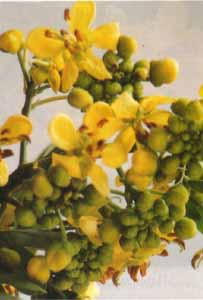
Photos:
left -- habit with flowers
right -- habit with fruits
Click on the pictures to enlarge. |
 |
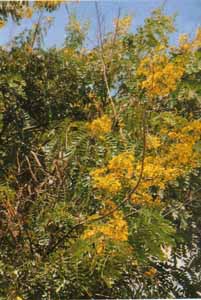 |
Identification characters:
A tree; younger stems terete, puyberulent. Leaves alternate, unipinnately
compound, paripinnate; stipules caducous; petioles and racheae canaliculate at
the adaxial side, glands absent; petiolules short; leaflets oblong to
elliptic-oblong, the bases truncate, the margins entire, the tips mucronate, the
upper surfaces subcoriaceous. Inflorescences terminal or axillary corymbose
panicles; bracts lanceolate. Flowers ebracteolate, pedicellate, bisexual,
zygomorphic, pentamerous, hypogynous. Calyx aposepalous, thesepals trimorphic,
1+2+2. Corolla apopetalous, the petals trimorphic, clawed, 1+2+2, rarely 1+4,
yellow, deciduous. Androecium dithecous, oblongoid, basifixed, introrse,
yellowish brown, dehiscence by terminal pores. Pistil 1, ovary oblongoid,
1-carpelled, 1-loculed, the placentaion parietal along ventral suture, the
ovules many in 2 alternating rows on a single placenta, the style 1, curved, the
stigma simple, the gynophore distinct. Fruit a pod, linear-oblongoid, flattened,
acuminate at both ends, dark brown; seeds 10-30, oblongoid to obovoid-oblong,
flattened, dark brown, endospermic.
Flowering and fruiting periods: Throughout the year
Distribution: Grows wild or planted in warmer parts of Myanmar.
Parts used and uses: Leaf -- Indigestioin; Carminative; As an expectorant.
Root -- Conjunctivitis. Leaf -- Heart burn; Promotes digestion;
Hypnotic; Expectorant, Antipyretic, Apthus ucler; Gingivitis; Purifies blood;
Eczema; Antidote for bites of poisonous animals; Replenishes energy;
Heals blotches on skin due to menstrual disorder.
Leaf and flower -- Heal blotches on skin due to menstrual disorder.
Main
Index of DB | Top
Contents of this page
KS-TMN 130
|
Botanical name: Cassia tora L. Sp. Pl. 376. 1753.
Myanmar name: Dan-gywe
English name: Foetid Cassia
Family: Leguminosae - Caesalpinioideae
Burmese-Myanmar name in Nagathein 2-086:
{dan.kywè:}
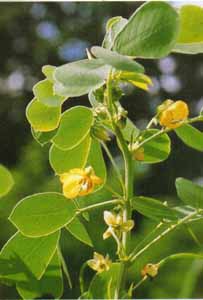
Photos:
left -- habit with flowers
right -- habit with fruits
Click on the pictures to enlarge. |
 |
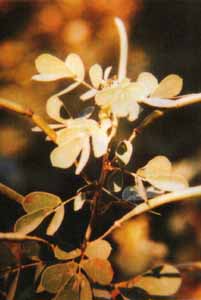 |
Identification characters:
An annual herb, fortid, woody below; younger stems cylindrical, pubsecent.
Leaves alternate, unipinnately compound, paripinnate; stipules linear-subulate,
caducous; petioles cylindrical, canaliculate at the adaxial sides, pulvinii
cylindrical; racheae cylindrical, canaliculate at the adaxial sides, a yellow
filiform gland distinct between each of the two lowest pairs of leaflets;
petiolules short, pubescent; leaflets opposite, 3 pairs, obovate-oblong, the
bases oblique, the margins entire, the tips mucronate, the surfaces glabrous or
pubescent at the margins, the upper glaucous. Inflorescences in axillary cymes,
the cymules 1- to 2-flowered, the upper dense; peduncles glaucous; bracts
linear-subulate, caducous. Flowers ebracteloate, pedicellate, bisexual,
zygomorphic, pe, pentamerous, hypogynous. Calyx aposepalous, the sepals 5,
trimorphic, cucullate, the 2 inner ovate, the 2 outer ovate-oblong, the
remaining one broadly ovate, coriaceous. Corolla apopetalous, the petals 5,
trimorphic, the posterior petal broadly obovate, 2-lobed, the 2 laterals
obliquely oblong or obovate-oblong, the 2 anterior ones obliquely obovate,
bright yellow with distinct veins. Androecium polyandrous, stamens 10, 7
fertile, 3 sterile, the fertile stamens 2 long, 5 short, the anthers dithecous,
oblongoid, the tips truncate, the bases obscurely sagittate, yellowish brown
basifixed, introrse, dehisce by terminal pores, the sterile ones light brown.
Pistil 1, ovary oblongoid, sickled-shaped, 1-carpelled, 1-loculed, the
placentation parietal along ventral suture, the ovules many 2 alternating rows
on a single placenta, the style 1, short, the stigma capitate. Fruit a pod,
subtetragonous, long, the tips obscurely capitate, brown, curved, obliquely
septate, glabrous; seeds 20-30, rhomboidal, brown or yellowish brown, hard,
shining, glabrous.
Flowering period: July-September
Fruiting period: August-October
Distribution:
A weed throughout Myanmar, common in dry plains and on low hills.
Parts used and uses: Leaf and seed -- Diuretic; Carthartic;
Carminative; Asthma; Cough; Expectorant; Pruritis; Ringworm; Infections; Knee-ache;
Antidote for poisons; Skin diseases; Good for heart. Seed -- Oedema;
Heals boils and pustules; Cellulitis; Eye diseases.
Main
Index of DB | Top
Contents of this page
KS-TMN 133
|
Botanical name: Tamarindus indica L.Sp. Pl. 34. 1753.
Myanmar name: Magyi
Myanmar name in script:
 {man-kyiñ:}
-- loosely pronounced as {man-kyiñ:}
-- loosely pronounced as
 {ma.kyi:} {ma.kyi:}
English name: Tamarind Tree
Family: Leguminosae - Caesalpiniodeae
Burmese-Myanmar name in Nagathein 2-456:
{man-kyiñ:}
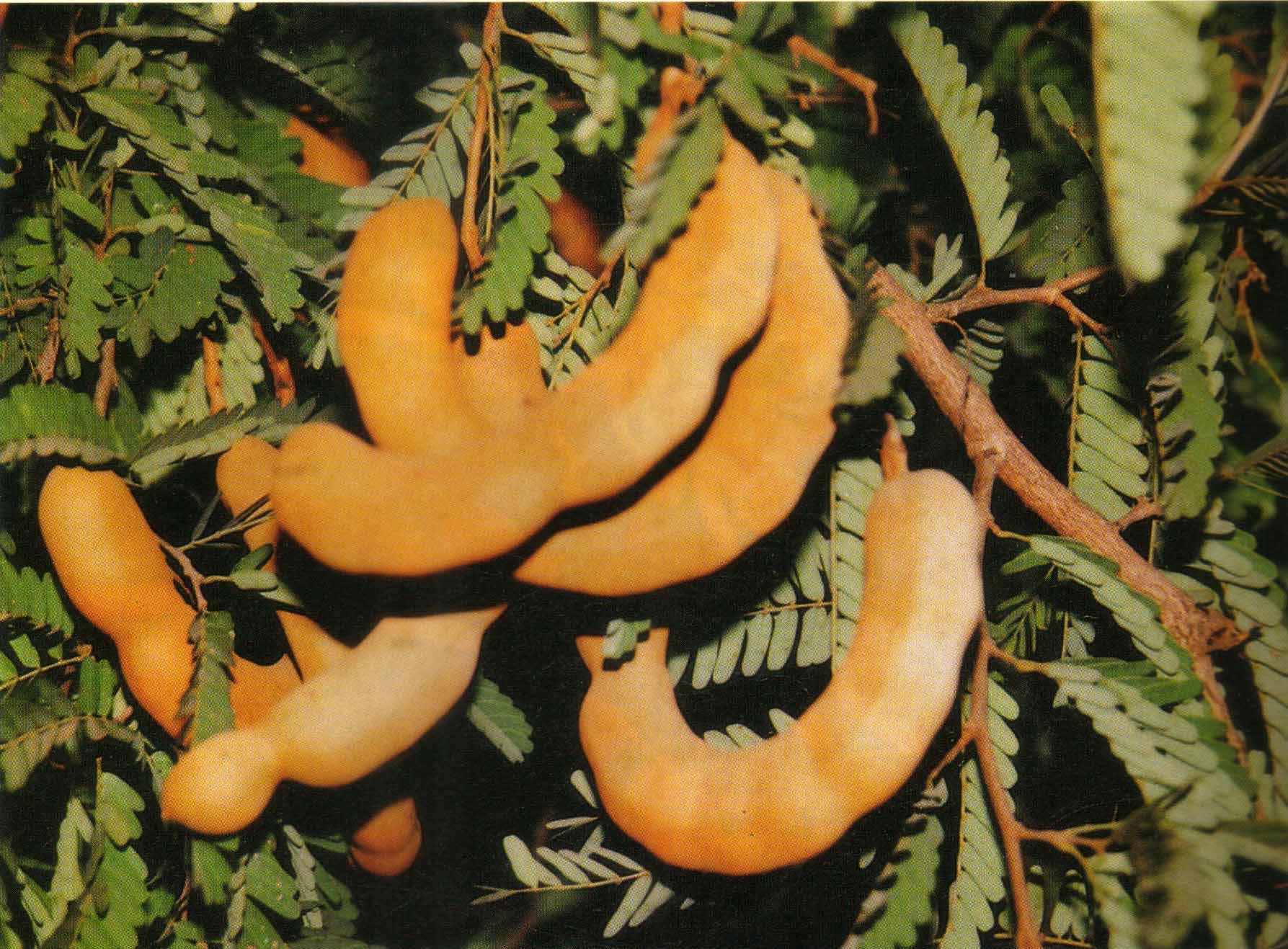
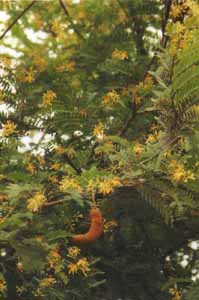
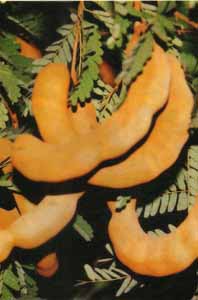
Photos:
left -- habit with flowers
right -- habit with fruits
Click on the pictures to enlarge. |
 |
 |
Identification characters:
A large tree, unarmed; branches spreading, glabrous. Leaves alternate,
unipinnately compound, paripinnate; stipules caducous; petiolate; petiolules
obsolete; leaflets oblong, 10-16 pairs, opposite, closely set on the rachis, the
bases obtusely oblique, the margins entire, the tips rounded or retuse,
reticulate, glabrous. Inflorescences terminal and axillary at the ends of the
branchlets, racemes lax, few-flowered; bracts concave, enclosing the buds,
caducous. Flowers ebracteolate, pedicellate, bisexual, zygomorphic, penamerous,
hypogynous. Calyx sunsepalous, 5-fid, the tubes narrowly trubinate, disc
prominent above its base, the lobes oblong or lanceolate. Corolla apopetalous,
the petals 3, the upper hooded, the two laterals obovate-oblong, the 2 lower
reduced to scales, yellowish with pink stripes. Androecium monadelphous, connate
nearly half their lengths, fertile stamens 3, staminodes 7, reduced to bristle,
the anthers dithecous, oblongoid, versatile, dehiscence longitudinal. Pistil 1,
ovary oblongoid, flattened, 1-carpelled, 1-loculed, the placentation parietal
along ventral suture, the ovules many, in 2 alternating rows on a single
placenta, the style 1, pubescent, as long as the stamens, the stigma capitate;
gynophore distinct. Fruit a pod, ligulate, 3- to 10-seeded, epicarp thin and
crustaceous, mesocarp thick and pulpy; seeds obovoid-oblongoid, truncate at the
ends, smooth, brown, non-endospermic.
Flowering period: September-October
Fruiting period: October-February
Distribution: Naturalized and planted throughout Myanmar.
Parts used and uses: Roots, Leaves, flowers, fruits and seeds -- Abdominal tumours.
Root -- Amoebic dysentery. Bark -- Heals boils and carbuncles;
As an antidote for poisons; Haemorrhoids; Polyuria; Jaundice; Indigestion;
Flatulence; Emesis; Colic; Dysentery. Leaf -- Otalgia; Prickly hearts;
As an antidote for snake-bite; Dysuria; Deodorant; Eye disease.
Flower -- Biliousness. Ripe fruit -- Internal haemorrhoid; Loss of appetite;
Cannabis intoxication; Leprosy; Constipation; Biliousness; Indigestion;
Cholera; Heartburn. Seed -- Amoebic dysentery; Oligospermia; Polyuria;
As an antidote for scorpion stings; Dysentery.
Main
Index of DB | Top
Contents of this page
End of TIL file