Update:
2006-03-18 08:37 AM +0700
TIL
Medicinal Plants of Myanmar
Lauraceae
by Kyaw Soe and Tin Myo Ngwé, Forest Resource Environment Development and
Conservation Association (FREDA), Series 1, 2004, ISBN 974-91986-0-3
Copied by U Kyaw Tun, and staff of TIL
for staff and students of TIL. Not for sale.
Main Index of DB |
Top
Index of Collected papers
Agri.Dept.2000:
Akshara |
Science names |
Family names
Contents of this page
UKT: Nagathein references are given to check the Burmese-Myanmar names. *
shows where there is no agreement in Burmese name but when the plant is
identifiable from botanical name.
{ka.ra.wé:}
Cinnamomum tamala Fr. Nees.
{this-kram:po:} ; {thi-ho-this-kram:po:}
Cinnamomum zeylanicum Bl.
Main Index of DB |
Top
Index of Collected papers
Agri.Dept.2000:
Akshara |
Science names |
Family names
Contents of this page
KS-TMN 117
|
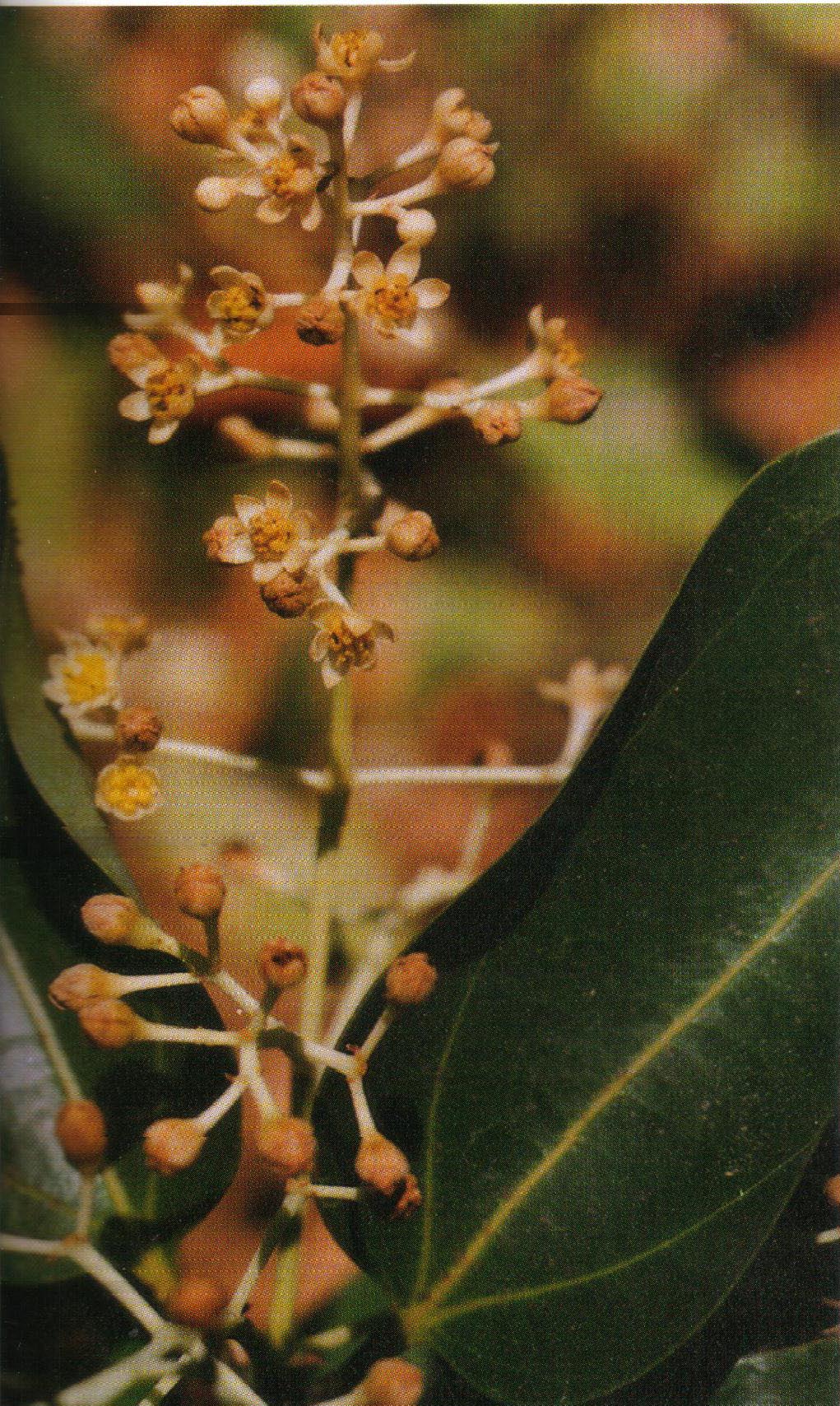
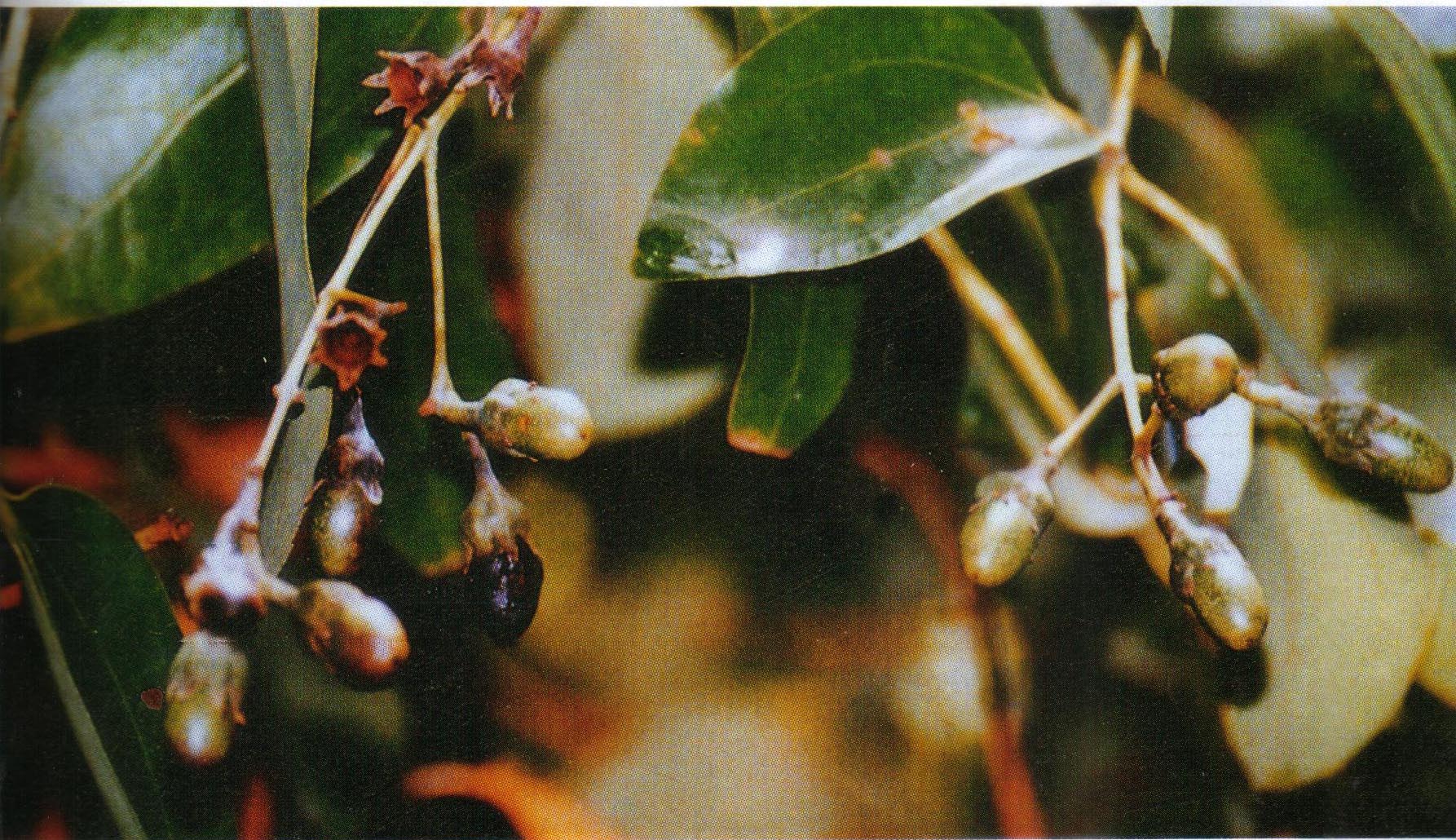
Botanical name: Cinnamomum tamala Fr.
Nees in Nees & Eberm. Med. Pharm. Bot. II:426.
Myanmar name: Karaway
English names: Cassia Cinnamon; Indian Cassia Lignea
Family: Lauraceae Burmese-Myanmar name in Nagathein
{ka.ra.wé:}
Photos:
left -- habit with flowers
right -- habit with fruits
Click on the pictures to enlarge. |
 |
 |
Identification characters:
An evergreen tree, bark slightly rough, dark brown or greyish brown, lenticels
prominent. Leaves opposite to sub-opposite, simpe; exstipulate; petiolate;
laminae ovate to broadly ovate-lanceolate, the bases obtuse to oblique, the
margins entire, the margins entire, the tip acute to slightly acuminte,
3-costate, reticulate, the surfaces glabrous, the lower glaucous, coriaceous.
Inflorescences in terminal paniculate cymes, axillary ones few; peduncles
quadrangular, the main peduncles longer than the leaves, flowers lax; bracts
deciduous. Flowers bracteolate, deciduous, pedicellate, bisexual, zygomorphic,
trimerous, hypogynous. Perianth synphyllous, campanulate, 6-lobed, 2-seriate,
the lobes elliptic, sericeous, cream colored, the tubes short, accrescent and
persisting as a cupule at the base of fruit. Androecium polyandrous, stamens in
4 whorls of 3 each, adnate to the perianth tube, the first and the second whorls
opposite the petals, inserted, introrse, the third whorl alternate the petals,
extrorse, the filament bases of the third whorl bear 2 organe coloured sessile
glands, the fourth whorl of 3 staminodes, the filament bases villous, the
anthers 4-celled, basifixed, dehisce by flap-like valves opening upwards. Pistil
1, ovary oblongoid, sessile, 1-carpelled, 1-loculed, the placentation parietal,
the ovule solitary, apical pendulous, the style thick and stout, the stigma
discoid. Fruit a drupe, elliposid, apiculate, the basal prominent; seed 1,
elliposid, hard, glabrous, non-endospermic.
Flowering period: October-December
Fruiting period: January-March
Distribution: Growa wild in tropical nad subtopical Myanmar, upto 4000ft.
Parts used and uses: Leaf and bark
-- Pruritis; Gonorrhoea; Sinusitis; Heart disease; Carminative;
Indigestion; Gastrointestinal colic; Diarrhoea; Gastric distention; Cough;
Antidote for poisons. Leaf -- Aethritis; Gastrointestinal Colic; Asthma; Cough; Antidote for snake venom
and opium intoxication. Bark -- Oedema.
Main
Index of DB | Top
Contents of this page
KS-TMN 118
{this-kram:po:} ; {thi-ho-this-kram:po:}
Cinnamomum zeylanicum Bl.
Botanical name: Cinnamomum Zeylanicum
Breyn. in Ephem. Nat. Cur. dec, I. ann. 4,139.
Myanmar names: Thit-kyan-bo; Thiho-thit-kyan-bo; Hman-thin.
English names: Cinnamon; Ceylon Cinnamon.
Family: Lauraceae
Burmese-Myanmar name in Nagathein
{this-kram:po:} ; {thi-ho-this-kram:po:}
Photos:
left -- habit with flowers
right -- habit with fruits
Click on the pictures to enlarge. |
 |
 |
Identification characters:
An evergreen tree; moderate sized; bark smooth, thick, greyish brown to
yellowish brown, lenticles prominent, young parts glabrous, buds sericeous.
Leaves opposite or subopposite, rarely alternate near the inflorescence axis,
simple; exstipulate; petiolate; laminae ovate or ovate-lanceolate, the bases
obtuse to slightly oblique, the margins entire, the tips subacute or slightly
acuminate, 3- to 5-costate, reticulate glabrous, very coriaceous. Inflorescences
in terminal and axillary paniculate cymes; peduncles quadrangular, the main
peduncles longer than the leaves, flowers lax; bracts deciduous. Flowers
bracteolate deciduous, pedicellate, bisexual, zygomorphic, trimerous, hypogynous.
Perianth synphyllou, campanulate 6- to 8-lobed, 2-seriate, the lobes unequal,
oblong or obovate, sericeous, cream or ivory-white, the tubes short, accrescent
and persisting as a cupule at the base of fruit. Androecium polyandrous, stamens
in 4 whorls of 3 each, adnate to the perianthe tube, the first and the second
whorls opposite the petals, inserted, introrse, the third whorl alternate the
petals, extrorse, the filament bases of the third whorl bear 2 orange colored
sessile glands, the fourth whorl of 3 staminodes, the filament base villous, the
anthers 4-celled, basifixed, dehisce by flap-like valves opening upwards.
Pistill 1, ovary ovoid, sessile, 1-carpelled, 1-loculed, the placentation
parietal, the ovule solitary, apical pendulous, the style thick and stout, the
stigma discoid. Fruit a drupe, oblongoid, subtended by accrescent perianth tube
at the base only, deciduous or often persistent, minutely apiculate, dark
purple; seed 1, narrowly ovoid, pendulous, testa membranous, glabrous,
non-endospermic.
Flowering period: April-June
Fruiting period: June-September
Distribution: Grows wild;
common in the coastal regions of lower Myanmar upto 3000ft
Parts used and uses: Bark
-- Cholecystitis; Laryngitis; Heartburn; Dysentery; Aphrodisiac; Abdominal
tumour; Heart disease; Antiseptic; Pruritis; Cough; Influenza; Indigestion.
Seed oil -- Haemostatic; Gastric distention; Loss of appetite; Emesis;
Diarrhoea; Tinnitus; Tooth-ache.
Main
Index of DB | Top
Contents of this page
End of TIL file