Update:
2006-03-18 01:16 AM +0700
TIL
Medicinal Plants of Myanmar
Boraginaceae
by Kyaw Soe and Tin Myo Ngwè, Forest Resource Environment Development and
Conservation Association (FREDA), Series 1, 2004, ISBN 974-91986-0-3
Copied by U Kyaw Tun, and staff of TIL
for staff and students of TIL. Not for sale.
Main Index of DB |
Top
Index of Collected papers |
Agri.Dept.2000: Akshara |
Science names
| Family names
Contents of this page
UKT: Nagathein references are given to check the Burmese-Myanmar names. *
shows where there is no agreement in Burmese name but when the plant is
identifiable from botanical name.
{hsing-lak-maung:kri:} ; {hsing-nha-maung:kri:}
Heliotropium indicum L. 1-487
Main Index of DB |
Top
Contents of this page
KS-TMN 074
{hsing-lak-maung:kri:} ; {hsing-nha-maung:kri:}
Heliotropium indicum L. 1-487
Botanical name: Heliotroplum
indicum L. Sp. Pl. 130. 1753.
Myanmar names: Sinlet-maung-gyi; Sinnha-maung-gyi
English name: -
Family: Boraginaceae
Burmese-Myanmar name in Nagathein 1-487:
{hsin-lak-maung:kri:} ; {hsin-nha-maung:kri:}
Photos:
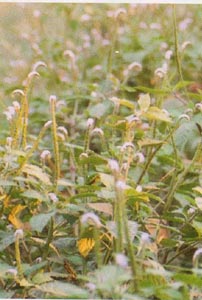
left -- habit with flowers and fruits
right -- wild growing plants
Click on the pictures to enlarge. |
 |
 |
Identification characters:
An annual herb, coarse, succulent; stems stout, cylindrical, with longitudinal
grooves, branches ascending, densely hirsute. Leaves alternate or subopposite,
simple; exstipulate; petioles obscurely winged; laminae ovate or ovate-oblong,
the bases rounded, then narrowed and decurrent into the petiole, the margins
crenulate, the tips subacute, unicostate, reticulate, the veins more conspicuous
on the lower side, the upper surfaces puberulent, the lower villous.
Inflorescences scorpioid cymes, spicate, terminal and unilateral on the
peduncle, leaf apposed; bracts lanceolate, persistent. Flowers ebracteolate,
sessile, bisexual, actinomorphic, pentamerous, hypogynous. Calyx synsepalous,
5-partite, the lobes linear-lanceolate. Corolla synpetalous, 5-lobed,
infundibuliform, the tubes tubular, the lobes orbicular, spreading, imbricate or
contorted in bud, naked at the throat, light mauve. Androecium polyandrous,
stamens 5, epipetalous, inserted, the filaments very short, alternate with the
corolla lobes, the anthers dithecous, ovoid, basifixed, introrse, dehiscence
longitudinal. Pistil 1, ovary ovoid, 2-carpelled, syncarpous, 2-loculed,
becoming 4-loculed at maturity due to false septation, the ovule 1 in each
locule, the placentation axile, at times seemingly basal, the style 1, terminal,
the stigma conoid-linear. Fruit a durpe, ovoid, 2-lobed, 4-ribbed, separating
into two, 2-seeded, 2-pointed pyrenes; seeds 4, ovoid, endosperm abundant.
Flowering period: April-June-October
Fruiting period: July-August-November
Distribution: A common weed on road-sides and stream-bed areas.
Parts used and uses: Leaf -- Astringent; Antipyretic for high fevers; Analgesic; Remedy for sores.
Leaf juice -- Excessive
lacrimation.
Main Index of DB |
Top
Contents of this page
End of TIL file

