Update:
2006-03-17 02:58 PM +0700
TIL
Medicinal Plants of Myanmar
Bignoniaceae
by Kyaw Soe and Tin Myo Ngwè, Forest Resource Environment Development and
Conservation Association (FREDA), Series 1, 2004, ISBN 974-91986-0-3
Copied by U Kyaw Tun, and staff of TIL
for staff and students of TIL. Not for sale.
Main Index of DB |
Top
Index of Collected papers |
Agri.Dept.2000: Akshara |
Science names
| Family names
Contents of this page
UKT: Nagathein references are given to check the Burmese-Myanmar names. *
shows where there is no agreement in Burmese name but when the plant is
identifiable from botanical name.
{E-ka.raiz}
Millingtonia hortensis L. 4-105
{kraung-sha} Oroxylum indicum Vent. 1-194
Main Index of DB |
Top
Contents of this page
KS-TMN 069
Botanical name: Millingtonia hortensis Linn. f. Suppl. 291.
Myanmar name: Aegayit
English name: Indian Cork Tree
Family: Bignoniaceae
Burmese-Myanmar name in Nagathein 4-105:
{E-ka.raiz}
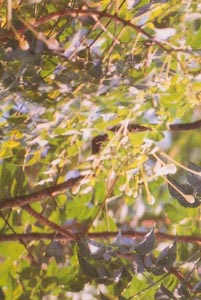
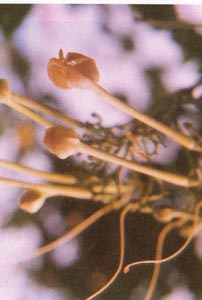
Photos:
left -- habit with flowers
right -- flowers close up
Click on the pictures to enlarge.
|
 |
 |
Identification characters:
An erect tree; branches drooping, bark corky. Leaves
opposite, tripinnately compound; exstipulate; petiolate; petiolulate, the upper
tertiary leaflets sessile; exstipellate; leaflets ovate-lanceolate, the bases
rounded or cuneate, the margins serrate, the tips acuminate, pubescent when
young, glabrescent. Inflorescences in paniculate cymes, terminal or axillary,
the cymules 3-flowered; bracts minute. Flowers ebracteolate, pedicellate,
besexual, zygomorphic, pentamerous, hypogynous. Calyx synsepalous, 5-toothed,
campanulate. Corolla synpetalous, 5-lobed,infundibuliform, the tube long,
slender, cylindrical, white. Androecium didynamous, stamens 4,epipetalous, the
filaments shortly exserted, the anthers dithecous, one cell ovoid, the second
cell appearing as a small hook, white, dehiscence longitudinal; disc small,
cushion-like. Pistil 1, ovary subsessile, 2-carpelled, syncarpous, 2-loculed,
the placentation axile, the ovules numerous in each locule, the style long, the
stigma 2-lobed, ellipsoid. Fruit a 2-valved septicidal capsule, oblongoid, acute
at both ends, flat, woody; seeds discoid, compressed, winged, except the base,
the wing narrow at the apex, non-endospermic.
Flowering period: October - December
Fruiting period: November - February
Distribution: Commonly grows wild or planted throughout Myanmar.
Parts used and uses: Leaf and root
-- Hypertension; Plague; Stimulating effect on cardiovascular system; Purify blood;
Alcohol intoxication; Antidote for
poisons. Root -- Leucoderma; Muscle stiffness; Alcohol intoxication; Giddiness.
Leaf -- Small pox; Amenorrhoea
Main Index of DB |
Top
Contents of this page
KS-TMN 070
Botanical name: Oroxylum indicum Vent. Dec. Gen. Nov. 8. 1808.
Myanmar name: Kyaung-sha
English: Indian Trumpet flower
Family: Bignoniaceae
Burmese-Myanmar name in Nagathein 1-194:
{kraung-sha}
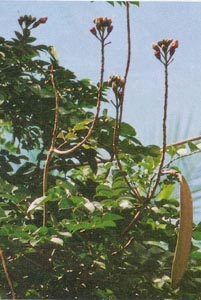
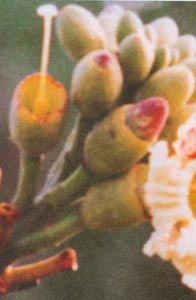
Photos:
left -- habit with flowers and fruits
right -- flowers close up
Click on the pictures to enlarge.
|
 |
 |
Identification characters:
A small tree, deciduous; bark light brown, corky, lenticels
numerous, the younger stems glabrous. Leaves opposite, decussate, decompound,
ternate; exstipulate; petiolate; petiolules short; exstipellate; leaflets ovate
or elliptic, the bases rounded or obtusely acute, the margins entire, the tips
acute to acuminate, the surfaces glabrous. Inflorescences terminal racemes;
peduncles long, stout; bracts distinct. Flowers ebracteolate, pedicellate,
bisexual, zygomorphic, pentamerous, hypogynous. Calyx synsepalous, 5-lobed,
campanulate, coriaceous, persistent. Corolla synpetalous, 5-lobed, campanulate,
ventricose, the lobes orbicular, subequal, crisped, reddish purple, fleshy,
caducous. Androecium polyandrous, stamens 5, epipetalous, inserted, the
filaments straight, 4 subequal, the fifth one shorter, the bases woolly, the
anthers dithecous, oblongoid, divergent below, the connective with a short mucro,
basifixed, introrse, dehiscence longitudinal; disc large, fleshy,. Pistil 1,
ovary oblongoid, subsessile, 2-carpelled, syncarpous, 2-loculed, the
placentation axile, the ovules numerous in each locule, the style filiform, the
stigma 2-lobed. Fruit a 2-valved septifragal capsule, oblongoid, tapering to
both ends, flat, valves semiwoody; seeds discoid, compressed, numerous, with a
broad hyaline wing, non-endospermic.
Flowering period: June - July
Fruiting period: July - September
Distribution: Commonly grows wild throughout Myanmar. Also cultivated.
Parts used and uses: Root bark, fruit
-- Good for the treatment of heart and neck diseases; Haemorrhoids;
Abdominal tumours; Infections; Flatulence; as an expectorant.
Plant -- Leprosy; Diarrhoea; Dyspepsia; Cough; Infections; Nausea, Vomitting;
Abscess; Flatulence. Root bark -- Neurological disorders; Life saver; Asthma; Cough; Migraine;
Indigestion; Postpartum uterus contraction pain; Gynaecological diseases. Leaf
-- Oropharyngeal ulcer; Opium intoxication. Flower -- Improves appetite.
Main Index of DB |
Top
Contents of this page
End of TIL file