 • Punicaceae
compiled by U Kyaw Tun, U Pe Than, and staff of TIL. Not for sale.
• Punica granatum • {tha.lè:}
• Punicaceae
Main Index of DB | Top
Contents of this page
Burmese-Myanmar transcript names:
• Agri.Dept.2000 58-1555:
{tha.lè:}
• FAO 181: salebin, talebin, thale
• Lè-seik-shin : NL
• KS-TMN 189: Tha-le
• Nagathein 3-326:
{tha.lè:}
• UHM 40: Tha-le
Myanmar-Script Spelling
•
Official Myanmar Dictionaries
{tha.lè:} -
 -- TravPo-M-Dict 321
 {ta.lhèÑ:} -
 -- TravPo-M-Dict 122
{ta.lhèÑ:} - n. pomegranate, Punica granatum - Myan-Engl-Dict 165
Hindi:
Sanskrit:
English common name used in Myanmar:
• Agri.Dept.2000 58-1555: Carthaginian apple
• FAO 181: Pomegranate
• Lè-seik-shin : NL
• KS-TMN 189: Pomegranate Tree
• Nagathein 3-326: NG
• UHM 40: Pomegranate, Carthaginian Apple, Grenadier
Picture :
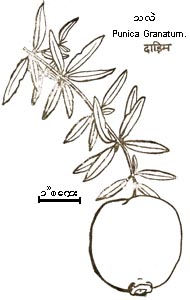
• Leader from Nagathein 3-326
• Photos:
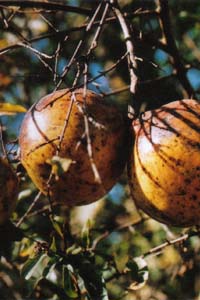
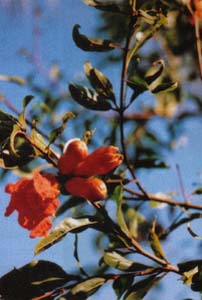
left -- habit with flowers
right -- habit with fruits.
Click on the pictures to enlarge. -- KS-TMN
Plant identification characters :
• Key characteristics: Shrub or small tree; branching from base; each branch ends in a spine; sometimes spines on twigs; leaves mostly opposite. Description: A deciduous shrub or small tree up to 6, sometimes 10 m in height. Often richly branching from the base, each branch ending in a spine. Often also spines from leaf corners. Leaves mostly opposite, sometimes sub-opposite or clustered, oblong-lanceolate, 1–9 cm long and 0.5–2.5 cm wide with acute or obtuse base, entire margin and obtuse or emarginate tip. Flowers 1–5 together at top of twigs, waxy, 4–5 cm long and wide with red to white petals. Fruits 6–12 cm in diameter, very variable in color, with leathery skin. The interior of the fruit is separated by membranous walls and white spongy tissue into compartments packed with numerous small transparent sacs filled with juicy pulp and seed. -- FAO
• A large deciduous shrub, or a small tree, often armed with small spines, axillary or terminal. Leaves opposite or fasciculate, simple; exstipulate; petioles very short; laminae oblong-elliptic or oblong-oblanceolate or obovate, the bases attenuate, the margins entire, the tips acute or obtuse, unicostate, reticulate, the surfaces glabrous, pellucid-punctate, the upper shining, the lower green colour darker. Inflorescences mostly solitary cymes, sometimes 2- to 4-flowered, terminal on short shoots or sometimes axillary. Flowers large, showy, ebracteate, ebracteolate, subsessile, bisexual, actinomorphic, pentamerous, epigynous. Calyx synsepalous, 5- to 7-lobed, the tubes campanulate, forming a hypanthium below, adnate to the ovary, enlarged above, fleshy. Corolla apopetalous, the petals 5-7, obovate, crumpled in bud, emerging from edge of hypanthium, inserted between calyx lobes, scarlet. Androecium polyandrous, stamens very numerous, emerging in many whorls from upper half of hypanthium below the petals, the filaments filiform, the anthers dithecous, wllipsoid, dorsifixed, dehiscence longitudinal. Pistil 1, ovary inferior, globose, 5- to 9-carpelled, syncarpous, the locules 2-tiered, the upper 5- to 9-loculed, the placentation parietal, the ovules numerous in each locule, the style long, slender, the stigma capitate, Fruit a berry crowned with persistent calyx lobes, globose; seeds many, angular, testa fleshy forming the pulp in fruit, non-endospermic. Flowering period: June-July. Fruiting period: October-November -- KS-TMN
• A large shrub or small tree with oblong or obovate shining leaves, orange ned showy flowers and many seeded pome like berry fruit, the seeds of which are surrounded by a succulent red edible flesh. -- UHM
Distribution in Myanmar:
• Planted mainly on highlands. -- UKT-TMN
• Kalaw, Taunggyi, Hopong, Central Range, Mongnai Range (Southern Shan States). -- UHM
Distribution elsewhere:
Ecology: Hardy subtropical species tolerating low winter temperatures, drought and a wide range of soil conditions. In Southeast Asia found up to 1,600 m altitude. In areas with high rainfall evergreen with prolonged fruiting season but lower quality fruit. Distribution: From its origin in central Asia, it has now spread to most subtropical and tropical countries, including all the countries covered by this field guide.
Part used and used as:
• Fruit eaten fresh or made into juice or syrup. Almost every part of the plant have long traditions of medicinal use and ink can be prepared from the fruit rind. -- FAO
• Root: Anthelmintic Root bark: Haemorrhoids; Bleeding piles; Leucorrhoea; Infantile cough; Infantile diarrhoea; Intrauterine disease Bark: Bronchitis; Dysentery; Infections Leaf: Psychosis; Opthalmia; Antidote for poisons; Tinnitus Flower: Epistaxis Unripe fruit: Antiemetic; Indigestion; Gains weight Ripe fruit: Aphrodisiac; Promotes peristalsis of the intestine; Biliousness; Carminative; Expectorant; Gains weight; Laryngitis; Heart disease; Stomatitis; Opthalmia; Pyrexia Sour fruit: Carminative; Expectorant Sweet fruit: Pyrexia; Laryngitis; Stomatitis; Heart disease; Carminative; Expectorant; Biliousness; To allay thirst; Gives energy; Promotes spermatogenesis; Promotes brain function; Slight constipation Sweetish sour fruit: Appetizer; Heartburn; Biliousness. Fruit wall: Amoebic dysentery; Haemorrhoid; Cough; Infections. -- KS-TMN
• The dried bark of the stem and root. Bark is used as a taeniafuge usually in the form of a decoction and for the preparation of Pelletierine Tannate -- UHM
Ethnobotany (Worldwide use):
Constituents:
• 1. Liquid alkaloids: Pelletierine, Methylpelletierine, Methyl-isopelletierine, Isopelletierine. 2. Solid crystalline alkaloids: Pseudopelletierine. 3. About 22 percent of tannin, calcium oxalate and a yellow colouring substance.(7) -- UHM
Entry format: Botanical name / Family / Ref. Burmese-Myanmar
transcripts (• Agri.Dept.2000 :
• FAO :
• Lè-seik-shin :
• KS-TMN:
• Nagathein :
• UHM :/ Myanmar-Script Spelling (•
Official Myanmar Dictionaries : - TravPo-M-Dict - Myan-Engl-Dict - Myan-Ortho
/ Hindi /
Sanskrit / English common name used in Myanmar / Picture /
Plant identification characters / Distribution in Myanmar / Part
used and uses / Constituents /
End of TIL file