Update:
2006-03-29 09:11 AM +0700
TIL
Medicinal Plants of Myanmar
Leguminosae - Papilionoideae
by Kyaw Soe and Tin Myo Ngwé, Forest Resource Environment Development and
Conservation Association (FREDA), Series 1, 2004, ISBN 974-91986-0-3
Copied by U Kyaw Tun, and staff of TIL
for staff and students of TIL. Not for sale.
Main Index of DB |
Top
Index of Collected papers
Agri.Dept.2000:
Akshara |
Science names |
Family names
Contents of this page
UKT: Nagathein references are given to check the Burmese-Myanmar names. *
shows where there is no agreement in Burmese name but when the plant is
identifiable from botanical name.
{aung-mè:hpru} ; {pè:nauk-ni}
Clitoria ternatea L. 4-169
{né-lhè.}
Psoralea corylifolia L. 2-145
{pa.dauk}
Pterocarpus macrocarpus Kz 2-196
{pauk-pan:} ; {pauk-pan:hpru}
Sesbania grandiflora Pers. 2-237
Main Index of DB |
Top
Index of Collected papers
Agri.Dept.2000:
Akshara |
Science names |
Family names
Contents of this page
KS-TMN 145
{aung-mè:hpru} ; {pè:nauk-ni}
Clitoria ternatea L. 4-169
|
Botanical name: Clitoria ternatea L. Sp. Pl. 753. 1753.
Myanmar names: Aung-me-hpyu; Pe-nauk-ni
English names: Butterfly Pea; Winged leaved Clitoria; Mussel-shell Creeper
Family: Leguminosae - Papilionoideae
Burmese-Myanmar name in Nagathein 4-169:
{aung-mè:hpru} ; {pè:nauk-ni}
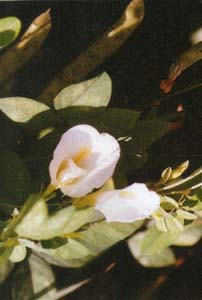
Photos:
left --habit with flowers and fruits
right -- habit with fruits
Click on the pictures to enlarge. |
 |
 |
Identification characters:
Scandent undershrubs; stems twining, slender, downy. Leaves alternate,
unipinnately compound, 3- to 7- foliolate, imparipinnate; stipulate; petiolate;
petiolulate; stipellate; leaflets 3-7, oblong or elliptic-oblong, the bases
obtuse to rounded, the margins entire, the tips rounded, retuse, reticulate,
subcoriaceous. Inflorescences axillary cymes, solitary; bracts persistent.
Flowers with large persistent orbicular bracteoles, pedicellate, bisexual,
zygomorphic, pentamerous, hpogynous. Calyx synsepalous, 5-partite, sepaloid,
deciduous. Corolla apopetalous, papilionaceous, 1+2+(2), the posterior or
vexillum (standard) spathulate, dark blue with an orange centre, the 2 alae
(wings), the 2 carina (keels) incurved. Androecium diadelphous, stamens 10, the
filaments long, inserted, the anthers dithecous, dorsifixed, introrse,
dehiscence longitudinal. Pistil 1,ovary oblongoid, 1-carpelled, 1-loculed, the
placentation parietal along ventral suture, the ovules many in the locule, the
style slender, incurved, the stigma simple. Fruit a pod, linear, flattened;
seeds 6-10, yellowish brown, smooth, non-endospermic.
Flowering period: October - December
Fruiting period: November - January
Distribution: Grows wild on hedges throughout tropical regions of Myanmar
Parts used and uses: Roots, leaves, flowers, fruits and seeds
-- Carthartic; Brain disease; Leprosy;
Analgesic; Colic; Inflammations; Burning sensation; Expectorant; Infections;
Heal boils and carbuncles; As an antidote for snake venoms and other poisons;
Good for eyes. Root -- Dysuria; Cathartic; Brain tonic; Infectious diseases; Eye diseases;
Elephantiasis; Heals sores and boils; Leprosy; Leucoderma; Biliousness;
Expectorant; Head-ache; As an antidote for snake venoms and other poisons. Leaf
-- Ear diseases; Aphrodisiac; Oedema. Flower -- Infantile eye disease. Seed
-- Ascites; Hepatomegaly; Orchitis; Hiccough.
Main
Index of DB | Top
Contents of this page
KS-TMN 146
|
Botanical name: Psoralea corylifolia L. Sp. Pl. 764. 1753.
Myanmar name: Ne-hle
English name: Babchi seeds
Family: Leguminosae-Papilionoideae
Burmese-Myanmar name in Nagathein 2-145:
{né-lhè.}
Photos:
left --habit with flowers and fruits
right -- habit with fruits
Click on the pictures to enlarge. |
 |
 |
Identification characters:
An annual herb; stems erect, solid, longitudinally ridged, sericeous,
gland-dotted, the young stems 5-ribbed. Leaves alternate, simple; stipules
lanceolate, reflexed, sericeous; petioles 5-ribbed, canaliculated at the adaxial
sides, sericeous, gland-dotted; laminae ovate to broadly ovate, the bases
truncate or rounded, obscurely oblique, the margins dentate, undulate, the tips
acute, 5-costate at the sinus reticulate, sericeous, gland-dotted.
Inflorescences axillary racemes, 30- to 45-flowered, densely borne at the
terminal ends of the peduncles; peduncles 5-ribbed, sericeous, gland-dotted;
bracts ovate, subtend every third flower on the peduncle, sericeous,
gland-dotted; persistent. Flowers small, ebracteolate, pedicellate, bisexual,
zygomorphic, pentamerous, hypogynous. Calyx synsepalous, 5-lobed, companulate
the lobes ovate with acute tips, the anterior lobe largest, sericeous,
gland-dotted, persistent. Corolla apopetalous, papilionaceous, 1+2+(2), the
posterior or vexillum (standard) orbicular, crested in the middle of the upper
margin, the limbs purple, the claws paler, the 2 laterals or alae (wings)
oblong, auricled at one basal side of limb, white with purple tips, the 2 lower
or carina (keels) obliquely spathulate, the claw long and narrow, white with
dark purple fused tips, glabrous. Androecium diadelphous, stamens 1+(9),
inserted, the anthers dithecous, dimorphic, the anther lobes of the vexillary
stamen and those of the shorter filaments cuboid, dorsifixed, those of the 5
longer filaments ovoid, basifixed, introrse, dehiscence longitudinal. Pistil 1,
ovary ellipsoid, 1-carpelled, 1-loculed, the placentation parieta lalong ventral
suture, the ovule solitary in the locule, the style filiform, the stigma
discoid; gynophore short warty. Fruit a pod, oblongoid, pale green, warty,
glabrous; seed solitary, oblongoid, rarely flatteded, dark brown to blackish,
aromatic, non-endospermic.
Flowering period: October-December
Fruiting period: November-March
Distribution: Grows wild, common in topical plains of Myanmar
Parts used and uses: Roots, leaves, flowers, fruits, seeds -- Haematemesis;
Heart disease; Asthma; Leprosy; Heartburn; Infections; Gives energy
Fruit: Biliousness; Expectorant; Carminative; Leprosy; Emesis; Oedema: Asthma;
Cough; Indigestion; Good for skin and hair growth.
Main
Index of DB | Top
Contents of this page
KS-TMN 149
|
Botanical name: Pterocarpus macrocarpus Kurz. in Journ. Asiat. Soc. Beng. 63;2, 187.
Myanmar name: Padauk
English name: Burma Rosewood
Family: Leguminosae-Papilionoideae
Burmese-Myanmar name in Nagathein 2-196:
{pa.dauk}
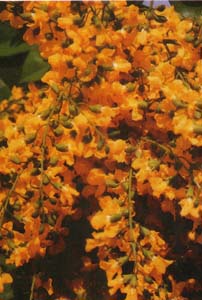
Photos:
left -- flowers and fruits
right -- habit with fruits
Click on the pictures to enlarge. |
 |
 |
Identification characters:
A tree; younger stems fulvo-pubescent. Leaves alternate, unipinnately compound,
paripinnate, exstipulate; petiolate; petiolulate; exstipellate; leaflets
ovate-oblong to ovate, the bases truncate, the margins entire, the tips retuse,
reticulate, the upper surfaces glabrous, the lower fulvo-glabrescent, especially
on the veins, coriaceous; rachises fulvo-puberulent. Inflorescences in
paniculate cymes, terminal and axillary, 1-2 per axil; bracts minute, caducous.
Flower bracteolate, the bracteoles minute, caducous, pedicellate, the pedicels
as long as the calyx, fulvo-pubescent, bisexual, zygomorphic, pentamerous,
hypogynous. Calyx synsepalous, 5-fid, turbinate, the lobes subulate, small,
fulvo-pubescent. Corolla apopetalous, papilionaceous, bright deep yellow, the
petals 1+2+2, about half the length longer than calyx, the claws long, the
posterior (standard) orbicular, crisped, the 2 laterals (wings) hastate,
crisped, the 2 lower (keel) free. Androecium diadelphous, stamens 10, 5 in each
phalange, the anthers dithecous, dorsifixed, dehiscence longitudinal. Pistil 1,
ovary ellipsoid, obscurely stalked, 1-carpelled, 1-loculed, the placetation
parietal along ventral suture, the ovules many in 2 alternating rows on a single
placenta, the style filiform, slightly incurved, the stigma simple. Fruit a pod,
orbicular, with a brosd rigid wing, canescent, beak of pod at the basal corner,
silky and veined against the seed; seed 1, subreniform, non-endospermic.
Flowering period: April-May
Fruiting period: June-August
Distribution: Commonly grows wild all over Myanmar
Parts used and uses: Wood -- Dysentery; Constipation. Leaf -- Pyrexia. Fruit --
Emetic.
Main
Index of DB | Top
Contents of this page
KS-TMN 150
{pauk-pan:} ; {pauk-pan:hpru}
Sesbania grandiflora Pers. 2-237
|
Botanical name: Sesbania grandiflora Pers. Syn. 11. 316. 1806.
Myanmar names: Pauk-pan, Pauk-pan-hpyu
English name: --
Family: Leguminosea-Papilionioideae
Burmese-Myanmar name in Nagathein 2-237:
{pauk-pan:}
Photos:
left -- habit with flowers
right -- habit with fruits
Click on the pictures to enlarge. |
 |
 |
Identification characters:
A small tree, wood soft, branches terete. Leaves alternate, unipinnately
compound, imparipinnate; exstipulate; petioles short, pulvinate; leaflets 16-30
pairs, linear-oblong, the bases rounded to obtuse, the margins entire, the tips
rounded to obtuse, mucronate, the surfaces glabrous, deciduoud. Inflorescens in
short axillary racemes, laxly flowered, buds falcately recurved. Flowers showy,
ebracteolate, 2-lipped, glabrous. Corolla apopetalous, the petals 5,
long-clawed, papilionaceous, the posterior or vexillum (standard) broad, the 2
laterals or alae (wings), the 2 lower or carina (keels) obtuse, straight, white.
Androecium diadelphous, stamens 1+(9), inserted, the anthers dithecous,
dorsifixed, introrse, dehiscence longitudinal. Pistil 1, ovary linear-oblongoid,
the gynophore distinct, 1-carpelled, 1-loculed, the placentation parietal along
ventral suture, ovules numerous in the locule, the style filiform, incurved, the
stigma capitate. Fruit a pod, long, narrow, falcate, not torulose, dehiscent,
septate transversely between the seeds, the sutures much thickened; seeds
numerous, oblongoid, non-endospermic.
Flowering and fruiting periods: October-December
Distribution: Grow wild and cultivated throughout Myanmar.
Parts used and uses: Root -- Arthitis; Inflammations. Fresh bark -- Leucorrhoea.
Leaf -- Metrorrhagia; Epilepsy; Psychosis; Migraine; Purifies blood;
Infections; Antidote for poisons. Flower -- Migraine; Xerophthalmia associated
with lack of vitamin A. Fruit -- Heart disease; Epilepsy; Promotes intellectual
capacity; Colic.
Main
Index of DB | Top
Contents of this page
End of TIL file