Update:
2006-03-29 08:55 AM +0700
TIL
Medicinal Plants of Myanmar
Lecythidaceae
by Kyaw Soe and Tin Myo Ngwé, Forest Resource Environment Development and
Conservation Association (FREDA), Series 1, 2004, ISBN 974-91986-0-3
Copied by U Kyaw Tun, and staff of TIL
for staff and students of TIL. Not for sale.
Main Index of DB |
Top
Index of Collected papers
Agri.Dept.2000:
Akshara |
Science names |
Family names
Contents of this page
UKT: Nagathein references are given to check the Burmese-Myanmar names. *
shows where there is no agreement in Burmese name but when the plant is
identifiable from botanical name.
{kyi~:} ; {kyi~:-ni} } ; {ré-kyi~:}
Barringtonia acutangula Gaertn. 1-148
Main Index of DB |
Top
Index of Collected papers
Agri.Dept.2000:
Akshara |
Science names |
Family names
Contents of this page
KS-TMN 121
{kyiñ:} ; {kyiñ:-ni} } ; {ré-kyiñ:}
Barringtonia acutangula Gaertn. 1-148
|
Botanical name: Barringtonia
acutangula Gaertn. Fruct. 11,97. 1791.
Myanmar names: Kyee; Kyee-ni; Ye - kyee
English names: Indian Oak; Small Indian Oak
Family: Lecythidaceae
Burmese-Myanmar name in Nagathein 1-148:
{kyiñ:} ; {kyiñ:-ni} } ; {ré-kyiñ:}
Photos:
left -- habit with flowers
right -- habit with fruits
Click on the pictures to enlarge. |
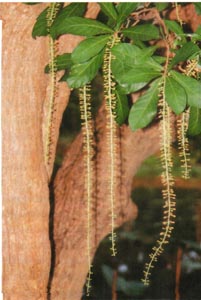 |
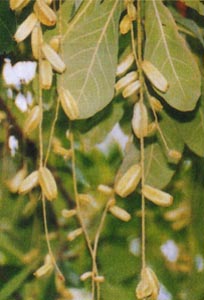 |
Identification characters:
A tree; younger stems slender, glabrous, pale grey. Leaves opposite to
sub-alternate, simple, crowded towards the ends of branches; exstipulate, the
tips acute to rounded, sometimes emarginate, unicostate, reticulate, not
gland-dotted. Inflorescences in terminal and axillary racimiform spikes slender,
pendulous, many-flowered; bracts small, ovate, deciduous. Flowers bracteolate,
the bracteoles caducous, pedicellate, bisexual, actinomorphic, tetramerous,
epigynous. Calyx synsepalous, infundibuliform, 4-lobed, the lobes orbicular,
ciliolate, the tube nearly as long as the lobes, persistent. Corolla apopetalous,
the petals 4, elliptic-oblong, red, the bases adnate to the staminal tube,
inserted on the margin of the annular disc. Androecium monadelphous, stamens
about 50, all fertile, the filaments filiform, reddish, connate at the bases, to
form a staminal tube, the anthers dithecous, versatile, introrse, dehiscence
longitudinal; disc annular, adnate to the staminal tube. Pistil 1, ovary
inferior, 2-carpelled, syncarpous, 2-loculed, the placentation axile, the ovules
2-8 in each locule, pendulous, the style long, filiform, the stigma 2-lobed.
Fruit a berry, oblongoid, quadrangular, broadest in the middle, subtruncate at
each end, crowned by the persistent calyx lobes, 1-seeded by abortion; seed
solitary, ovoid-ellipsoid, non-endospermic.
Flowering period: January-April
Fruiting period: May - August
Distribution: Grows wild in Myanmar, common near water edges of streams, lakes and ponds.
Parts used and uses: Whole plant
-- Carminative. Root -- Cathartic; For longevity of life.
Leaf -- Indigestion; Promotes peristalsis of the intestine.
Seed -- Vertigo; Neurological disease; Oxytocic; Colic; Antiseptic; Ophthalmina;
Epiphora; Gastric ulcer; Constipation; Common cold; Cough; Deafness; Migraine;
Listlessness and lack of activity; Psychoses; Sudden onset of fever; Greyness of
hair, Leucoderma; Menorrhagia; Sterility in woman; Impotency; Haemarrhoids;
Nyctalopia; Asthma; Jaundice; Back-ache; Boils, Cuts, Bruises; Ringworm;
Anthelmintic; Antidote for snake and scorpion venoms; Carminative; As an expectorant
Main
Index of DB | Top
Contents of this page
End of TIL file