• Araliaceae family - general characters
• Panax fruticosum • {ga.Loan-lak-thæÑ:}
 - syn. Polyscias fruticosa
• Hedera spp.
• Heptapleurum spp.
• Panax spp.
• Polyscias spp.
compiled by U Kyaw Tun, U Pe Than, and staff of TIL. Not for sale.
Family: Araliaceae 1
entry
• Araliaceae family - general characters
• Panax fruticosum • {ga.Loan-lak-thæÑ:}
- syn. Polyscias fruticosa
• Hedera spp.
• Heptapleurum spp.
• Panax spp.
• Polyscias spp.
UKT: The following spp. of this family are listed in Agri.Dept.2000
Araliaceae -- Heteropanax fragrans -- {ta.cham:sa} 24-0617
Araliaceae -- Panax fruticosum -- {ga.Loan-lak-thæñ:} 14-0356
Araliaceae -- Panax schinseng -- {ging-hsing:} 15-0373
Araliaceae -- Schefflera venulosa -- {Bi-lu:lak-wa:} 42-1106
Araliaceae -- Talinum patens -- {kau-li.thein (htau:ling-soan)} 03-0074
Main Index of DB | Top
Contents of this page
From: Families yielding important phytopharmaceuticals in Fundamentals of Pharmacognosy and Phytotherapy, by Michael Heinrich, J. Barnes, S. Gibbons, and E. Williamson, October 2003, ISBN:0443071322, pp.320 -- www.fleshandbones.com/readingroom/pdf/747.pdf
Important medicinal plants from the family
• Hedera helix L. [(common) ivy], used as a cough remedy.
• Panax ginseng C.A. Meyer (ginseng), used as an adaptogene (a very
ill-defined category) and to combat mental and physical stress [and sometimes
replaced by Eleutherococcus (Acanthopanax) senticosus (Rupr.
and Maxim) Maxim from the same family].
Morphological characteristics of the family
This family consists mostly of woody species, characterized by hermaphrodite
flowers in a simple umbel (see the closely related Apiaceae with a double
umbel). The leaf lobes are hand-shaped, and the flowers relatively inconspicuous
with two pistils, an inferior gynaecium, a small calyx and generally a white to
greenish corolla, with free petals and sepals.
Distribution
This family of >700 species is widely dispersed in tropical and subtropical
Asia and in the Americas. Hedera helix is the only species native to
Europe.
Chemical characteristics of the family
Of particular importance from a pharmacognostical perspective are the
saponins, triterpenoids and some acetylenic compounds. The triterpenoids (ginsengosides)
are implicated in the pharmacological effects of Panax ginseng, while
saponins (hederasaponins) are of relevance for the secretolytic effect of
Hedera helix.
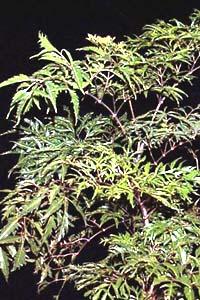
syn. Panax fruticosus L.; Polyscias fruticosa
(L.) Harms
--
www.ars-grin.gov/cgi-bin/npgs/html/taxon.pl?409424
Ref. Burmese-Myanmar
transcripts
• Agri.Dept.2000 14-0356:
{ga.Loan-lak-thæÑ:}
-- gives the name as Panax fructicosum
• Chklist: Kalon-letthe -- name given as Polyscias fruticosa
• LSR : NL
• FAO : NL
• KS-TMN: NL
• Nagathein : NL
• UHM : NL
Myanmar-Script Spelling
•
Official Myanmar Dictionaries :
{ga.Loan-lak-thæÑ:}
-
 - TravPo-M-Dict
064
- TravPo-M-Dict
064
{ga.Loan-lak-thæÑ:}
- n. ornamental shrub with pointed, digitate leaves, Polyscias
fructicosa - Myan-Engl-Dict 084
{ga.Loan-lak-thæÑ:}
- NL in Myan-Ortho
Chklist data
• Polyscias fruticosa (L.) Harms. Habit: Shrub. Distribution:
Cultivated. Common Names: Kalon-letthe
UKT: Not listed as Panax spp.
panaxAnalysis of numbers of papers/mentions over time (Agricola database 1970-1996):
Panax fruticosum
Common Name(s):
Hindi
Sanskrit :
English common name used in Myanmar :
• Agri.Dept.2000 14-0356: NG
• Chklist: NG
• LSR : NL
• FAO : NL
• KS-TMN: NL
• Nagathein : NL
• UHM : NL
Picture :
• Leader: --
http://www.plantoftheweek.org/week253.shtml
Plant identification characters :
• Polyscias fruticosa, or Ming Aralia, is an
evergreen shrub or small tree native to India to Polynesia. The dark green
glossy leaves are at least tripinnate and appear much divided. Individual leaves
vary from narrowly ovate to lanceolate and are about 4 inches (10 cm) long.
Plants will reach up to 6-8 feet (1-2 m) in height. They make excellent indoor
trees and are very long lived in containers. They are used as hedge material in
USDA zone 10. Blooming Time: Usually summer. Flowers are small
and inconspicuous.
Culture: Polyscias fruticosa need full
sun to partial shade to high interior lighting. In the greenhouse, we use a soil
mix consisting of 2 parts peat moss to 2 parts loam to 1 part sand or perlite.
The plants should be kept moist and never should be allowed to dry thoroughly.
Plants are fertilized only 3 times during the growing season using a balanced
fertilizer diluted to ½ the strength recommended on the label. Since the plants
are fairly slow growers, very little pruning is needed to keep the desired form.
During the winter months, water should be restricted, but the plant should never
be allowed to dry out completely.
Propagation: Polyscias fruticosa are
propagated from root and stem cuttings, air layers and from suckers at the base.
Polyscias fruticosa was featured as Plant of the
Week March 26-April 1, 2004. --
http://www.plantoftheweek.org/week253.shtml
Distribution in Myanmar :
Part used and uses
Constituents
Results of search for 'Hedera' in the Checklist of Plants of
Myanmar, U.S. National Herbarium, 30 Jul 2006.
• Hedera helix C.B. Clarke. Habit: Climber/Creeper. Distribution:
Cultivated. Common Names: English ivy, Kyaukkat-nwe
• Hedera nepalensis K. Koch. Cited as: Hedera himalaica Tobler.
Habit: Climber. Distribution: Kachin
USDA-NRCS
"HEDER","Hedera L.","ivy","Araliaceae"
"HECA37","Hedera canariensis Willd.","Canary ivy","Araliaceae"
"HECA31","Hedera caucasigena Pojark.","","Araliaceae"
"HECO20","Hedera colchica (K. Koch) K. Koch","colchis ivy","Araliaceae"
"HEHE","Hedera helix L.","English ivy","Araliaceae"
"HEHEC","Hedera helix L. ssp. canariensis (Willd.) Cout.","Algerian
ivy","Araliaceae"
"HEHI12","Hedera hibernica (Kirchn.) Bean.","Atlantic Ivy","Araliaceae"
"HEHEH2","Hedera helix L. var. hibernica (Kirchn.) Jaeger",">>Hedera
hibernica","Araliaceae"
Results of search for 'Heptapleurum' in the Checklist of
Plants of Myanmar, U.S. National Herbarium, 30 Jul 2006.
• Heptapleurum elatum C. B. Clarke. Habit: Tree. Distribution: Reported
from Myanmar
• Heptapleurum venulosum Seem. Habit: Small tree, Climber.
Distribution: Ayeyarwady, Mandalay, Yangon. Common Names: Myauk-letwa,
Natthami-letwa, Tauktet-letwa
• Schefflera hypoleuca (Kurz) Harms. Cited as: Heptapleurum
hypoleucum Kurz. Habit: Tree. Distribution: Chin, Mon, Unknown. Common
Names: Kane-pee
• Schefflera impressa (C.B. Clarke) Harms. Cited as: Heptapleurum
impressum C. B. Clarke. Habit: Tree. Distribution: Reported from Myanmar
• Schefflera khasiana (C.B. Clarke) R. Viguier. Cited as:
Heptapleurum khasianum C. B. Clarke. Habit: Tree. Distribution: Reported
from Myanmar
• Schefflera lawranceana R. Viguier. Cited as: Heptapleurum
lawranceanum Prain. Habit: Tree. Distribution: Kachin
Results of search for 'Panax' in the Checklist of Plants of
Myanmar, U.S. National Herbarium, 30 Jul 2006.
• Panax ginseng C. A. Mey. Cited as: Panax schin-seng Nees.
Habit: Shrub. Distribution: Reported from Myanmar. Common Names: Asiatic
ginseng, Chinese ginseng, Kauli-thein
• Panax pseudoginseng Wall. Habit: Shrub. Distribution: Kachin, Sagaing
• Panax pseudoginseng subsp. himalaicus Hara. Habit: Shrub.
Distribution: Kachin
• Panax pseudoginseng var. bipinnatifidus (Seem.) Li. Habit:
Shrub. Distribution: Kachin
• Panax quinquefolium L. Habit: Shrub. Distribution: Cultivated. Common
Names: American ginseng
USDA-NRCS
"PANAX","Panax L.","ginseng","Araliaceae"
"PAGI2","Panax ginseng C. Meyer","Chinese ginseng","Araliaceae"
"PASC17","Panax schinseng Nees",">>Panax ginseng","Araliaceae"
"PAPS11","Panax pseudoginseng Wallich","ginseng","Araliaceae"
"PAPSJ","Panax pseudoginseng Wallich ssp. japonicus (C. Meyer) H.
Hara","Japanese ginseng","Araliaceae"
"PARE17","Panax repens Maxim.",">>Panax pseudoginseng ssp.
japonicus","Araliaceae"
"PAPSP","Panax pseudoginseng Wallich ssp. pseudoginseng","ginseng","Araliaceae"
"PAQU","Panax quinquefolius L.","American ginseng","Araliaceae"
"PATR2","Panax trifolius L.","dwarf ginseng","Araliaceae"
Results of search for 'Polyscias' in the Checklist of Plants
of Myanmar, U.S. National Herbarium, 30 Jul 2006.
• Polyscias fruticosa (L.) Harms. Habit: Shrub. Distribution:
Cultivated. Common Names: Kalon-letthe
USDA-NRCS
"POLYS4","Polyscias J.R. & G. Forst.","aralia","Araliaceae"
"POCU14","Polyscias cumingiana (K. Presl) Fernandez-Villar","Malaysian
aralia","Araliaceae"
"ARPI7","Arthrophyllum pinnatum (Lam.) C. B. Clarke",">>Polyscias
cumingiana","Araliaceae"
"NOPI","Nothopanax pinnatus (Lam.) Miq.",">>Polyscias
cumingiana","Araliaceae"
"PORU15","Polyscias rumphiana Harms",">>Polyscias cumingiana","Araliaceae"
"POFR5","Polyscias fruticosa (L.) H.A.T. Harms","Ming aralia","Araliaceae"
"NOFR2","Nothopanax fruticosus (L.) Miq.",">>Polyscias
fruticosa","Araliaceae"
"POGR28","Polyscias grandifolia Volkens","","Araliaceae"
"POGU","Polyscias guilfoylei (Bull ex Cogn. & E. March.) Bailey","geranium
aralia","Araliaceae"
"POSC10","Polyscias scutellaria (Burm. f.) Fosberg","shield aralia","Araliaceae"
"POBA7","Polyscias balfouriana (hort. Sander ex André) Bailey",">>Polyscias
scutellaria","Araliaceae"
"POPI13","Polyscias pinnata J.R. & G. Forst.",">>Polyscias
scutellaria","Araliaceae"
"POSU20","Polyscias subcapitata Kanehira","polyscias","Araliaceae"
"POTR24","Polyscias tricochleata (Miq.) Fosberg","","Araliaceae"
Entry format: Botanical name / Family / Ref. Burmese-Myanmar
transcripts • Agri.Dept.2000 :
• Chklist: • LSR : • FAO : • KS-TMN:
• Nagathein :
• UHM :/ Myanmar-Script Spelling (•
Official Myanmar Dictionaries : - TravPo-M-Dict - Myan-Engl-Dict - Myan-Ortho
/ Chklist data / Hindi /
Sanskrit / English common name used in Myanmar / Picture /
Plant identification characters / Distribution in Myanmar / Part
used and uses / Constituents /
End of TIL file