Update:
2007-03-11 01:43 PM -0500
TIL
Medicinal Plants of Myanmar
Apiaceae
compiled by U Kyaw Tun, U Pe Than, and staff of TIL. Not for sale.
Contents of this page:
Family: Apiaceae 4 entries
• Apiaceae family - general characters
• Apium graveolens
• {nän-nän (ta.roat)}

• Centella asiatica
• {mring:hkwa-rwak-ping}

• Coriandrum sativum
• {nän-nän
(mran-ma)}

•Foeniculum vulgare
• {sa.moan-sa.pa:}

•Trachyspermum ammi •
{sa.mwat}

• Apium spp.
• Carum spp.
• Centella spp.
• Coriandrum spp.
• Foeniculum spp.
• Trachyspermum spp.
Main Index of DB |
Top
Contents of this page
(aka Umbelliferae)
From: Families yielding important phytopharmaceuticals in
Fundamentals of Pharmacognosy and Phytotherapy, by Michael Heinrich, J.
Barnes, S. Gibbons, and E. Williamson, October 2003, ISBN:0443071322, pp.320 --
www.fleshandbones.com/readingroom/pdf/747.pdf
Important medicinal plants in the family:
• Carum carvi L. (caraway), a carminative and also important as a spice.
• Coriandrum sativum L. (coriander),
a carminative and also important as a spice.
• Foeniculum vulgare Miller (fennel), a mild carminative.
• Levisticum officinale Koch (lovage), a carminative and antidyspeptic.
• Pimpinella anisum L. (anise-fruit, wrongly called ‘seed’), an expectorant,
spasmolytic and carminative.
Morphological characteristics of the family

This family of nearly exclusively herbaceous species is characterized by hermaphrodite flowers
in a double umbel (Fig. 4.2); note that the closely related Araliaceae have a simple umbel.
Typical for the family are the furrowed stems and hollow internodes, leaves with a sheathing base
and generally a much divided lamina. The flowers are relatively inconspicuous, with two pistils,
an inferior gynaecium with two carpels, a small calyx and generally a white to greenish corolla,
with free petals and sepals.
Distribution
Members of this family, which has about 3000 species,
are mostly native to temperate regions of the northern hemisphere.
Chemical characteristics of the family
Unlike the Araliaceae,
members of this family are often rich in essential oil, which is one of
the main reasons for the pharmaceutical importance for many of the apiaceous
drugs (see above). Also common are 17-carbon skeleton polyacetylenes, which
are sometimes poisonous, and (furano-)coumarins, which are responsible for
phototoxic effects (e.g. in Heracleum mantegazzianum Sommier and Levier,
hogweed). Some species accumulate alkaloids (e.g. the toxic coniine from hemlock,
Conium maculatum L.).
Contents of this page
Family : Apiaceae; former listing as Umbelliferae
UKT: Apium graveolens has been identified also as
 {sa.mwut} by:
• LSR 161:
{sa.mwut},
 {ta.roat-nän-nän}
• Agri-Dept2000:
Apium graveolens -- Umbelliferae -- {nän-nän-ta.roat)} 33-0864
Apium graveolens -- Umbelliferae -- {sa.mwat} {ta.roat-nännän} 17-0422
Apium graveolens -- Umbelliferae -- {ta.roat-nän-nän} 25-0646
However, since I suspect that
{sa.mwut} is not A. graveolen, but
Trachyspermum ammi , I have include the latter onn this page.
Burmese-Myanmar transcript names:
• Agri.Dept.2000 25-0646 :
 {ta.roat nän-nän}
33-864:
{nän-nän (ta.roat)}
• Chklist: Celery, Phat-kyi-che, Ta-rok-nannan, Taru-ta-na-ngaw,
Tayok-nannan
• FAO : NL
• LSR 161:
{sa.mwut},
{ta.roat-nän-nän}
• KS-TMN : NL
• Nagathein 2-021:
 {ta.roat-nän-nän-ping}
• UHM 06: Ta-yoke-nan-nan
Myanmar-Script Spelling
•
{sa.mwat} -
 --
MMDict080
--
MMDict080
•
{sa.mwat} /|samu'|/ - n. kind of shrub, Carum copticum -- MEDict104
UKT: See Apium graveolens . Is it
{ta.roat-nän-nän} or
{sa.mwat}? Is
{ta.roat-nän-nän} and
{sa.mwat} the same?
The answer to the first question: Apium graveolens is
most likely to be
{ta.roat-nän-nän}.
The answer to the second question: It is most probable that
{ta.roat-nän-nän} and
{sa.mwat} are different., because, the only sources that state that they are
the same are the Agri.Dept2000 and its sister publication LSR.
Now the question, what is
{sa.mwat}? Chklist names a plant with Burmese name "Samok". If Samok is
{sa.mwat}, then it must be
Trachyspermum ammi .
• Trachyspermum ammi (L.) Sprague . Habit: Shrub . Distribution:
Cultivated . Common Names: Bishop's weed, Lovage, Samok -- Chklist
But the plant given by MEDict104, is Carum copticum , not Trachyspermum ammi
.
USDA-NRCS
gives:
"CACO44","Carum copticum (L.) Benth. & Hook. f. ex C.B.
Clarke",">> Trachyspermum ammi","Apiaceae"
Based on the above considerations MMPDB will treat,
Apium graveolens? as
{ta.roat-nän-nän}, and
Trachyspermum ammi as
{sa.mwat}.
Data above updated (070310) in Akshara index
r4c1ta.htm
Chklist data: 070310
• Apium graveolens L. Habit: Herb. Distribution:
Cultivated. Common Names: Celery, Phat-kyi-che, Ta-rok-nannan, Taru-ta-na-ngaw,
Tayok-nannan
Hindi:
Sanskrit:
English common name used in Myanmar :
• Agri.Dept.2000 25-0646: Celery
• FAO : NL
• LSR 161: Celery; Wild celery
• KS-TMN : NL
• Nagathein 2-021: NG
• UHM 06: Celery seed, Celery fruit, Apii Fructus
Picture:
• Leader from Nagathein 2-22
Plant identification characters :
• A biennial (sometimes annual) herb, leaves 6-15"
long and possess 3 pairs and a terminal leaflet,
all coarsely serrate and ternately lobed or divided,
inflorescence compound umbell or small white flowers -- UHM
Distribution of Myanmar:
• Kachin States, Chin Hills (wild), Lawksawk, Mongnai, Taunglelon
(Southern Shan State), Bauktaw, Kamayut (Rangoon) cultivated. -- UHM
Part used and used as:
• Dried ripe fruit. Used as Stimulant and condiment -- UHM
Constituents:
• 1. Up to 3 % of a colorless volatile oil containing d-limone. (7). -- UHM
Contents of this page
syn. Hydrocotyle asiatica
Family : Apiaceae; former listing as Umbelliferae
Burmese-Myanmar transcript names:
• Agri.Dept.2000 48-1266:
 {mring:hkwa} - Hydrocotyle asiatica
• Chklist: Myin-hkwa
• FAO : NL
• LSR 347:
 {mring:hkwa-ping} - Hydrocotyle asiatica
• KS-TMN:
• Nagathein 2-498:
 {mring:hkwa-kri:} - Hydrocotyle asiatica
• UHM 13: Myin-khwa - Centella asiatica
Myanmar-Script Spelling :
•
 {mring-hkwa-rwak} -
 --
MMDict252
--
MMDict252
•
{mring-hkwa} /|mjin: khwa|/ - n. 3. kind of pennywort used medicinally and also as a
vegetable. Hydrocotyle asiatica -- MEDict371
UKT: {rwak} simply means 'leaf' or 'leaves'
referring to the fact that the leaves are used. {ping} means 'plant'. To show
that it is plant whose leaves are eaten, MMPDB2006 has adopted the name
{mring:hkwa-rwak-ping}.
Data above updated (070311) in Akshara index
r5c5maM.htm
Chklist data: 070310
• Centella asiatica (L.) Urb. . Cited as: Hydrocotyle
asiatica L. . Habit: Herb . Distribution: Wide . Common Names: Myin-hkwa
Hindi:
Sanskrit:
English common name used in Myanmar:
• Penny wort -- Agri.Dept.2000
• Asiatic Pennyworth -- UHM
Picture (with ref.):
Plant:
• A slender herbaceous creeping plant with long prostate stems
coming off from the leaf axils of a vertical root-stock -- UHM
Distribution in Myanmar:
•
Rangoon, Insein, Pegu, Pyinmana, Mandalay, traces throughout Burma -- UHM
Part used and uses ::
• Fresh and dried leaves. Used as brain tonic, skin diseases, nervous system and
blood trouble, leprosy and syphilitic affections -- UHM
Constituents:
• 1. Alkaloid - Hydrocotyline
2. Glucoside - asiaticoside (in fresh leaves) (4) -- UHM
Contents of this page
Family : Apiaceae; former listing as Umbelliferae
Burmese-Myanmar transcript names:
• Agri.Dept.2000 33-0863:
{nän-nän (mran-ma)}
• Chklist: Nannan, Phat-kyi, Ta-ner-hgaw
• FAO : NL
• LSR 243:
 {nän-nän-ping}
• KS-TMN :
• Nagathein 2-158:
 {nän-nän}
• UHM 17: Nan-nan
Myanmar-Script Spelling :
•
{nän-nän} -
 --
MMDict165
--
MMDict165
•
{nän-nän} /|nan nan|/ - n. coriander. Coriandrum sativum . -- MEDict230
The foliage is "cilantro" (a parsley-like garnish with a distinctive,
fresh fragrance that is used in Mexican and Southeast Asian salads, soups,
and meat dishes) and the dried seeds are "coriander". --
www.floridata.com/ref/C/cori_sat.cfm
Data above updated (070311) in Akshara index :
r4c5na.htm
Chklist data: 060619
• Coriandrum sativum L. Habit: Herb. Distribution:
Cultivated. Common Names: Coriander, Nannan, Phat-kyi, Ta-ner-hgaw
Hindi:
Sanskrit:
English common name used in Myanmar :
• Agri.Dept.2000 33-0863: Coriander
• FAO : NL
• LSR 243: Coriander
• KS-TMN :
• Nagathein 2-158: NG
• UHM 17: Coriander, coriander seed
Picture :
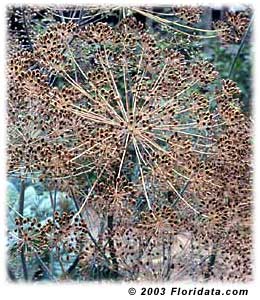
• Leader picture on right from:
www.floridata.com/ref/C/cori_sat.cfm
• Seeds ready for harvest --
www.floridata.com/ref/C/cori_sat.cfm
Plant identification characters :
• An annual foetid smelling herb with erect slender smooth stem, branched in
the upper part. The lower leaves are long-petioled, pinnate with nearly
sessile, ovate to suborbicular deep lobed leaflets, crenate dentate on margin,
upper leaves nearly sessile bi- or tri-pinnate with ultimate segments
strap-shaped or linear. Inflor. compound umbels of white or pink flowers.
Fruit is nearly spherical cremocarp.
The name, "coriander", is derived from the
Greek for "bed-bug", because the smell of the fresh foliage
is said to resemble that of bug infested
bed linens. The mature seeds do not retain this smell.
Coriander is a delicately branched annual that reaches a height of
2-3 ft (0.6-0.9 m) with a spread of 1-2 ft (0.3-0.6 m). It often becomes top
heavy and falls over, sprawling along the ground and sending up branches like so
many new plants. The lower leaves of coriander are lobed, about 1-2 in (2.5-5.1
cm) across, and look a little like Italian parsley
(
Petroselinum crispum). The upper leaves are finely dissected into
linear segments and almost fernlike. The white or pink flowers are tiny and
borne in numerous compound umbels (flat-topped clusters in which the flower
stems arise from a single point). The flower clusters are only about 1-2
(2.5-5.1 cm) across, but are so abundant that the whole plant is quite showy.
The seeds are contained in spherical yellowish brown pods that are ribbed and
rough textured, and about an eighth inch in diameter. --
www.floridata.com/ref/C/cori_sat.cfm
Distribution in Myanmar:
• Throughout Burma -- UHM
Part used and used as :
• Dried ripe fruit. Used as Aromatic stimulant, carminative -- UHM
• The herb, Coriandrum sativum, gives us two distinctly different flavors
for the kitchen. The lacy foliage is "cilantro", a parsley-like garnish with a
distinctive, fresh fragrance that is indispensable in Mexican and Southeast
Asian salads, soups, and meat dishes. The dried seeds are "coriander", a
pleasantly aromatic spice that is much used in European and Middle Eastern
stews, sausages, sweet breads and cakes. --
www.floridata.com/ref/C/cori_sat.cfm
Constituents :
•1. Up to 1 % volatile oil containing Coriandrol, 2. Fixed oil,
3. Calcium oxalate 4. Tannin (7) -- UHM
Contents of this page
Family: Apiaceae; former listing as Umbelliferae
Burmese-Myanmar transcript names:
• Agri.Dept.2000 16-0414:
{sa.moan-sa.pa:}
• Chklist: Fennel, Samon-saba
• FAO : NL
• LSR 151:
{sa.moan-sa.pa:}
• KS-TMN: NL
• Nagathein 1-377:
{sa.moan-sa.pa:}
• UHM 26: Samon-saba
Myanmar-Script Spelling :
•
{sa.moan-sa.pa:} -
 --
MMDict080
--
MMDict080
•
{sa.moan-sa.pa:} - n. aniseed -- MEDict104
UKT: Note that 'aniseed' is Pimpinella anisum and not
Foeniculum vulgare .
anise seed or aniseed n. 1.
The seedlike fruit of the anise. -- AHTD
anise n. 1. An annual, aromatic Mediterranean herb (Pimpinella
anisum) in the parsley family, cultivated for its seedlike fruits and the
oil obtained from them and used to flavor foods, liqueurs, and candies. 2.
Anise seed. [Middle English anis from Old French from Latin
anīsum from Greek anison] -- AHTD
Data above updated (070311) in Akshara index :
r2c1sa.htm
Chklist data: 060619
• Foeniculum vulgare Mill. Habit: Herb. Distribution:
Shan. Common Names: Fennel, Samon-saba
Hindi:
Sanskrit:
English common name used in Myanmar:
• Agri.Dept.2000 16-0414: Fennel
• FAO : NL
• Lè-seik-shin 151: Fennel
• KS-TMN: NL
• Nagathein 1-377: Fennel
• UHM 26: Fennel seed
Picture:
• Leader from Nagathein 1-377:
Plant identification characters :
• A perennial aromatic herb attaining a height of about 1m. with
narrow pinnae, small yellow flowers in compound umbels and oblong cremocarps. -- UHM
Distribution of Myanmar:
• Shan States. -- UHM
Part used and uses:
• The dried ripe fruit. Stimulant, carminative, galactagogue and condiment.
Source of volatile oil of fennel. -- UHM
Constituents:
• Up to 6.5 percent of volatile oil. (Oleum foeniculi)
containing anethol and fenchone, fixed oil.
Calcium oxalate etc. (7) -- UHM
Contents of this page
Family : Apiaceae
UKT: Trachyspermum ammi is tentatively identified as
{sa.mwat} . I am still waiting for more inforation from Burmese sources.
• Synonyms:
Carum copticum (L.) Benth. & Hook. f.,
Carum copticum (L.) C.B.
Clarke, Carum ajowan, Ptychotis ajowan,
Trachyspermum copticum (L.) Link --
http://www.uni-graz.at/~katzer/engl/Trac_amm.html
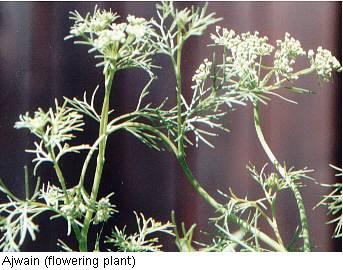
• Ajwain (Trachyspermum ammi ) is one of those spices that are
very often confused with other plants, despite its unambigous English name.
Literature has examples of misidentification with other spices (celery, lovage,
nigella) and even nonculinary plants (goutweed, toothpickweed). --
http://www.uni-graz.at/~katzer/engl/Trac_amm.html
Ref. Burmese-Myanmar
transcripts
• Agri.Dept.2000 :
• Chklist: Bishop's weed, Lovage, Samok
• LSR :
• FAO :
• KS-TMN:
• Nagathein :
• UHM :
Myanmar-Script Spelling
•
{sa.mwat} -
--
MMDict080
•
{sa.mwat} /|samu'|/ - n. kind of shrub, Carum copticum -- MEDict104
UKT: See Apium graveolens . Is it
{ta.roat-nän-nän} or
{sa.mwat}? Is
{ta.roat-nän-nän} and
{sa.mwat} the same?
The answer to the first question: Apium graveolens is
most likely to be
{ta.roat-nän-nän}.
The answer to the second question: It is most probable that
{ta.roat-nän-nän} and
{sa.mwat} are different., because, the only sources that state that they are
the same are the Agri.Dept2000 and its sister publication LSR.
Now the question, what is
{sa.mwat}? Chklist names a plant with Burmese name "Samok". If Samok is
{sa.mwat}, then it must be
Trachyspermum ammi .
• Trachyspermum ammi (L.) Sprague . Habit: Shrub . Distribution:
Cultivated . Common Names: Bishop's weed, Lovage, Samok -- Chklist
But the plant given by MEDict104, is Carum copticum , not Trachyspermum ammi
.
USDA-NRCS
gives:
"CACO44","Carum copticum (L.) Benth. & Hook. f. ex C.B.
Clarke",">> Trachyspermum ammi","Apiaceae"
Based on the above considerations MMPDB will treat,
Apium graveolens? as
{ta.roat-nän-nän}, and
Trachyspermum ammi as
{sa.mwat}.
Data above updated (070311) in Akshara index :
r2c1sa.htm .
Chklist data :
• Trachyspermum ammi (L.) Sprague . Habit: Shrub . Distribution:
Cultivated . Common Names: Bishop's weed, Lovage, Samok
Hindi : Ajvain, Carom, Omum
Sanskrit : Yavaanika, Ugragandha,
Brahmadarbha, Ajmodika, Deepyaka, Yavsaha
--
English common name used in Myanmar :
Picture :
• Leader --
http://www.uni-graz.at/~katzer/engl/Trac_amm.html
• Seeds --
http://www.uni-graz.at/~katzer/engl/Trac_amm.html
Plant identification characters :
Distribution in Myanmar :
Part used and uses :
Constituents :
The essential oil (2.5 to 5% in the dried fruits) is dominated
by thymol (35 to 60%); furthermore, α-pinene, p-cymene, limonene and
γ-terpinene have been found.
In the essential oil distilled from aerial parts (flowers, leaves) of
ajwain grown in Algeria, however, isothymol (50%) was found to be the
dominant constituent before p-cymene, thymol, limonene and γ-terpinene.
Note, however, that the name isothymol is not well defined and might refer
to both 2-isopropyl-4-methylphenol and 3-isopropyl-6-methylphenol (carvacrol).
(Journal of Essential Oil Research, 15, 39, 2003)
From South Indian ajwain fruits, almost pure thymol has been isolated
(98%), but the leaf oil was found to be composed of monoterpenoids and
sesquiterpenoids: 43% cadinene, 11% longifolene, 5% thymol, 3% camphor and
others. (Indian Journal of Pharmaceutical Sciences, 64,
250, 2002) --
http://www.uni-graz.at/~katzer/engl/Trac_amm.html
Contents of this page
Results of search for 'Apium' in the Checklist of Plants of
Myanmar, U.S. National Herbarium, 10 Mar 2007.
• Apium graveolens L. Habit: Herb. Distribution:
Cultivated. Common Names: Celery, Phat-kyi-che, Ta-rok-nannan, Taru-ta-na-ngaw,
Tayok-nannan
USDA-NRCS
"APIUM","Apium L.","celery",
"Apiaceae"
"APGR2","Apium graveolens L.","
wild celery","Apiaceae"
"APGRD","Apium graveolens
L. var. dulce (P. Mill.) DC.","wild celery","Apiaceae"
"APDU2","Apium dulce Miller",">>Apium graveolens
var. dulce","Apiaceae"
"CEGR11","Celeri graveolens
(L.) Britt. p.p.",">>Apium graveolens var. dulce","
Apiaceae"
"APGRR","Apium graveolens L. var. rapaceum (Miller)
Gaudin","celeriac","Apiaceae"
"APRA2","Apium
rapaceum Miller",">>Apium graveolens var. rapaceum","
Apiaceae"
"APNO","Apium nodiflorum (L.) Lag.","European
marshwort","Apiaceae"
"CYNO4","Cyclospermum nodiflorum
(L.) W.D.J. Koch",">>Apium nodiflorum","Apiaceae"
"APPR2","Apium prostratum Labill.","prostrate marshwort","
Apiaceae"
"APRE","Apium repens (Jacq.) Lag.","creeping
marshwort","Apiaceae"
Contents of this page
Results of search for 'Carum' in the Checklist of Plants of
Myanmar, U.S. National Herbarium, 10 Mar 2007.
• Carum carvi L. . Habit: Herb . Distribution: Cultivated . Common
Names: Caraway, Karaway, Karaway-si
• Trachyspermum khasianum (C.B. Clarke) H. Wolff . Cited as: Carum
khasianum C.B. Clarke . Habit: Herb . Distribution: Chin, Shan
• Trachyspermum roxburghianum (DC.) Craib . Cited as: Carum
roxburghianum Benth. & Hook. f. Habit: Herb . Distribution: Reported from
Myanmar . Common Names: Kant-balu
USDA-NRCS-data
"CACO44","Carum copticum (L.) Benth. & Hook. f. ex C.B.
Clarke",">>Trachyspermum ammi","Apiaceae"
Contents of this page
Results of search for 'Centella' in the Checklist of Plants
of Myanmar, U.S. National Herbarium, 10 Mar 2007.
• Centella asiatica (L.) Urb. . Cited as: Hydrocotyle
asiatica L. . Habit: Herb . Distribution: Wide . Common Names: Myin-hkwa
USDA-NRCS
"CENTE","Centella L.","centella","Apiaceae"
"CEAS","Centella asiatica (L.) Urban","spadeleaf","
Apiaceae"
"HYAS4","Hydrocotyle asiatica L.",">
>Centella asiatica","Apiaceae"
"CEER2","Centella
erecta (L. f.) Fern.","erect centella","Apiaceae"
"CEAS5",
"Centella asiatica auct. non (L.) Urban [misapplied]",">>Centella
erecta","Apiaceae"
"CERE5","Centella repanda (Pers.) Small",
">>Centella erecta","Apiaceae"
Contents of this page
Results of search for 'Coriandrum' in the Checklist of Plants
of Myanmar, U.S. National Herbarium, 19 Jun 2006.
• Coriandrum sativum L. Habit: Herb. Distribution:
Cultivated. Common Names: Coriander, Nannan, Phat-kyi, Ta-ner-hgaw
USDA-NRCS
"CORIA","Coriandrum L.","coriander","Apiaceae"
"COSA","Coriandrum sativum L.","coriander","Apiaceae"
Contents of this page
Results of search for 'Foeniculum' in the Checklist of Plants
of Myanmar, U.S. National Herbarium, 19 Jun 2006.
• Foeniculum vulgare Mill. Habit: Herb. Distribution:
Shan. Common Names: Fennel, Samon-saba
USDA-NRCS
"FOENI","Foeniculum P. Mill.","fennel","Apiaceae"
"FOVU","Foeniculum vulgare P. Mill.","sweet fennel","Apiaceae"
"FOFO","Foeniculum foeniculum (L.) Karst.",">>Foeniculum
vulgare","Apiaceae"
Contents of this page
Results of search for 'Trachyspermum' in the Checklist of
Plants of Myanmar, U.S. National Herbarium, 10 Mar 2007.
• Trachyspermum ammi (L.) Sprague . Habit: Shrub . Distribution:
Cultivated . Common Names: Bishop's weed, Lovage, Samok
• Trachyspermum khasianum (C.B. Clarke) H. Wolff . Cited as: Carum
khasianum C.B. Clarke . Habit: Herb . Distribution: Chin, Shan
• Trachyspermum roxburghianum (DC.) Craib . Cited as: Carum
roxburghianum Benth. & Hook. f. . Habit: Herb . Distribution: Reported from
Myanmar . Common Names: Kant-balu
Contents of this page
Entry format: Botanical name / Family / Ref. Burmese-Myanmar
transcripts • Agri.Dept.2000 :
• Chklist: • LSR : • FAO : • KS-TMN:
• Nagathein :
• UHM :/ Myanmar-Script Spelling (
• Official Myanmar Dictionaries : - TravPo-M-Dict - Myan-Engl-Dict -
Myan-Ortho / Chklist data / Hindi /
Sanskrit / English common name used in Myanmar /
Picture / Plant identification characters /
Distribution in Myanmar / Part used and uses /
Constituents /
End of TIL file