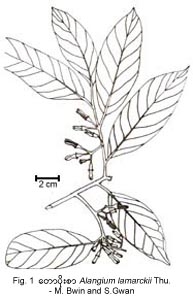
 Alangium lamarckii Thw.
by Daw Mya Bwin and U Sein Gwan, Pharmacology Research Division, Department of Medical Research, Ministry of Health, Rangoon, 1973.
HTML version with additions from other sources by U Pe Than and staff of TIL for staff and students of TIL. Not for sale.
Main Index of DB |
Top
Contents of this page
Contents of this page: Plants for hypotensive action
• See Plants for
hypertensive action
Alangium lamarckii -- {tau:po:sa} Taw-posa
Moringa oleifera -- {dan.da.lun}; Dan-da-lun
Citrullus vulgaris -- {hpa.rè:} Phay-ye
Hibiscus rosa-sinensis -- {hkaung-rum:} Khaung-yan.
Hibiscus Sabdariffa -- {chin-paung-ni}Chinbaungni.
Alstonia scholaris -- {lak-htoap-ka.lé:};
{taung-ma.ro:}; {lak-pan-hka:};
Carissa carandas -- {hkan° pin} Khan-pin
Millingtonia hortensis -- {E-ka.riz} Egayit.
Plantago major Linn --
{a.krau:paung:ta.htaung} Akyaw-baung-ta-htaung, {hpa:krau:ywat} Hpa-kyaw-rwet, {man:soat-ywat} Mahn-suit-rwet,
{hsé:kyau-kri:} Se-gyaw-gyi
Apium graveolens -- {ta.roap-nan-nan} Tayoke-nan-nan.
Bidens pilosa -- Burmese name, nil; English name, nil
Lactuca sativa -- {hsa.lat} Salat.
Solanum tuberosum -- {a-lu:} Alu.
Convolvulus arvensis -- {kauk-ro:nwè~} Kauk-yo nwe
Acanthus Ilicifolius -- {ré-hka.ra} Ye-Khaya.
Viscum album -- Burmese name, nil; English name: Mistletoe.
Nigella sativa -- {sa.moan-nak} Samon-net.
Acorus calamus -- {lin:né} Linne.
Areca catechu -- {kwum:thi:pin} Kun-thi-pin
Arundo donax -- {a.lo-kyu} Alo-kyu.
Curcuma comosa -- {na.nwin:hka:} or {hsa.nwin:hka:} Na-nwin-ga, Sa-nwin-ga.
Alangium lamarckii Thw.p01
Burmese name:
 {tau:po:sa} Taw-posa
ALANGIUM LAMARCKII Thw. Enum. 133 (1859)
Alangium decapetalum Lamk. Dict. i. 174
Alangium hexapetalum Lamk. & DC. ii. c.
Alangium tomentosum Lamk. & DC. ii. c.
Alangium latifolium Miq. in. Pl. Hohenack. No. 719.
English common name: Nil.
Description:
A small tree. Leaves alternate, variable narrowly oblong or ovate-lanceolate,
glabrous above, pubescent on the nerves; petioles densely pubescent. Flowers
few, white in axillary fascicles, densely pubescent. Fruit when young ovoid or
ellipsoid, becoming nearly globular when ripe. Family Alangiaceae. Flowering in January.
Distribution:
Mergui district, locality Sin-din-taw.
Uses:
• The leaf extract is used as a hypotensive agent in anesthetized dogs and
conscious rabbits. fn01-01 The bark
alkaloid also in small doses reduced blood pressure temporarily.
fn01-02
• Leaves are also used as poultice in rheumatic pains. Root bark used as
purgative, anthelmintic and in fever and skin diseases. fn01-02
---------------
fn01-01 SANYAL, A., V. Das-Gupta & P.K. Das (1965). Studies on Alangium lamarckii Thw. i. Pharmacological studies of the total alkaloid extract of the leaves. Indian J. Med. Res. 53, 1072-1078. fn01-01b
fn01-02 CHOPRA, R. N., S. I,. Nayar & I. C. Chopra (1956). Glossary of Indian Medicinal plants. p. 10. New Delhi: Council of Scientific and Industrial Research. fn01-02b
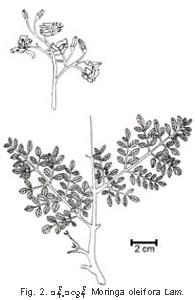 Moringa oleifera Lam.
p04
Burmese name:
 {dan.da.lun}; Dan-da-lun.
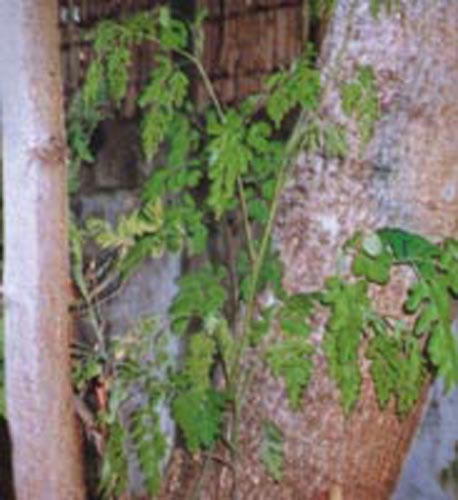
Click on the small figures to enlarge.
MORINGA OLEIFERA Lam. Encylc. I. 398 (1784).
Moringa pterygosperma Gaertn. Fruct. II. 314 (1791).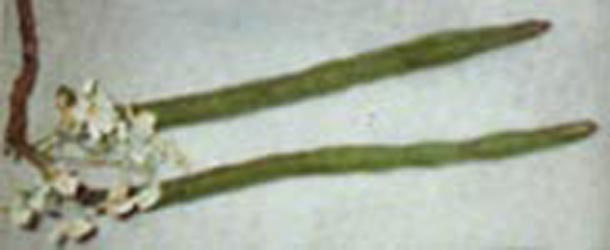
Moringa polygona DC. Prodr. ii. 478 (1825).
Moringa zeylanica Pers.
Hyperanthera decandra Willd.
Guilandina Moringa Linn. Sp. Pl. 281 (1753).
English common name: Drumstick.
Click on small pictures to enlarge to see insert from
1• Ministry of Health, Dept. of Traditional Medicine (MinHealth),
Collection of Commonly Used Herbal Plants (in Burmese), 2003
Description:
A middle sized tree, bark corky; root pungent; young parts tomentose. Leaves
usually 3-pinnate, leaflets of the lateral of the lateral elliptic, the terminal
obovate and slightly larger than the lateral ones. Flowers white, many flowered,
densely arranged. Fruit long, pods, 9-ribbed. Seeds 3-angle, the angles winged.
Family Moringaceae. Flowering from December to May and fruiting from April to
June.
Distribution:
Often cultivated in gardens for its edible fruits throughout Burma.
Uses
• The Burmese believe that macerated juice of mature green leaves taken twice a
day, once in the morning before food and once before retiring at night produces
a fall in blood pressure fn04-01.
• The plant is used as stimulant in paralytic affections and intermittent fever,
also in epilepsy, chronic rheumatism, as carminative, stomachic, abortificient,
cardiac and circulatory tonic.fn04-03
• Root bark used as fomentation to relieve spasm.3
• Bark used in diseases of liver and spleen, articular pains, tetanus and
paralysis. 3
• Flowers as stimulant and aphrodisiac. 3
• Oil from seeds used as external application in rheumatism. 3
• Gum from the plant used for dental caries. 3
---------------
fn04-03 Chopra, P.n., S. L. Nayar & I. C. Chopra (1956). Glossary of INdian medicinal plants, p. 170. New Delhi: Council of Scientific and Industrial Research. fn04-03b
p06
Burmese name:
 {hpa.rè:} Phay-ye.
CITRULLUS VULGARIS Schrad. ex Eckl. & Zeyh. Enum. 279 (1836).
Cucurbita Citrullus Linn. Sp. Pl. 1010 (1753).
Citrullus fistulosus Stocks in Hook. Kew Journ. Bot. III. t. 3.
Cucumia Citrullus DC. Prodr. III. 301. (1828).
Cucurbita Citrullus Linn; Roxb. Fl. Ind. III. 319 (1832).
English common name: Water melon.
Description
An extensively climbing annual with thick angular branching stems; young shoots
villous woolly at their tips. Tendril bifid, stout, pubescent. Leaves divided or
moderately lobed, some what hairy, alternate. Flowers rather large, yellow
within, greenish outside. Fruit large, sub-globose or ellipsoid, dark green.
Family Cucurbitaceae. Fruiting from June to July.
Distribution
Cultivated for its edible fruits in dry areas.
Uses
• A saponin bitrin and cucurbocitrin isolated from the seed was formerly used for
hypertension. fn06-01
• Fruit is cooling and used as diuretic.
• The seed has a cooling effect, used as a tonic and also for diuretic. Seed oil
used as a substitute for almond oil. fn06-02
• Seed contains diuretic principles.1
• Cucurbitocitrin a glucosidal saponin isolated from the seed has been used as an
antihypertensive drug, oral dose used from 60 to 120 mg.1
---------------
fn06-01 The Merck Index of Chemicals and Drugs (1960). Seventh edition, 1105, 299 & 267. Rahway: New Jersey, U.S.A.: Merck & Co., Inc. fn06-01b
fn06-02 Chopra, R. N., S. L. Nayar & I. C. Chopra (1956). Glossary of Indian Medicinal plants, p. 67. New Delhi: Council of Scientific and Industrial Research. fn06-02b
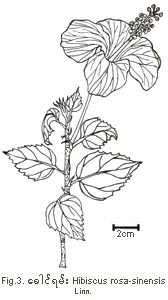 Hibiscus rosa-sinensis Linn.
 p08
Burmese name:
 {hkaung-rum:} Khaung-yan.
Hibiscus Rosa-Sinensis Linn. Sp. Pl. 694 (1753).
English common name: Shoe Flower.
Description
An evergreen shrub. Leaves ovate or ovate-lanceolate, margin serrate toward the
top, entire near the base; stipules lanceolate-subulate. Flowers large, red.
Family Malvaceae. Flowers from February to October.
Distribution
Commonly grown in gardens for its large, ornamental flowers throughout Burma.
Uses
• Air dried powdered leaf extract lowers blood pressure.
fn08-01
• Root of the plant used in cough. fn08-02
• Infusion of petals is given as a demulcent and refrigeratant drink in fevers.
2
---------------
fn08-01 Agrawal, S. L. & S. Shinde (1967). Studies on HIbiscus rosa-sinensis II. Preliminary pharmacologics investigations. Indian J. Med. Res., 55, 1007-10. fn08-01b
fn08-02 Chopra, R. N., S. L. Nayar& I. C. Chopra (1956). Glossary of INdian medicinal plants, p. 133. New Delhi: Council of Scientific and Industrial Research. fn08-02b
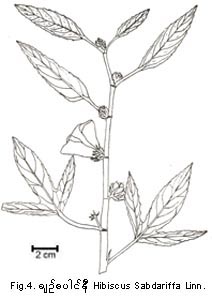 Hibiscus Sabdariffa Linn.
p09
Burmese name:
 {chin-paung-ni}
Chinbaungni.
{chin-paung-ni}
Chinbaungni.
Hibiscus Sabdariffa Linn. Sp Pl. 659 (1753).
Hibiscus sanguineous Griff. Not. iv. 520.
English common name: Roselle; Red sorrel; Indian Sorrel.
Description
An erect, glabrous shrub or small tree. Stem and branches reddish purple. Leaves
simple, lower ones undivided, upper palmately three to five lobed, lobes
lanceolate or oblong, the middle lobe the longest, serrate, glandular on the
midrib beneath, often blotched with purple; petioles reddish purple; stipules
linear, acute. Flowers yellow with a dark, crimson eye. Fruit capsule, ovoid,
beaked, hairy. Family Malvaceae. Flowers and fruits from December to March.
Distribution
Often planted in house compounds, for edible purposes throughout Burma.
Uses
• Infusion of drug used to reduce blood pressure.
fn09-01
• Leaves, seeds and ripe calyces used as diuretic and antiscorbutic.
In bilious condition, succulent calyx boiled in water is used as a drink. 1
-----------------
fn09-01 Chopra, R. N. & S. L. Nayar & I. C. Chopra (1956). Glossary of Indian medicinal plants, p. 133. Council of Scientific and Industrial Research: New Delhi. fn09-01b
p10
Burmese name:
 {lak-htoap-ka.lé:}
 {taung-ma.ro:}
 {lak-pan-hka:}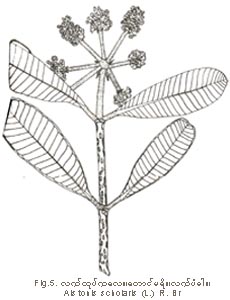
Let-toke-galay, Taung-mayo. Let-pan-kha.
Alstonia Scholaris (L.) R. Br. in Men. Wern. Soc,. 175 (1809).
Echites scholaris L. Mant. 11. 55 (1767).
Echites pala Buch. -Ham. exa Sprent. Syst. I. 633. (1825).
English common name: Nil.
Description
An erect, small or medium-sized, evergreen tree with a dense crown. Bark
grey-white. Leaves whorled. oblong-lanceolate or obovate. Flowers
greenish-yellow, in compact umbellate cymes, fragrant. Fruit in folliciles, in
pendulous clusters. Family Apocyanaceae. Flowers from October to December;
fruiting from February to June.
Distribution
Widely distributed in Burma. Often planted as road side trees.
Uses
• The bark alkaloids produce a sharp fall of blood pressure in cats.
fn10-01
• Drug used in the treatment of malarial fever, chronic diarrhoea and advanced
stages of dysentery. It also relased isolated strips of rat intestine. 1
• Milky juice (late) is applied to ulcers.
fn10-02
---------------
fn10-01 Chopra, R. N. & I. C. Chopra (1955). A review of work an Indian medicinal plants, 24.. Cambridge Printing Works, Kashmere Gate: Delhi. fn10-01b
fn10-02 Chopra, R. N, S. L. Nayar & I. C. Chopra (1956). Glossary of Indian medicinal plants, 14 Council of Scientific and Industrial Research: New Delhi. fn10-02b
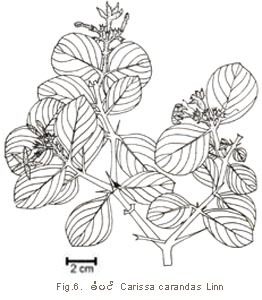 Carissa carandas Linn.
p12
Burmese name: cHyif {hkan° pin} Khan-pin.
Carissa Carandas Linn. Mant. I. 52 (1767).
Carissa paucinervai A. DC. Prodr. VIII. 333 (1844).
Carrissa congesta Wight Ic. t. 1289 (1850).
Arduina carandas (L.) K. Schum. in Engler & Prantl. Nat. Pflanzenfam. IV. Abt.
2. 127 (1895).
English common name: Natal plum.
Description
Armed, large spreading shrub. Leaves opposite, ellipcic-obovate to obovate;
stipules paired, spiniform, sometimes simple or forked. Flowers small, white or
pinkish. Fruit berries, ellipsoidal in shape, at first the colour of the fruit
turns red and pink checks then turn purple when ripe. Family Apocynaceae.
Flowers from April to June, fruiting from June to July.
Distribution
Often planted in gardens as an ornamental plant throughout Burma.
Uses
Alcoholic root extract lowers the blood pressure in cats.
fn12-01
Toot is bitter, used in the treatment of stomachic and also as anti-anthelminthic.
Decoction of leaves is given at the commencement of remittent fever.
fn12-02
--------------
fn12-01 Chatterjee, M. L. & A. R. Roy (1965). Pharmacological action of Carissa carandas L. root. Bull. Calcutta Sch. trop. Med. 13, 14-16. In: Chem. Abstr. (1965). 63, 3501 fg. fn12-01b
fn12-02 Chopra, R. N., S. L. Nayar & I. C. Chopra (1956). Glossary of Indian medicinal plants. 52. Council of Scientific and Industrial Research: New Delh: fn12-02b
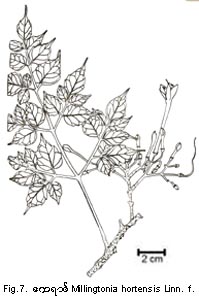 Millingtonia Hortensis Linn. f.
p14
Burmese name: {u&Zf {E-ka.riz} Egayit.
Millingtonia Hortensis Linn. f. Suppl. 291, (1781).
Bignonia Azedarachta Koen. Ann. Bot. i. 178
Bignonia suberosa Roxb. Pl. Cor. iii. II. t. 241.
English common name: Nil.
Description
An erect tree; bark greyish-black, corky. Leaves compound, 2--3 pinnate, alternate. Leaftets ovate or ovate-lanceolate, acuminate, sinuate or crenate, deep green above. Flowers white, fragrant, numberous, pendulous, in terminal panicles, No fruit seen. Family Bignoniaceae. Flowering from November to December.
Distribution
Widely distributed in Burma. Often planted in house compound for its fragrant flowers and also for its medicinal value of the root bark.
Uses
Locally the watery extract of the root bark and the leaves is used to relieve dizziness, for hight blood pressure patients.
The Burmese people also believed that the root bark watery extract has an anti-alcoholic effect. fn14-01
---------------
fn14-01 jr0if;? OD;? (1964)/ ½kyfjyb,aq;tbd"gef/ trSwf (1) pmrsufESm 278/ fn14-01b
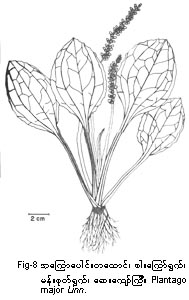 Plantago Major Linn
Burmese name: taMumaygif;waxmif/ zg;aMum½Guf/ ref;pkwf½Guf/ aq;ausmfBuD;/ Akyaw-baung-ta-htaung, Hpa-kyaw-ywet, Mahn-suit-ywet, Se-gyaw-gyi
Plantago Major Linn. Sp. Pl. 112 (1753).
Plantago erosa Wall. in Roxb. Fl. Ind. Ed. Carey & Wall. i. 423, &
Cat. 6412.
Plantago asiatica Linn. Sp. Pl. 163 (1753).
Plantago longiscapa Zacquem. mss.
English common name: English's Foot, Greater Plantain, Plantain Ribgrass,
Plantain Ribwort, Ripple Grass.
Description
A perennial herb with an erect stout rootstock. Leaves radical alternate, ovate, or oblong-ovate, 3-7 ribbed, sinuate-toothed, or obtuse margin, petiole (leaf stalk) five nerved usually longer than the leaf blade. Flowers small, crowded in long slender rather cylindric, lax spikes, white in colour. Fruit, ovoid capsules, when mature the top coming off as a conical lid tipped with the remains of the style. Seeds small, dull black, angled. Family Plantaginaceae. Flowering and fruiting the whole year round.
Distribution
Grows wild along the streams and river banks, also in shady and moist places, temperate climate, Taunggyi, Kalaw, Maymyo, Kyauk-me, and also in the Kachin States, Moulmein and cultivated for its medicinal properties in Rangoon. fn16-01
Uses
Locally the infusion is taken orally in the belief that it produces a fall in
blood pressure. 1
Grounded leaves is also applied to swollen wounds and sores.
Leaves and roots acts as astringent and used in fever.
fn16-02
---------------
fn16-01 Khin Kyi Kyi, Mya-Bwin, Sein-Gwan, Chit-Maung, Aye-Than. M. Mya-Tu & Saw Johnson Tha (1971). Hypotensive property of Plantago major Linn. --Union of Burma Z. Life Sei. 4, 167--171. fn16-01b
fn16-02 Chopra, R. N., S. L. Nayar & I. C. Chopra (1956). Glossary of Indian medicinal plants. p 196. Council of Scientific and Industrial Research: New Delhi. fn16-02b
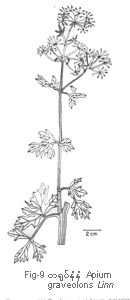 Apium Graveolens Linn.
Burmese name: w½kyfeHeH {ta.roap-nan-nan} Tayoke-nan-nan.
Apium Graveolens Linn. Sp. Pl. 264 (1753).
English common name: Celery, cultivated celery, Marsh Parsley, Wild celery.
Description
Biennial. Stems erect, branching. Radical leaves pinnate, with large deeply lobed segments, cauline 3-partite; segments once or twice trifid, coarsely toothed at the apex. Flowering stalk umbel-rays 5--10. Fruit ridges narrow, broad. Family Umbelliferae.
Distribution
Planted throughout Burma for its edible value.
Uses
They watery extract of the whole plant mixed with sugar or honey, has been
extensively used among the local people as a remedy against hypertension.
fn18-01
Root used as alternative, diuretic, also given in anasarca and colic.
Seeds used as stimulant, cordial, tonic, carminative, diuretic, emmenagogue, as
antiseptic, in bronchitis, asthma an dfor liver and spleen diseases.
fn18-02
---------------
fn18-01 Sein Gwan, Kin Saw O., Ma Than Yee & Han Min (1958-59). The nautre of the chemical constituents of Apium graveolens. jjPro. Burma Med. Res Soc. I, 19-20. fn18-01b
fn18-02 Chopra, R. N., S. L. Nayar & I. C. Chopra (1956). Glossary of Indian medicinal plants. 2.. Council of Scientific and Jndustrial Research: New Delhi. fn18-02b
p20
Burmese name: Nil.
Bidens Pilosa Linn. Sp. Pl. 832. (1753).
Budens biternata Merrill et Scherff.
English common name: Nil.
Description
Erect annual herb; Stems quadrangular, grooved; branches opposite. Leaves very variable, alternate, sometimes 3-foliate, but usually consisting of 2 subopposite pairs of leaflets and a deeply 3-lobed terminal leaflet which is larger than the lateral ones, the lowest pair of leaflets sometimes again pinnately divided; ultimate leaflets subsessile, ovate, acute, serrate, glabrous; common petioles somewhat dilated and sheathing at the base. Flower heads yellow. Fruit achenes, linear, quadrangular, slightly tapering towards the apex. Family Compositae. Flowering in May.
Distribution
Maymyo, Katha, Pakokku and Taunggyi (locality, Mye-byu village). Common along the water courses.
Uses
The watery extract of the plant is used to test the hypotensive action.
fn20-01
Infusion of the plant taken in Malaya for coughs.
In Brazil leaves are used as styptic and as vulnerary, applied to foul ulcers
and swollen glands. fn20-02
--------------
fn20-01Diaz-Fantinelii. M. (1965). Some pharmacocynamic effects induced by Bidens pilosa Linn. (Compositae). Revta form. (B. Aires.) 107, 199-201. In: Int. Pharm. Abstr. (199) 3, 1048. fn20-01b
fn20-02 Chopra, R. N., S. L. Nayar & I. C. Chopra (1956). Glossary of Indian medicinal piants. p. 37. New Delhi Council of Scientific & Industrial Research. fn20-02b
Burmese name: qvwf {hsa.lat} Salat.
Lactuca Sativa Linn. Sp. Pl. 795 (1753).
English common name: Garden lettuce.
Description
An erect, annual, leafy herb. Radical leaves variable; cauline ones auriculate. Heads yellow, in long, irregular panicles. Family Compositae. Flowering from February to May.
Distribution
Widely grown as garden vegetable throughout Burma for its crisp, edible, radicle leaves.
Uses
The chemical composition of the plant was used as hypotensive properties. fn21-01
---------------
fn21-01 Sollero, L., O. M. Da Fonseca, W. B. Mors, A. A. De Figueiredo, N. Sharapin (1968). Chemical composition and hypotensive properties of garden lettuce (Lactuca sativa). Ciene, Cult. (S. Paulol) 20, 33-5 (Eng.) In: Chem. Abstr. (1969) 70, 8318. fn21-01b
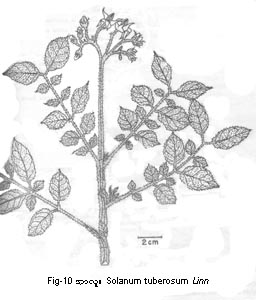 Solanum Tuberosum Linn.
 p22
Burmese name: tmvl; {a-lu:} Alu.
Solanum Tuberosum Linn. Sp. Pl. 185 (1753).
English common name; Potato
Description
A herb with underground, stem tubers. Leaves compound, alternate pubescent. Flowers white to bluish, in forking clusters. Family Solanaceae. Flowers from January to March.
Distribution
Cultivated during the cold season for its edible underground tubers, in Upper Burma and Hill forests, above 2,500. fn22-01
Uses
A mixture of alkaloids isolated from different parts of the plant lower blood pressure.
--------------
fn22-01 Prichev, p., N. Nikiforov & R. Rusev (1967) Pharmacological properties of glycoalkaloids obtained Solanum tuberosum. Eksp. Med. Marfol, v, 36-41. In: Chem. Abstr. (1968). 68. 11518e. fn22-01b
p23
Burmese name: aumuf½kd;EG, {kauk-ro:nwè~} Kauk-yo nwe.
Convolvulus Arvensis Linn. Sp. Pl. 153 (1753).
Convolvulus Malcolmii Roxb. Hort. Beng. 14.
Convolvulus divaricata Wall. Cat. 1422.
English common name: Lesser biweed, Field bindweed, Deer's foot bindweed.
Description
A creeping, twining herb. Leaves ovate or oblong-lanceolate, leaf base auriculate or hastate. Flowers middle-sized, solitary, purplish-pink or white. Fruit, a globose capsule. Family Convolvulaceae. Flowers and fruits from July to Obtober.
Distribution
A common weed. especially in the fields. Grown in Arid regions.
Uses
Extract of the above ground parts reduced blood pressure level.
fn23-01
Root used as purgative.
Plant yield resinous substances, possesses cathartic properties.
fn23-02
--------------
fn23-01 Voronina, M. N. (1966). Pharmacology of the lesser biweed. Farmakol. Toksikol 29, 70-72. In: Biol. Abstr. (1966) 47, 112298. fn23-01b
fn23-02 Chopra, R. N.. S. I.. Nayar & I. C. Chopra (1956). Glossary of INdian medicinal plants, p 76. Council of Scientific and Industrial Rsearch: New Delhi. fn23-02b
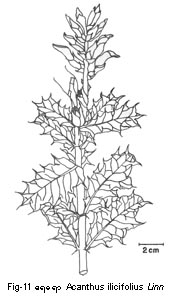 Acanthus Ilicifolius Linn.
Burmese name: a&c&m {ré-hka.ra} Ye-Khaya.
Acanthus Ilicifolius Linn. Sp. Pl. 639 (1753).
Acanthus Doloarius Blanco Fl. Filip. 487.
Dilivaria ilicifolia Zuss. Gen. 103 (1789).
English common name: Sea Holly.
Description
Stems erect, scarcely branched cylindric, stout. Leaves holly like, oblong or elliptic, with sharp spinous teeth on the margin terminating the lateral nerves and the midrib; 2 stipule-like spines present at the base. Flowers sessible in opposite pairs, in terminal crowded or interrupted spikes, blue in colour. Fruit capsules, oblong, apiculate, brown. smooth and shining. Family Acanthaceae. Flowering and fruiting during the rainy months.
Distribution
Grown along the sea-shore. Found in Syriam and in other swampy areas.
Uses
The root extract of the plant is locally used to lower blood pressure. It is
taken once in the morning and once in the evening before going to bed.
fn24-01
Leaves used as fomentation in rheumatism and neuralgia.
Plant used in asthma.
Decoction of plant used in dyspepsia.
Leaves and tender shoots used in snake-bite.
fn24-02
-------------
fn24-01 owdk;aomif;? aMu;rkHowif;pm/ 29.6.69/ fn24-01b
fn24-02 Chopra, R. N., S. L. Nayar & I. C. Chopra (1956) Glossary of Indian medicinal plants, p. 3. New Delhi: Council of Scientific and Industrial Research. fn24-02b
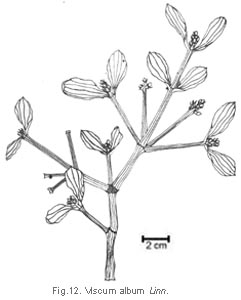 Viscum Album Linn.
 Burmese name: Nil.
Viscum Album Linn. Sp. Pl. 1023 (1753).
Viscum stellatum Don Prodr. 142. (1824).
English common name: Mistletoe.
Description
A large, yellowish green bush, branches jointed. Leaves opposite, sessible, variable, oblong, broad or narrow, usually with obtuse tip and cuneate base, glabrous, thick and fleshy. Flowers unisexual, dioecious, sessile, in clusters of 3 or 5 in the forks of the branches, supported by cup-shaped slightly ciliate bracts: terminal flower solitary, the lateral in opposite or dedussate pairs. Fruit. berry. Family Loranthaceae.
Distribution
Martaban and hill forests, above 25, 000 ft.
Uses
One active principle, produces a fall of blood pressure.
fn25-01
Berry is used as laxative, tonic, aphrodisiac, diuretic and cardiotonic.
Plant is used in enlargement of the spleen, in cases of wound, tumours, and
diseases of the ear. fn25-02
--------------
fn25-01 Chopra, R. N., S. L. Nayar & I. C. Chopra (1956). Glossary of Indian medicinal plants, 256. Council of Scientific and Industrial Research: New Delhi. fn25-01b
fn25-02 N. Nhaus, J., M. Stoll & F. Vester (1970). Thymus Stimulation and cancer Prophylaris by Viscum Proteins. Experientia 26, p. 253. fn25-02b
 Nigella Sativa Linn.
 p26
Burmese name: prkefeuf {sa.moan-nak} Samon-net.
Nigella Sativa Linn. Sp. Pl. 753 (1753).
English common name: Black Cummin, Nutmeg Flower, Small Fennel.
Description
Annual herb. Leaves 2-3 pinnatisect, cut into linear or linear-lanceolate segments. Flowers pale blue on solitary long stalks. Fruit composed of 5-12 more or less united follicles. Family Ranunculaceae.
Distribution
Upper Burma.
Uses
The seed oil possess hypotensive effect. fn26-01
Seeds used as stinulant, carminative, diuretic, emmenagogue, galactagogue;
useful in mild cases of puerperal fever; reduced to powder and mixed with
sesamum oil much used as an external application in eruptions of the skin.
fn26-02
-------------
fn26-01 Mahpoux, M., M. jDakakmy. A. Gemel., & H. Moussa (1964). Choleretic action of Nigella sativa L. seed oil. Egypt Pharma. Bull. 44, 225-229 In: Biol. Abstr. (1966) 47, 6197. fn26-01b
fn26-02 Chopra, R. N>, S. L. Nayar & I. C. Chopra (1956). Glossary of Indian medicinal plants, p. i 76. Council of Scientific and Industrial Research: New Delhi. fn26-02b
p27
Burmese name: vif;ae {lin:né} Linne.
Acorus Calamus Linn. Sp. Pl. 324 (1753).
Acorus Griffithii and nilaghirensis Schott in Ostr. Bot. Zeitschr. 357 (1858)
and 101 (1859).
Acorus Belangeri Schott in Ann. Mus. Lugd. Bat. i. 284.
Acorus Casia Bertol. Pl. Asiat. ii. 8 (1865).
English common name: Sweet Flag.
Description
Rootstock thick, creeping and branching. Leaves bright green, acute, thickened in the middle, margins waved. Spathe ensiform. Spadix cylindric, dense flowered, slightly curved. Family Araceae. Flowering during the rainy months.
Distribution
Widely distributed in Burma. Often planted for its medicinal properties.
Uses
Aqueous and alcoholic extract of the rhizome lowers blood pressure in rabbits
and cats. fn27-01
Rhizome used as emetic, also in dyspepsia, bronchitis, dysentery of children,
possess insecticidal properties. fn27-02
---------------
fn27-01 Maj, Jerzy, Z. Lastowki & K. Lukowski (1965) Pharmacologival properties of native calamus, II. Central action of extracts. Dissertationes Pharm., 17, 157-61 (Pol.). In. Chem. Abstr. (1965), 63, 1889oh. fn27-01b
fn27-02 Chopra, R. N., S. L. Nayar & I. C. Chopra (1956) Glossary of Indian medicinal plants, p. 5. New Delhi; Council of Sceintific and Industrial Research. fn27-02b
p29
Burmese name: uGrf;oD;yif {kwum:thi:pin} Kun-thi-pin.
Areca Catechu Linn. Sp. Pl. 1189 (1753).
Areca faufel Gaertn Fruct. i. 19, t. 7. f2. (1788).
Areca hortensis Low. Fl. Cochinch. 568 (1790).
English common name: Areca Nut Palm, Betel Nut Palm, Catechu Plam.
Description
Trunk solitary, uniformly thick. Leaves compound with numerous leaflets, glabrous. Spathe double, compressed, glabrous. Flowers. Rachiscompressed, branches with filiform, shout. Female flowers solitary, 2 or 3 at or near the asbe of each ramification of the spadix. Fruit oblongoid smooth, orange or scarlet. Family Palmae.
Distribution
Cultivated for its edible betel nuts throughout Burma.
Uses
Arecoline-HCI isolated from the nut decreases blood pressure in rabbits.
Nut useful in urinary disorders, as an anthelmintic, nervine tonic.
fn29-01
--------------
fn29-01 Chopra, R. N., S. L. Nayar & I. C. Chopra (1956). Glossary of Indian medicinal plat., p. 26. Council of Scientific and Industrial Research: New Delhi. fn29-01b
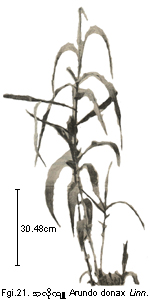 Arundo Donax Linn.
 p32
Burmese name: tvdkusL {a.lo-kyu} Alo-kyu.
Arundo Donax Linn. Sp. Pl. 81 (1753).
Arudo Bengalensis bifaria Retz. Obs. IV. 22 and V. 20.
Arundo longifolia Salisb. Prodr. 24.
Arundo sativa Lank. Fl. Fr. III. 616.
Arundo trifolia Roxb. Ic. Pict. t. 853.
Donax arundinaceus Beauv. Agrost. 78, t. 16, f. 4.
Donax benghalensis Beauv. l. C. 78.
Donax bifarius Trin. in Spreng. Neue Entdeck. ii. 73.
Amphidonx bengalensis Nees exsteud. Syn. Gram. 197.
Amphidonax bifaria Nees exsteud. Syn. Gram. 410.
Scolochloa arundinacea Mert. Koch. Flo Germ. I. 529.
Aira benghalensis Gmel. Syst. i. 174.
Arundo Wall. Cat. n. 5018, excl. F., 5020.
English common name: Nil.
Description
Tall, perennial grass with erect culms. Stems hollow, green. Leaves linear-lanceolate tapering to a fine point. Flowers in spikes, terminal, erect branches. Family Gramineae. Flowers and fruits from September to February.
Distribution
Maymyo, Thayetmyo and Rangoon (planted).
Uses
Decoction of rhizome used as diuretic and as emollient.
Gramine isolated from the rhizome, in larger doses causes a fall in blood
pressure. fn32-01
----------------
fn32-01 Chopra, R. N., S. L. Nayar & I. C. Chopra (1956). Glossary of Indian medicinal plants, p. 27. Council of Scientific and Industrial Research: New Delhi. fn32-01b
 Curcuma Comosa Roxb.
p34
Burmese name: eEGif;cg;?qEGif;cg; {na.nwin:hka:} or {hsa.nwin:hka:} Na-nwin-ga, Sa-nwin-ga.
Curcuma Comosa Roxb. in Asiat. Res. XI. 336 (1810).
English common name: Nil.
Description
Rootstock large of palmately branched sessile annulate tuber, aromatic with light yellow circling deeper yellow inside when young; colour changing to bright orange on becoming older. Leaves large, lanceolate to oblong-elliptic, leaf-stalk as long as the blade, plain green except in the earliest, which are clouded with faint brown down the centre above, glabrous on both sides. Flowering spike arising from the centre of the tuft of leaves. Appearing after the leaves are developed, flowers fragrant, pinkish-yellow, longer than the flowering bracts; flower bracts greenish tipped with purplish-red streak, those of the coma tinged with purplish-red at the tip and with white base below. Family Zingiberaceae. Flowering in late August to September.
Distribution
Pegu, Twante and Rangoon, Often cultivated for its medicinal use.
Uses
Burmese people believed that powdered dried rhizome mixed with honey taken one tablespoon twice a day produces a fall in blood pressure. fn34-01
--------------
fn34-01 a½TbkHokc/ aMu;rkHowif;pm/ aeYpGJ/ 13.2.71;/ fn34-01b
End of TIL file
