Update:
2011-12-31 11:37 PM +0630
TIL
ENGLISH PRONOUNCING DICTIONARY
Information panels
informT-W.htm
Daniel Jones. Edited by Peter Roach, James Hartman and Jane Setter. Cambridge
University Press, 2003.
Scanned by Maung Kan Tun and edited by U Kyaw Tun, M.S. (I.P.S.T., U.S.A.). Not for
sale. Prepared for students of TIL Computing and Language Center, Yangon, MYANMAR .
index.htm |Top
DJPD16-indx
Information panels W to T
73. Tap |
74. Tense |
75. Tone |
76. Tone unit |
77. Trill |
78. Triphthong | • Two-three tone problem |
79. Uvular |
80. Velar |
81. Velarization |
82. Vocal folds | • Vocalic R |
83. Voice onset time |
84. Voicing |
85. Vowel |
•
Vowel length | 86. Vowel reduction |
87. Weak form |
Contents of this page
p527. A sound which resembles [t] or [d] ,
being made by a complete closure between the tongue and the alveolar region,
but which is very brief and is produced by a sharp upward throw of the tongue
blade. A soon as contact is made, the effects of gravity and air pressure cause
the tongue to fall again.
Examples for English
The tap sound (for which the phonetic
symbol is [ɾ]
(U027E)) is noticeable in Scottish accents as the realisation of /r/ ,
and in US English it is often heard as a (voiced) realization of /t/
when it occurs after a stressed vowel and before an unstressed one, e.g.:
<getting better> (US) /ˈget̬,ɪŋ ˈbet̬.ɚ/
[g̊ẹɾɪŋb̥ẹɾɚ]
In British English it used to be quite
common to hear a tap for /r/
in careful or emphatic speech (e.g. <very>
[v̥ẹɾɪ] ), though this is less
often heard now. It is increasingly common to hear the American-style tapped
/t/
in England.
Several varieties of tap are possible:
they may be voiced or voiceless. For instance, Scottish pre-pausal
/r/
is often realised as a voiceless tap, as in <here>
[hiɾ̥]
. Taps may also be produced with the
SOFT PALATE lowered, resulting
in a nasalised tap which is sometimes heard in the US English pronunciation of
words like <mental> [mẹɾ̃əɫ]
. A closely related sound is the
FLAP, and the TRILL also
has some similar characteristics.
Contents of this page
p531. See
Lax.
Contents of this page
p540. An identifiable movement or
level of PITCH that is
used in a linguistically contrastive way.
Examples for English
In English, tone forms the central
part of INTONATION,
and the difference between, for example, a rising and a falling tone on a
particular word may cause a different interpretation of the sentence in which it
occurs, e.g.:
► <it was
ˋ cold> (meaning 'it was cold' )
► <it was ˊ cold> (meaning 'was it cold?')
UKT:Note the
accent symbols:
[ ˋ ] (U02CB) -- WinXP character map calls it "Modifier Letter Grave Accent"
[ ˊ ] (U02CA) -- WinXP character map calls it "Modifier Letter Acute Accent"
There are often recognised as being at
least five tones in English: a fall, a rise, a fall-rise, a rise-fall and a
level tone.
Meanings are frequently ascribed to
each tone; the scope of this panel does not allow us to discuss this further.
In intonation, tone may be spread over
many syllables. E.g., in:
► <his ˇ
car could have broken down>
(in which the pitch movement falls on <car> and rises on <down>)
In other languages
In some languages (known as 'tone
languages') the linguistic function of tone is to change the meaning of a word:
in Mandarin Chinese, for example, [ma] said on a high pitch means <mother> while
[ma] said on a low rising tone means <hemp>. It is usual to identify tones as
being a property of individual syllables.
Contents of this page
p541. A unit of speech consisting of
one or more syllables or feet.
Examples for English
A tone unit must contain a tonic
syllable, that is, a syllable on which a pitch movement begins. Only one tonic
syllable is allowed in an English tone unit. The tone unit may also contain a
'head' (from the first stressed syllable up to the tonic syllable), a 'pre-head'
(any unstressed syllables preceding the head) and a 'tail' (all syllables after
the tonic syllable). The tonic syllable is underline in each of the examples
which follow:
► < ˋyes
>
tonic
► < ˈJoe said ˋyes >
head + tonic
► < and then ˈJoe said ˋyes >
pre-head + head + tonic
► < and then ˈJoe said ˋyes to me >
pre-head + head + tonic + tail
As each of the non-tonic elements is
optional, it is possible to have any combination together with the tonic
syllable, e.g.:
► < was
it ˇyou >
pre-head + tonic
► < it was ˇyesterday >
pre-head + tonic + tail
► < ˇnow I understand >
tonic + tail
In the study of
INTONATION it is
usual to divide speech into larger units than syllables. If one studies only
short sentences said in isolation it may be sufficient to make no subdivision of
the utterance, but in longer utterances there must be some points at which the
analyst marks a break between the end of one pattern and the beginning of the
next. These breaks divide speech into 'tone-units', and are called 'tone-unit
boundaries', e.g.;
< the ˇlast time I saw her |
was ˋyesterday | >
If the study of intonation is part of
phonology, these boundaries should be identifiable with reference to their
effect on pronunciation rather than to grammatical information about word and
clause boundaries: statistically however, we find that in most cases tone-unit
boundaries do fall at obvious syntactic boundaries, and it would be rather odd
to divide two tone-units in the middle of a phrase. The most obvious factor to
look for in trying to establish boundaries is the presence of a pause, and in
slow careful speech (e.g. in lectures, sermons and political speeches) this may
be done quite regularly. However, it seems that we detect tone-unit boundaries
even when the speaker does not make a pause, if there is an identifiable break
or discontinuity in the rhythm or in the intonation pattern.
There is evidence that we use a larger
number of shorter tone-units in informal conversational speech, and fewer,
longer tone units in formal styles.
Contents of this page
p548. A speech sound produced by the
rapid vibration of one the vocal organs.
Examples
The parts of the body that are used in
speaking (the 'vocal apparatus') include some 'wobbly bits' that can be made to
vibrate. When this type of vibration is made as a speech sound, it is called a
trill. The possibilities include a
BILABIAL trill, where
the lips vibrate (used as a mild insult, this is sometimes called "blowing a
raspberry", or, in the US, a 'Bronx Cheer'), a tongue-tip trill which is
produced in many languages for a sound represented alphabetically as
<r>,
and a uvular trill, which is a rather dramatic way pronouncing a "uvular r" as
found in French, German and many European languages, most commonly used in
acting and singing.
In British English, the trill most
likely to occur is the
ALVEOLAR trill, which is (perhaps confusingly) represented by the symbol
[r]
, and is an allophone of the English phoneme
/r/.
However, it most frequently occurs in restricted contexts, such as singing.
Contents of this page
p549. A vowel glide with three
distinguishable vowel qualities.
Examples for English
In British English there are said to
be five triphthongs, formed by adding /ə/
(U0259) to the diphthongs /eɪ aɪ ɔɪ aʊ əʊ/
. US English treats most of these sequences differently, e.g.:
<layer> /leɪəʳ/ (US) /ˈleɪ.ɚ/
<liar> /laɪəʳ/ (US) /ˈlaɪ.ɚ/
<loyal> /lɔɪəl/ (US) /ˈlɔɪ.əl/
<power> /paʊəʳ/ (US) /paʊɚ/ [UKT: note, there
is no "dot" preceding ɚ]
<mower> /məʊəʳ/ (US) /ˈmoʊ.ɚ/
UKT: Note that
/əʳ/
(U0259 U02B3) in British English generally becomes
/ɚ/
(U025A) in US English.
There are many other examples of
sequences of three vowel qualities, e.g. <play-off>
/pleɪɒf/
, <reopen> /riəʊpən/
, so the five listed above must have some special characteristic. One
possibility is that speakers feel them to be one syllable; this may be the case,
but there does not seem to be any clear way of proving this. This is a matter
which depends to some extent on the accent: many BBC speakers pronounce these
sequences almost as pure vowels (prolongations of the first element of the
triphthong), so that the word <Ireland>, for example, sounds like
/ˈɑː.lənd/
. In Lancashire and Yorkshire accents, on the other hand, the middle vowel (
/ɪ/
or /ʊ/
) is pronounced with such a close vowel quality that it would seem more
appropriate to transcribe the triphthongs with
/j/
or /w/
in the middle (e.g. <fire> /ˈfaj.ər/
, emphasising the disyllabic aspect of their pronunciation.
Contents of this page
UKT
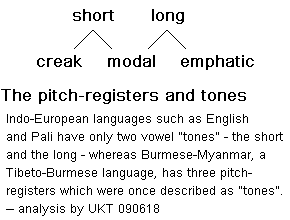 Our task of comparing Eng-Lat to Bur-Myan is not easy because
English have only two "tones" for vowels the short
and the long, whereas Burmese has three, the creak, the modal,
and the emphatic. The one way to reconcile them is to think in
terms of 5 registers:
Our task of comparing Eng-Lat to Bur-Myan is not easy because
English have only two "tones" for vowels the short
and the long, whereas Burmese has three, the creak, the modal,
and the emphatic. The one way to reconcile them is to think in
terms of 5 registers:
creak, short, modal, long, emphatic
The Bur-Myan "creak" register is strictly not
a vowel, because it could not be sung continuously like
regular vowels. It may be looked on as a
"semi-consonant".
The English short vowel is sometimes close to creak and
sometimes to modal. Similarly the English long vowel is
between modal and emphatic. For the vowel /a/, we have
{aa.}, {a}, {/ə/}, {aa}, {aa:}
-- the short-a /æ/ and the long-a /a/ are
transcribed as a and ā in Pal-Lat.
Since both Bur-Myan and Eng-Lat do not have dedicated
graphemes to represent the central vowel, schwa /ə/,
I have to use {/ə/} for the modal. The Bur-Myan
schwa is found in words like
 {a.ni} meaning the "colour red" in which
schwa is represented by {a.} or {a·}. [In Romabama
the "middle dot · " is reserved for schwa.]
In some Bur-Myan words
{a.ni} meaning the "colour red" in which
schwa is represented by {a.} or {a·}. [In Romabama
the "middle dot · " is reserved for schwa.]
In some Bur-Myan words
 {a.} stands for the sound of
 {aa.}, but in others as schwa {/ə/} or {a·}.
The following example is provided by my colleague,
Saya Kalasan, a noted Manipuri-Burmese
{aa.}, but in others as schwa {/ə/} or {a·}.
The following example is provided by my colleague,
Saya Kalasan, a noted Manipuri-Burmese
 {poaN~Na:} author on Astrology-Astronomy, who speaks
and writes Sanskrit and Hindi in addition to Burmese and
English:
{poaN~Na:} author on Astrology-Astronomy, who speaks
and writes Sanskrit and Hindi in addition to Burmese and
English:

{a·mé/ a·mé/ a·mé. þa: ha/ a. ko a. lwun: tèý//}
Now which is the "consonant"
{a.} and which is the "vowel"?
The correspondence between two tones of English and three
tones of Burmese is a problem (as far as I know), and lacks
a concise name, because of which I will refer to it as the
Two-Three Tone problem.
Contents of this page
p572. A consonant sound made between
the back of the tongue and a lump of soft tissue (uvula) which is in the back of
the mouth, dangling from the end of the soft palate.
Examples for English
English does not have any examples of
uvular sounds as phonemes, but sounds with this place of articulation are widely
found in other languages.
In other languages
The voiceless uvular
PLOSIVE
[q]
is found as the phoneme /q/
in many dialects of Arabic. Uvular
FRICATIVES [χ ʁ ]
(U03C7 and U0281) are found quite commonly: German, Hebrew, Dutch and Spanish,
for example, have voiceless ones, and French, Arabic and Danish have voiced
ones. The uvular
NASAL [ɴ]
(U0274) is found in some Inuit languages. The uvular itself is active only when
it vibrates in a uvular TRILL,
[ʀ]
(U0280).
Contents of this page
p575. Velar consonant sounds are
produced between the tongue and the
SOFT PALATE, or 'velum'.
Examples for English
Velar sounds occurring as English
phonemes are /k g/
and /ŋ/.
The first two are PLOSIVES,
and the last, a
NASAL. Although /k g/
can occur syllable-initially and finally,
/ŋ/ is restricted to
syllable-final position only in English, e.g.:
<cap> /kæp/
<gap> /gæp/
<sack> /sæk/
<sang> /sæŋ/
<sag> /sæg/
/k/
and /g/
are one of the pairs of consonants said to be distinguished from each other by
being FORTIS or
LENIS rather than voiced
or voiceless.
Contents of this page
p576. A type of secondary articulation
in which a constriction in the vocal tract is added to the primary constriction
which gives a consonant its place of articulation.
Examples for English
In the case of English
DARK L, the
/l/
phoneme is articulated with its usual primary constriction in the alveolar
region, while the back of the tongue is raised as for an [u] vowel creating a
secondary constriction (see DARK L).
In other languages
Arabic has a number of consonant
phonemes that are velarized, and are known as 'emphatic' consonants.
Contents of this page
p581. An essential part of the larynx,
performing a number of important linguistic functions. The term 'vocal cords' is
also used.
The vocal folds may be firmly closed
to produce what is sometimes called a
GLOTTAL STOP, and
while they are closed the larynx may be moved up or down move air out of or into
the vocal tract; this is done in the production of 'ejective' and 'implosive'
constants. When brought into light contact with each other the vocal folds tend
to vibrate if air is forced through them, producing VOICING, also called
'phonation'. This vibration can be made to vary in many ways, resulting in
differences in such things as
PITCH, loudness and
voice quality. If a narrow opening is made between the vocal folds, friction
noise can result and this is found in whispering and in the glottal fricative
[h].
A more widely open glottis is found in most voiceless consonants.
Contents of this page
p581. A measure of the timing of the
start of voicing.
All languages distinguishes between
voiced and voiceless consonants, and
PLOSIVES are the most
common consonants to be distinguished in this way. However, this is not a simple
matter of a plosive being either completely voiced or completely voiceless: the
timing of voicing in relation to the consonant articulation is very important.
In one particular case this is so noticeable that it has for a long time been
given its own name: ASPIRATION, in which the beginning of full voicing does not happen until
some time after the release of the plosive (usually voiceless). This delay, or
'lag', has been the subject of much experimental investigation which has led to
the development of a scientific measure of voice timing called voice onset time
or V.O.T.. The onset of voicing in a plosive may lag behind the plosive release,
or it may precede ('lead') it, resulting in a fully or partially voiced plosive.
Both can be represented on the V.O.T. scale, one case having positive values and
the other negative values.
Contents of this page
p581. A term used to refer to the
vibration of the VOCAL FOLDS.
A sound made with this vibration is called voiced, and one without
vibration is called voiceless. Most vowels in most languages are voiced,
though voiceless vowels are found in some languages. Among consonants, it is
very common to find pairs that are distinguished from each other by the presence
or absence of voicing, but in English we find that consonants such as
/b d g v ð z
ʒ/ , though frequently described
as voiced (in contrast with the corresponding voiceless consonants
/p t k f θ s
ʃ/ ) often have little or no
voicing. See FORTIS,
LENIS,
ONSET TIME. Whispering is
speech that is entirely voiceless.
UKT: Alternative terms for voiceless (vl) and voiced (vd):
surd and sonant, respectively. If you are Burmese-Myanmar, you can
use the Pali-Myanmar
 {a.Gau-tha.} and
 {Gau-tha.}, respectively.
In other languages
Many pairs of consonants distinguished
by the voiced-voiceless contrast are found in different languages. Welsh has
voiced and voiceless
LATERAL consonants, while Burmese has voiced and voiceless
NASAL
consonants.
Contents of this page
p583. Definition
The class of sound which makes the
least obstruction to the flow of air. They are almost always found at the centre
of a syllable, and it is rare to find any sound other than a vowel which is able
to stand alone as a whole syllable.
UKT: Note the phrase "the class of sound" in the above. When I was asked
(back in the US in the late 50's -- years before I became aware of the IPA), how
many "vowels" are there in Burmese, I had answered "more than a, e, i, o,
u". I was under the impression that by vowels, we mean the
vowel-script . At least to make myself clear, I will try to differentiate
vowel-script from vowel-sound. English-Latin has only 5 vowel-scripts, whereas
Burmese-Myanmar has about 10. Both English and Burmese has about the same number
of vowel-sounds. To make up for the paucity of vowel-script, English-Latin has
to resort to digraphs such as [ae] or [æ] .
Examples for English
Here we examine the vowel monophthongs
of English. In phonetic terms, each vowel has a number of properties that
distinguish it from other vowels. These include the shape of the lips, which may
be rounded (as for an [u]
vowel), NEUTRAL (as for [ə]
(U0259)) or spread (as in a smile, or an [ i ] vowel -- photographers
traditionally ask their subjects to say <cheese>
/ʧiːz/
so that they will seem to be smiling):
| Unrounded |
Rounded |
(us) |
Unrounded |
Rounded |
| iː |
uː |
|
iː |
uː |
| ɪ |
ʊ |
|
ɪ |
ʊ |
| e |
ɔː |
|
e |
ɔː |
| æ |
ɒ |
|
æ |
|
| ʌ |
|
|
ʌ |
|
| ɑː |
|
|
ɑː |
|
| ɜː |
|
|
ɝː |
|
| ə |
|
|
ə ɚ |
|
Secondly, the front, the middle, or
the back of the tongue may be raised, giving different vowel qualities: the BBC
English /æ/
vowel of <cat> /kæt/
is a front vowel, while the /ɑː/
of <cart> /kɑːt
(us) kɑːrt/
is a back vowel:
| Front |
Central |
Back |
(us) |
Front |
Central |
Back |
|
| iː |
ʌ |
uː |
|
iː |
ʌ |
uː |
|
| ɪ |
ɜː |
ʊ |
|
ɪ |
ɝː |
ʊ |
|
| e |
ə |
ɔː |
|
e |
ə ɚ |
ɔː |
|
| æ |
|
ɒ |
|
æ |
|
ɑː |
|
| |
|
ɑː |
|
|
|
|
|
The tongue (and the lower jaw) may be
raised close to the roof of the mouth, or the tongue may be left low in the
mouth with the jaw comparatively open. In British phonetics we talk about
'close' and 'open' vowels, whereas American phoneticians more often talk about
'high' and 'low' vowels. The meaning is clear in either case, e.g.:
| Close |
Mid |
Open |
(us) |
High |
Mid |
Low |
|
| iː |
e |
ʌ |
|
iː |
e |
ʌ |
|
| ɪ |
ɜː |
ɒ |
|
ɪ |
ɝː |
ɑː |
|
| uː |
ə |
ɑː |
|
uː |
ə ɚ |
æ |
|
| ʊ |
ɔː |
æ |
|
ʊ |
ɔː |
|
|
Vowels also differ in other ways: they may be 'nasalised' (see
NASALISATION) by
being pronounced with the soft palate lowered as for
[m n] or [ŋ].
Vowels may be voiced, as the great majority are, or voiceless: in English the
first vowel in <perhaps> or <potato> is often voiceless. It is claimed that in
some languages (including English) there is a distinction to be made between
TENSE and
LAX vowels, the former
being made with greater force than the latter.
In other languages
Nasalisation is phonemically
contrastive in French, where we find 'minimal pairs' such as <très>
/trɛ/
(very) and <train> /trɛ̃/
(train), where the [ ˜ ]
(U02DC) diacritic indicates nasality. Concerning voiceless vowels: in
Portuguese, for example, unstressed vowels in the last syllable of a word are
often voiceless. Less usual is the case of stressed voiceless vowels, but these
are found in French: close vowels, particularly /i/
but also the close front round /y/,
become voiceless for some speakers when they are word-final before a pause (for
example <oui> [wi̥],
<midi> [midi̥]
, and also <entendu> [ɑ̃tɑ̃dẙ] )
UKT: Compare the IPA /æ/ /ɑ/ /ɑː/
vowels to the Burmese /a./, /a/, /a:/ .
Note that the Burmese vowels are definitely the front, the middle and the back vowels.
The French <très> is similar to a make-up Burmese (Mx,f;) where the {ra. ris}
sound is to be pronounced as in Pali. The final [s] is silent.
Contents of this page
From Wikipedia
In linguistics, vowel
length is the perceived duration of a vowel sound. Often the
chroneme, or
the "longness", acts like a consonant, and may etymologically be one such as in
Australian English. While not distinctive in most dialects of English, vowel length
is an important phonemic factor in many other
languages, for instance in Czech, Hindi, Sanskrit, Fijian, Finnish, Japanese,
Hawaiian, Classical Latin, German, Latvian, Old English, Samoan, Thai, and
Vietnamese. It plays
a phonetic role in the majority of English dialects, and is said to be phonemic
in a few dialects, such as Australian English
and New Zealand English.
It also plays a lesser phonetic role in Cantonese, which
is exceptional among the spoken variants
of Chinese.
English does indeed rely on vowel length. Listening to German speakers speak
English makes this very apparent. They say "pot" and "pod" with the same vowel
length (also "kit / kid", "lab / lap"). A native English speaker uses a long
vowel with words ending in a soft consonant. (For example, pick / pig, cease /
seize etc.)
Most languages do not distinguish vowel length, and for those that do,
usually the only distinction is between short vowels and long
vowels. There are very few languages that distinguish three vowel lengths,
for instance Mixe.
Some languages, such as Finnish, Estonian and Japanese also have words where
long vowels are immediately followed by more vowels, e.g. Japanese hōō
"phoenix" or Estonian jäääär "ice edge".
See the whole article from Wikipedia in TIL library on
Vowel length.
Contents of this page
p583. The process by which an unstressed vowel may change
to become like the mid central vowel 'schwa' /ə/ (U0259).
In the words <photograph>, <photographic> and <photography>,
the vowels in the first three syllables alternate between full vowels and
/ə/ according to the position of stress, e.g.:
<photograph> /ˈfəʊ.tə.grɑːf/
(US) /ˈfoʊ.t̬ə.græf/
<photographic> /ˌfəʊ.təˈgræf.ɪk/
(US) /-ˈtɑːg.rə/
Although the word <man> is pronounced /mæn/,
the reduced form can be seen in <postman>
/ˈpəʊst.mən (US) ˈpoʊst-/ ,
<chairman'> /ˈʧeə.mən (US) ʧer-/ , etc.
Another example of vowel reduction is
found in the alternation between /e/ (U0259) and /ɪ/ (U026A)
in, for example, the first syllables of <exhibition>
/ˌek.sɪˈbɪʃ.ən/ and /ɪgˈzɪb.ɪt/.
Contents of this page
p589. A variant form of a word, used when it is unstressed.
Examples for English
A very important aspect of the
dynamics of English pronunciation is that many very common words have not only a
'strong' or 'full' pronunciation (which is used when the word is said in
isolation), but also one or more weak forms which are used when the word occurs
in certain contexts. Words which have weak forms are, for the most part,
function words such as conjunctions (e.g. <and> , <but>) , articles (e.g. <a> ,
<the>) , pronouns (e.g. <she> , <he> , <her> ), prepositions (e.g. <for> ,
<to> ) and
some auxiliary and modal verbs (e.g. <do> , <must> ). Generally the strong form of
such words is used when the word is being quoted (e.g. the word <and> is given
its strong form in the sentence 'We use the word and to join clauses'),
when it is being contrasted (e.g. <for> in 'There are arguments for and
against') and when it is at the end of a sentence (e.g. <from> in 'Where did you
get it from?'). Often the pronunciation of a weak-form word is so
different from its strong form that if it were heard in isolation it would be
impossible to recognise it: for example, <and> can become /ṇ/
in <us and them>, <fish and chips>, and <of> can become
/f/ or /v/
in <of course>. The reason for this is that to someone who knows the language
well these words are usually predictable in their normal context.
Contents of this page
End of TIL file